
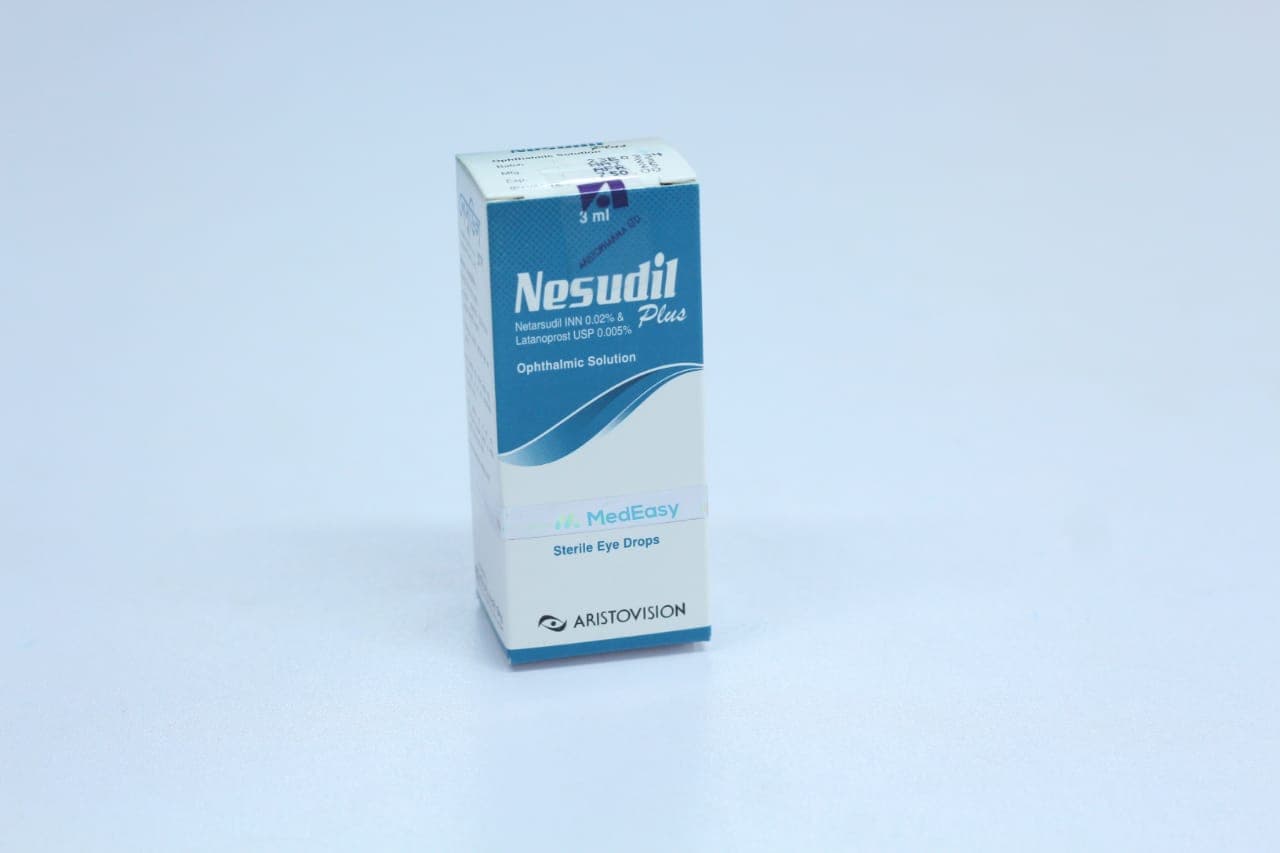

Medicine overview
Indications of Nesudil Plus
Nesudil Plus is a fixed-dose combination ophthalmic solution indicated for the reduction of elevated intraocular pressure (IOP) in patients with open-angle glaucoma or ocular hypertension.
- Established/approved use: Reduction of elevated IOP in open-angle glaucoma or ocular hypertension. It is commonly prescribed when IOP control with a single topical agent (such as a prostaglandin analog or a Rho kinase inhibitor alone) has been insufficient, allowing dual-mechanism control from one bottle.
- Not for: Angle-closure glaucoma or other non-open-angle forms of glaucoma; Nesudil Plus has not been established as effective in these conditions.
Composition
Each mL of Netarsudil + Latanoprost ophthalmic solution contains netarsudil 0.02% (as netarsudil mesylate) and latanoprost 0.005%, formulated as a sterile, preserved, isotonic aqueous solution for topical ophthalmic use.
Description
Nesudil Plus is a fixed-dose combination eye drop that brings together two agents with complementary mechanisms for lowering intraocular pressure: netarsudil, a Rho kinase (ROCK) inhibitor, and latanoprost, a prostaglandin F2-alpha analog. By acting on two different outflow pathways of aqueous humor simultaneously, Nesudil Plus provides greater IOP reduction than either agent typically achieves alone, in a single once-daily drop.
Therapeutic Class
Nesudil Plus belongs to the anti-glaucoma / ocular hypotensive class of ophthalmic agents. It is a fixed-dose combination of a Rho kinase (ROCK) inhibitor (netarsudil) and a prostaglandin F2-alpha analog (latanoprost).
Pharmacology
Netarsudil + Latanoprost lowers intraocular pressure through two distinct, complementary mechanisms:
- Netarsudil inhibits Rho kinase (ROCK), which relaxes the trabecular meshwork, increases conventional (trabecular) outflow of aqueous humor, and is also thought to lower episcleral venous pressure.
- Latanoprost is a prostaglandin F2-alpha analog that increases uveoscleral (unconventional) outflow of aqueous humor by activating prostaglandin FP receptors.
Because the two components act on different outflow pathways, their combined effect on lowering IOP is additive.
Dosage & Administration of Nesudil Plus
Nesudil Plus is for topical ophthalmic use only.
| Indication | Dose |
|---|---|
| Open-angle glaucoma / ocular hypertension (adults) | One drop in the affected eye(s) once daily in the evening. |
If a dose is missed, treatment should continue with the next scheduled dose the following evening; do not instill an extra drop to make up for a missed dose. If used with other topical ophthalmic medicines, separate administration by at least 5 minutes. Contact lenses should be removed before instillation and may be reinserted 15 minutes later.
Administration of Nesudil Plus
Wash hands before use. Tilt the head back, gently pull down the lower eyelid to form a pocket, and instill one drop of Nesudil Plus into the affected eye without letting the dropper tip touch the eye or any surface (to avoid contamination). Close the eye gently and apply light pressure over the inner corner of the eye (nasolacrimal occlusion) for 1–2 minutes to reduce systemic absorption. Use in the evening, and use only in the eye(s) as directed by the physician.
Interaction of Nesudil Plus
No formal drug-drug interaction studies have been conducted with Nesudil Plus. The following points are clinically relevant:
- Other topical ophthalmic products: If more than one topical ophthalmic medicine is being used, doses should be administered at least 5 minutes apart to prevent one drop from washing out the other.
- Other prostaglandin analogs: Concurrent use of Nesudil Plus with another prostaglandin analog is not recommended, as this combination has been associated with a paradoxical increase in IOP in some patients.
- Solutions containing thimerosal: Admixing Nesudil Plus with topical products containing thimerosal may cause precipitation; if such a product is required, administer at a separate time.
Contraindications
Netarsudil + Latanoprost is contraindicated in patients with known hypersensitivity to netarsudil, latanoprost, or any other component of the formulation.
Side Effects of Nesudil Plus
The most common side effect of Nesudil Plus is conjunctival hyperemia (eye redness), reported in a substantial proportion of patients, mainly attributable to the netarsudil component. Other reported effects include:
- Corneal verticillata (whorl-like corneal deposits, related to netarsudil)
- Instillation site pain or discomfort
- Conjunctival hemorrhage
- Increased lacrimation (watery eyes)
- Erythema of the eyelid
- Reduced visual acuity
- Dry eye sensation
Most of these effects are mild to moderate and localized to the eye. Pigmentation-related changes (iris, eyelash, periorbital skin) are addressed separately under Precautions and Warnings.
Pregnancy & Lactation
Pregnancy: There are no adequate and well-controlled studies of Nesudil Plus in pregnant women. Prostaglandin analogs such as latanoprost can be pharmacologically active on uterine smooth muscle. Nesudil Plus should be used during pregnancy only if clearly needed and if the potential benefit justifies the potential risk to the fetus; consult a physician before use.
Lactation: It is not known whether netarsudil or latanoprost are excreted in human breast milk. Because many drugs are excreted in breast milk, caution should be exercised, and a physician should be consulted to weigh the benefits of treatment against any potential risk to the nursing infant.
Precautions & Warnings
The following precautions should be observed with Nesudil Plus:
- Pigmentation changes: Nesudil Plus may gradually and permanently increase the amount of brown pigment in the iris, and may also cause pigmentation changes in periorbital tissue and eyelashes (increased length, thickness, and number of lashes). Iris pigmentation changes are more noticeable in patients with mixed-color irises (e.g. blue-brown, green-brown) and may not be immediately apparent for months to years. Patients should be informed of this possible permanent change in eye color before starting treatment.
- Corneal verticillata: Whorl-shaped corneal deposits have been observed with netarsudil-containing products; these are usually not vision-affecting but should be monitored.
- Macular edema: Prostaglandin analogs including latanoprost have been associated with macular edema, including cystoid macular edema; caution is advised in aphakic or pseudophakic patients with a torn posterior lens capsule, or with known risk factors for macular edema.
- Bacterial keratitis: Contamination of multi-dose ophthalmic containers has been associated with bacterial keratitis. Patients should avoid touching the dropper tip to any surface.
- Contact lenses: Contact lenses should be removed before instilling Nesudil Plus and may be reinserted 15 minutes after administration, as the solution contains a preservative that may be absorbed by soft contact lenses.
Overdose Effects of Nesudil Plus
No specific information is available on overdose with Nesudil Plus in humans. In case of accidental ocular overdose, the eye may be flushed with warm water. If Nesudil Plus is accidentally ingested or a significant overdose is suspected, seek immediate medical attention or contact a poison control center; do not attempt unsupervised home treatment.
Storage Conditions
Store unopened bottles in a refrigerator (2°C–8°C). After opening, the bottle may be stored at room temperature (up to 25°C), away from light and moisture, and must be discarded 6 weeks after opening. Keep out of reach of children.
Use In Special Populations
Pediatric use: Safety and efficacy of Nesudil Plus have not been established in pediatric patients.
Geriatric use: No overall differences in safety or effectiveness have been observed between elderly and younger adult patients.
Hepatic/renal impairment: Not specifically studied; systemic absorption following ocular administration is minimal, so significant systemic effects requiring dose adjustment are not expected, but caution and physician guidance are advised.
Pregnancy and lactation: See Pregnancy and Lactation section above.
Duration Of Treatment
Nesudil Plus is generally used as a long-term, chronic therapy for glaucoma or ocular hypertension, for as long as the treating ophthalmologist determines it is needed to control intraocular pressure. Regular follow-up visits with IOP measurement and eye examination are required to monitor treatment response and detect any pigmentation or corneal changes. Nesudil Plus should not be stopped or the dose changed without consulting the prescribing physician.
Drug Classes
Netarsudil + Latanoprost is a fixed-dose ophthalmic combination of a Rho kinase (ROCK) inhibitor (netarsudil) and a prostaglandin F2-alpha analog (latanoprost), both classified as ocular hypotensive / anti-glaucoma agents.
Mode Of Action
Netarsudil + Latanoprost lowers intraocular pressure via two complementary mechanisms acting on different aqueous humor outflow pathways: netarsudil inhibits Rho kinase, relaxing the trabecular meshwork to increase conventional trabecular outflow and reduce episcleral venous pressure, while latanoprost activates prostaglandin FP receptors to increase uveoscleral outflow. This dual action produces an additive IOP-lowering effect from a single once-daily drop.
Pediatric Uses
The safety and efficacy of Nesudil Plus in pediatric patients have not been established. It should not be used in children unless specifically directed and monitored by a pediatric ophthalmologist, given the lack of established dosing and safety data in this age group.
Frequently Asked Questions
Q: What is Nesudil Plus 0.02% + 0.005% Ophthalmic Solution used for?
A: Nesudil Plus 0.02% + 0.005% Ophthalmic Solution is an eye drop used to reduce elevated intraocular pressure (eye pressure) in people with open-angle glaucoma or ocular hypertension, especially when a single medicine has not controlled the pressure adequately.
Q: How should I use Nesudil Plus 0.02% + 0.005% Ophthalmic Solution eye drops?
A: Instill one drop of Nesudil Plus 0.02% + 0.005% Ophthalmic Solution in the affected eye(s) once daily in the evening. Wash your hands first, avoid touching the dropper tip to your eye, and if you use other eye drops, wait at least 5 minutes between them.
Q: Can Nesudil Plus 0.02% + 0.005% Ophthalmic Solution permanently change my eye color?
A: Yes, Nesudil Plus 0.02% + 0.005% Ophthalmic Solution can cause a gradual and permanent increase in brown pigmentation of the iris, particularly in people with mixed-color eyes, and may also darken or thicken the eyelashes and surrounding skin. Tell your doctor if you notice these changes.
Q: Is it safe to use Nesudil Plus 0.02% + 0.005% Ophthalmic Solution while pregnant or breastfeeding?
A: Nesudil Plus 0.02% + 0.005% Ophthalmic Solution should be used during pregnancy only if clearly needed and if the benefit outweighs potential risk to the baby, and caution is advised during breastfeeding since it is not known whether it passes into breast milk. Always consult your physician before use in these situations.
Q: Can I wear contact lenses while using Nesudil Plus 0.02% + 0.005% Ophthalmic Solution?
A: Remove contact lenses before instilling Nesudil Plus 0.02% + 0.005% Ophthalmic Solution and wait at least 15 minutes before reinserting them, as the preservative in the solution can be absorbed by soft contact lenses.
Q: What side effects should I watch for with Nesudil Plus 0.02% + 0.005% Ophthalmic Solution?
A: The most common side effect of Nesudil Plus 0.02% + 0.005% Ophthalmic Solution is eye redness (conjunctival hyperemia). Other effects can include eye discomfort, watery eyes, corneal deposits, and eyelid redness. Contact your doctor if you experience vision changes, eye pain, or signs of infection.
Disclaimer
The information provided is accurate to the best of our knowledge, but it does not replace professional medical advice. We cannot guarantee its completeness or accuracy, and the absence of specific information about a drug should not be taken as an endorsement. We are not responsible for any consequences arising from this information, so please consult a healthcare professional for any concerns or questions.
