
8% Off
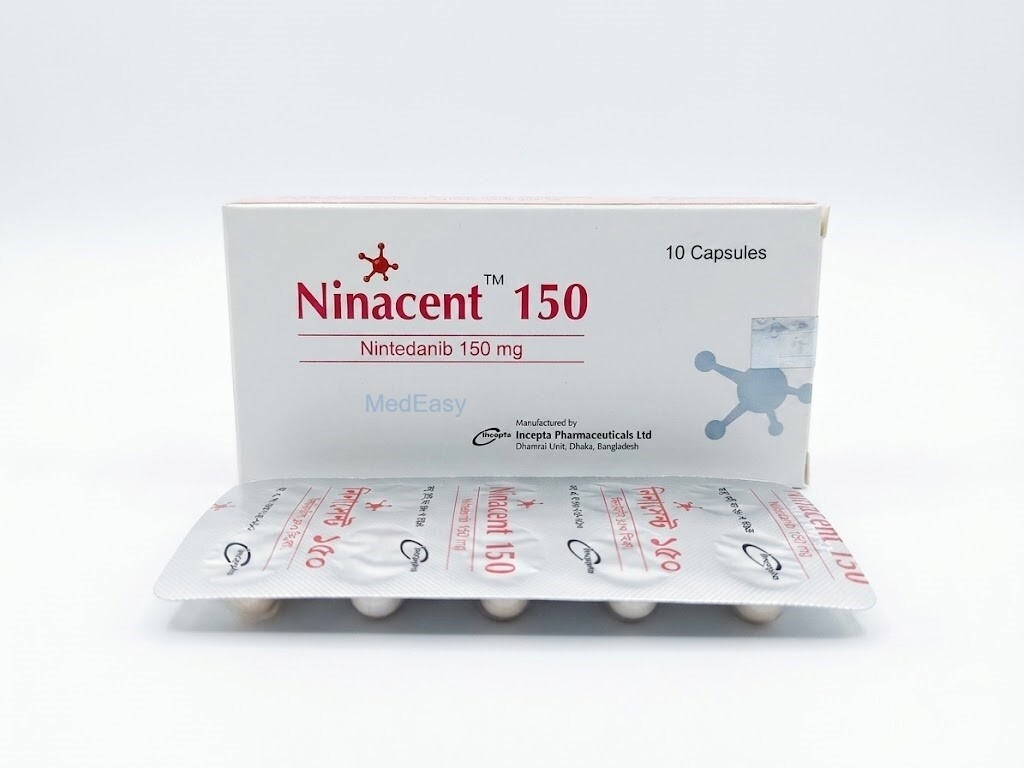
Ninacent150 mg
Incepta Pharmaceuticals Ltd.
৳3220.00
Add to cart


Nifev is a multi-target tyrosine kinase inhibitor approved for specific fibrotic lung conditions and, in combination therapy, certain lung cancers. Approved/established indications include:
Combination/adjunct use:
Nifev should not be used for lung diseases or cancers outside these approved settings and should only be prescribed by a physician experienced in managing these conditions.
Each soft gelatin capsule of Nintedanib contains nintedanib (as nintedanib esylate) equivalent to 100 mg or 150 mg of nintedanib base. The capsule fill also contains excipients including soya lecithin, medium-chain triglycerides, and hard fat, within a gelatin shell with printing ink.
Because the capsule contains soya lecithin, Nintedanib must not be used in patients with known hypersensitivity to peanut or soya.
Nifev is an orally administered, small-molecule tyrosine kinase inhibitor that blocks multiple receptors involved in blood vessel growth and fibrotic tissue remodeling. It is supplied as soft gelatin capsules (100 mg and 150 mg) taken twice daily. Nifev was developed both as an antifibrotic agent for progressive lung fibrosis and, in a different dosing and combination regimen, as an antiangiogenic agent for certain lung cancers.
Nifev belongs to the therapeutic class of multi-target tyrosine kinase inhibitors (angiokinase inhibitors), used as an antifibrotic and antineoplastic agent.
Nintedanib is a small-molecule, intracellular inhibitor that competitively binds to the adenosine triphosphate (ATP)-binding pockets of three receptor tyrosine kinase families:
Nintedanib also inhibits non-receptor tyrosine kinases such as Lck, Lyn, and Src. By blocking these pathways, Nintedanib interrupts signaling cascades that drive fibroblast proliferation, migration, and differentiation into myofibroblasts in fibrotic lung tissue, and inhibits angiogenesis that supports tumor growth. Nintedanib is well absorbed after oral administration, extensively bound to plasma proteins (about 97-98%), metabolized primarily by ester hydrolysis with subsequent glucuronidation, and eliminated mainly via the biliary/fecal route, with an elimination half-life of approximately 10-15 hours.
Dosing of Nifev depends on the indication being treated. It should always be taken with food, swallowed whole with water, and not chewed or crushed.
| Indication | Recommended dose |
|---|---|
| Idiopathic pulmonary fibrosis (IPF) | 150 mg orally twice daily, approximately 12 hours apart |
| Chronic fibrosing ILD with progressive phenotype | 150 mg orally twice daily, approximately 12 hours apart |
| Systemic sclerosis-associated ILD (SSc-ILD) | 150 mg orally twice daily, approximately 12 hours apart |
| NSCLC (adenocarcinoma), combination therapy | 200 mg orally twice daily on Days 2-21 of each 21-day docetaxel cycle, as determined by the treating oncologist |
If diarrhea, liver enzyme elevation, or other adverse reactions occur, the dose of Nifev may be reduced to 100 mg twice daily, or treatment temporarily interrupted, per physician judgment. If 100 mg twice daily is not tolerated, Nifev should be permanently discontinued.
Mild hepatic impairment (Child-Pugh A): reduce to 100 mg twice daily. Moderate to severe hepatic impairment (Child-Pugh B or C): use of Nifev is not recommended.
If a dose of Nifev is missed, the next dose should be taken at the regularly scheduled time; the total daily dose should not exceed the prescribed maximum.
Nifev capsules should be taken orally with food, swallowed whole with a glass of water. Do not open, chew, or crush the capsules, as this may alter drug absorption and increase the risk of local mucosal irritation. Doses should be spaced approximately 12 hours apart, at approximately the same times each day.
Nifev is a substrate of P-glycoprotein (P-gp) and, to a lesser extent, CYP3A4. Clinically significant interactions include:
Inform the prescriber of all other medicines, supplements, and herbal products being used before starting Nifev.
Nintedanib is contraindicated in patients with known hypersensitivity to nintedanib, to peanut, or to soya, since the capsules contain soya lecithin. There are no other well-established absolute contraindications; other risk factors, such as recent surgery, bleeding risk, or hepatic impairment, require caution rather than absolute avoidance (see Precautions and Warnings).
The most common side effect of Nifev is diarrhea, occurring in more than half of treated patients and occasionally requiring dose adjustment or antidiarrheal treatment. Other common side effects include:
Serious but less common effects include hepatotoxicity, gastrointestinal perforation, bleeding events, and arterial thromboembolic events (see Precautions and Warnings). Patients should promptly report severe or persistent diarrhea, yellowing of the skin or eyes, unusual bleeding or bruising, or severe abdominal pain while taking Nifev.
Nifev can cause fetal harm and is not recommended during pregnancy, based on animal studies showing embryo-fetal toxicity and its antiangiogenic mechanism of action. Women of reproductive potential must use effective (barrier) contraception during treatment with Nifev and for at least 3 months after the last dose. If pregnancy occurs during treatment, the patient should inform her physician immediately so the potential risk to the fetus can be assessed. Nifev should be used in pregnancy only if there is no alternative and only if the potential benefit, in the treating physician's judgment, justifies the potential risk.
It is not known whether Nifev passes into human breast milk. Because of the potential for serious adverse effects in a nursing infant, breastfeeding is not recommended during treatment with Nifev and for at least a few days after the final dose. A physician should be consulted regarding infant feeding options.
Nifev carries several serious risks that require monitoring:
Patients should be counseled to promptly report new or worsening symptoms and to attend all scheduled monitoring visits while taking Nifev.
There is limited clinical experience with overdose of Nifev. Based on its known effects, overdose may increase the risk and severity of gastrointestinal symptoms, such as diarrhea, nausea, and vomiting, and liver function abnormalities. There is no specific antidote for Nifev overdose. If overdose is suspected, seek immediate medical attention or contact a poison control center; treatment should be supportive, with interruption of Nifev and symptomatic management as directed by a physician.
Store at room temperature (below 30°C), in the original blister/container, away from light and moisture. Keep out of reach of children.
Renal impairment: No dose adjustment is required in patients with mild to moderate renal impairment; Nifev has not been well studied in severe renal impairment or end-stage renal disease, so caution is advised.
Hepatic impairment: Dose reduction to 100 mg twice daily is required in mild impairment (Child-Pugh A); Nifev is not recommended in moderate to severe hepatic impairment (Child-Pugh B or C).
Elderly: No overall differences in safety or efficacy have been observed based on age alone, but elderly patients should be monitored closely for adverse effects, particularly diarrhea and bleeding risk.
Low body weight/ethnicity: Patients with low body weight (under 45 kg) or of certain ethnic backgrounds may have higher drug exposure and should be monitored closely for adverse effects.
Pediatric patients: Safety and efficacy of Nifev have not been established in children.
Nifev for pulmonary fibrosis and ILD indications is generally intended for long-term, continuous use, since it slows disease progression rather than curing the underlying condition. Treatment is typically continued indefinitely as long as the patient tolerates it and continues to derive benefit, under regular physician review. For the NSCLC combination indication, Nifev is continued in cycles alongside docetaxel until disease progression or unacceptable toxicity occurs. Any decision to stop or interrupt Nifev should be made in consultation with the prescribing physician.
Tyrosine kinase inhibitor (angiokinase inhibitor); antifibrotic agent; antineoplastic agent
Nintedanib works by blocking the intracellular signaling of VEGFR, FGFR, and PDGFR tyrosine kinase receptors, key drivers of fibroblast activity and blood vessel formation. By inhibiting these pathways, Nintedanib reduces the proliferation and migration of fibroblasts in fibrotic lung disease and suppresses tumor angiogenesis in cancer, thereby slowing disease progression.
The safety and efficacy of Nifev have not been established in pediatric patients. Nifev is approved for use in adults only, and its use in children or adolescents is not recommended outside of a clinical trial setting.
Q: What is Nifev 150 mg Capsule used for?
A: Nifev 150 mg Capsule is used to treat idiopathic pulmonary fibrosis (IPF), chronic fibrosing interstitial lung diseases with a progressive phenotype, and systemic sclerosis-associated interstitial lung disease (SSc-ILD). It is also used, in combination with docetaxel, for certain types of advanced non-small cell lung cancer.
Q: How should I take Nifev 150 mg Capsule?
A: Nifev 150 mg Capsule capsules should be swallowed whole with food, approximately 12 hours apart, at the same times each day. Do not chew or crush the capsules.
Q: What are the most common side effects of Nifev 150 mg Capsule?
A: Diarrhea is the most common side effect of Nifev 150 mg Capsule and can sometimes be severe. Other common effects include nausea, vomiting, abdominal pain, decreased appetite, liver enzyme elevation, and weight loss. Tell your doctor promptly if diarrhea is severe or persistent.
Q: Can Nifev 150 mg Capsule be used during pregnancy?
A: No. Nifev 150 mg Capsule can harm an unborn baby and is not recommended during pregnancy. Women who can become pregnant must use effective contraception during treatment with Nifev 150 mg Capsule and for at least 3 months after stopping it. Tell your doctor immediately if you become pregnant while taking Nifev 150 mg Capsule.
Q: Who should not take Nifev 150 mg Capsule?
A: Nifev 150 mg Capsule should not be used by anyone with a known allergy to Nifev 150 mg Capsule, peanut, or soya, since the capsules contain soya lecithin. Tell your doctor about any allergies before starting Nifev 150 mg Capsule.
Q: Does Nifev 150 mg Capsule require monitoring while I take it?
A: Yes. Your doctor will check your liver function tests before and periodically during treatment with Nifev 150 mg Capsule, since it can affect the liver. You should also be monitored for bleeding, gastrointestinal symptoms, and blood pressure changes.
Disclaimer
The information provided is accurate to the best of our knowledge, but it does not replace professional medical advice. We cannot guarantee its completeness or accuracy, and the absence of specific information about a drug should not be taken as an endorsement. We are not responsible for any consequences arising from this information, so please consult a healthcare professional for any concerns or questions.
