
Key facts
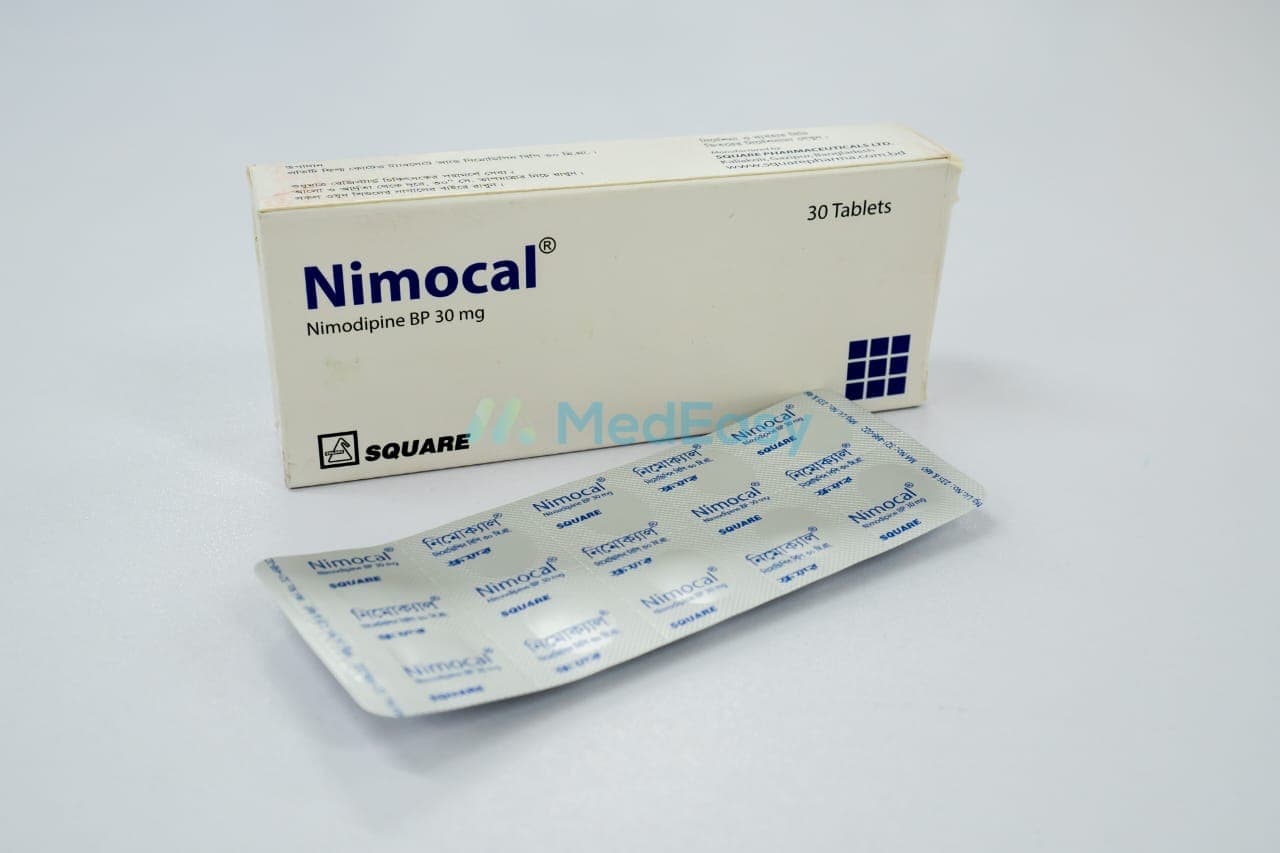
Nimocal 30 mg Tablet is available on MedEasy for ৳4.53 per piece, with home delivery anywhere in Bangladesh. It is manufactured by Square Pharmaceuticals PLC. Its generic name is Nimodipine.
- Pack sizes
- piece, 30's pack
- Prescription
- Required. Upload a valid doctor's prescription at checkout; a MedEasy pharmacist verifies it before dispatch.
- Delivery
- Home delivery across Bangladesh. Same-day delivery in Dhaka, Chattogram, Sylhet and Bogura city areas; 2-3 days elsewhere.
- Payment
- Cash on delivery, bKash, cards and mobile banking.
- Brand
- Nimocal
- Generic name
- Nimodipine
- Manufacturer
- Square Pharmaceuticals PLC.
- Form & strength
- Tablet 30 mg
- Availability
- In stock
- Authenticity
- Sourced from licensed suppliers and the manufacturer's authorised distributors in Bangladesh.

Medicine overview
Indications of Nimocal
Nimocal is a dihydropyridine calcium channel blocker that is FDA-approved for a single, well-defined indication in neurocritical care.
Established (FDA-approved) indication
- Aneurysmal subarachnoid hemorrhage (SAH): Nimocal is indicated to improve neurological outcome by reducing the incidence and severity of ischemic neurological deficits (cerebral vasospasm-related) in adult patients with subarachnoid hemorrhage from ruptured intracranial berry aneurysms, regardless of the patient's post-ictus neurological grade (Hunt and Hess Grades I-V).
Nimocal does not reverse or reduce the angiographic vasospasm itself; its clinical benefit is on neurological outcome. Treatment should be started within 96 hours of the onset of subarachnoid hemorrhage and requires a physician's supervision in a hospital setting. There is no well-established, guideline-supported role for Nimocal outside this indication, and off-label use should only occur under direct specialist guidance.
Composition
Each soft gelatin capsule contains Nimodipine 30 mg as the active ingredient. Nimodipine is also available in some markets as an oral solution. In Bangladesh, Nimodipine is marketed as 30 mg oral capsules/tablets.
Description
Nimocal is a dihydropyridine-class calcium channel blocker that, unlike most other agents in its class, is used specifically for its effect on the cerebral vasculature rather than for blood pressure control. It is highly lipophilic, which allows it to cross the blood-brain barrier and reach the cerebrospinal fluid.
Nimocal is used exclusively in the hospital setting to reduce ischemic neurological deficits following aneurysmal subarachnoid hemorrhage. It is administered strictly by the oral or enteral route; it must never be given intravenously.
Therapeutic Class
Nimocal belongs to the calcium channel blocker (CCB) class, specifically the dihydropyridine subgroup. Within this subgroup, Nimocal is distinguished by its relatively selective action on cerebral (rather than systemic) blood vessels, which is why it is used in neurology/neurosurgery rather than as an antihypertensive.
Pharmacology
Pharmacodynamics
Nimodipine inhibits the transmembrane influx of calcium ions into vascular smooth muscle cells, producing relaxation of cerebral blood vessels. The precise mechanism by which this translates into improved neurological outcome after subarachnoid hemorrhage has not been fully established, but Nimodipine reduces the incidence and severity of ischemic deficits without necessarily reversing angiographic vasospasm.
Pharmacokinetics
- Absorption: Rapidly absorbed after oral dosing, with peak plasma concentration reached within about 1 hour; a standard meal can reduce peak concentration and overall bioavailability substantially, so Nimodipine is best taken apart from food.
- Distribution: More than 95% bound to plasma proteins; high lipophilicity allows penetration into the cerebrospinal fluid.
- Metabolism: Undergoes extensive first-pass hepatic metabolism via the CYP3A4 enzyme system, giving an average oral bioavailability of only about 13%.
- Elimination: Eliminated almost entirely as metabolites, mainly via bile/feces with a smaller renal component; effective half-life is short (roughly 1-2 hours), which is why frequent (every 4 hour) dosing is required despite a longer terminal half-life.
Dosage & Administration of Nimocal
Adult Dosage (Subarachnoid Hemorrhage)
| Population | Dose | Duration |
|---|---|---|
| Standard adult dose | 60 mg (two 30 mg capsules) orally every 4 hours | 21 consecutive days, started within 96 hours of hemorrhage onset |
| Hepatic impairment (e.g. cirrhosis) | Reduced to 30 mg orally every 4 hours, with close monitoring of blood pressure and heart rate | Same 21-day course |
Administration Instructions
- Nimocal is for oral or enteral (feeding-tube) use only. It must never be given by intravenous injection or any other parenteral route — see Contraindications.
- Swallow capsules whole with a small amount of liquid; do not chew or open unless the patient cannot swallow (see below).
- Take at least 1 hour before or 2 hours after meals, since food reduces absorption; avoid grapefruit juice.
- If the patient cannot swallow the capsule: under medical supervision, the ends of the capsule may be punctured with a sterile needle, the liquid contents withdrawn into a needle-free oral/enteral syringe, and the dose instilled through a nasogastric tube, followed by a saline flush to clear the tube. This technique must only be performed by trained healthcare staff.
Pediatric Dosage
Safety and efficacy in pediatric patients have not been established; Nimocal is not used in children outside specialist/investigational settings.
Administration of Nimocal
Nimocal must be taken by mouth or via a feeding tube only — never intravenously. Take on an empty stomach (1 hour before or 2 hours after food) with a little liquid. If the patient cannot swallow, a physician or nurse may withdraw the liquid contents through a needle and give the dose via a nasogastric tube, flushing afterward with saline.
Interaction of Nimocal
Clinically Significant Interactions
- Strong CYP3A4 inhibitors (e.g. certain macrolide antibiotics, azole antifungals, HIV protease inhibitors, nefazodone): markedly raise Nimocal plasma levels, greatly increasing the risk of severe hypotension. Concurrent use is contraindicated — see Contraindications.
- Strong CYP3A4 inducers (e.g. rifampin, phenobarbital, phenytoin, carbamazepine): can substantially reduce Nimocal plasma levels and efficacy; concurrent use should generally be avoided.
- Other antihypertensive agents or vasodilators: may have an additive blood-pressure-lowering effect when combined with Nimocal; blood pressure should be monitored closely.
- Grapefruit juice: inhibits intestinal CYP3A4 metabolism and can raise Nimocal levels for several days after ingestion; it should be avoided during treatment.
Contraindications
- Known hypersensitivity to Nimodipine or any component of the formulation.
- Concurrent use with strong CYP3A4 inhibitors (e.g. certain macrolides, azole antifungals, HIV protease inhibitors, nefazodone), due to markedly increased Nimodipine plasma levels and risk of severe, life-threatening hypotension.
- Intravenous or any other parenteral administration. Nimodipine is formulated strictly for oral/enteral use; injecting the capsule contents intravenously has caused serious, life-threatening adverse events and death, and must never be done under any circumstance.
Side Effects of Nimocal
The most common adverse effect of Nimocal is a drop in blood pressure. Because subarachnoid hemorrhage itself often alters consciousness, some adverse effects may be under-reported in affected patients.
Common
- Decreased blood pressure (most frequently reported)
- Headache
- Nausea
- Diarrhea
- Rash
- Edema (fluid retention/swelling)
- Abnormal liver function test results
- Bradycardia (slow heart rate)
Uncommon/Rare
- Intestinal pseudo-obstruction or ileus (reduced bowel motility) — usually managed conservatively; report severe abdominal distension or constipation promptly.
Pregnancy & Lactation
Pregnancy
Nimocal should be used during pregnancy only if clearly needed, and only if the potential benefit to the mother justifies the potential risk to the fetus. Animal studies have shown adverse fetal effects at high doses; adequate, well-controlled studies in pregnant women are lacking. A physician should always be consulted before use in pregnancy.
Breastfeeding
It is not known whether Nimocal passes into human breast milk, but related compounds have been detected in animal milk at levels exceeding those in maternal blood. Because of the potential for adverse effects in a nursing infant, a decision should be made in consultation with a physician about whether to discontinue breastfeeding or discontinue Nimocal, taking into account the importance of the medicine to the mother.
Precautions & Warnings
Route of administration warning
Nimocal must be given by the oral or enteral route only. Intravenous or other parenteral administration is contraindicated and has resulted in death and serious harm — see Contraindications.
Hypotension
Nimocal can lower blood pressure, particularly in patients already receiving other antihypertensive medicines. Blood pressure and heart rate should be monitored regularly during treatment, especially at initiation and after dose changes.
Hepatic impairment
Patients with liver disease (e.g. cirrhosis) metabolize Nimocal more slowly, leading to higher blood levels; a reduced dose and closer monitoring of blood pressure and heart rate are required — see Dosage and Administration.
Gastrointestinal effects
Rarely, Nimocal has been associated with intestinal pseudo-obstruction or ileus. Report persistent abdominal distension, severe constipation, or vomiting to a physician promptly.
General
Nimocal should only be used under the supervision of a physician experienced in the management of subarachnoid hemorrhage, typically in a hospital setting.
Overdose Effects of Nimocal
No cases of oral overdose with Nimocal have been well documented, but an overdose would be expected to cause excessive vasodilation leading to marked, sustained low blood pressure and a reflex increase or decrease in heart rate.
If an overdose of Nimocal is suspected, seek immediate medical attention or contact emergency services/a poison control center right away. Treatment is supportive and may include intravenous fluids and vasopressor medicines to maintain blood pressure under close medical supervision; because Nimocal is highly protein-bound, dialysis is not expected to be effective. Do not attempt to manage a suspected overdose at home.
Storage Conditions
Store between 20°C and 25°C (68°F-77°F) in the original packaging, protected from light and from freezing. Keep out of reach of children.
Use In Special Populations
Pregnancy and lactation
Use only if clearly needed — see Pregnancy and Lactation section above.
Pediatric use
Safety and efficacy of Nimocal in pediatric patients have not been established.
Geriatric use
Elderly patients (studied at 59-79 years) have shown roughly two-fold higher Nimocal blood levels than younger adults; the clinical significance is not fully established, but Nimocal should be used with caution in elderly patients, taking into account age-related decreases in hepatic, renal, and cardiac function.
Hepatic impairment
Bioavailability of Nimocal is increased in patients with liver cirrhosis; a reduced dose (30 mg every 4 hours) with close monitoring is recommended — see Dosage and Administration.
Renal impairment
Less than 1% of a Nimocal dose is excreted unchanged in urine; no specific dose adjustment is established for renal impairment, but Nimocal should still be used with appropriate monitoring in these patients.
Duration Of Treatment
The standard course of Nimocal for subarachnoid hemorrhage is 21 consecutive days, started within 96 hours of the onset of hemorrhage. The duration should not be shortened or extended except on a physician's advice.
Drug Classes
Calcium channel blockers; Dihydropyridine derivatives
Mode Of Action
Nimodipine blocks the influx of calcium ions through voltage-gated (L-type) calcium channels in vascular smooth muscle cell membranes. By reducing intracellular calcium entry, it relaxes cerebral blood vessels. Its high lipophilicity allows it to cross the blood-brain barrier and act preferentially on the cerebral vasculature. The exact link between this action and the observed improvement in neurological outcome after subarachnoid hemorrhage is not completely understood, since Nimodipine improves outcomes without necessarily relieving angiographic vasospasm.
Pregnancy
C
Pediatric Uses
The safety and efficacy of Nimocal have not been established in pediatric patients. Nimocal is not recommended for use in children outside of specialist, investigational settings, and should only be considered in a child if a physician determines the potential benefit clearly outweighs the unknown risks.
Frequently Asked Questions
Q: What is Nimocal 30 mg Tablet used for?
A: Nimocal 30 mg Tablet is used in hospitalized patients who have had a subarachnoid hemorrhage (bleeding around the brain) from a ruptured brain aneurysm. It helps improve neurological outcome by reducing the severity of ischemic (blood-flow-related) deficits that can occur in the following weeks.
Q: Can Nimocal 30 mg Tablet be given as an injection?
A: No. Nimocal 30 mg Tablet must only be taken by mouth or through a feeding tube. Giving Nimocal 30 mg Tablet intravenously or by any other injection is strictly forbidden and has caused deaths and serious, life-threatening harm. Only trained healthcare staff should ever handle the capsule contents for feeding-tube use.
Q: How long is Nimocal 30 mg Tablet treatment usually given?
A: The typical course is 60 mg every 4 hours for 21 consecutive days, started within 96 hours of the hemorrhage, and should always follow a physician's exact instructions.
Q: Can Nimocal 30 mg Tablet be taken with food?
A: It is best taken on an empty stomach — at least 1 hour before or 2 hours after a meal — because food, and especially grapefruit juice, can reduce how much Nimocal 30 mg Tablet the body absorbs or increase its blood levels.
Q: Is Nimocal 30 mg Tablet safe in pregnancy?
A: Nimocal 30 mg Tablet should be used in pregnancy only if clearly necessary and if a physician judges that the benefit to the mother outweighs the potential risk to the fetus, since animal studies have shown fetal harm at high doses and human data are limited. Always consult a physician.
Q: What should I do if a dose of Nimocal 30 mg Tablet is missed or an overdose is suspected?
A: Nimocal 30 mg Tablet is administered in a hospital setting under medical supervision, so dosing is managed by the healthcare team. If an overdose is ever suspected, seek immediate medical attention or contact emergency services, as it can cause a dangerous drop in blood pressure requiring urgent treatment.
Disclaimer
The information provided is accurate to the best of our knowledge, but it does not replace professional medical advice. We cannot guarantee its completeness or accuracy, and the absence of specific information about a drug should not be taken as an endorsement. We are not responsible for any consequences arising from this information, so please consult a healthcare professional for any concerns or questions.