

10% Off
Miotrol2.5 mg
Drug International Ltd.
৳153.00
Add to cart
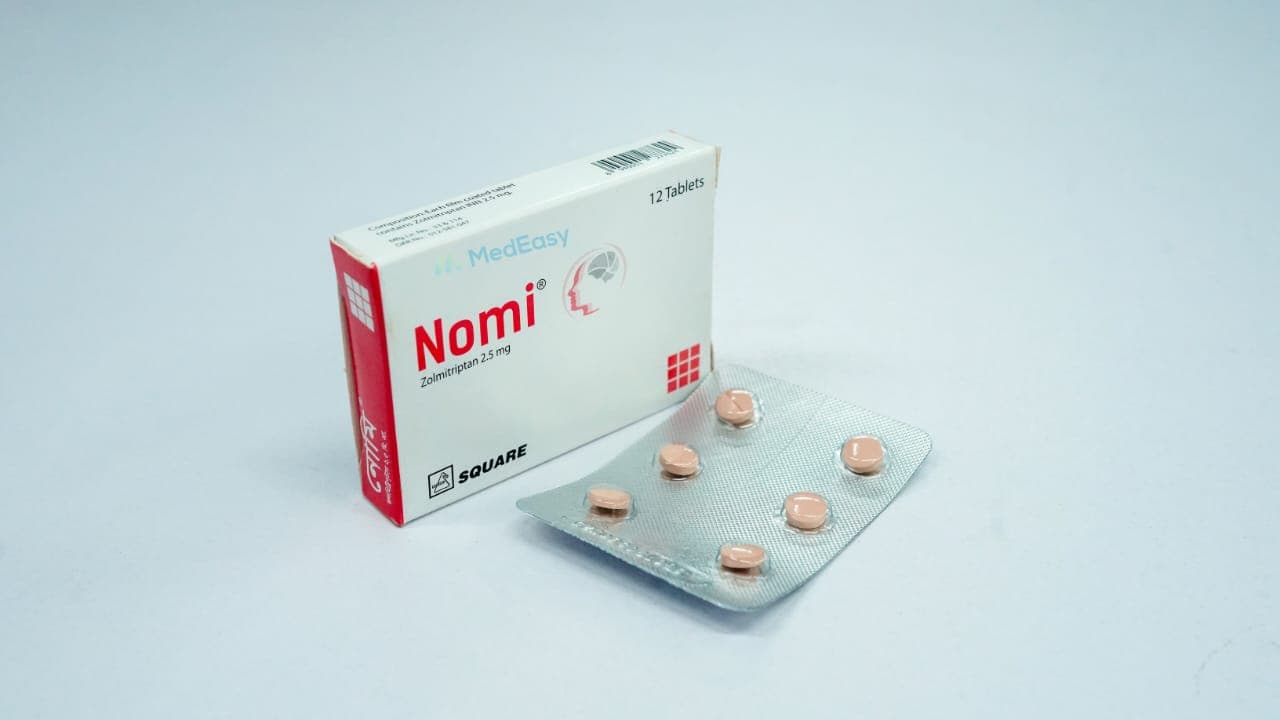

Nomi is FDA-approved for the acute treatment of migraine with or without aura in adults. It is used to relieve an ongoing migraine attack, not to reduce the number of attacks a patient has.
Nomi is not indicated for the prevention (prophylaxis) of migraine, and is not indicated for cluster headache, tension-type headache, or other headache types not clearly diagnosed as migraine. There is no well-established off-label use of Nomi that is commonly recommended in guidelines.
Each tablet or orally disintegrating tablet of Zolmitriptan contains Zolmitriptan as the active pharmaceutical ingredient, commonly available in strengths of 2.5 mg. A nasal spray formulation of Zolmitriptan is also available, delivering 2.5 mg or 5 mg per spray. Excipients vary by manufacturer and formulation.
Nomi is a second-generation triptan, a class of medicines used specifically for the acute treatment of migraine attacks. It works by binding selectively to serotonin (5-HT1B/1D) receptors in the brain and cranial blood vessels, leading to constriction of dilated blood vessels and reduction of the inflammatory signaling associated with migraine pain.
Nomi is available as conventional tablets, orally disintegrating tablets (which dissolve on the tongue without water, useful for patients with migraine-associated nausea), and as a nasal spray for faster onset of action. It does not prevent migraine attacks and should be taken as soon as migraine symptoms begin for best effect.
Nomi belongs to the triptan class of drugs, specifically classified as a selective serotonin 5-HT1B/1D receptor agonist. This class of anti-migraine agents also includes sumatriptan, rizatriptan, naratriptan, and eletriptan.
Zolmitriptan is a selective agonist at serotonin 5-HT1B and 5-HT1D receptors. Its therapeutic effect in migraine is believed to occur through three main mechanisms:
Zolmitriptan is well absorbed orally (bioavailability approximately 40%), with peak plasma concentration reached in about 1.5-2 hours. It is metabolized in the liver, partly to an active metabolite (N-desmethyl-zolmitriptan) that is more potent than the parent drug, and eliminated primarily via the kidneys. Its elimination half-life is approximately 2.5-3 hours.
The dosing of Nomi is individualized based on indication and patient factors, as summarized below.
| Population/Situation | Recommended Dosing of Nomi |
|---|---|
| Adults - initial dose | 2.5 mg (or 1.25 mg in patients who may be more sensitive) taken orally at the onset of a migraine attack |
| Adults - repeat dosing | If migraine returns or the first dose was only partially effective, a second dose may be taken at least 2 hours after the first |
| Maximum single dose | 5 mg |
| Maximum total daily dose | 10 mg within 24 hours |
| Hepatic impairment (moderate-severe) | Limit single dose to 1.25 mg; maximum 5 mg/day in severe impairment (see Precautions) |
| Concurrent cimetidine use | Maximum single dose 2.5 mg; maximum daily dose 5 mg (see Interactions) |
| Pediatric use | Not recommended; safety and efficacy not established (see Pediatric Uses) |
Nomi should be taken as soon as possible after migraine symptoms begin, but is effective when administered at any stage of an attack. It should not be used to prevent an attack before symptoms start.
Nomi tablets are swallowed whole with water. Orally disintegrating tablets of Nomi should be placed on the tongue, where they dissolve without the need for water, and can be taken by patients who have nausea or vomiting during a migraine attack. The nasal spray formulation of Nomi is administered as a single spray into one nostril. Nomi can be taken with or without food.
Nomi has several well-documented, clinically significant drug interactions:
Zolmitriptan is contraindicated in patients with:
Common side effects of Nomi (occurring in approximately 5% or more of patients and more often than with placebo) include:
Serious but rare side effects include myocardial infarction, other cardiac arrhythmias, coronary artery vasospasm, stroke, serotonin syndrome (especially with concurrent SSRIs/SNRIs; see Interactions), and anaphylaxis/hypersensitivity reactions. Patients experiencing chest pain, severe dizziness, sudden weakness, or signs of an allergic reaction after taking Nomi should seek immediate medical attention.
Pregnancy: There are limited data on the use of Nomi in pregnant women. Animal studies have shown adverse effects (embryolethality and fetal structural abnormalities) at doses relevant to human exposure. Nomi should be used during pregnancy only if the potential benefit justifies the potential risk to the fetus; consult a physician before use if pregnant or planning pregnancy.
Lactation: It is not known whether Nomi passes into human breast milk in clinically significant amounts. Caution is advised, and a physician should be consulted to weigh the benefits of treatment against the potential risk to a breastfeeding infant before using Nomi while breastfeeding.
Nomi should be used with caution in the following situations:
Limited experience with Nomi overdose is available. Doses around 50 mg have commonly caused sedation. If an overdose of Nomi is suspected, seek immediate medical attention or contact a poison control center. Management is supportive, with monitoring of cardiovascular status and vital signs for at least 15 hours or while symptoms persist, as the elimination half-life of Nomi is prolonged compared to normal. There is no specific antidote for Nomi overdose; it is not known whether hemodialysis or peritoneal dialysis is effective in removing it from the body.
Store at room temperature (below 30°C), away from light and moisture. Keep out of reach of children.
Elderly patients: Nomi clearance is somewhat reduced with age; use with caution and screening for cardiovascular risk factors is recommended in older adults, particularly postmenopausal women and men over 40.
Renal impairment: No specific dose adjustment is generally required for mild to moderate renal impairment; Nomi has not been studied in severe renal impairment, so caution is advised.
Hepatic impairment: Dose reduction of Nomi is required in moderate to severe hepatic impairment (see Dosage and Administration).
Pediatric patients: See Pediatric Uses.
Nomi is used on an as-needed basis for individual migraine attacks, not as a continuous daily treatment. A single dose is typically taken per attack, with a second dose permitted after at least 2 hours if needed, up to the maximum daily dose. Patients should limit use of Nomi to no more than 2-3 days per week to avoid medication-overuse headache. If migraine attacks are frequent, a physician should be consulted regarding preventive (prophylactic) therapy, since Nomi itself is not a preventive treatment.
Triptan; Selective serotonin 5-HT1B/1D receptor agonist; Anti-migraine agent
Zolmitriptan selectively activates 5-HT1B and 5-HT1D serotonin receptors located on cranial blood vessels and trigeminal sensory nerves. This produces vasoconstriction of dilated cranial vessels and inhibits the release of vasoactive, pro-inflammatory neuropeptides, thereby interrupting the pathological processes believed to underlie migraine pain.
C
The safety and efficacy of Nomi in pediatric patients under 12 years of age have not been established. In adolescents aged 12 to 17 years, clinical trials of Nomi nasal spray did not demonstrate a statistically significant difference in efficacy compared to placebo, so Nomi is not currently recommended for use in this age group. Nomi should not be used in children or adolescents unless specifically directed by a physician experienced in pediatric migraine management.
Q: What is Nomi 2.5 mg Tablet used for?
A: Nomi 2.5 mg Tablet is used for the acute treatment of migraine attacks with or without aura in adults. It relieves an ongoing migraine but does not prevent future attacks.
Q: How quickly does Nomi 2.5 mg Tablet work?
A: Many patients notice improvement in migraine symptoms within 1 to 2 hours of taking Nomi 2.5 mg Tablet. It works best when taken as soon as migraine symptoms begin.
Q: Can I take Nomi 2.5 mg Tablet for a regular headache or to prevent migraines?
A: No. Nomi 2.5 mg Tablet is intended only for treating a migraine attack that has already started, not for other types of headache and not for preventing migraines from occurring.
Q: Who should not take Nomi 2.5 mg Tablet?
A: Nomi 2.5 mg Tablet should not be used by people with a history of heart disease (such as angina or heart attack), stroke or TIA, uncontrolled high blood pressure, peripheral vascular disease, hemiplegic or basilar migraine, or by those who have used another triptan or an ergotamine-type medicine in the past 24 hours, or an MAO-A inhibitor in the past 2 weeks. Anyone allergic to Nomi 2.5 mg Tablet should also avoid it.
Q: Can I take Nomi 2.5 mg Tablet with antidepressants?
A: Taking Nomi 2.5 mg Tablet together with certain antidepressants (SSRIs or SNRIs) can increase the risk of a rare but serious condition called serotonin syndrome. Tell your doctor about all medicines you take before starting Nomi 2.5 mg Tablet.
Q: Is it safe to use Nomi 2.5 mg Tablet during pregnancy or while breastfeeding?
A: Nomi 2.5 mg Tablet should be used during pregnancy only if clearly needed and if the potential benefit justifies the potential risk to the baby, since animal studies have shown possible fetal harm. It is not known whether Nomi 2.5 mg Tablet passes into breast milk, so a doctor should be consulted before use while breastfeeding.
Disclaimer
The information provided is accurate to the best of our knowledge, but it does not replace professional medical advice. We cannot guarantee its completeness or accuracy, and the absence of specific information about a drug should not be taken as an endorsement. We are not responsible for any consequences arising from this information, so please consult a healthcare professional for any concerns or questions.
