
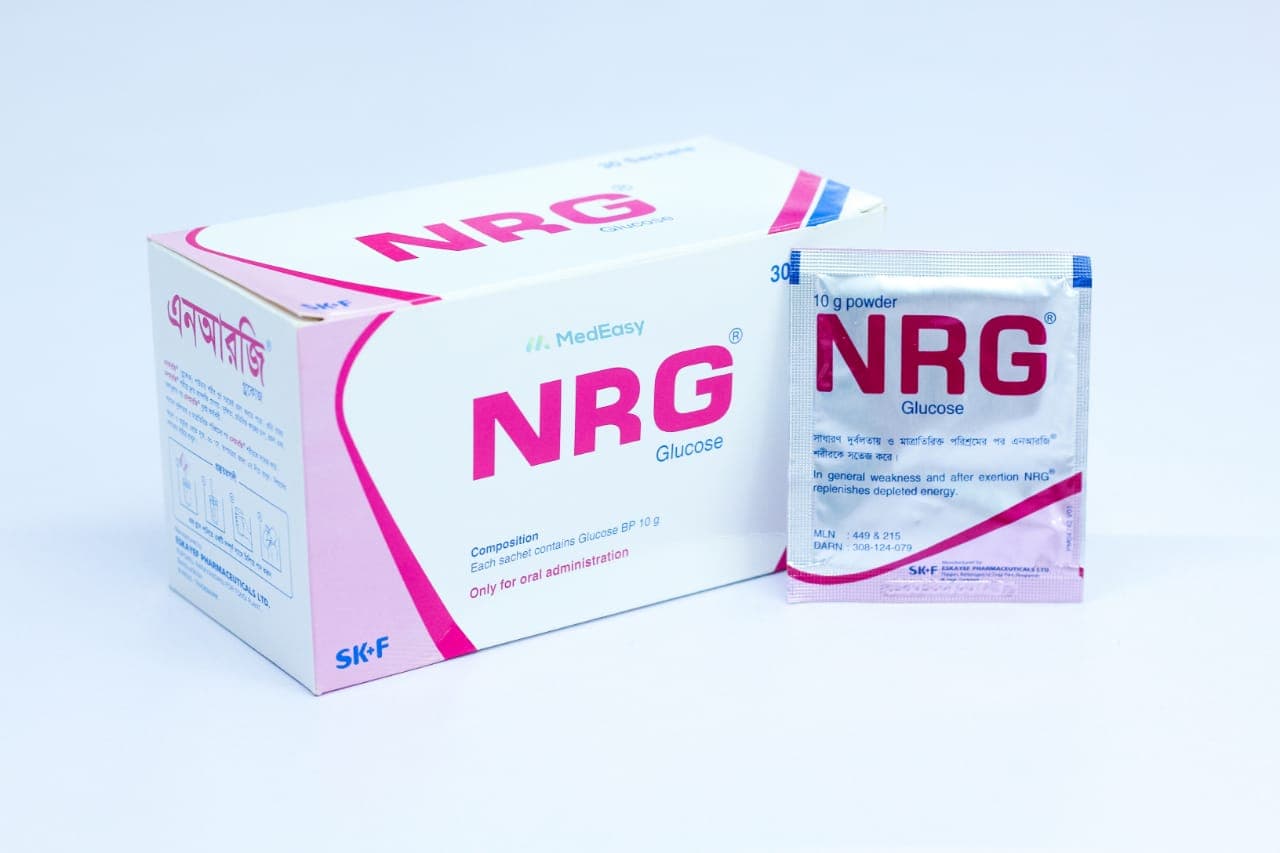

Medicine overview
Indications of NRG
NRG (NRG monohydrate) solutions are used for the following indications, listed by strength of evidence:
Established / FDA-approved uses (intravenous)
- Source of calories and free water for patients who cannot take adequate oral fluids/nutrition (e.g. peri-operative, critically ill, or NPO patients) — typically 5% NRG solutions.
- Treatment of hypoglycemia, including severe/symptomatic hypoglycemia (e.g. insulin overdose, prolonged fasting) — typically 10–50% NRG solutions given as IV infusion or slow IV push.
- Diluent/vehicle for administering compatible IV medications and for reconstituting/diluting other injectable drugs.
- Component of parenteral nutrition (TPN) regimens, where higher-concentration NRG (e.g. 20–70%) supplies non-protein calories, usually via a central venous line.
Guideline-supported adjunct use
- Emergency management of hyperkalemia, given together with regular insulin (insulin–NRG infusion) to shift potassium intracellularly while insulin is administered — this is an adjunct, combination-therapy use and does not lower total body potassium.
Oral use
- Oral glucose (NRG) solution is used for mild-to-moderate hypoglycemia in a conscious patient able to swallow, and as the standard glucose load for an oral glucose tolerance test (OGTT) used to screen for diabetes/gestational diabetes.
The specific concentration and route (IV vs. oral) used depend on the clinical indication and must be selected by a physician; see Dosage and Administration.
Composition
Each formulation contains Dextrose (dextrose monohydrate), USP, as the active ingredient, supplied as a sterile, non-pyrogenic aqueous solution for intravenous infusion in various concentrations (commonly 5%, 10%, and 25% w/v, with higher concentrations such as 20%, 50%, and 70% available for specialised/central-line use), or as an oral powder/solution for oral glucose administration.
IV solutions contain no bacteriostatic, antimicrobial agent, or added buffer unless otherwise specified on the label, and are intended for single use.
Description
NRG is the medically purified form of D-glucose, a simple monosaccharide carbohydrate that is the body's primary and most readily usable source of cellular energy. When given intravenously, NRG solutions provide calories and free water; when given orally, NRG is absorbed directly from the gut and raises blood glucose rapidly.
NRG is marketed as sterile intravenous infusion solutions in a range of concentrations, and as an oral powder/solution, and is widely used in hospital and emergency settings in Bangladesh and internationally.
Therapeutic Class
NRG belongs to the therapeutic class of intravenous fluid and electrolyte replenishers / caloric agents (carbohydrates). It is also classified as an anti-hypoglycemic agent when used to correct low blood glucose, and functions as an IV diluent/vehicle.
Pharmacology
Mechanism / Pharmacodynamics
Dextrose (D-glucose) is the principal carbohydrate circulating in the blood and the main energy source for most tissues. Once infused or absorbed, Dextrose is taken up by cells (an insulin-dependent process in most tissues) and metabolised via glycolysis and oxidative phosphorylation to produce adenosine triphosphate (ATP), carbon dioxide, and water, yielding approximately 3.4 kcal per gram. Excess Dextrose is stored as glycogen (liver, muscle) or converted to fat.
Pharmacokinetics
Intravenously administered Dextrose enters the systemic circulation directly and is distributed to all insulin-responsive and insulin-independent tissues; orally administered Dextrose is absorbed rapidly from the small intestine via active (SGLT1) and facilitated (GLUT) transport, producing a fast rise in blood glucose. Dextrose is metabolised primarily in the liver and muscle, and its metabolic end products (CO2 and H2O) are eliminated via respiration and renal excretion; a small amount may be excreted unchanged in urine if the renal glucose threshold is exceeded (glycosuria).
Dosage & Administration of NRG
NRG dosing is individualised by indication, concentration, patient age, weight, fluid/electrolyte status, and clinical response, and IV use requires monitoring by a physician or under medical supervision.
| Indication | Typical adult dosing | Notes |
|---|---|---|
| Fluid/caloric maintenance | 5% NRG: 500–1000 mL IV infusion, rate individualised; usually not exceeding 0.5 g/kg/hour to avoid glycosuria | May be given via peripheral vein |
| Moderate fluid/carbohydrate depletion | 10% NRG: dose and rate individualised (e.g. up to 20–30 mL/kg over the prescribed period) per clinical status | Peripheral vein may be used cautiously; watch for irritation |
| Severe/symptomatic hypoglycemia | 10–50% NRG IV; a common regimen is 25 g (50 mL of 50% NRG) by slow IV push, or continuous infusion of a lower concentration until glucose stabilises | Recheck blood glucose after treatment; higher concentrations (>12.5%) generally require a large peripheral or central vein |
| Hyperkalemia (adjunct) | NRG (e.g. 25–50 g) given with regular insulin (commonly 5–10 units) by IV infusion | Combination therapy only; monitor blood glucose and potassium closely; see Precautions |
| Parenteral nutrition component | Higher concentrations (20–70%) as part of an individualised TPN prescription | Concentrations >10–12.5% (osmolarity ≥900 mOsm/L) generally require central venous administration |
| Oral hypoglycemia treatment | 10–20 g oral NRG as a single dose; may repeat once after about 10–15 minutes if symptoms/low glucose persist | Only for a conscious patient able to swallow safely |
| Oral glucose tolerance test | Standard oral NRG load per the testing protocol in use (physician/laboratory directed) | Test-specific; follow local protocol |
Renal/hepatic impairment: use with caution and closer monitoring of glucose, fluid, and electrolyte status in renal or hepatic impairment; no fixed dose-reduction schedule is established — the prescribing physician individualises the rate and concentration.
Administration of NRG
Intravenous NRG must be administered by, or under the direct supervision of, a qualified healthcare professional using strict aseptic technique:
- Inspect the container/bag for clarity, absence of particulate matter, and an intact seal before use; discard if the solution is discoloured or cloudy.
- Use a sterile administration set; do not add other medications unless compatibility has been confirmed.
- Concentrations of 5% or less may generally be given via a peripheral vein; higher concentrations (typically above 10–12.5%, or with osmolarity ≥900 mOsm/L) should be given through a central venous line to reduce the risk of vein irritation, phlebitis, and thrombosis.
- Infusion rate should be increased gradually and individualised, with periodic monitoring of blood glucose, fluid balance, and electrolytes, particularly in neonates, elderly patients, and those with diabetes or renal impairment.
- NRG solution is for single use only; discard any unused portion.
Oral NRG (powder/solution) is taken by mouth; for hypoglycemia it should only be given to a conscious patient who can swallow safely.
Interaction of NRG
Clinically significant interactions with NRG are related mainly to its effect on blood glucose, fluid, and electrolyte balance rather than classical pharmacokinetic drug-drug interactions:
- Insulin and other glucose-lowering drugs: NRG raises blood glucose and can blunt or oppose their effect; conversely, when NRG is combined with insulin (e.g. for hyperkalemia treatment), the combination can cause hypoglycemia if not monitored — blood glucose must be monitored closely.
- Corticosteroids and ACTH: may increase blood glucose and promote sodium/fluid retention, compounding the hyperglycemic and fluid-overload risks of NRG infusion.
- Vasopressin/desmopressin and other antidiuretic drugs: increase the risk of fluid retention and hyponatremia when co-administered with large volumes of NRG solution.
- Diuretics and drugs affecting electrolyte balance: concurrent use requires closer monitoring of serum electrolytes during NRG infusion, particularly potassium, sodium, and phosphate.
- Whole blood: NRG solution should not be administered through the same line as whole blood, as it may cause pseudoagglutination or hemolysis of red blood cells.
Report all other medicines being used to the treating physician before starting NRG infusion so that fluid, electrolyte, and glucose management can be adjusted appropriately.
Contraindications
Dextrose is contraindicated in:
- Patients with known hypersensitivity to Dextrose (dextrose) or to any component of the formulation.
- Patients with clinically significant hyperglycemia that is uncontrolled, until the hyperglycemia is addressed.
Diabetes, fluid-overload-prone conditions, and electrolyte disturbances are important precautions requiring caution and monitoring, not absolute contraindications — see Precautions and Warnings.
Side Effects of NRG
The most commonly reported adverse reactions with NRG infusion are:
- Hyperglycemia and, if severe or prolonged, glycosuria/osmotic diuresis.
- Hypersensitivity/infusion reactions — rash, urticaria, and rarely anaphylaxis, angioedema, or bronchospasm.
- Hyponatremia, which can be severe, particularly with large-volume infusion.
- Local reactions at the infusion site — pain, redness, irritation, phlebitis, and thrombosis, especially with higher-concentration solutions given peripherally.
- Infection at the injection site or systemically, related to IV access.
- Electrolyte imbalance (e.g. hypokalemia, hypophosphatemia) and, with excessive/rapid administration, fluid overload which can lead to pulmonary edema.
Oral NRG is generally well tolerated; mild nausea or gastrointestinal discomfort may occasionally occur.
Seek prompt medical attention for signs of a serious reaction (difficulty breathing, swelling of the face/throat, chest pain, severe confusion) during or after NRG administration.
Pregnancy & Lactation
Pregnancy: NRG is a physiologic nutrient and, when administered appropriately for a valid clinical indication (such as maternal hypoglycemia or fluid/caloric support), is not expected to cause adverse developmental outcomes; nonetheless, NRG should be used in pregnancy only if clearly needed, with the concentration, rate, and volume individualised and monitored by the treating physician, as excessive administration can cause maternal hyperglycemia, fluid overload, or electrolyte disturbance that may indirectly affect the fetus.
Lactation: There is no evidence that appropriately administered NRG is harmful during breastfeeding; as a normal component of maternal metabolism it is not expected to adversely affect a breastfed infant. The potential benefit of maternal treatment should be weighed against any clinical concern, and use should be guided by a physician.
Precautions & Warnings
The following precautions apply to intravenous NRG administration:
- Hyperglycemia: monitor blood glucose regularly, especially in patients with diabetes, sepsis, renal impairment, or on corticosteroids; supplemental insulin may be required. Risk is higher with rapid infusion or high-concentration solutions.
- Fluid overload/cardiac and renal conditions: use with caution in patients prone to fluid overload (e.g. heart failure, renal impairment, edematous states), as large-volume NRG infusion can precipitate or worsen fluid overload, pulmonary edema, or electrolyte disturbance.
- Local vein irritation/phlebitis: hypertonic NRG concentrations (generally above 10–12.5%) can cause vein irritation, phlebitis, and thrombosis when given peripherally; such concentrations should be given via a central venous line, and the infusion site should be monitored and changed if irritation develops.
- Hyponatremia: large-volume NRG-containing fluids can cause or worsen hyponatremia, particularly in children, the elderly, postoperative patients, and those on diuretics; monitor serum sodium in at-risk patients.
- Refeeding syndrome: in severely malnourished patients, introduce NRG-containing nutrition slowly with close monitoring of potassium, phosphate, and magnesium to avoid dangerous electrolyte shifts.
- Extravasation: hypertonic NRG solutions can cause tissue damage if they extravasate outside the vein; the infusion site should be checked regularly, particularly in neonates and small children.
- Diabetic patients: NRG infusion requires more frequent blood glucose monitoring and possible insulin dose adjustment.
Overdose Effects of NRG
Excessive or too-rapid administration of NRG can cause hyperglycemia, hyperosmolar state, osmotic diuresis with dehydration, electrolyte disturbances (including hypokalemia and hypophosphatemia), and fluid overload with risk of pulmonary edema; in predisposed patients it may precipitate hyperosmolar hyperglycemic state.
If overdose or an adverse reaction from excessive NRG administration is suspected, the infusion should be stopped or the rate reduced immediately and the patient evaluated by a physician, with supportive treatment (which may include insulin, fluid/electrolyte correction, and monitoring of cardiac, respiratory, and neurological status) as clinically indicated. Seek immediate medical attention or contact emergency services/a poison control center; do not attempt to manage a suspected overdose at home.
Storage Conditions
Store at room temperature (below 30°C), protected from light and moisture. Do not freeze. Keep out of reach of children. Discard any unused or partially used solution; do not reuse single-dose containers.
Use In Special Populations
Pediatric use
NRG is widely used in neonates, infants, and children for fluid/caloric support and treatment of hypoglycemia, but requires close monitoring: neonates, particularly preterm and low-birth-weight infants, are at increased risk of hyperglycemia, hypoglycemia, hyponatremia, and (with very rapid administration of hypertonic solutions) intracranial hemorrhage. Concentration and rate should be individualised by a physician; lower concentrations (e.g. 10%) are typically used for neonatal hypoglycemia rather than the higher (25–50%) concentrations used in adults.
Geriatric use
Elderly patients are at increased risk of hyponatremia, fluid overload, and hyperglycemia; use a cautious, individualised infusion rate, generally starting at the low end of the dosing range, with close monitoring of fluid, electrolyte, and glucose status.
Renal impairment
Use with caution; reduced ability to excrete free water and electrolytes increases the risk of fluid overload, hyperkalemia (if potassium is co-administered), and electrolyte disturbance. Monitor closely and individualise the infusion rate and volume.
Hepatic impairment
Use with caution; impaired glucose regulation and fluid handling may require closer monitoring of blood glucose and fluid balance.
Diabetic patients
Requires more frequent blood glucose monitoring and possible concurrent insulin therapy; see Precautions and Warnings.
Duration Of Treatment
The duration of NRG therapy is individualised and determined by the treating physician based on the clinical indication, ranging from a single dose (e.g. treatment of acute hypoglycemia) to continuous infusion over hours to days (e.g. fluid/caloric maintenance or parenteral nutrition support). NRG infusion should be reassessed regularly against the patient's fluid, electrolyte, and glucose status, and stopped or adjusted as clinical needs change.
Drug Classes
Intravenous fluid and electrolyte replenisher; Carbohydrate/caloric agent; Anti-hypoglycemic agent; IV diluent/vehicle
Mode Of Action
Dextrose acts by directly supplying D-glucose, the body's principal metabolic fuel, to the bloodstream. Once available in circulation, Dextrose is transported into cells (largely via insulin-dependent GLUT4 transporters in muscle and adipose tissue, and insulin-independent transporters in the brain, liver, and red blood cells) and metabolised through glycolysis and the citric acid cycle to generate ATP, correcting hypoglycemia and providing calories. When given with insulin for hyperkalemia, insulin drives cellular uptake of both Dextrose and potassium, shifting potassium from the extracellular to the intracellular space and lowering serum potassium, while the co-administered Dextrose prevents insulin-induced hypoglycemia.
Pediatric Uses
NRG is commonly used in pediatric and neonatal patients for treatment of hypoglycemia and for fluid/caloric support when oral intake is inadequate, including in preterm and low-birth-weight infants under close medical supervision. Formal pediatric dosing is individualised by weight and clinical status rather than a single fixed regimen; a typical approach for neonatal hypoglycemia uses a lower-concentration solution (e.g. 10% NRG) given as a small IV bolus followed by a maintenance infusion, per institutional/AAP-aligned protocols, with the exact regimen determined by the treating physician.
Because infants (especially preterm/very-low-birth-weight neonates) are more susceptible to hyperglycemia, hypoglycemia, hyponatremia, and fluid-related complications, blood glucose, electrolytes, and fluid balance should be monitored closely throughout NRG administration in this population. Safety and efficacy of specific high-concentration formulations have not been separately established for all pediatric subgroups; use per physician direction only.
Frequently Asked Questions
Q: What is NRG 100% Powder used for?
A: NRG 100% Powder (NRG 100% Powder monohydrate) solutions are mainly used intravenously to provide fluids and calories, to treat low blood sugar (hypoglycemia), as a vehicle for other IV medicines, and as part of nutrition support; a related oral form is used for mild hypoglycemia and for glucose tolerance testing.
Q: Is NRG 100% Powder the same as sugar?
A: Yes, NRG 100% Powder is medical-grade D-glucose, the same simple sugar the body normally uses for energy, but it is manufactured and packaged as a sterile solution/powder suitable for injection or supervised oral use.
Q: Can NRG 100% Powder be given at home?
A: Intravenous NRG 100% Powder must be given in a hospital or clinical setting by a healthcare professional, with monitoring of blood glucose, fluids, and electrolytes; it should never be self-administered intravenously at home. Oral NRG 100% Powder for mild hypoglycemia may be used at home only as directed by a physician.
Q: Is NRG 100% Powder safe for diabetic patients?
A: NRG 100% Powder can be used in diabetic patients when clinically indicated (for example, to treat hypoglycemia from too much insulin), but it must be given cautiously with frequent blood glucose monitoring, because NRG 100% Powder itself raises blood sugar and may require adjustment of insulin or other diabetes medicines.
Q: What are the main risks of NRG 100% Powder infusion?
A: The main risks are high blood sugar (hyperglycemia), low blood sodium (hyponatremia), fluid overload, and irritation or clotting of the vein (phlebitis/thrombosis) at the infusion site, especially with more concentrated solutions. These risks are minimised through physician-directed dosing and monitoring.
Q: What should I do if I think I have received too much NRG 100% Powder?
A: If excessive or too-rapid NRG 100% Powder administration is suspected, tell the healthcare team immediately so the infusion can be stopped or adjusted; if you develop symptoms such as severe confusion, breathing difficulty, or chest pain after leaving a healthcare facility, seek immediate medical attention or contact emergency services/a poison control center rather than trying to manage it at home.
Disclaimer
The information provided is accurate to the best of our knowledge, but it does not replace professional medical advice. We cannot guarantee its completeness or accuracy, and the absence of specific information about a drug should not be taken as an endorsement. We are not responsible for any consequences arising from this information, so please consult a healthcare professional for any concerns or questions.
