8% Off
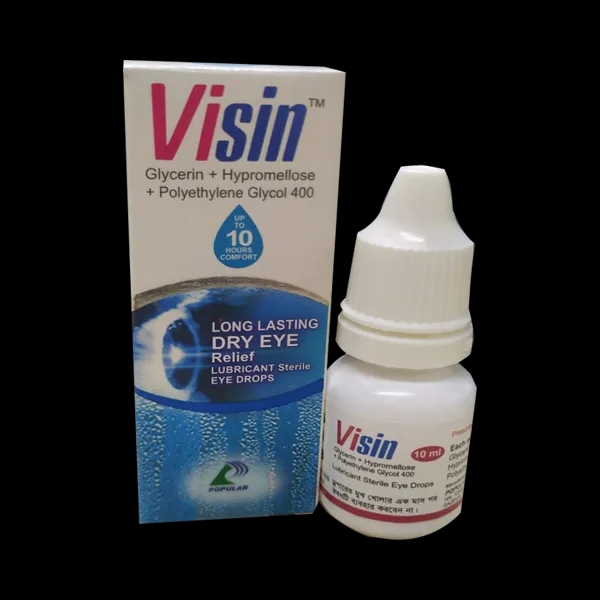
Visin0.2%+0.36%
Popular Pharmaceuticals Ltd.
৳230.00
Add to cart


Oculax is an ophthalmic lubricant (artificial tears) combination indicated for:
This is a symptomatic, supportive therapy; it does not treat the underlying cause of dry eye disease and does not replace evaluation for persistent or worsening symptoms.
Each mL of ophthalmic solution contains Glycerol (glycerin), Hypromellose (hydroxypropyl methylcellulose), and Polyethylene Glycol 400 as the active demulcent/lubricating ingredients, in an isotonic buffered aqueous vehicle, with or without a preservative depending on the specific product presentation (single-dose preservative-free units are available for frequent use or sensitive eyes).
Oculax is a fixed-dose combination ophthalmic lubricant used as artificial tears. Glycerol is a humectant demulcent, Hypromellose is a viscosity-increasing cellulose polymer, and Polyethylene Glycol 400 is a water-soluble demulcent polymer; together they form a stable, viscous tear-film substitute that coats the ocular surface, reduces friction between the eyelid and cornea, and slows evaporative tear loss.
It is classified as an over-the-counter (OTC) ophthalmic demulcent product used for the symptomatic management of dry eye and minor ocular irritation.
Ophthalmic lubricant / demulcent (artificial tears); Oculax belongs to the class of ocular surface lubricants used for dry eye and irritation relief.
Glycerol + Hypromellose + Polyethylene Glycol 400 acts locally on the ocular surface with no intended systemic pharmacologic action.
Together, these agents stabilize the pre-corneal tear film, reduce surface friction and desiccation, and provide symptomatic relief without significant systemic absorption when used as directed.
Oculax is dosed as follows:
| Population | Dose | Frequency |
|---|---|---|
| Adults | 1-2 drops in the affected eye(s) | As needed, typically 3-4 times daily or more frequently if required |
| Children | 1-2 drops in the affected eye(s) | As needed under adult supervision; consult a physician for use in young children |
Shake the bottle gently before use if indicated on the product label. Tilt the head back, pull down the lower eyelid to form a small pocket, instill the drop(s), and close the eye gently for 1-2 minutes. Avoid touching the dropper tip to the eye or any surface to prevent contamination.
For ophthalmic (topical eye) use only. Wash hands before use. Instill directly into the conjunctival sac of the affected eye(s). Do not inject or take by any other route. If using other eye drops or ointments concurrently, space administration by at least 5-10 minutes and use this product last if an ointment is involved.
Oculax has minimal potential for clinically significant drug interactions due to negligible systemic absorption.
Glycerol + Hypromellose + Polyethylene Glycol 400 is contraindicated in patients with known hypersensitivity to glycerol, hypromellose, polyethylene glycol 400, or any other component of the formulation.
Oculax is generally very well tolerated, as it is minimally to not systemically absorbed. Reported effects are typically local and transient:
If eye pain, marked redness, vision changes, or discomfort persists beyond 72 hours or worsens, discontinue use and seek medical advice (see Precautions).
There are no well-controlled studies specifically evaluating Oculax in pregnancy or lactation. Because ocular administration results in minimal to negligible systemic absorption, the risk to a fetus or breastfeeding infant is expected to be very low; however, as a general precaution, pregnant or breastfeeding women should use this product only if clearly needed and should consult a physician or pharmacist before use.
Observe the following precautions when using Oculax:
Ocular overdose (excessive instillation) of Oculax is unlikely to cause serious harm and may cause transient blurred vision or watering of the eye; simply blot away the excess. If the product is accidentally swallowed in significant quantity, or if a severe or unexpected reaction occurs, seek immediate medical attention or contact a poison control center/emergency services rather than attempting home treatment.
Store at room temperature (below 30°C), away from light and moisture. Keep out of reach of children. Discard the bottle after the period stated on the label following first opening (do not use beyond the labeled in-use period), and discard single-dose preservative-free units immediately after use.
Contact lens wearers: Remove lenses before use unless the product is specifically labeled as lens-compatible; see Precautions.
Elderly: No special dose adjustment is required; age-related dry eye is a common indication for use.
Renal or hepatic impairment: No dose adjustment is necessary, as systemic absorption of Oculax is negligible with ocular use.
Pregnancy and lactation: See Pregnancy and Lactation section above.
May be used as needed for symptomatic relief of dry eye and ocular irritation, including on a long-term, as-needed basis for chronic dry eye. If symptoms do not improve, or if eye pain, vision changes, or redness persist beyond 72 hours or worsen at any time, discontinue use and consult a physician.
Ophthalmic demulcent / lubricant (artificial tears) combination.
Glycerol + Hypromellose + Polyethylene Glycol 400 works by combining a humectant (glycerol), a viscosity-enhancing polymer (hypromellose), and a water-soluble demulcent (polyethylene glycol 400) to form a stable, lubricating film over the ocular surface. This film reduces friction from blinking, slows evaporation of the natural tear film, and helps retain moisture, thereby relieving the burning, irritation, and foreign-body sensation associated with dry eye.
Ophthalmic lubricants such as Oculax are commonly used in children for dry eye or ocular irritation under adult supervision; however, formal safety and efficacy data in young children (particularly infants) are limited, and formal age-based labeling varies by product. Use in children, especially those under 2 years of age, should be under the guidance of a physician. Follow the same instillation technique as for adults and avoid contamination of the dropper tip.
Q: What is Oculax 0.2%+0.36%+1% Ophthalmic Solution used for?
A: Oculax 0.2%+0.36%+1% Ophthalmic Solution is an artificial tears eye drop used for temporary relief of burning, irritation, and discomfort caused by dryness of the eye, and for protecting the eye from further irritation due to wind, sun, or prolonged screen use.
Q: Can I use Oculax 0.2%+0.36%+1% Ophthalmic Solution while wearing contact lenses?
A: Remove your contact lenses before using Oculax 0.2%+0.36%+1% Ophthalmic Solution unless the specific product you have is labeled as safe for use with lenses in place. Wait as directed on the product label before reinserting your lenses.
Q: How often can I use Oculax 0.2%+0.36%+1% Ophthalmic Solution?
A: Typically 1-2 drops in the affected eye(s), 3-4 times daily or as needed for symptom relief, unless your physician or the product label directs otherwise. Preservative-free single-dose units may be used more frequently.
Q: Is Oculax 0.2%+0.36%+1% Ophthalmic Solution safe during pregnancy or breastfeeding?
A: Systemic absorption from eye drops is minimal, so risk is expected to be very low, but as a precaution pregnant or breastfeeding women should use Oculax 0.2%+0.36%+1% Ophthalmic Solution only if clearly needed and should consult a physician or pharmacist first.
Q: What should I do if my eye symptoms do not improve?
A: If eye pain, vision changes, or redness persists beyond 72 hours of using Oculax 0.2%+0.36%+1% Ophthalmic Solution, or worsens at any time, stop using the product and consult a physician, as this may indicate a condition requiring different treatment.
Q: What if I accidentally use more drops than recommended?
A: Using extra drops of Oculax 0.2%+0.36%+1% Ophthalmic Solution is unlikely to be harmful and may just cause temporary blurred vision or watering; simply blot the excess. If the liquid is swallowed in a large amount or you notice a severe reaction, seek immediate medical attention or contact a poison control center.
Disclaimer
The information provided is accurate to the best of our knowledge, but it does not replace professional medical advice. We cannot guarantee its completeness or accuracy, and the absence of specific information about a drug should not be taken as an endorsement. We are not responsible for any consequences arising from this information, so please consult a healthcare professional for any concerns or questions.