8% Off
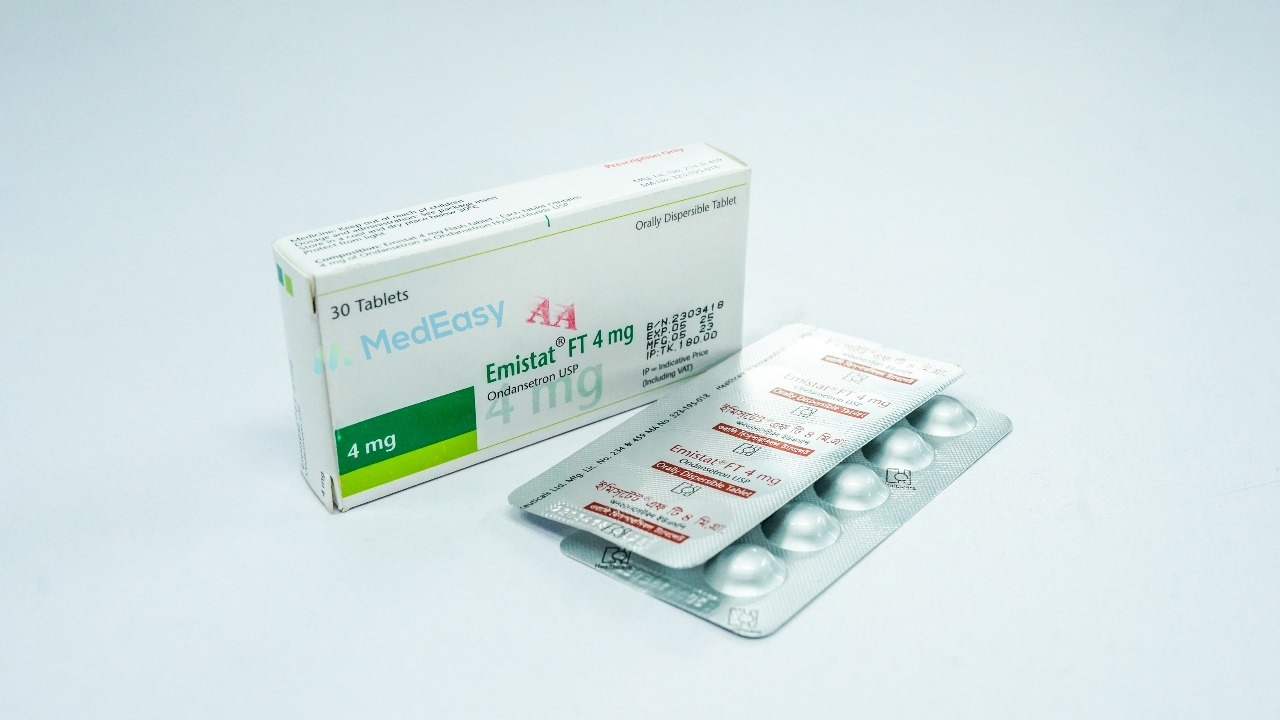
Emistat FT4 mg
Healthcare Pharmaceuticals Ltd.
৳55.20
Add to cart


Onaseron ODT is not indicated for routine prevention or treatment of nausea unrelated to the above settings.
Ondansetron is available (as ondansetron or ondansetron hydrochloride) in several dosage forms and strengths, including:
Exact available strengths and formulations may vary by manufacturer and market.
Onaseron ODT is a selective serotonin 5-HT3 receptor antagonist used mainly as an antiemetic to preventand treat nausea and vomiting associated with cancer chemotherapy, radiotherapy, and surgery. It works by blockingserotonin receptors both in the central nervous system (chemoreceptor trigger zone) and peripherally on vagal nerveendings in the gastrointestinal tract, interrupting the reflex pathway that triggers vomiting.
Onaseron ODT does not stimulate gastrointestinal motility and is not a substitute for nasogastricsuction where that is clinically indicated.
Antiemetic — Selective serotonin 5-HT3 receptor antagonist
Ondansetron is a potent, highly selective antagonist of the 5-HT3 (serotonin type 3) receptor. Cytotoxicchemotherapy and radiotherapy cause release of serotonin from enterochromaffin cells in the small intestine, whichstimulates vagal afferents via 5-HT3 receptors, triggering the vomiting reflex; Ondansetron blocks this pathway bothperipherally and centrally at the chemoreceptor trigger zone. Ondansetron has no effect on dopamine receptors anddoes not have significant prokinetic activity.
| Population | Regimen |
|---|---|
| Adults (highly emetogenic chemotherapy) | 0.15 mg/kg IV (up to 3 doses) or a single 24 mg oral dose (as three 8 mg tablets), given 30 minutes before chemotherapy |
| Adults (moderately emetogenic chemotherapy) | 8 mg orally 30 minutes before chemotherapy, then 8 mg 8 hours later; continue 8 mg twice daily for 1–2 days after chemotherapy if needed |
| Children 4–11 years | 4 mg orally three times daily (before, and 4 and 8 hours after chemotherapy) |
| Children ≥12 years | Same as adult moderately-emetogenic regimen |
| Children 6 months–18 years (IV, per approved pediatric regimen) | 0.15 mg/kg per dose IV, up to 3 doses, maximum 16 mg per single dose |
8 mg orally 1–2 hours before each fraction of radiotherapy; for total body irradiation, 8 mg every 8 hours; treatment may continue for up to 5 days after completion of a course, depending on regimen.
| Population | Dose |
|---|---|
| Adults (prevention) | 16 mg orally 1 hour before induction of anaesthesia, OR 4 mg IV/IM as a single dose at induction |
| Adults (treatment of established PONV) | 4 mg IV/IM as a single dose |
| Children >40 kg | 4 mg IV, single dose |
| Children ≤40 kg | 0.1 mg/kg IV, single dose |
No dosage adjustment is generally required.
In severe hepatic impairment, total daily dose should not exceed 8 mg.
See Administration for how to take each formulation, and Use in Special Populations for further detail on pediatric, elderly, renal, and hepatic dosing considerations.
Onaseron ODT should be used during pregnancy only if clearly needed and if the potential benefit justifies thepotential risk to the fetus; a physician should always be consulted before use in pregnancy. Some observationalstudies have suggested a small increased risk of certain birth defects (such as orofacial clefts) with first-trimesteruse of Onaseron ODT, although data are not entirely consistent and a definite causal relationship has not beenestablished. Animal reproduction studies have not shown harm to the fetus, but adequate, well-controlled studies inpregnant women are limited.
Onaseron ODT is excreted in animal breast milk; it is not known whether it is excreted in human breast milk.Caution is advised, and a physician should be consulted to weigh the benefits of treatment against any potential riskto a breastfeeding infant.
There is no specific antidote for Onaseron ODT overdose. Reported effects of overdose include sudden transientblindness, severe constipation, hypotension, and a vasovagal episode with transient second-degree AV block; QTprolongation has also been reported. If overdose is suspected, seek immediate medical attention or contact a poisoncontrol center; management is supportive and symptomatic, with ECG monitoring where appropriate. Do not attemptspecific home treatment for a suspected overdose of Onaseron ODT.
Store at room temperature (below 30°C), away from light and moisture. Keep out of reach of children.
Duration depends on indication: for chemotherapy- or radiotherapy-induced nausea, Onaseron ODT is typicallyused for the day(s) of treatment and for 1–2 days afterward as needed, following the specific regimen prescribed. Forpostoperative nausea and vomiting, a single dose is usually sufficient. Onaseron ODT is not intended for long-termcontinuous use; if nausea persists beyond the expected course, the patient should be reassessed by a physician.
Serotonin 5-HT3 receptor antagonists (antiemetics)
Ondansetron selectively and competitively blocks 5-HT3 receptors located on vagal afferent nerve terminals inthe gut and in the area postrema/chemoreceptor trigger zone of the brainstem. By preventing serotonin (released fromenterochromaffin cells during chemotherapy, radiotherapy, or surgical stimulation) from activating these receptors,Ondansetron interrupts the afferent signalling that would otherwise trigger the vomiting reflex, thereby preventingor reducing nausea and vomiting.
B
Onaseron ODT is approved for prevention of chemotherapy-induced nausea and vomiting in children 6 months ofage and older, with dosing based on age/weight as detailed in Dosage and Administration. It is also used forprevention and treatment of postoperative nausea and vomiting in children, with data supporting use from about 1 monthof age for this indication in some formulations, though data are more limited than in adults. Onaseron ODT issometimes used off-label for nausea and vomiting due to acute gastroenteritis in children, per clinical judgment andlocal guidelines. Safety and efficacy of Onaseron ODT have not been established below the studied age thresholdsfor each indication, and a pediatrician should guide use in young children.
Q: What is Onaseron ODT 4 mg Tablet used for?
A: Onaseron ODT 4 mg Tablet is used to prevent and treat nausea and vomiting caused by cancer chemotherapy, radiotherapy, and surgery. It is sometimes used off-label for other causes of nausea, such as gastroenteritis, based on clinical judgment.
Q: Can I take Onaseron ODT 4 mg Tablet during pregnancy?
A: Onaseron ODT 4 mg Tablet should only be used in pregnancy if clearly needed, since some studies have suggested a small increased risk of certain birth defects with first-trimester use, though this is not firmly established. Always consult your physician before using Onaseron ODT 4 mg Tablet if you are pregnant or trying to become pregnant.
Q: Who should not take Onaseron ODT 4 mg Tablet?
A: People with a known hypersensitivity to Onaseron ODT 4 mg Tablet or those taking apomorphine should not take Onaseron ODT 4 mg Tablet, because this combination can cause profound hypotension and loss of consciousness.
Q: What are the most common side effects of Onaseron ODT 4 mg Tablet?
A: The most common side effects of Onaseron ODT 4 mg Tablet are headache, constipation, diarrhea, and fatigue. Serious but rare effects include allergic reactions and changes in heart rhythm (QT prolongation), so tell your doctor about any heart conditions or medicines you take before starting Onaseron ODT 4 mg Tablet.
Q: Can Onaseron ODT 4 mg Tablet be given to children?
A: Yes, Onaseron ODT 4 mg Tablet is approved for prevention of chemotherapy-induced nausea and vomiting in children 6 months and older, and for postoperative nausea and vomiting in children, using age/weight-based dosing. Safety in younger infants has not been established, so a pediatrician should supervise use.
Q: What should I do if I miss a dose or suspect an overdose of Onaseron ODT 4 mg Tablet?
A: If a scheduled dose of Onaseron ODT 4 mg Tablet is missed, take it as soon as remembered unless it is nearly time for the next dose. If an overdose of Onaseron ODT 4 mg Tablet is suspected, seek immediate medical attention or contact a poison control center, since effects such as visual disturbance, severe constipation, or heart rhythm changes have been reported.
Disclaimer
The information provided is accurate to the best of our knowledge, but it does not replace professional medical advice. We cannot guarantee its completeness or accuracy, and the absence of specific information about a drug should not be taken as an endorsement. We are not responsible for any consequences arising from this information, so please consult a healthcare professional for any concerns or questions.