
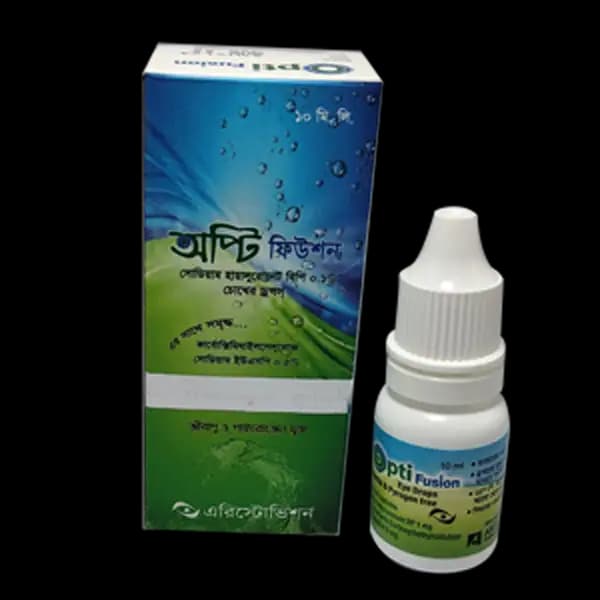

Medicine overview
Indications of Opti Fusion
Opti Fusion is a combination viscoelastic and lubricant preparation formulated in two distinct product types with different, well-established uses:
Ophthalmic lubricant (eye drops)
- Symptomatic relief of dry eye, ocular irritation, burning, and foreign-body sensation caused by insufficient tear production (established, widely used over-the-counter indication).
- Temporary relief of eye discomfort due to minor irritants such as wind, sun exposure, or prolonged screen use.
Surgical anti-adhesion barrier/gel
- Adjunct during open or laparoscopic abdominal and pelvic surgery to reduce the incidence, extent, and severity of post-operative adhesion formation between tissue surfaces (label/guideline-supported use; efficacy varies by surgical site and technique, used as an adjunct to, not a replacement for, good surgical technique).
Use Opti Fusion only for the specific formulation and indication for which it was prescribed or dispensed, since the ophthalmic drop and the surgical barrier are not interchangeable products.
Composition
Each formulation of Sodium Hyaluronate + Carboxymethylcellulose Sodium combines two viscoelastic polymers:
- Sodium Hyaluronate – a high-molecular-weight, naturally occurring polysaccharide that binds water and provides lubrication and viscoelasticity.
- Carboxymethylcellulose Sodium – a water-soluble cellulose derivative that adds viscosity, prolongs surface retention, and provides mechanical protection.
Ophthalmic formulations are typically supplied as sterile isotonic solutions (with or without preservative) in multi-dose bottles or preservative-free single-use vials. Surgical formulations are supplied as a sterile bioresorbable membrane/film or gel for intraoperative placement. Exact concentrations vary by brand and are specified on the product label.
Description
Opti Fusion is a combination of two high-molecular-weight, biocompatible polymers used for their lubricating and viscoelastic properties. As ophthalmic drops, it coats and lubricates the ocular surface, stabilizing the tear film and relieving symptoms of dryness. As a surgical bioresorbable barrier, it is placed between tissue surfaces during surgery to physically separate them while natural healing occurs, after which it is absorbed by the body over about one to four weeks. Opti Fusion does not have a pharmacologic (drug-receptor) mechanism of action; its benefit is mechanical/physical.
Therapeutic Class
Opti Fusion belongs to the class of ophthalmic lubricants/artificial tear preparations (for the eye-drop formulation) and to the class of surgical adhesion-prevention barriers/viscoelastic devices (for the surgical formulation). It is not an antibiotic, anti-inflammatory, or systemically acting drug.
Pharmacology
Sodium Hyaluronate + Carboxymethylcellulose Sodium acts through physical rather than pharmacological mechanisms:
- Ophthalmic use: the combined polymers increase tear film viscosity and residence time on the ocular surface, forming a protective, lubricating layer that reduces friction from blinking and relieves dryness-related irritation.
- Surgical use: when hydrated, the membrane forms a hydrophilic gel that physically separates injured tissue surfaces for approximately 5–7 days, the critical period of mesothelial repair, and is then hydrolyzed and cleared from the body within about 28 days, without eliciting a significant foreign-body or inflammatory reaction.
Dosage & Administration of Opti Fusion
Ophthalmic (eye drops)
Instill 1–2 drops into the affected eye(s) as needed for dryness/irritation, typically 3–4 times daily or as directed by the physician/product label; preservative-free single-use vials are generally used once and discarded.
Surgical anti-adhesion barrier
Opti Fusion in this form is applied intraoperatively by the surgeon directly onto the tissue surface(s) at risk of adhesion formation, after achieving hemostasis and before closure; it is not self-administered and has no patient-adjustable dose.
| Use | Typical regimen |
|---|---|
| Dry eye symptom relief | 1–2 drops per eye, 3–4 times daily or as needed |
| Surgical adhesion prevention | Single intraoperative application by the surgical team; amount depends on area to be covered |
Administration of Opti Fusion
Ophthalmic drops: wash hands before use, tilt the head back, gently pull down the lower eyelid, instill the drop(s) without letting the tip touch the eye or any surface, and close the eye gently for a moment. Contact lenses should generally be removed before instillation and only reinserted after the time specified on the product label, unless the specific product is labeled safe for use with lenses in place. The surgical form of Opti Fusion is administered only intraoperatively by a qualified surgeon under sterile conditions; it must never be self-administered.
Interaction of Opti Fusion
Opti Fusion has minimal systemic absorption and few clinically significant drug interactions.
- Other topical ophthalmic products: if using other eye drops, space administration by at least 5–10 minutes to avoid dilution/washout of either product; use the most viscous product last.
- Surgical barrier form: avoid placing intraperitoneal antibiotic solutions, povidone-iodine, or other irrigants in direct contact with the membrane immediately after placement, as this may cause premature dissolution and reduce efficacy.
No significant systemic drug-drug interactions have been established for Opti Fusion.
Contraindications
Sodium Hyaluronate + Carboxymethylcellulose Sodium is contraindicated in:
- Known hypersensitivity to sodium hyaluronate, carboxymethylcellulose sodium, or any excipient in the specific formulation.
For the surgical anti-adhesion barrier formulation specifically, it is additionally contraindicated:
- In the presence of active peritonitis, intra-abdominal abscess, or established intra-abdominal/pelvic infection.
- In areas of active bleeding, until hemostasis has been achieved.
Side Effects of Opti Fusion
Opti Fusion is generally well tolerated. Reported effects include:
Ophthalmic use
- Temporary blurred vision immediately after instillation
- Mild stinging, burning, or ocular irritation
- Eye redness or watering
- Rarely, hypersensitivity reactions (itching, swelling, allergic conjunctivitis)
Surgical barrier use
- Fever and localized abdominal/pelvic discomfort in the post-operative period
- Rarely, reports of anastomotic leak or abscess when the material was wrapped circumferentially around a fresh bowel anastomosis (label warns against this specific application)
- Rarely, foreign-body or inflammatory type reactions
Pregnancy & Lactation
Data specific to Opti Fusion in pregnancy and lactation are limited. Because systemic absorption is minimal (ophthalmic route) or the surgical barrier is used only when clinically indicated during a procedure, risk is expected to be low; however, as a general precaution, Opti Fusion should be used in pregnancy only if clearly needed and if the potential benefit justifies any potential risk, and a physician should be consulted. It is not known whether the components are excreted in human milk; caution is advised and a physician or pharmacist should be consulted before use during breastfeeding.
Precautions & Warnings
Before using Opti Fusion, consider the following:
- For ophthalmic use, remove contact lenses before instillation and reinsert only after the interval stated on the label, unless the product is specifically labeled safe for use with lenses in place.
- Vision may be temporarily blurred immediately after instillation; do not drive or operate machinery until vision clears.
- Preservative-containing multi-dose formulations may cause more irritation with frequent, long-term use than preservative-free single-use vials; discuss frequent use with a physician.
- Do not touch the applicator tip to the eye or any other surface to avoid contamination.
- Discontinue and consult a physician if eye pain, vision changes, redness, or irritation persists or worsens.
- The surgical anti-adhesion barrier form must be handled and placed only by trained surgical personnel under sterile conditions; it should not be used as a hemostatic agent and should not be left in contact with active bleeding.
- See Contraindications for absolute restrictions on the surgical formulation (active peritonitis, intra-abdominal infection/abscess, active bleeding).
Overdose Effects of Opti Fusion
Overdose with the ophthalmic form of Opti Fusion is unlikely to cause serious harm beyond transient blurred vision or irritation from excessive instillation; if a large amount is accidentally ingested or if the surgical form is used inappropriately, seek immediate medical attention or contact a poison control center/emergency services rather than attempting home treatment. Do not attempt to self-manage a suspected overdose or surgical misapplication without professional medical guidance.
Storage Conditions
Store at room temperature (below 30°C), away from light and moisture. Keep out of reach of children. Do not use the ophthalmic solution after the labeled discard period once opened, and discard preservative-free single-use vials after each use.
Use In Special Populations
Elderly: No dose adjustment is generally required for Opti Fusion; dry eye is common in this population and the ophthalmic form is commonly used.
Renal/hepatic impairment: No specific dose adjustment is established, given minimal systemic absorption.
Pregnancy/lactation: See Pregnancy and Lactation section.
Pediatric patients: See Pediatric Uses section.
Duration Of Treatment
The ophthalmic form of Opti Fusion may be used as needed for as long as dry eye symptoms persist; if symptoms do not improve within 72 hours, or if they worsen, a physician should be consulted. The surgical barrier form is used as a single intraoperative application and is not a repeated-use treatment course.
Drug Classes
Sodium Hyaluronate + Carboxymethylcellulose Sodium is classified under ophthalmic lubricants/artificial tears and surgical adhesion-barrier viscoelastic devices.
Mode Of Action
Sodium Hyaluronate + Carboxymethylcellulose Sodium works by physical/mechanical rather than pharmacologic action: the combined polymers increase viscosity and water retention, forming a lubricating film on the ocular surface (eye drops) or a temporary physical barrier between healing tissue surfaces (surgical form), which is later resorbed by the body.
Pediatric Uses
Safety and efficacy of the ophthalmic form of Opti Fusion have not been formally established in young children in controlled studies, although it is used clinically for dry eye symptoms in children under medical supervision when needed. The surgical anti-adhesion barrier form has been used in pediatric abdominal/pelvic surgery as an adjunct, but pediatric-specific outcome data are more limited than in adults; use should be guided by the operating surgeon's clinical judgment.
Frequently Asked Questions
Q: What is Opti Fusion 0.1%+0.5% Ophthalmic Solution used for?
A: Opti Fusion 0.1%+0.5% Ophthalmic Solution is used as lubricating eye drops for dry eye symptom relief, and in a separate surgical formulation, as a barrier placed during abdominal or pelvic surgery to help reduce post-operative tissue adhesions.
Q: Can I use Opti Fusion 0.1%+0.5% Ophthalmic Solution eye drops with contact lenses?
A: Contact lenses should generally be removed before instilling Opti Fusion 0.1%+0.5% Ophthalmic Solution eye drops and reinserted only after the time stated on the product label, unless the specific product is labeled safe for use with lenses in place.
Q: Is Opti Fusion 0.1%+0.5% Ophthalmic Solution safe during pregnancy?
A: Opti Fusion 0.1%+0.5% Ophthalmic Solution should be used during pregnancy only if clearly needed and if the potential benefit justifies any potential risk; a physician should be consulted before use, as dedicated safety data are limited.
Q: What are the common side effects of Opti Fusion 0.1%+0.5% Ophthalmic Solution?
A: The most common effects are temporary blurred vision right after using the eye drops, and mild stinging, burning, or redness. The surgical barrier form may rarely cause fever, localized discomfort, or, if used against surgical instructions, wound-healing complications.
Q: Who should not use Opti Fusion 0.1%+0.5% Ophthalmic Solution?
A: Anyone with known hypersensitivity to sodium hyaluronate, carboxymethylcellulose sodium, or related excipients should not use Opti Fusion 0.1%+0.5% Ophthalmic Solution. The surgical barrier form must not be used in patients with active peritonitis, intra-abdominal abscess/infection, or in areas of active bleeding.
Q: What should I do if I accidentally use too much Opti Fusion 0.1%+0.5% Ophthalmic Solution?
A: Excess use of the eye-drop form is unlikely to cause serious harm, but if you have concerns, experience persistent symptoms, or a large amount is swallowed, seek immediate medical attention or contact a poison control center rather than treating it at home.
Disclaimer
The information provided is accurate to the best of our knowledge, but it does not replace professional medical advice. We cannot guarantee its completeness or accuracy, and the absence of specific information about a drug should not be taken as an endorsement. We are not responsible for any consequences arising from this information, so please consult a healthcare professional for any concerns or questions.
