
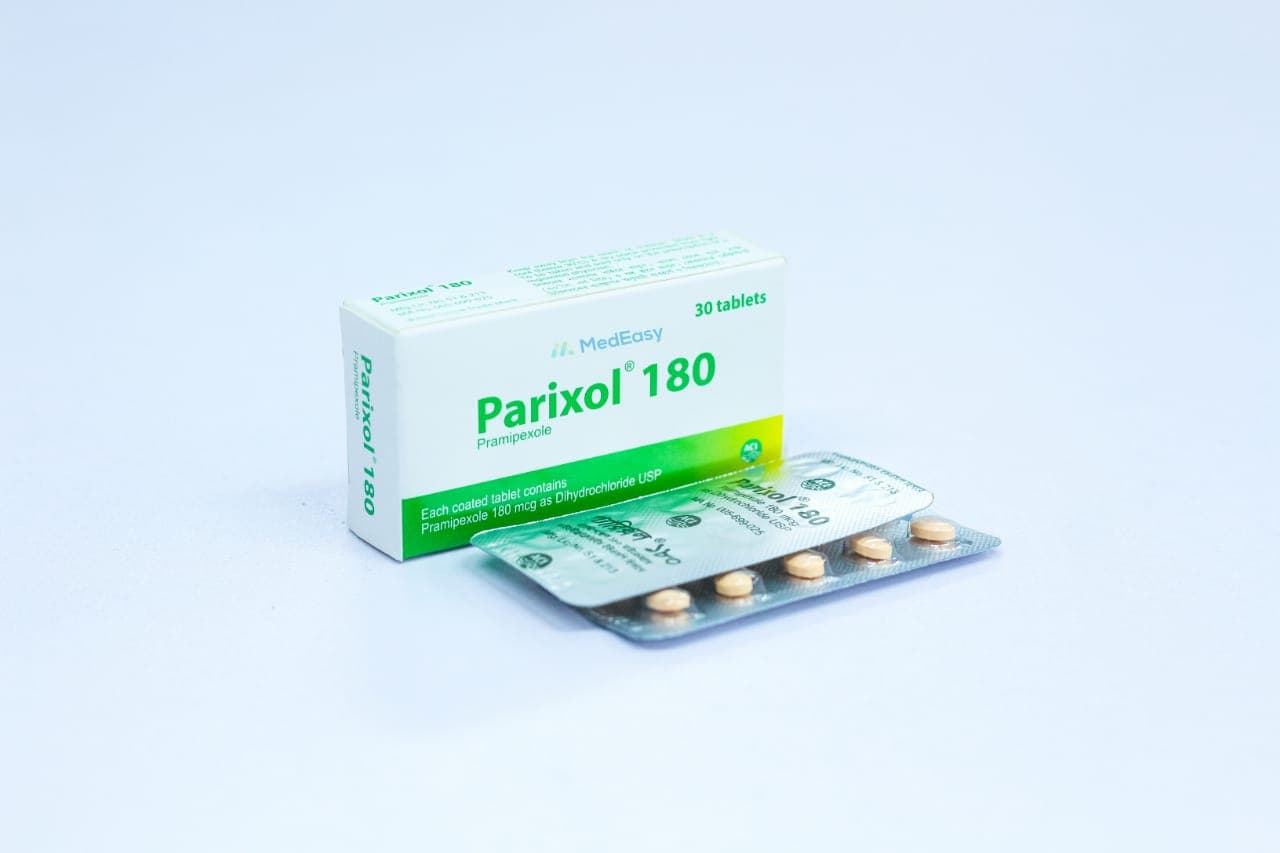

Medicine overview
Indications of Parixol
Parixol is a non-ergot dopamine agonist used in the following settings:
Established / FDA-approved uses
- Idiopathic Parkinson's disease - as monotherapy in early disease, or in combination with levodopa in more advanced disease to reduce "off" time and improve motor fluctuations.
- Moderate-to-severe primary Restless Legs Syndrome (RLS) - immediate-release Parixol only; the extended-release formulation is not approved for RLS.
Not established / not recommended
- Parixol is not indicated for drug-induced or secondary parkinsonism, and evidence supporting use outside the above two indications is insufficient; it should not be used off-label without specialist guidance.
Composition
Each tablet contains Pramipexole (as pramipexole dihydrochloride monohydrate) in strengths typically ranging from 0.125 mg to 1.5 mg (salt form) for immediate-release tablets, equivalent to approximately 0.088 mg to 1.1 mg of Pramipexole base. Extended-release strengths are also available in some markets. Exact available strengths vary by manufacturer.
Description
Parixol is a non-ergoline (non-ergot) dopamine agonist with high relative in-vitrospecificity and full intrinsic activity at the D2 subfamily of dopamine receptors, preferentiallybinding to the D3 receptor subtype. It is used to manage the motor symptoms of Parkinson's disease andto relieve the uncomfortable sensations and urge to move associated with moderate-to-severe primaryRestless Legs Syndrome. Parixol is administered orally and is eliminated predominantly unchanged by the kidneys.
Therapeutic Class
Antiparkinsonian agent; Non-ergot dopamine receptor agonist
Pharmacology
Mechanism of action
Pramipexole binds with high selectivity and full intrinsic activity to the D2 subfamily ofdopamine receptors, with preferential affinity for the D3 receptor. Its antiparkinsonian action is thoughtto result from stimulation of dopamine receptors in the striatum; its effect on restless legs syndromeis believed to occur through dopaminergic mechanisms, though the precise site of action is not fully established.
Pharmacokinetics
- Absorption: rapidly and completely absorbed orally, with absolute bioavailability greater than 90%; food does not affect the extent of absorption but may delay time to peak concentration.
- Distribution: low plasma protein binding (approximately 15%); large volume of distribution.
- Metabolism: undergoes minimal hepatic metabolism.
- Elimination: approximately 90% of a dose is excreted unchanged in urine; elimination half-life is roughly 8 hours in young adults and about 12 hours in the elderly, prolonged further in renal impairment.
Dosage & Administration of Parixol
Parkinson's disease (immediate-release tablets)
| Week | Dose |
|---|---|
| Week 1 | 0.125 mg three times daily |
| Week 2 | 0.25 mg three times daily |
| Week 3 | 0.5 mg three times daily |
Dose may be titrated further at weekly intervals based on response and tolerability, up to a maximumof 4.5 mg per day (1.5 mg three times daily). Parixol should be tapered gradually rather than stopped abruptly (see Precautions).
Restless Legs Syndrome (immediate-release tablets only)
Initial dose: 0.125 mg once daily, taken 2-3 hours before bedtime. If needed, the dose may be increasedevery 4-7 days, up to a maximum of 0.5 mg/day. Doses higher than those used for RLS trials have not shownadded benefit and increase the risk of augmentation (see Precautions).
Renal impairment
| Creatinine clearance | Parkinson's disease dosing |
|---|---|
| ≥60 mL/min | Standard dosing/titration |
| 35-59 mL/min | Reduced starting dose and slower titration; twice-daily dosing may be used |
| 15-34 mL/min | Further reduced dose; once-daily dosing recommended |
Use in severe renal impairment and dialysis has not been well studied; dose individualization underphysician supervision is required. For RLS, a lower starting dose is also advised in moderate-to-severe renal impairment.
Missed dose / discontinuation
If a dose of Parixol is missed, it should generally be skipped and the next dose taken at the usual timerather than doubling up, unless a physician advises otherwise. Parixol must never be stopped abruptly (see Precautions).
Administration of Parixol
- Parixol immediate-release tablets may be taken with or without food; taking with food may reduce nausea.
- Extended-release tablets, where prescribed, must be swallowed whole and must not be crushed, chewed, or divided.
- Take at approximately the same times each day.
- Do not stop Parixol suddenly without consulting a physician; the dose must be tapered gradually.
Interaction of Parixol
- Dopamine antagonists (e.g., antipsychotics, metoclopramide): may reduce the effectiveness of Parixol; concurrent use is generally avoided.
- Cimetidine and other drugs handled by the renal organic cation transporter (OCT2): may reduce renal clearance of Parixol and increase its plasma concentration by roughly 50%, requiring possible dose adjustment.
- CNS depressants and alcohol: additive sedative effects; concurrent use increases the risk of somnolence and sudden sleep episodes.
- Levodopa: when combined, dose reduction of levodopa may be needed as dyskinesia can be increased or precipitated; combination is nonetheless a recognized treatment strategy in advancing Parkinson's disease.
Contraindications
Pramipexole is contraindicated only in patients with known hypersensitivity to Pramipexole or any component of the formulation.There are no other well-established absolute contraindications; conditions such as renal impairment, elderly age,or history of psychiatric symptoms require caution and dose adjustment rather than avoidance (see Precautions and Use in Special Populations).
Side Effects of Parixol
Common side effects
- Nausea, dizziness, drowsiness/somnolence
- Constipation, dry mouth
- Insomnia, fatigue, headache
- Orthostatic hypotension, peripheral edema
- Hallucinations and confusion (more frequent in elderly patients)
Serious side effects (seek medical attention)
- Sudden onset of sleep during daily activities, including driving, without warning drowsiness
- New or worsening impulse control problems (compulsive gambling, hypersexuality, binge eating, compulsive shopping)
- Severe dyskinesia when used with levodopa
- Symptoms of dopamine agonist withdrawal or a neuroleptic malignant-like syndrome (fever, muscle rigidity, confusion) if Parixol is stopped abruptly
- Augmentation (earlier onset or worsening of restless legs symptoms) with long-term RLS treatment
Pregnancy & Lactation
Pregnancy: Animal reproduction studies with Parixol have shown adverse developmental effects atdoses relevant to human exposure, and there are no adequate and well-controlled studies in pregnant women.Parixol should be used during pregnancy only if the potential benefit justifies the potential risk to the fetus;a physician should always be consulted before use in pregnancy.
Lactation: Parixol, as a dopamine agonist, is expected to inhibit prolactin secretion and maysuppress lactation. Because of the potential for adverse effects on the nursing infant and on milk production,a decision should be made in consultation with a physician to discontinue Parixol or discontinue breastfeeding.
Precautions & Warnings
- Sudden onset of sleep: Patients treated with Parixol have reported falling asleep suddenly duringactivities of daily living, including driving, sometimes without any warning signs. Patients should be counseledbefore starting treatment and after dose increases, and should exercise caution when driving or operating machinery.
- Impulse control disorders: compulsive gambling, hypersexuality, binge eating, and compulsiveshopping have been reported. Patients and caregivers should be counseled to monitor for and report such behaviors;dose reduction or discontinuation may be required if they occur.
- Hallucinations and confusion: more common in elderly patients; use with caution and at thelowest effective dose in this population.
- Orthostatic hypotension: particularly at the start of treatment or after dose increases; monitor blood pressure.
- Dyskinesia: may occur or worsen when Parixol is used with levodopa; levodopa dose reduction may be needed.
- Augmentation in RLS: long-term use for restless legs syndrome may lead to augmentation(symptoms appearing earlier in the day, increasing in intensity, or spreading to other limbs); this requiresreassessment of dose and therapy.
- Renal impairment: Parixol is eliminated primarily by the kidneys; dose adjustment is required in renal impairment (see Dosage and Administration).
- Abrupt discontinuation: stopping Parixol suddenly can precipitate dopamine agonist withdrawalsyndrome or a neuroleptic malignant syndrome-like reaction (fever, muscle rigidity, altered consciousness); thedose must be tapered gradually under medical supervision.
Overdose Effects of Parixol
There is no specific antidote for Parixol overdose. Expected features relate to excessive dopaminergicstimulation and may include nausea, vomiting, dyskinesia, hallucinations, agitation, and hypotension.Anyone who has taken more than the prescribed dose of Parixol, or who shows signs of overdose, should seekimmediate medical attention or contact emergency services/poison control. Management in a hospital settingis supportive and symptomatic (general supportive measures, cardiac and vital sign monitoring); there is noestablished role for specific home treatment.
Storage Conditions
Store at room temperature (below 30°C), away from light and moisture. Keep out of reach of children.
Use In Special Populations
Renal impairment
Since Parixol is eliminated mainly by the kidneys, dose reduction and/or less frequent dosing is required inmoderate-to-severe renal impairment (see Dosage and Administration table); use in severe impairment or dialysisrequires individualized physician supervision.
Hepatic impairment
No dose adjustment is expected to be necessary in hepatic impairment, as Parixol undergoes minimal hepatic metabolism; however, formal studies are limited.
Elderly
Elderly patients have reduced renal clearance of Parixol and are more susceptible to hallucinations and confusion;treatment should generally start at the lower end of the dosing range.
Children
Safety and efficacy of Parixol have not been established in patients under 18 years of age (see Pediatric Uses).
Duration Of Treatment
Parixol is generally used long-term as chronic therapy for Parkinson's disease or restless legs syndrome, withthe dose individualized to the lowest effective amount. Response and side effects should be reassessed periodicallyby the treating physician; in RLS specifically, long-term use should be monitored for augmentation, which mayrequire a change in dose, timing, or therapy. Treatment should not be discontinued abruptly (see Precautions).
Drug Classes
Non-ergot dopamine agonist (D2/D3 receptor agonist); Antiparkinsonian agent
Mode Of Action
Pramipexole is a non-ergoline dopamine agonist that binds with high selectivity and full intrinsic activity to theD2 subfamily of dopamine receptors, showing preferential affinity for the D3 receptor subtype, and has littleor no affinity for non-dopaminergic receptors. In Parkinson's disease, stimulation of striatal dopamine receptorsby Pramipexole is believed to compensate for reduced endogenous dopamine, improving motor symptoms. In restless legssyndrome, dopaminergic stimulation is thought to relieve the sensory-motor symptoms, although the exact site andmechanism of action in RLS is not fully established.
Pregnancy
Category C
Pediatric Uses
The safety and efficacy of Parixol have not been established in pediatric patients (below 18 years of age)for either Parkinson's disease or restless legs syndrome, both of which are uncommon in this age group.Parixol is therefore not recommended for use in children, and pediatric dosing has not been defined.
Frequently Asked Questions
Q: What is Parixol 180 mcg Tablet used for?
A: Parixol 180 mcg Tablet is used to treat the motor symptoms of Parkinson's disease (alone or with levodopa) and to relieve moderate-to-severe primary Restless Legs Syndrome.
Q: How should I take Parixol 180 mcg Tablet?
A: Take Parixol 180 mcg Tablet exactly as prescribed, at the same times each day, with or without food. Do not stop taking it suddenly without talking to your doctor, since abrupt discontinuation can cause a withdrawal syndrome with fever and confusion.
Q: Can Parixol 180 mcg Tablet make me suddenly fall asleep?
A: Yes. Some patients taking Parixol 180 mcg Tablet have fallen asleep suddenly during daily activities, including driving, sometimes without warning. Use caution when driving or operating machinery, especially after starting treatment or increasing the dose.
Q: Can Parixol 180 mcg Tablet cause unusual urges or behaviors?
A: Yes. Parixol 180 mcg Tablet has been associated with impulse control problems such as compulsive gambling, hypersexuality, binge eating, or compulsive shopping. Tell your doctor immediately if you or your family notice these behaviors, as the dose may need to be reduced or the medicine stopped.
Q: Is Parixol 180 mcg Tablet safe during pregnancy or breastfeeding?
A: Parixol 180 mcg Tablet should be used in pregnancy only if the potential benefit justifies the potential risk to the baby, and only under medical supervision. It may also reduce breast milk production, so breastfeeding mothers should consult their physician before use.
Q: What should I do if I take too much Parixol 180 mcg Tablet?
A: An overdose of Parixol 180 mcg Tablet can cause nausea, vomiting, abnormal movements, hallucinations, and low blood pressure. Seek immediate medical attention or contact emergency services/poison control rather than trying to manage it at home.
Disclaimer
The information provided is accurate to the best of our knowledge, but it does not replace professional medical advice. We cannot guarantee its completeness or accuracy, and the absence of specific information about a drug should not be taken as an endorsement. We are not responsible for any consequences arising from this information, so please consult a healthcare professional for any concerns or questions.
