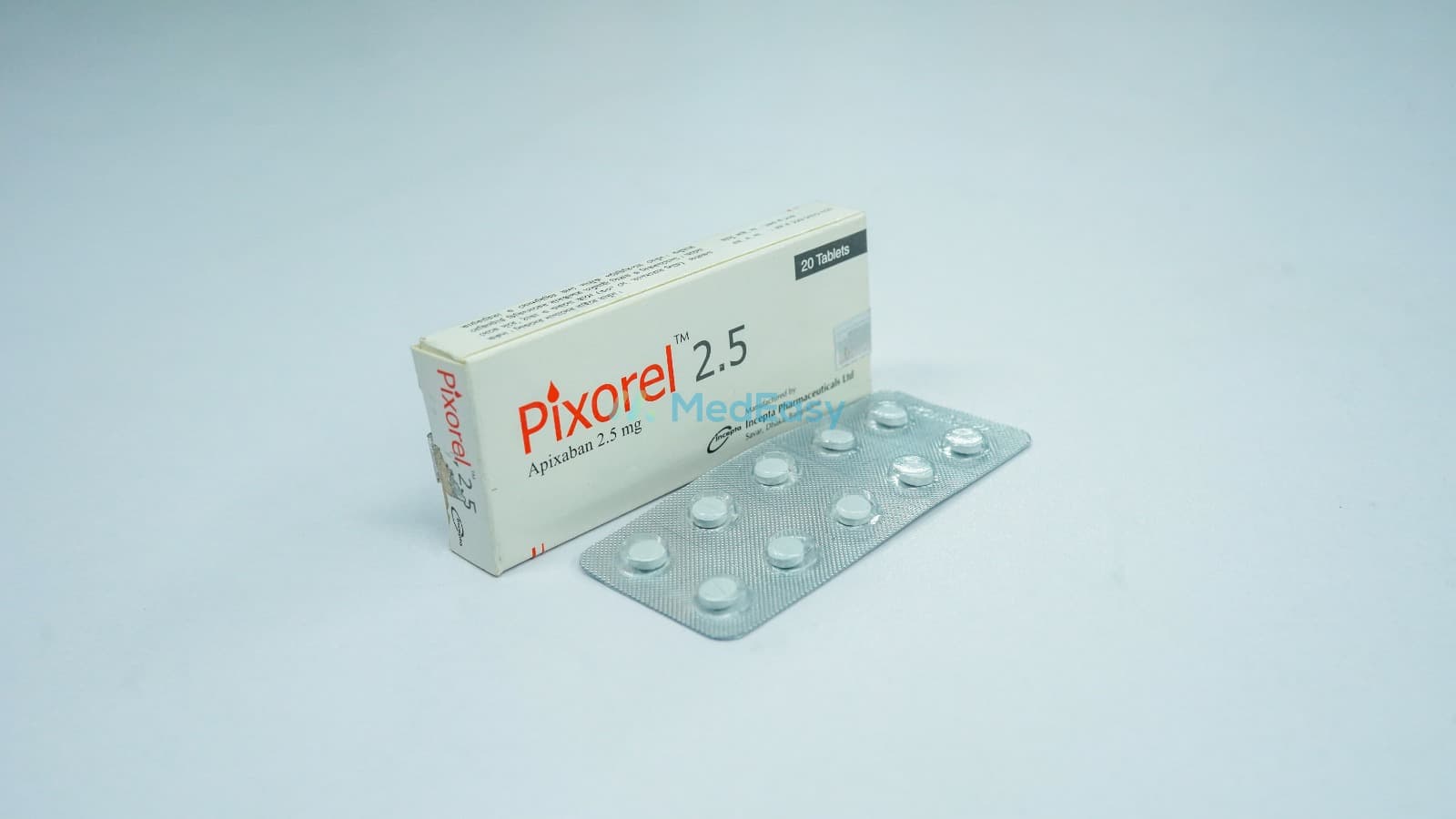
Pixorel 2.5 mg is a factor Xa inhibitor indicated:
To reduce the risk of stroke and systemic embolism in patients with nonvalvular atrial fibrillation
For the prophylaxis of deep vein thrombosis (DVT), which may lead to pulmonary embolism (PE), in patients who have undergone hip or knee replacement surgery ... Read morePixorel 2.5 mg is a factor Xa inhibitor indicated:
To reduce the risk of stroke and systemic embolism in patients with nonvalvular atrial fibrillation
For the prophylaxis of deep vein thrombosis (DVT), which may lead to pulmonary embolism (PE), in patients who have undergone hip or knee replacement surgery
For the treatment of DVT and PE, and for the reduction in the risk of recurrent DVT and PE following initial therapy
Pixorel 2.5 mg acts by inhibiting coagulation, and thus prevents development of blood clots. As a result of FXa inhibition, Pixorel 2.5 mg prolongs clotting tests such as prothrombin time (PT), INR, and activated partial thromboplastin time (aPTT). Changes observed in these clotting tests at the expected therapeutic dose, however, are small, subject to a high degree of variability, and not useful in monitoring the anticoagulation effect of Pixorel 2.5 mg.
Dosage & Administration of Pixorel 2.5 mg
Reduction of risk of stroke and systemic embolism in nonvalvular atrial fibrillation:
The recommended dose: 5 mg orally twice daily.
In patients with at least 2 of the following characteristics: age greater than or equal to 80 years, body weight less than or equal to 60 kg, or serum creatinine greater than or equal to 1.5 mg/dL, the recommended dose is 2.5 mg orally twice daily.
Prophylaxis of DVT following hip or knee replacement surgery: The recommended dose is 2.5 mg orally twice daily.Treatment of DVT and PE: The recommended dose is 10 mg taken orally twice daily for 7 days, followed by 5 mg taken orally twice daily.Reduction in the risk of recurrent DVT and PE following initial therapy: The recommended dose is 2.5 mg taken orally twice daily.
Dosage of Pixorel 2.5 mg
Recommended Dose: The recommended dose of Pixorel 2.5 mg for most patients is 5 mg taken orally twice daily.Dosage Adjustments: The recommended dose of Pixorel 2.5 mg is 2.5 mg twice daily in patients with any 2 of the following characteristics: age ≥80 years, body weight ≤60 kg, serum creatinine ≥1.5mg/dl.CYP3A4 and P-gp inhibitors: When Pixorel 2.5 mg is coadministered with drugs that are strong dual inhibitors of cytochrome P450 3A4 (CYP3A4) and P-glycoprotein (P-gp) (e.g. ketoconazole, itraconazole, ritonavir, clarithromycin) the recommended dose is 2.5 mg twice daily.Missed Dose: If a dose of Pixorel 2.5 mg is not taken at the scheduled time, the dose should be taken as soon as possible on the same day and twice-daily administration should be resumed. The dose should not be doubled to make up for a missed dose.Discontinuation for Surgery and Other Interventions: Pixorel 2.5 mg should be discontinued at least 48 hours prior to elective surgery or invasive procedures with a moderate or high risk of unacceptable or clinically significant bleeding. Pixorel 2.5 mg should be discontinued at least 24 hours prior to elective surgery or invasive procedures with a low risk of bleeding or where the bleeding would be non-critical in location and easily controlled.Switching from or to Pixorel 2.5 mg: Switching from warfarin to Pixorel 2.5 mg: Warfarin should be discontinued and Pixorel 2.5 mg started when the international normalized ratio (INR) is below 2.0.Switching from Pixorel 2.5 mg to warfarin: Pixorel 2.5 mg affects INR, so that INR measurements during co-administration with warfarin may not be useful for determining the appropriate dose of warfarin. If continuous anticoagulation is necessary, discontinue Pixorel 2.5 mg and begin both a parenteral anticoagulant and warfarin at the time the next dose of Pixorel 2.5 mg would have been taken, discontinuing the parenteral anticoagulant when INR reaches an acceptable range.Switching between Pixorel 2.5 mg and anticoagulants other than warfarin: Discontinue one being taken and begin the other at the next scheduled dose.
Interaction of Pixorel 2.5 mg
Pixorel 2.5 mg is a substrate of both CYP3A4 and P-gp. Inhibitors of CYP3A4 and P-gp increase exposure to Pixorel 2.5 mg and increase the risk of bleeding. Inducers of CYP3A4 and P-gp decrease exposure to Pixorel 2.5 mg and increase the risk of stroke.
Contraindications
Pixorel 2.5 mg is contraindicated in patients with the following conditions: Active pathological bleeding. Severe hypersensitivity reaction to Pixorel 2.5 mg (i.e. anaphylactic reactions).
Side Effects of Pixorel 2.5 mg
Pixorel 2.5 mg can cause a skin rash or severe allergic reaction.
Pregnancy & Lactation
Pregnancy Category B. There are no adequate and well-controlled studies of Pixorel 2.5 mg in pregnant women. Treatment is likely to increase the risk of hemorrhage during pregnancy and delivery. Pixorel 2.5 mg should be used during pregnancy only if the potential benefit outweighs the potential risk to the mother and fetus. Treatment of pregnant rats, rabbits, and mice after implantation until the end of gestation resulted in fetal exposure to Pixorel 2.5 mg, but was not associated with increased risk for fetal malformations or toxicity. No maternal or fetal deaths were attributed to bleeding. Increased incidence of maternal bleeding was observed in mice, rats, and rabbits at maternal exposures that were 19, 4, and 1 times, respectively, the human exposure of unbound drug, based on area under plasma-concentration time curve (AUC) comparisons at the maximum recommended human dose (MRHD) of 10 mg (5 mg twice daily).Nursing Mothers: It is unknown whether Pixorel 2.5 mg or its metabolites are excreted in human milk. Rats excrete Pixorel 2.5 mg in milk (12% of the maternal dose). Women should be instructed either to discontinue breastfeeding or to discontinue Pixorel 2.5 mg therapy, taking into account the importance of the drug to the mother.
Precautions & Warnings
Increased Risk of Stroke with Discontinuation of Pixorel 2.5 mg Discontinuing Pixorel 2.5 mg in the absence of adequate alternative anticoagulation increases the risk of thrombotic events. An increased rate of stroke was observed during the transition from Pixorel 2.5 mg to warfarin in clinical trials in patients with nonvalvular atrial fibrillation. If Pixorel 2.5 mg must be discontinued for a reason other than pathological bleeding, consider coverage with another anticoagulant.
Overdose Effects of Pixorel 2.5 mg
There is no antidote to Pixorel 2.5 mg. Overdose of Pixorel 2.5 mg increases the risk of bleeding. Activated charcoal may be useful in the management of Pixorel 2.5 mg overdose.
Storage Conditions
Keep in a dry place and store below 30°C. Protect from light and keep out of the reach of children.
Use In Special Populations
Pediatric Use: Safety and effectiveness in pediatric patients have not been established.
Pixorel 2.5 mg acts by inhibiting coagulation, and thus prevents development of blood clots. As a result of FXa inhibition, Pixorel 2.5 mg prolongs clotting tests such as prothrombin time (PT), INR, and activated partial thromboplastin time (aPTT). Changes observed in these clotting tests at the expected therapeutic dose, however, are small, subject to a high degree of variability, and not useful in monitoring the anticoagulation effect of Pixorel 2.5 mg.
Pregnancy
Pregnancy: There are no adequate and well-controlled studies of Pixorel 2.5 mg in pregnant women. Treatment is likely to increase the risk of hemorrhage during pregnancy and delivery. Pixorel 2.5 mg should be used during pregnancy only if the potential benefit outweighs the potential risk to the mother and fetus.Labor and Delivery: Safety and effectiveness of Pixorel 2.5 mg during labor and delivery have not been studied in clinical trials. Consider the risks of bleeding and of stroke in using Pixorel 2.5 mg in this condition.Nursing Mothers: It is unknown whether Pixorel 2.5 mg or its metabolites are excreted in human milk. Women should be instructed either to discontinue breastfeeding or to discontinue Pixorel 2.5 mg therapy, taking into account the importance of the drug to the mother.
Pediatric Uses
Hepatic Impairment: No dose adjustment is required in patients with mild hepatic impairment. Because patients with moderate hepatic impairment may have intrinsic coagulation abnormalities and there is limited clinical experience with Pixorel 2.5 mg in these patients, dosing recommendations cannot be provided Pixorel 2.5 mg is not recommended in patients with severe hepatic impairment Renal Impairment: The dosing adjustment for moderate renal impairment is described above. No data inform use in patients with creatinine clearance <15 ml/min or on dialysis. Pediatric Use: Safety and effectiveness in pediatric patients have not been established.Geriatric Use: Of the total subjects in clinical studies of Pixorel 2.5 mg, >69% were 65 and older, and >31% were 75 and older. The effects of Pixorel 2.5 mg on the risk of stroke and major bleeding compared to warfarin were maintained in geriatric subjects.
Frequently Asked Questions
What is Pixorel 2.5 mg used for?
Pixorel 2.5 mg is a factor Xa inhibitor indicated: To reduce the risk of stroke and systemic embolism in patients with nonvalvular atrial fibrillation For the prophylaxis of deep vein thrombosis (DVT), which may lead to pulmonary embolism (PE), in patients who have undergone hip or knee replacement surgery ... Read morePixorel 2.5 mg is a factor Xa inhibitor indicated: To reduce the risk of stroke…
What is the dosage of Pixorel 2.5 mg?
Recommended Dose: The recommended dose of Pixorel 2.5 mg for most patients is 5 mg taken orally twice daily.Dosage Adjustments: The recommended dose of Pixorel 2.5 mg is 2.5 mg twice daily in patients with any 2 of the following characteristics: age ≥80 years, body weight ≤60 kg, serum creatinine ≥1.5mg/dl.CYP3A4 and P-gp inhibitors: When Pixorel 2.5 mg is coadministered with drugs that are strong…
What are the side effects of Pixorel 2.5 mg?
Pixorel 2.5 mg can cause a skin rash or severe allergic reaction.
Who should not take Pixorel 2.5 mg?
Pixorel 2.5 mg is contraindicated in patients with the following conditions: Active pathological bleeding. Severe hypersensitivity reaction to Pixorel 2.5 mg (i.e. anaphylactic reactions).
What precautions should be taken with Pixorel 2.5 mg?
Increased Risk of Stroke with Discontinuation of Pixorel 2.5 mg Discontinuing Pixorel 2.5 mg in the absence of adequate alternative anticoagulation increases the risk of thrombotic events. An increased rate of stroke was observed during the transition from Pixorel 2.5 mg to warfarin in clinical trials in patients with nonvalvular atrial fibrillation. If Pixorel 2.5 mg must be discontinued for a re…
Is Pixorel 2.5 mg safe during pregnancy and breastfeeding?
Pregnancy Category B. There are no adequate and well-controlled studies of Pixorel 2.5 mg in pregnant women. Treatment is likely to increase the risk of hemorrhage during pregnancy and delivery. Pixorel 2.5 mg should be used during pregnancy only if the potential benefit outweighs the potential risk to the mother and fetus. Treatment of pregnant rats, rabbits, and mice after implantation until the…
Disclaimer
The information provided is accurate to our best practices, but it does not replace professional medical advice. We cannot guarantee its completeness or accuracy. The absence of specific information about a drug should not be seen as an endorsement. We are not responsible for any consequences resulting from this information, so consult a healthcare professional for any concerns or questions.