
10% Off
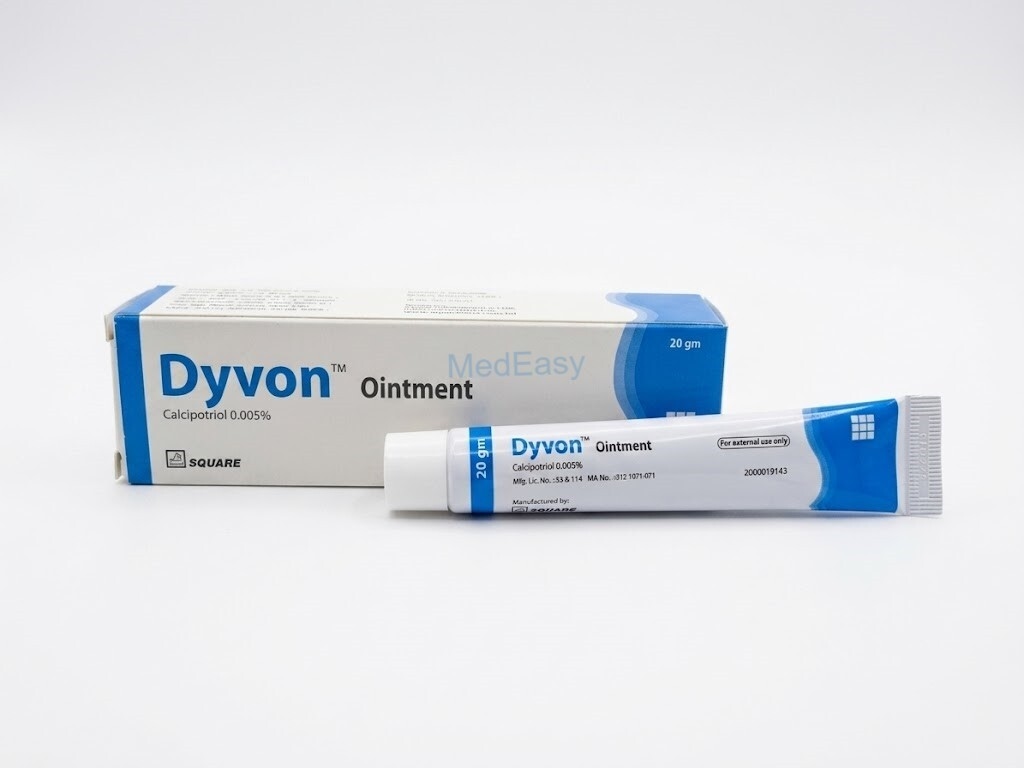
Dyvon0.005% w/w
Square Pharmaceuticals PLC.
৳315.95
Add to cart


Planex is a synthetic vitamin D3 analog used topically for the treatment of plaque psoriasis (psoriasis vulgaris).
Planex is not indicated for erythrodermic, exfoliative, or generalized pustular psoriasis.
Calcipotriol Monohydrate is available in the following common topical strengths and dosage forms (formulation availability varies by market):
Planex is a synthetic derivative of calcitriol (the active form of vitamin D3), formulated for topical use in the management of plaque psoriasis. Planex regulates skin cell (keratinocyte) proliferation and differentiation and has anti-inflammatory activity within the skin, helping to reduce the scaling, thickening, and redness characteristic of psoriatic plaques.
Planex is applied directly to affected skin as a cream, ointment, or solution, either alone or in combination with a topical corticosteroid, and is not intended for oral, ophthalmic, or intravaginal use.
Planex belongs to the therapeutic class of topical antipsoriatics, specifically the vitamin D3 analog subclass of dermatological agents.
Mechanism: Calcipotriol Monohydrate binds to the vitamin D receptor in keratinocytes and other skin cells, resulting in:
Pharmacokinetics: Following topical application to psoriatic plaques, approximately 5-6% of the applied dose of Calcipotriol Monohydrate is absorbed systemically. Absorbed drug is rapidly metabolized in the liver, primarily to less active/inactive metabolites, and eliminated mainly in bile/feces, with a minor renal route. Systemic exposure and effect on calcium metabolism increase if larger body surface areas are treated, if occlusive dressings are used, or if the recommended weekly dose is exceeded.
Planex should be applied only to the affected (psoriatic) skin, in the minimum amount needed to cover lesions, and the total weekly dose limit (see below) should not be exceeded to avoid disturbance of calcium metabolism.
| Indication | Adult dose | Notes |
|---|---|---|
| Plaque psoriasis (body), monotherapy | Apply a thin layer once or twice daily | Maximum weekly dose of Planex should not exceed 100 g of cream/ointment (or the equivalent) per week |
| Scalp psoriasis | Apply solution/foam to scalp lesions once or twice daily | Part hair, apply directly to plaques |
| Combination with topical corticosteroid | Apply once daily, generally for up to 4 weeks (body) as directed by physician | Follow the specific combination product's approved regimen |
Use in children below 18 years should be under specialist supervision only, with lower body-surface-area treatment limits; safety and effectiveness have not been established in children under 12 years for most Planex products (see Pediatric Use).
No well-established dose adjustment is defined for topical Planex, but caution is advised in patients with significant hepatic or renal impairment because of a theoretical risk of altered calcium handling; consult a physician.
Well-established, clinically significant interactions with Planex include:
Calcipotriol Monohydrate is contraindicated in patients with:
Note: Calcipotriol Monohydrate should not be used on erythrodermic, exfoliative, or generalized pustular psoriasis; this is a use-limitation based on lack of established safety/efficacy and risk of increased systemic absorption in these severe/unstable forms of psoriasis, assessed on an individual basis by the treating physician, rather than an absolute hypersensitivity-type contraindication.
Adverse effects reported with Planex are generally local and most common at the start of treatment:
Pregnancy: Data on the use of Planex in pregnant women are limited. Animal reproduction studies at high systemic doses have shown reproductive toxicity; topical use results in only limited systemic absorption. As a precaution, Planex should be used during pregnancy only if clearly needed and if the potential benefit justifies the potential risk to the fetus, for the shortest effective duration and over the smallest area possible; consult a physician before use.
Lactation: It is not known whether topically applied Planex is excreted in human breast milk in clinically significant amounts. Caution is advised; avoid application to the breast/nipple area to prevent direct infant exposure, and consult a physician before use while breastfeeding.
Excessive or prolonged topical application of Planex over large areas can lead to sufficient systemic absorption to cause hypercalcemia and hypercalciuria, which may present as nausea, vomiting, constipation, weakness, or confusion. Accidental oral ingestion of Planex preparations may also cause systemic vitamin D-like toxicity.
If overdose or accidental ingestion is suspected, or if symptoms of hypercalcemia develop, stop use of Planex immediately and seek immediate medical attention or contact a poison control center/emergency services. Do not attempt specific home treatment for suspected toxicity.
Store Planex at 15°C to 25°C (room temperature); do not freeze. Keep the container tightly closed, away from direct light and moisture. Keep out of reach and sight of children. Do not use after the expiry date printed on the pack.
Safety and effectiveness of Planex have not been well established in children under 12 years for most formulations; use in adolescents and children should be under specialist supervision, with attention to lower total body surface area limits because of a higher skin-surface-to-body-mass ratio and greater risk of systemic absorption (see Pediatric Use).
No specific dose adjustment is required based on age alone, but elderly patients may have thinner skin and should be monitored for local irritation and skin-related adverse effects.
Use Planex with caution in patients with significant renal or hepatic impairment because of a theoretical risk of altered calcium regulation; consult a physician.
Planex monotherapy (cream/ointment) is generally used continuously for up to 8 weeks; if no improvement is seen after this period, or if the condition worsens, the physician should reassess the diagnosis and treatment plan. When Planex is combined with a topical corticosteroid, treatment courses are often shorter (commonly up to 4 weeks continuous use for the combination), followed by intermittent or maintenance regimens as directed by the prescriber. Long-term continuous use beyond recommended periods should only continue under medical supervision, with periodic monitoring of serum calcium in patients treating large body surface areas.
Vitamin D3 analogs; Topical antipsoriatics; Dermatological agents
Calcipotriol Monohydrate acts by binding the vitamin D receptor in epidermal keratinocytes, normalizing abnormal keratinocyte proliferation and differentiation, and exerting local anti-inflammatory/immunomodulatory effects within psoriatic plaques, which together reduce scaling, thickening, and erythema of psoriatic lesions. Compared with natural calcitriol, Calcipotriol Monohydrate has substantially less effect on systemic calcium metabolism at recommended topical doses, though this effect is not eliminated, particularly at higher doses or over larger areas.
C
Planex is not established as safe and effective for use in children under 12 years of age for most approved formulations; some combination products specify a minimum age of 18 years. When prescribed for adolescents (12-17 years) under specialist supervision, treatment should be limited to the smallest effective area and shortest effective duration, because children have a greater skin-surface-area-to-body-weight ratio, which increases the risk of systemic absorption and hypercalcemia compared with adults. Parents/caregivers should be counseled on strict adherence to the prescribed area and amount, and should avoid application to the face and skin folds.
Q: What is Planex 0.005% w/w Ointment used for?
A: Planex 0.005% w/w Ointment is a topical vitamin D3 analog used to treat plaque psoriasis. It is applied directly to psoriatic skin lesions to reduce scaling, thickening, and redness, either alone or combined with a topical corticosteroid.
Q: Can I use Planex 0.005% w/w Ointment on my face?
A: Planex 0.005% w/w Ointment is generally not recommended for use on the face because it commonly causes irritation in this sensitive area. Apply it only to the areas your physician has directed, avoiding the face, eyes, lips, and skin folds.
Q: Is Planex 0.005% w/w Ointment safe during pregnancy?
A: Data on Planex 0.005% w/w Ointment use in pregnancy are limited. It should be used during pregnancy only if clearly needed and if the potential benefit justifies the potential risk to the fetus, for the shortest effective time and smallest area; always consult a physician before use during pregnancy.
Q: How much Planex 0.005% w/w Ointment can I use per week?
A: To reduce the risk of hypercalcemia (high blood calcium), the total weekly amount of Planex 0.005% w/w Ointment applied should not exceed the maximum your physician recommends (commonly around 100 g of cream/ointment per week for adults). Do not exceed the prescribed amount or frequency.
Q: What side effects can occur with Planex 0.005% w/w Ointment?
A: The most common side effects of Planex 0.005% w/w Ointment are local burning, stinging, itching, and redness at the application site, especially when starting treatment. Rarely, excessive use over large areas can raise blood calcium levels, which requires medical attention.
Q: Can I use other vitamin D or calcium products with Planex 0.005% w/w Ointment?
A: You should avoid using other vitamin D analogs or calcium supplements together with Planex 0.005% w/w Ointment unless your physician specifically approves it, because combined use can increase the risk of hypercalcemia.
Disclaimer
The information provided is accurate to the best of our knowledge, but it does not replace professional medical advice. We cannot guarantee its completeness or accuracy, and the absence of specific information about a drug should not be taken as an endorsement. We are not responsible for any consequences arising from this information, so please consult a healthcare professional for any concerns or questions.
