
10% Off
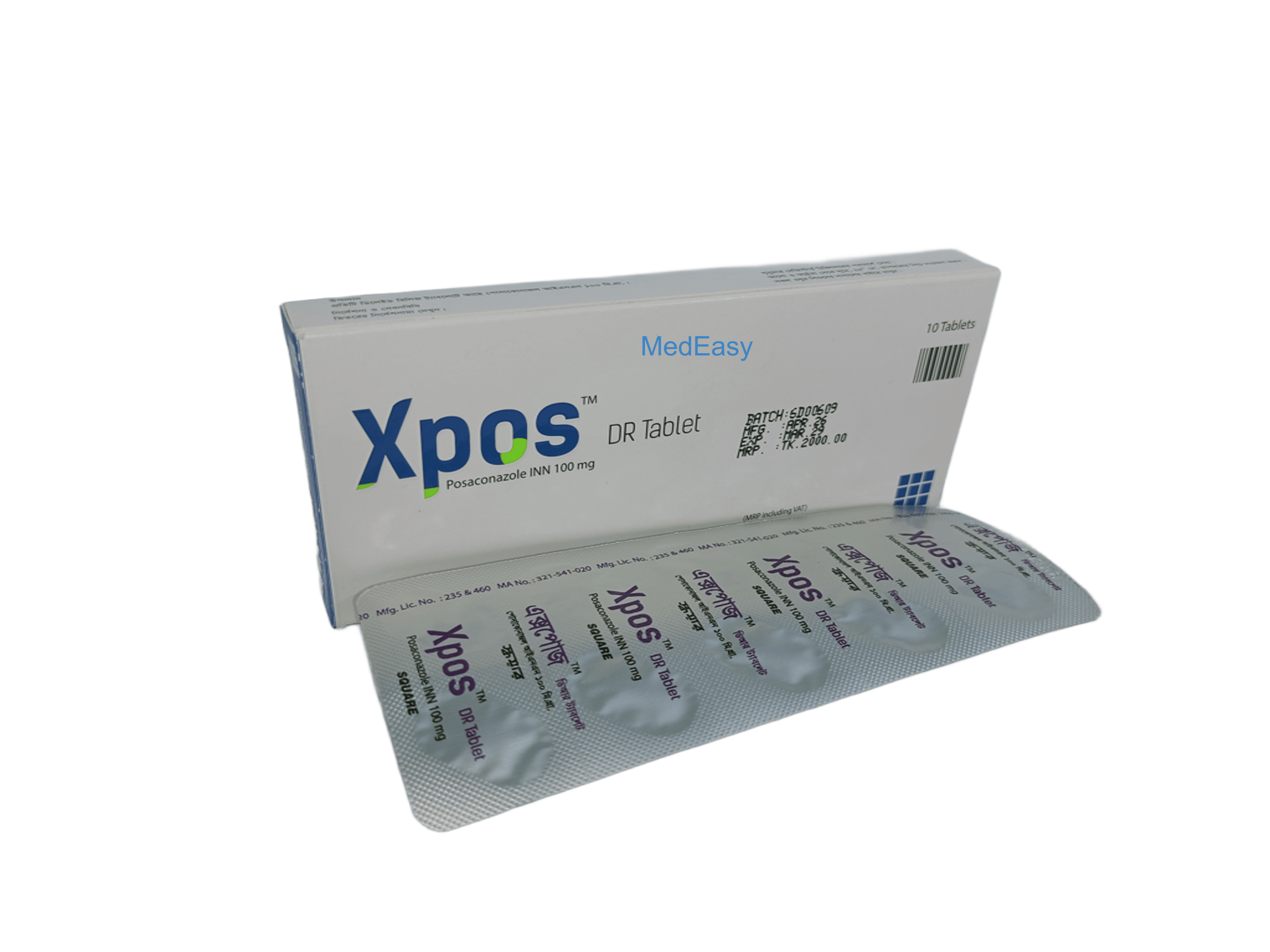
Xpos100 mg
Square Pharmaceuticals PLC.
৳1800.00
Add to cart


Note: Posac is a broad-spectrum antifungal reserved for confirmed or high-risk invasive fungal disease and prophylaxis in defined high-risk immunocompromised populations; it is not intended for routine or minor fungal infections.
Each Posaconazole delayed-release tablet contains 100 mg of Posaconazole. Posaconazole oral suspension contains 40 mg/mL of Posaconazole. Posaconazole injection contains 300 mg of Posaconazole per 16.7 mL (18 mg/mL) single-dose vial for intravenous infusion.
Posac is a second-generation triazole antifungal medicine used for the prevention and treatment of serious, invasive fungal infections caused by organisms such as Aspergillus and Candida species, primarily in patients whose immune systems are severely weakened.
Posac is available in three formulations — an oral delayed-release tablet, an oral suspension, and an intravenous injection — which have different absorption and bioavailability profiles and are not interchangeable at the same dose. The formulation, dose, and schedule must be selected and monitored by a physician based on the specific indication.
Triazole (azole) antifungal agent — Posac belongs to the same broad drug class as fluconazole, itraconazole, and voriconazole, but has an extended spectrum of activity.
Posaconazole absorption and bioavailability differ by formulation. The oral suspension is absorbed better when taken with food or a liquid nutritional supplement and its absorption can be reduced by drugs that increase gastric pH or motility. The delayed-release tablet is not significantly affected by gastric pH or motility and generally produces higher, more consistent plasma concentrations than the oral suspension. The IV formulation achieves predictable systemic exposure independent of gastrointestinal absorption. Posaconazole is highly protein-bound, is metabolized mainly via glucuronidation (not extensively by CYP450 oxidative pathways), and is eliminated primarily in feces, with a long elimination half-life supporting once-daily maintenance dosing after an initial loading phase.
See Mode of Action for how Posaconazole exerts its antifungal effect.
Antifungal stewardship: Take Posac exactly as prescribed by your physician; do not stop, extend, skip doses, or share this medicine with others without medical advice. Completing the full prescribed course is essential to prevent treatment failure and antifungal resistance.
| Population | Loading Dose (Day 1) | Maintenance Dose |
|---|---|---|
| Adults and pediatric patients ≥13 years | 300 mg twice daily | 300 mg once daily, starting Day 2; duration based on recovery from neutropenia or immunosuppression |
Swallow tablets whole with a full glass of water; do not split, crush, or chew. May be taken with or without food.
| Indication | Dose |
|---|---|
| Prophylaxis of invasive fungal infections (adults, ≥13 years) | 200 mg (5 mL) three times daily |
| Oropharyngeal candidiasis (OPC) | 100 mg twice daily on Day 1, then 100 mg once daily for 13 more days |
| OPC refractory to itraconazole/fluconazole | 400 mg (10 mL) twice daily; duration based on severity and response |
Take with a full meal or liquid nutritional supplement to maximize absorption; shake suspension well before each dose.
| Indication | Loading Dose (Day 1) | Maintenance Dose |
|---|---|---|
| Treatment of invasive aspergillosis (adults/peds ≥13 years) | 300 mg IV twice daily | 300 mg IV once daily; typical duration 6–12 weeks depending on response |
| Prophylaxis (adults and pediatrics ≥2 years, weight ≤40 kg) | 6 mg/kg (max 300 mg) twice daily | 6 mg/kg (max 300 mg) once daily |
Administer by slow intravenous infusion over approximately 90 minutes through a central venous line and an in-line filter. Do not give as an IV bolus. A peripheral line may be used only for a single dose before central line placement.
Posac formulations are administered differently and are not interchangeable:
Always take or receive Posac at the same times each day as prescribed, and complete the full course even if symptoms improve.
Posac is a strong inhibitor of the CYP3A4 enzyme, so it significantly raises blood levels of many drugs metabolized by this pathway. Only well-established, clinically significant interactions are listed here; contraindicated combinations are listed separately under Contraindications.
Avoid combining Posac with other drugs known to prolong the QT interval where possible, due to an increased risk of dangerous heart rhythm disturbances (see Precautions and Warnings).
Certain drugs must never be combined with Posac; see Contraindications for the complete list.
Posaconazole is contraindicated in the following situations:
Animal studies have shown that Posac may cause fetal harm (including skeletal malformations and pregnancy loss) at doses relevant to human exposure. Posac should be used during pregnancy only if clearly needed and if the potential benefit to the mother justifies the potential risk to the fetus. Always consult a physician before use in pregnancy or if pregnancy occurs during treatment.
It is not known whether Posac passes into human breast milk or what effect it may have on a breastfed infant. Because Posac is excreted in the milk of lactating animals, a decision should be made, in consultation with a physician, whether to discontinue breastfeeding or discontinue the medicine, weighing the benefits of breastfeeding against the mother's need for treatment.
Posac, like other azole antifungals, has been associated with prolongation of the QT interval on ECG and rare cases of torsades de pointes, a potentially life-threatening heart rhythm disturbance. Use with caution in patients with pre-existing heart rhythm disorders, and avoid combining with other QT-prolonging drugs where possible. Correct low potassium, magnesium, or calcium before and during treatment.
Mild-to-moderate elevations in liver enzymes are common; rare cases of severe hepatic reactions, including cholestasis and liver failure (some fatal), have been reported, more often at higher doses. Liver function tests should be checked before starting and periodically during treatment, and Posac should be discontinued if signs of liver disease develop.
Patients with severe diarrhea or vomiting should be monitored closely, since reduced drug absorption may increase the risk of breakthrough fungal infection.
The IV injection vehicle can accumulate in patients with moderate-to-severe kidney impairment; it should generally be avoided in this setting, with kidney function monitored and a switch to oral therapy considered if needed.
Take Posac exactly as prescribed by your physician; do not stop, extend, skip doses, or share this medicine with others without medical advice.
Do not switch between Posac tablet, suspension, and injection formulations without physician guidance, as they are dosed differently and are not bioequivalent.
Clinical experience with Posac overdose is limited, and no specific antidote is available. Posac is not effectively removed by hemodialysis. If an overdose of Posac is suspected, seek immediate medical attention or contact a poison control center right away. Treatment is supportive, with monitoring of vital signs, heart rhythm (ECG), and liver function as directed by a physician; do not attempt specific home treatment for a suspected overdose.
Store the delayed-release tablet and oral suspension at room temperature (below 30°C), away from light and moisture; do not refrigerate or freeze the oral suspension. Store the injection as directed on the pack, protected from freezing, and use promptly once prepared for infusion, per healthcare provider instructions. Keep all forms out of reach of children.
Duration of Posac therapy depends on the indication and clinical response:
Do not stop Posac early even if symptoms improve, unless advised by your physician, to reduce the risk of relapse or resistance.
Antifungals → Azole antifungals → Triazole antifungals (second-generation) — same broad class as fluconazole, itraconazole, and voriconazole, with Posaconazole used for its extended spectrum of activity.
Posaconazole works by inhibiting the fungal enzyme lanosterol 14-alpha-demethylase (a cytochrome P450-dependent enzyme), which is required to convert lanosterol to ergosterol. Ergosterol is an essential component of the fungal cell membrane. By blocking its synthesis, Posaconazole disrupts fungal cell membrane structure and function, leading to inhibition of fungal growth (fungistatic) and, for some organisms, fungal cell death (fungicidal). Posaconazole has a broader spectrum of activity than earlier azoles, covering many Aspergillus, Candida, and other mold species. See Pharmacology for absorption and elimination details.
Use of Posac in children depends on the formulation and indication:
Pediatric patients should be monitored for the same adverse effects as adults, including liver function and heart rhythm, as clinically indicated.
Q: What is Posac 100 mg Tablet (Delayed Release) used for?
A: Posac 100 mg Tablet (Delayed Release) is a triazole antifungal medicine used to prevent invasive fungal infections (such as those caused by Aspergillus and Candida) in people with severely weakened immune systems, and to treat certain invasive fungal infections and oral/throat thrush (oropharyngeal candidiasis), including cases that have not responded to other antifungal medicines.
Q: Can I switch between the Posac 100 mg Tablet (Delayed Release) tablet, suspension, and injection?
A: No. The different Posac 100 mg Tablet (Delayed Release) formulations are absorbed differently and are not interchangeable at the same dose. Only switch formulations if your physician specifically instructs you to and adjusts the dose accordingly.
Q: Are there foods or medicines I should avoid while taking Posac 100 mg Tablet (Delayed Release)?
A: Posac 100 mg Tablet (Delayed Release) oral suspension should be taken with food to absorb properly. Posac 100 mg Tablet (Delayed Release) interacts significantly with many medicines processed by the liver, including certain immunosuppressants (like tacrolimus, cyclosporine, and sirolimus), certain statins, ergot medicines, some heart rhythm medicines, and some sedatives. Posac 100 mg Tablet (Delayed Release) is contraindicated with sirolimus, pimozide, quinidine, simvastatin/lovastatin/atorvastatin, ergot alkaloids, and (during initiation) venetoclax in certain leukemias. Tell your doctor about all medicines you take before starting Posac 100 mg Tablet (Delayed Release).
Q: What monitoring will I need while on Posac 100 mg Tablet (Delayed Release)?
A: Your doctor will likely check your liver function tests periodically, and may check your heart rhythm (ECG) and blood electrolytes (potassium, magnesium), because Posac 100 mg Tablet (Delayed Release) can affect the liver and can prolong the QT interval, increasing the risk of an abnormal heart rhythm.
Q: Is Posac 100 mg Tablet (Delayed Release) safe during pregnancy or breastfeeding?
A: Posac 100 mg Tablet (Delayed Release) may cause harm to a developing baby based on animal studies, so it should be used in pregnancy only if clearly needed and the benefit outweighs the risk, as decided with your physician. It is not known if Posac 100 mg Tablet (Delayed Release) passes into breast milk, so breastfeeding decisions should also be made with your doctor's guidance.
Q: What should I do if I miss a dose or think I have taken too much Posac 100 mg Tablet (Delayed Release)?
A: If you miss a dose, take it as soon as you remember unless it is nearly time for the next dose — do not double up. If you suspect an overdose of Posac 100 mg Tablet (Delayed Release), seek immediate medical attention or contact a poison control center right away, as this requires prompt medical evaluation.
Disclaimer
The information provided is accurate to the best of our knowledge, but it does not replace professional medical advice. We cannot guarantee its completeness or accuracy, and the absence of specific information about a drug should not be taken as an endorsement. We are not responsible for any consequences arising from this information, so please consult a healthcare professional for any concerns or questions.
