
10% Off
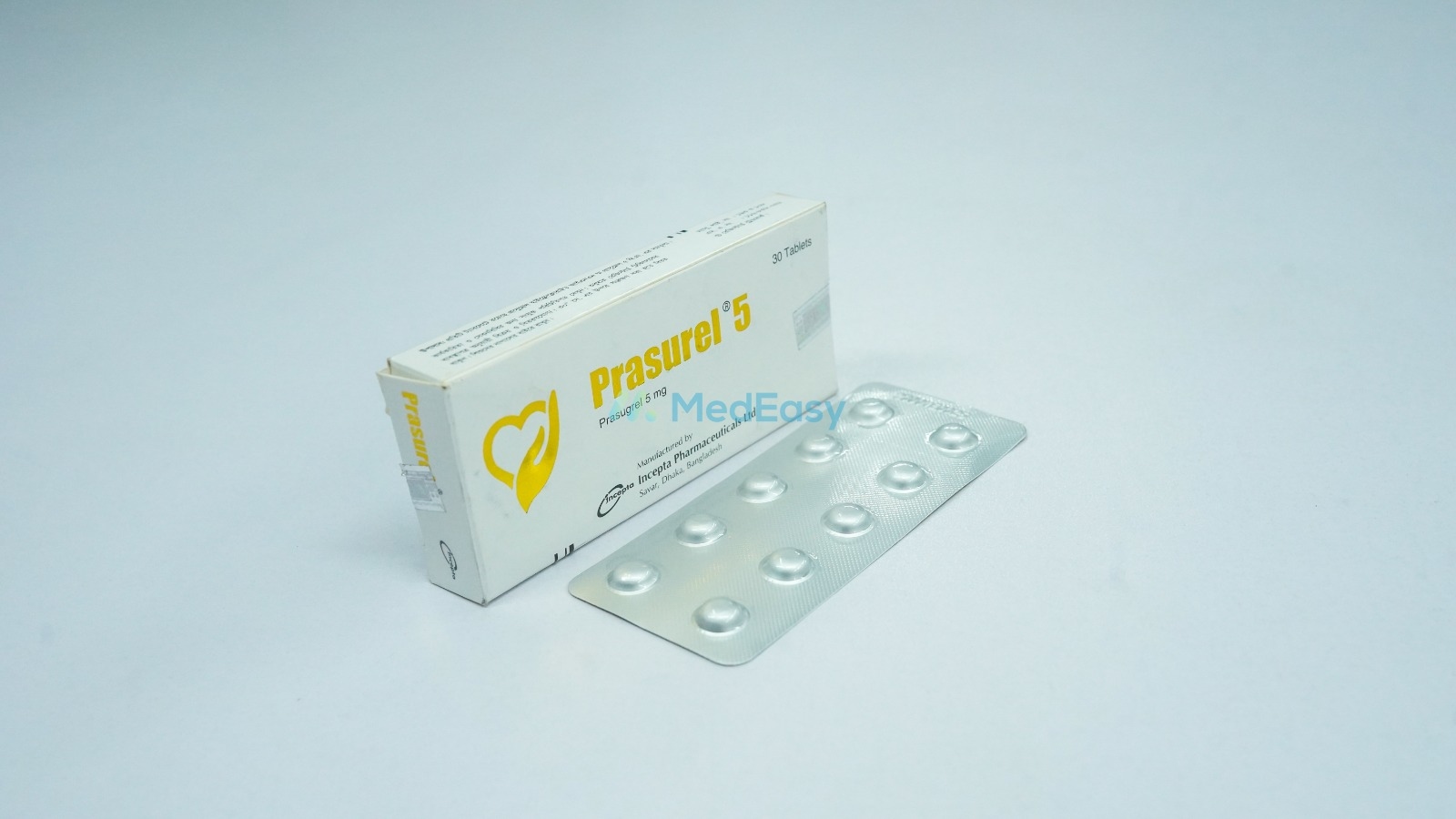
Prasurel5 mg
Incepta Pharmaceuticals Ltd.
৳108.00
Add to cart


Prasuva is an oral antiplatelet agent (P2Y12 inhibitor) indicated to reduce the rate of thrombotic cardiovascular events, including stent thrombosis, in patients with acute coronary syndrome (ACS) who are managed with percutaneous coronary intervention (PCI).
Prasuva must always be used in combination with aspirin; it is not intended as monotherapy. It is not indicated for patients managed medically without PCI, and is not recommended for routine use in patients ≥75 years of age.
Each film-coated tablet contains Prasugrel Hydrochloride equivalent to Prasugrel base 5 mg or 10 mg. Excipients include lactose, microcrystalline cellulose, hydroxypropyl cellulose, croscarmellose sodium, magnesium stearate, and film-coating agents.
Prasuva is a third-generation thienopyridine antiplatelet drug that acts as an irreversible inhibitor of the platelet P2Y12 ADP receptor. It is a prodrug that requires metabolic activation to exert its antiplatelet effect and is used, together with aspirin, to lower the risk of clot-related cardiovascular events in patients with acute coronary syndrome who undergo coronary stenting.
Prasuva belongs to the thienopyridine class of antiplatelet agents and works as a P2Y12 receptor inhibitor, a subclass of the broader ADP-receptor antagonist antiplatelet drug group.
Prasugrel Hydrochloride is a prodrug that is rapidly hydrolyzed in the intestine and then converted by hepatic cytochrome P450 enzymes (mainly CYP3A4 and CYP2B6, with contribution from CYP2C9 and CYP2C19) into an active metabolite. This active metabolite irreversibly binds to the P2Y12 class of ADP receptors on platelets, blocking ADP-mediated platelet activation and aggregation for the lifespan of the platelet (approximately 7-10 days). Onset of antiplatelet effect is rapid, with significant inhibition of platelet aggregation seen within 30 minutes of a loading dose.
Prasuva should be initiated with a single oral loading dose and continued as a once-daily maintenance dose, always in combination with aspirin (75-325 mg daily, usually 75-100 mg).
| Patient group | Loading dose | Maintenance dose |
|---|---|---|
| Adults, general (ACS managed with PCI) | 60 mg once | 10 mg once daily |
| Body weight <60 kg | 60 mg once | 5 mg once daily (dose reduction recommended) |
| Age ≥75 years | Generally not recommended; if used in a high-risk situation (e.g. diabetes, prior MI) at physician discretion | 5 mg once daily if used |
Treatment is usually continued for up to 12 months unless discontinued earlier by the treating physician, for example before surgery (see Precautions and Warnings). Prasuva may be taken with or without food. Patients undergoing PCI who are not already receiving a P2Y12 inhibitor should receive the loading dose as soon as the coronary anatomy is known and a decision has been made to proceed with PCI.
Take by mouth once daily, with or without food, at approximately the same time each day, in combination with aspirin as directed by the physician. Swallow the tablet whole; do not crush the loading dose if a faster onset is required, as crushed/chewed prasugrel may have altered absorption unless specifically directed by a physician.
Prasuva has clinically significant interactions mainly related to bleeding risk and, to a lesser extent, its metabolic activation:
Prasugrel Hydrochloride is contraindicated in:
The predominant and clinically most important adverse effect of Prasuva is bleeding, which can occasionally be severe or fatal.
Patients should seek urgent medical attention for unusual bruising, black/bloody stools, blood in urine or vomit, or any unexplained, prolonged, or severe bleeding while taking Prasuva.
Data on the use of Prasuva in pregnant women are limited. Prasuva should be used during pregnancy only if the potential benefit to the mother justifies the potential risk to the fetus, and only under close physician supervision.
It is not known whether prasugrel or its active metabolite is excreted in human breast milk. Because many drugs are excreted in breast milk and because of the potential for serious adverse reactions, including bleeding, in the nursing infant, a decision should be made whether to discontinue nursing or discontinue the drug, taking into account the importance of the drug to the mother; consult a physician before use while breastfeeding.
Bleeding risk (most important warning): Prasuva can cause significant, sometimes fatal, bleeding. Do not use in patients with active bleeding or a history of stroke or TIA (see Contraindications). Use with caution in patients ≥75 years of age (generally not recommended except in high-risk situations at physician discretion) and in patients with body weight <60 kg, both of which increase bleeding risk and may require a reduced maintenance dose.
Surgery: If a patient is to undergo elective surgery, Prasuva should be discontinued at least 7 days prior, if possible, unless the risk of delaying surgery outweighs the risk of increased bleeding.
Other precautions: Use caution in patients with a propensity to bleed (recent trauma, surgery, GI or genitourinary bleeding, recent major bleeding), and in those receiving concomitant medications that increase bleeding risk (see Interactions). Premature discontinuation increases the risk of stent thrombosis, myocardial infarction, and death; do not stop Prasuva without consulting the prescribing physician. Thrombotic thrombocytopenic purpura (TTP), a rare but life-threatening condition, has been reported; seek urgent care for symptoms such as fever, unexplained bruising/bleeding, confusion, or jaundice.
Overdose of Prasuva may lead to an increased risk of bleeding due to excessive platelet inhibition. There is no specific antidote or reversal agent for Prasuva. In case of suspected overdose, seek immediate medical attention or contact emergency services/a poison control center. Platelet transfusion may be considered by treating physicians to help restore platelet function if clinically significant bleeding occurs, but this should only be done under medical supervision in a hospital setting.
Store at room temperature (below 30°C), away from light and moisture. Keep out of reach of children.
Elderly (≥75 years): Use of Prasuva is generally not recommended in this age group because of an increased risk of fatal and intracranial bleeding, except in high-risk situations (e.g. diabetes or prior myocardial infarction) where the treating physician judges the benefit to outweigh the bleeding risk; a reduced 5 mg maintenance dose should be used if prescribed.
Low body weight (<60 kg): Associated with increased exposure to the active metabolite and higher bleeding risk; a reduced 5 mg maintenance dose is recommended.
Renal impairment: No dose adjustment is required, including in patients with severe renal impairment or end-stage renal disease, based on available pharmacokinetic data, though such patients may have an inherently increased bleeding risk.
Hepatic impairment: No dose adjustment is needed in mild-to-moderate hepatic impairment (Child-Pugh Class A or B). Prasuva has not been studied in and is not recommended for severe hepatic impairment (Child-Pugh Class C).
Pediatric: See Pediatric Uses.
In patients with acute coronary syndrome managed with PCI, treatment with Prasuva together with aspirin is generally continued for up to 12 months, as guided by the treating cardiologist based on individual thrombotic and bleeding risk. The exact duration should be individualized and determined by the prescribing physician; do not stop treatment early without medical advice, as premature discontinuation increases the risk of stent thrombosis.
Antiplatelet agent; Thienopyridine; P2Y12 receptor inhibitor (ADP receptor antagonist).
Prasugrel Hydrochloride is a prodrug that undergoes rapid intestinal hydrolysis followed by hepatic cytochrome P450-mediated oxidation to form a pharmacologically active metabolite. This active metabolite selectively and irreversibly binds to the P2Y12 subtype of ADP receptors on the platelet surface, preventing ADP-induced activation of the glycoprotein GPIIb/IIIa complex and thereby inhibiting platelet aggregation for the remaining lifespan of the affected platelets.
The safety and efficacy of Prasuva have not been established in pediatric patients (below 18 years of age). Prasuva is therefore not recommended for use in children or adolescents outside of a clinical trial setting, and should only be used in this population under specialist supervision if no suitable alternative exists.
Q: What is Prasuva 5 mg Tablet used for?
A: Prasuva 5 mg Tablet is used together with aspirin to reduce the risk of blood clots, heart attack, or stroke in people with acute coronary syndrome (unstable angina, NSTEMI, or STEMI) who have had a coronary stent placed via percutaneous coronary intervention (PCI).
Q: Can I stop taking Prasuva 5 mg Tablet on my own if I feel fine?
A: No. Stopping Prasuva 5 mg Tablet early, especially soon after stent placement, significantly increases the risk of stent thrombosis, heart attack, and death. Always consult your cardiologist before stopping or changing this medicine, even before other planned procedures.
Q: Who should not take Prasuva 5 mg Tablet?
A: Prasuva 5 mg Tablet should not be used by people who are allergic to it, who have active bleeding (such as a bleeding stomach ulcer or bleeding in the brain), or who have a history of stroke or transient ischemic attack (TIA), because it can markedly increase the risk of bleeding in the brain in these patients.
Q: What is the most important side effect to watch for?
A: The most important risk with Prasuva 5 mg Tablet is bleeding, which can occasionally be serious or life-threatening. Seek urgent medical attention if you notice unusual bruising, nosebleeds that will not stop, blood in your stool or urine, vomiting blood, or coughing up blood.
Q: Is Prasuva 5 mg Tablet safe during pregnancy or breastfeeding?
A: Data are limited. Prasuva 5 mg Tablet should be used in pregnancy only if the potential benefit outweighs the potential risk to the fetus, and a doctor should be consulted about breastfeeding, since it is not known whether the drug passes into breast milk.
Q: Do I need a lower dose if I am elderly or have low body weight?
A: Yes. In patients aged 75 years or older or weighing less than 60 kg, doctors generally use a reduced 5 mg daily maintenance dose of Prasuva 5 mg Tablet (after the usual loading dose) because of higher bleeding risk in these groups; use in patients ≥75 years is generally avoided unless there is a specific high-risk reason to use it.
Disclaimer
The information provided is accurate to the best of our knowledge, but it does not replace professional medical advice. We cannot guarantee its completeness or accuracy, and the absence of specific information about a drug should not be taken as an endorsement. We are not responsible for any consequences arising from this information, so please consult a healthcare professional for any concerns or questions.

