
8% Off
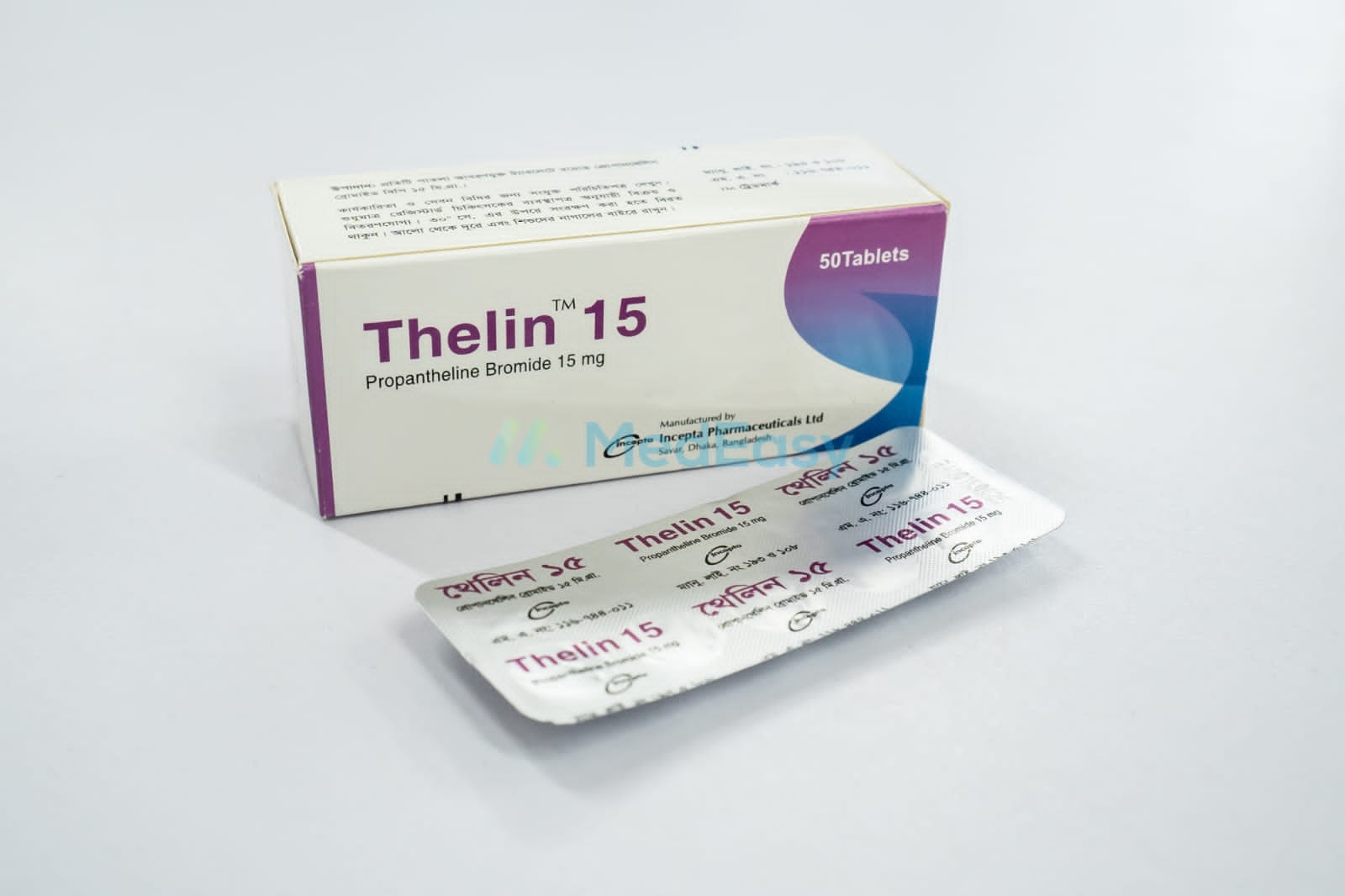
Thelin15 mg
Incepta Pharmaceuticals Ltd.
৳73.60
Add to cart

Prokind 15 mg Tablet is available on MedEasy for ৳110.40 per 10's Strip, with home delivery anywhere in Bangladesh. It is manufactured by Beacon Pharmaceuticals PLC. Its generic name is Propantheline Bromide.

Because of its antimuscarinic, smooth-muscle-relaxant action, Prokind has also been used off-label, based on clinical experience rather than large controlled trials, for:
These off-label uses should only be undertaken on a physician's advice, weighing benefit against the drug's anticholinergic side-effect profile.
Each tablet contains Propantheline Bromide as the active pharmaceutical ingredient, commonly available in 7.5 mg and 15 mg strengths as film-coated tablets, along with standard pharmaceutical excipients.
Prokind is a synthetic quaternary ammonium anticholinergic (antimuscarinic) compound belonging to the antispasmodic class of medicines. It acts by blocking the action of acetylcholine at muscarinic receptors in smooth muscle, glands, and the central and peripheral nervous system to varying degrees, thereby reducing gastrointestinal motility and secretions.
It is primarily used as an adjunct in the management of peptic ulcer disease and other conditions of gastrointestinal spasm, in combination with other standard therapies rather than as a stand-alone cure.
Prokind belongs to the anticholinergic (antimuscarinic) antispasmodic class of drugs, a subgroup of gastrointestinal motility-modifying agents.
Propantheline Bromide is a synthetic antimuscarinic agent that competitively blocks acetylcholine at postganglionic muscarinic receptor sites in smooth muscle, cardiac muscle, and exocrine glands. Through this action it:
As a quaternary ammonium compound, Propantheline Bromide is poorly and variably absorbed from the gastrointestinal tract and does not readily cross the blood-brain barrier, resulting in fewer central nervous system effects compared with tertiary amine anticholinergics, although confusion can still occur, particularly in elderly patients.
| Population | Typical Regimen |
|---|---|
| Usual adult | 15 mg, three times daily, 30 minutes before each meal, plus 30 mg at bedtime (total 75 mg/day). Dose is individualized up to a maximum of 120 mg/day based on response and tolerance. |
| Elderly / small-stature adults | Lower starting dose of 7.5 mg three times daily before meals, titrated cautiously due to increased sensitivity to anticholinergic effects. |
| Pediatric | Safety and efficacy have not been established; not recommended for routine pediatric use (see Use in Special Populations). |
Dosing should always be individualized by the prescribing physician based on symptom response and tolerability. See Administration for timing instructions and Contraindications/Precautions before use.
Always inform the physician or pharmacist of all other medicines being taken before starting Prokind.
Propantheline Bromide is contraindicated in patients with:
Side effects of Prokind are generally dose-related and reflect its anticholinergic action:
Patients should seek medical advice if side effects are severe or persistent.
Prokind is classified under the older FDA pregnancy category C. Adequate, well-controlled studies in pregnant women are lacking, and animal reproduction studies have not been extensively conducted. Prokind should be used during pregnancy only if clearly needed, and only if the potential benefit justifies the potential risk to the fetus; a physician should always be consulted before use in pregnancy.
It is not established whether Prokind is excreted in human breast milk. It may suppress lactation. Breastfeeding mothers should consult a physician before using Prokind, weighing the benefit of treatment against potential effects on milk supply and the infant.
Overdose of Prokind produces an intensification of anticholinergic effects, which may progress to central nervous system disturbance (restlessness, confusion, hallucinations), flushed/hot dry skin, marked tachycardia, circulatory changes, respiratory difficulty, neuromuscular blockade with weakness or paralysis, and, in severe cases, coma.
Any suspected overdose of Prokind is a medical emergency. Seek immediate medical attention or contact a poison control center / emergency services right away. Do not attempt to manage an overdose at home; treatment must be supervised by medical professionals and may include supportive care and specific reversal measures administered in a hospital setting.
Store at room temperature (below 30°C), away from light and moisture. Keep out of reach of children.
Use Prokind with caution in elderly patients, starting at a lower dose (e.g. 7.5 mg three times daily) due to increased sensitivity to anticholinergic side effects such as confusion, urinary retention, constipation, and heat-related illness (see Precautions and Warnings).
Specific dose-adjustment data for renal or hepatic impairment are not well established; use with caution and physician supervision in patients with significant renal or hepatic disease, as elimination may be affected.
See the Pregnancy and Lactation section for detailed guidance; use only under medical supervision.
See Pediatric Uses section; safety and efficacy in children have not been established.
The duration of treatment with Prokind should be determined by the prescribing physician based on the condition being treated and the patient's response. It is generally used for short-to-medium-term symptomatic/adjunctive relief alongside definitive therapy for peptic ulcer disease or other GI spasm conditions, and is not intended for indefinite use without periodic medical review. Long-term use should be reassessed regularly given the risk of cumulative anticholinergic side effects, especially in elderly patients.
Anticholinergics (Antimuscarinics); Gastrointestinal Antispasmodics
Propantheline Bromide is a synthetic quaternary ammonium antimuscarinic that competitively blocks acetylcholine at muscarinic receptors on gastrointestinal smooth muscle and exocrine glands, thereby reducing GI motility, spasm, and secretions (including gastric acid, saliva, and sweat).
C
The safety and effectiveness of Prokind in pediatric patients have not been established. Its use in children is generally not recommended outside of specific physician guidance, and alternative, better-studied therapies should be considered first for pediatric gastrointestinal conditions.
Q: What is Prokind 15 mg Tablet used for?
A: Prokind 15 mg Tablet is used mainly as adjunctive therapy for peptic ulcer disease, helping reduce stomach acid secretion and gastrointestinal spasm alongside other prescribed treatments. It is also sometimes used off-label for other conditions involving GI hypermotility or excessive sweating, on a physician's advice.
Q: How should I take Prokind 15 mg Tablet?
A: Prokind 15 mg Tablet is usually taken 30 minutes before meals, with an additional dose at bedtime, exactly as prescribed. Swallow the tablet with water and do not stop or change the dose without consulting your physician.
Q: Can I take Prokind 15 mg Tablet if I have glaucoma?
A: No. Prokind 15 mg Tablet is contraindicated in narrow-angle glaucoma because its anticholinergic effect can raise pressure inside the eye and worsen this condition. Always tell your doctor about any eye conditions before starting Prokind 15 mg Tablet.
Q: Is Prokind 15 mg Tablet safe during pregnancy or breastfeeding?
A: Prokind 15 mg Tablet falls under pregnancy category C, meaning safety in pregnancy is not fully established. It should be used in pregnancy only if clearly needed and if the benefit outweighs potential risk to the fetus, and only under medical supervision. It may also suppress breast milk production, so breastfeeding mothers should consult their physician before use.
Q: What are the common side effects of Prokind 15 mg Tablet?
A: Common side effects of Prokind 15 mg Tablet include dry mouth, blurred vision, constipation, urinary hesitancy, and reduced sweating. These are related to its anticholinergic action and are usually dose-related; contact your doctor if they are severe or bothersome.
Q: What should I do if I take too much Prokind 15 mg Tablet?
A: An overdose of Prokind 15 mg Tablet is a medical emergency that can cause severe anticholinergic effects, confusion, rapid heartbeat, and breathing difficulty. Seek immediate medical attention or contact emergency services or a poison control center right away; do not try to treat an overdose at home.
Disclaimer
The information provided is accurate to the best of our knowledge, but it does not replace professional medical advice. We cannot guarantee its completeness or accuracy, and the absence of specific information about a drug should not be taken as an endorsement. We are not responsible for any consequences arising from this information, so please consult a healthcare professional for any concerns or questions.