10% Off
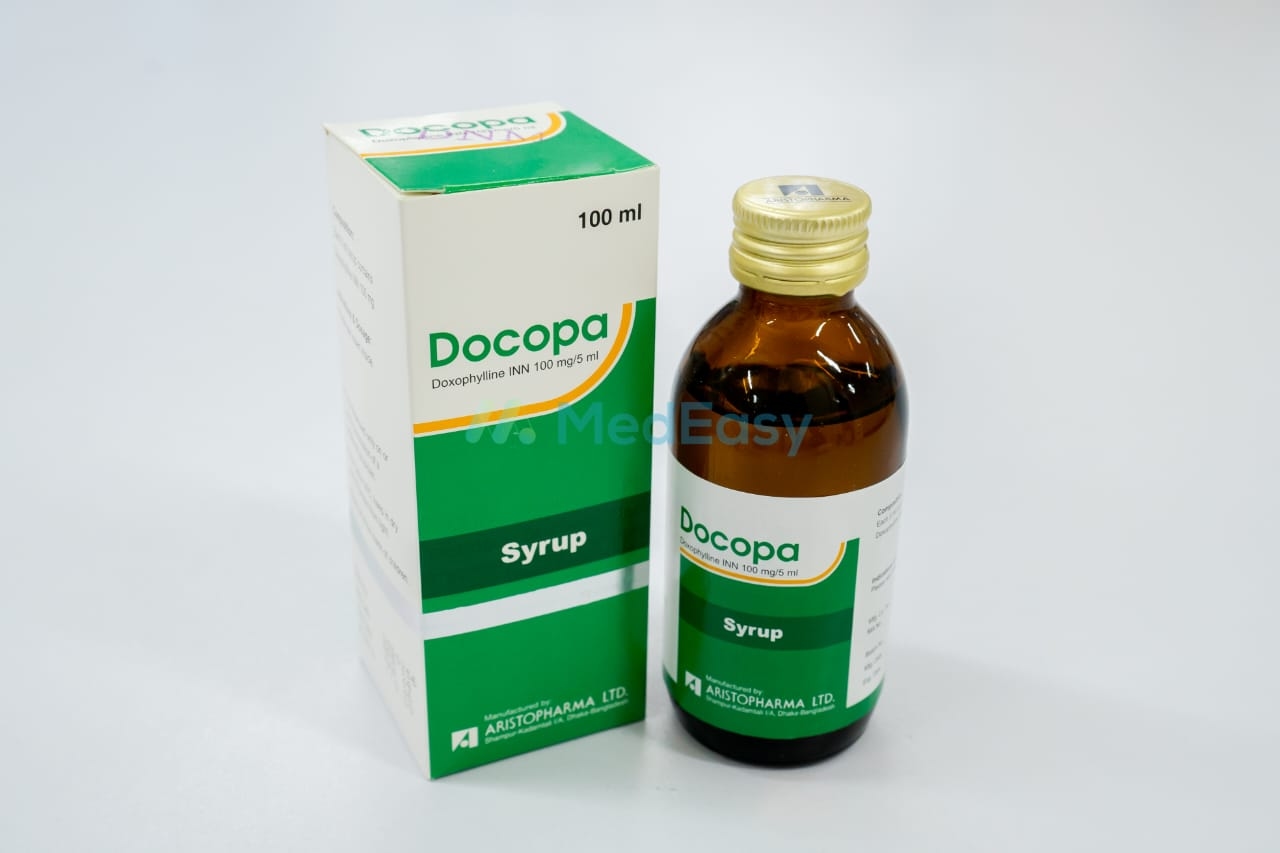
Docopa100 ml
Aristopharma Ltd.
৳99.00
Add to cart

Pulmodox 100 ml Syrup is available on MedEasy for ৳101.20 per 100 ml bottle, with home delivery anywhere in Bangladesh. It is manufactured by Unimed Unihealth MFG. Ltd. Its generic name is Doxophylline.

Pulmodox is indicated for the symptomatic maintenance treatment of reversible airway obstruction associated with:
Pulmodox has also been used in some markets as an adjunct in bronchiectasis with reversible airway obstruction; this use has a lower strength of evidence than its role in asthma and COPD.
Pulmodox is a maintenance bronchodilator for chronic, reversible airway disease; it is not intended for relief of acute bronchospasm or status asthmaticus, for which fast-acting rescue bronchodilators are preferred.
Doxophylline is marketed in Bangladesh and other countries in several oral dosage forms and strengths:
Each formulation also contains standard pharmaceutical excipients; exact excipients vary by manufacturer and brand.
Pulmodox is a xanthine-derivative bronchodilator structurally related to theophylline, distinguished by a dioxolane group at position 7 of the xanthine ring. It is used for the long-term, maintenance management of reversible airway obstruction in asthma and chronic obstructive pulmonary disease (COPD).
Compared with theophylline, Pulmodox has substantially lower affinity for adenosine A1/A2 receptors, which is proposed to explain the more favorable cardiac and central nervous system side-effect profile reported for Pulmodox in some clinical studies, while retaining a bronchodilator effect thought to be mediated mainly through phosphodiesterase inhibition. Pulmodox is widely marketed in Bangladesh, India, Italy, and other countries as tablets, sustained-release tablets, and syrup; it is not an antibiotic.
Pulmodox belongs to the therapeutic class of Xanthine derivative bronchodilators, a group of medicines used to relax airway smooth muscle and relieve reversible airflow obstruction in chronic respiratory disease.
Doxophylline is a methylxanthine bronchodilator that differs from theophylline by the addition of a dioxolane group at the 7-position of the xanthine nucleus. Its bronchodilator action is attributed mainly to non-selective inhibition of phosphodiesterase (PDE) enzymes in airway smooth muscle, which raises intracellular cyclic AMP and produces bronchial smooth muscle relaxation; Doxophylline may also reduce platelet-activating factor and leukotriene generation, contributing to a mild anti-inflammatory effect.
Unlike theophylline, Doxophylline has markedly reduced affinity for adenosine A1 and A2 receptors. Because many of the cardiac (tachycardia, arrhythmia) and central nervous system (tremor, insomnia, seizure) effects of xanthines are linked to adenosine receptor antagonism, this reduced affinity is proposed to underlie the comparatively better tolerability reported for Doxophylline versus theophylline in some studies, although Doxophylline can still cause these effects, particularly at higher doses or in susceptible patients.
Doxophylline is absorbed orally and metabolized mainly in the liver; clearance can be reduced by hepatic impairment, cardiac disease, advanced age, or concomitant use of certain drugs (see Interaction), and increased by smoking and some enzyme-inducing drugs.
Dosage of Pulmodox should be individualized by age, hepatic function, and clinical response. Typical dosing is summarized below; always follow the prescribing physician's instructions.
| Age / Group | Formulation | Typical Dose |
|---|---|---|
| Adults | Tablet (400 mg) | 400 mg two to three times daily |
| Elderly / hepatic or cardiac impairment | Tablet (200 mg) | 200 mg two to three times daily (reduced dose, see Use in Special Populations) |
| Adults (once-daily option) | Sustained-release (SR) tablet (400 mg) | 400 mg once daily, if the total daily requirement is 400 mg |
| Children over 12 years | Tablet (200 mg) or syrup | 200 mg, or 10 mL syrup, two to three times daily |
| Children 6-12 years | Syrup | 6-9 mg/kg body weight twice daily (weight-based; adjusted to actual product strength) |
For adults and children, Pulmodox is generally taken with or after food to reduce gastrointestinal upset. Sustained-release tablets of Pulmodox must be swallowed whole and must not be crushed or chewed. The dose of Pulmodox should be adjusted, and blood level monitoring considered where feasible, in patients with factors known to affect its hepatic clearance.
Pulmodox tablets, including sustained-release tablets, should be swallowed whole with a glass of water; sustained-release tablets must not be crushed, chewed, or split. Pulmodox syrup should be measured accurately using the measuring cup or spoon supplied with the product. Pulmodox is best taken with or shortly after meals to minimize gastrointestinal irritation, and doses should be spaced evenly through the day as directed by the prescribing physician to maintain steady blood levels.
Pulmodox undergoes hepatic metabolism and can interact with several other drugs and substances:
Patients should inform their physician of all medicines, supplements, and herbal products they are taking before starting Pulmodox.
Doxophylline is contraindicated in:
Other conditions sometimes mentioned in relation to Doxophylline, such as uncontrolled seizure disorders, hyperthyroidism, or significant hypotension, warrant caution rather than being absolute contraindications and are addressed under Precautions and Warnings.
Patients should seek medical attention if severe palpitations, chest pain, seizures, or signs of a severe allergic reaction occur while taking Pulmodox.
Pulmodox should be used during pregnancy only if clearly needed and if the potential benefit justifies the potential risk to the fetus. Animal reproduction studies have not shown adverse effects on pre- and postnatal development, but clinical data in pregnant women are insufficient to establish safety; a physician should always be consulted before using Pulmodox during pregnancy.
Pulmodox is generally considered contraindicated during breastfeeding, as xanthine derivatives are known to pass into breast milk and data specific to Pulmodox are insufficient to establish safety in nursing infants; breastfeeding mothers should not use Pulmodox without explicit medical advice, and an alternative may be preferred.
Use Pulmodox with caution in the following situations:
Elderly patients generally require a lower dose of Pulmodox owing to reduced hepatic clearance. Concurrent use with other xanthine-class drugs should be avoided (see Interaction). Pulmodox is not associated with a known risk of dependence or addiction. Patients should stop Pulmodox and seek medical care if palpitations, chest pain, seizures, or signs of a severe allergic reaction develop.
Overdose of Pulmodox can cause severe cardiac arrhythmias and tonic-clonic seizures, in addition to exaggerated common side effects such as persistent vomiting, marked tachycardia, and agitation. In case of a known or suspected overdose of Pulmodox, seek immediate medical attention or contact a poison control center or emergency services; do not attempt to manage a suspected overdose at home. There is no specific antidote for Pulmodox overdose; treatment in hospital is supportive, with cardiovascular monitoring and symptomatic management of arrhythmia or seizures. Treatment with Pulmodox should be discontinued and only resumed at a lower dose, if at all, once toxicity has resolved and under medical supervision.
Store Pulmodox at room temperature (below 30°C), away from light and moisture. Keep out of reach of children.
Use Pulmodox with caution in patients with renal impairment; monitoring is advised as elimination of the drug and its metabolites may be affected.
Pulmodox is extensively metabolized by the liver, and hepatic impairment can significantly reduce its clearance. A reduced dose (e.g. 200 mg instead of 400 mg per dose) and closer monitoring are recommended in these patients.
Elderly patients often have reduced hepatic clearance of Pulmodox and are generally started on the lower 200 mg dose two to three times daily.
See Pediatric Uses and Dosage and Administration for age-appropriate dosing of Pulmodox in children.
Pulmodox is not reported to impair alertness or the ability to drive or operate machinery at recommended doses, but individual response can vary.
Pulmodox is generally used as a long-term, ongoing maintenance therapy for chronic asthma and COPD, alongside other prescribed respiratory medicines, rather than as a short course. The duration of treatment with Pulmodox should be determined by the prescribing physician based on disease control, and treatment should not be stopped or altered without medical advice even if symptoms improve.
Doxophylline is classified as a Xanthine derivative / Bronchodilator, structurally related to theophylline but with reduced affinity for adenosine receptors.
Doxophylline relaxes bronchial smooth muscle mainly through non-selective inhibition of phosphodiesterase enzymes, which increases intracellular cyclic AMP in airway smooth muscle cells and produces bronchodilation. Because Doxophylline has low affinity for adenosine receptors compared with theophylline, it is thought to produce less adenosine-receptor-mediated cardiac stimulation and CNS excitation at therapeutic doses.
Use of Pulmodox in children should follow age- and weight-based dosing under medical guidance:
Sustained-release tablets of Pulmodox are intended for adult use and are generally not used in children. Parents and caregivers should not exceed the recommended dose of Pulmodox and should consult a pediatrician regularly to monitor growth and treatment response.
Q: What is Pulmodox 100 ml Syrup used for?
A: Pulmodox 100 ml Syrup is a xanthine-derivative bronchodilator used for the long-term maintenance treatment of reversible airway obstruction in chronic asthma and chronic obstructive pulmonary disease (COPD). It is not intended for immediate relief of a sudden asthma attack.
Q: Is Pulmodox 100 ml Syrup the same as theophylline?
A: No. Pulmodox 100 ml Syrup is chemically related to theophylline but has a different side chain that gives it much lower affinity for adenosine receptors, which is associated with fewer cardiac and central nervous system side effects than theophylline in some studies. Even so, Pulmodox 100 ml Syrup and theophylline should not be used together because their effects and toxicities can add up.
Q: Can Pulmodox 100 ml Syrup be taken during pregnancy or while breastfeeding?
A: Pulmodox 100 ml Syrup should be used in pregnancy only if a physician determines it is clearly needed and the benefit outweighs any potential risk to the fetus, as safety data in pregnant women are limited. Pulmodox 100 ml Syrup is generally considered contraindicated during breastfeeding because xanthine derivatives can pass into breast milk; a physician should be consulted for an alternative if breastfeeding.
Q: What should I avoid while taking Pulmodox 100 ml Syrup?
A: While taking Pulmodox 100 ml Syrup, avoid other xanthine-containing medicines (such as theophylline or aminophylline) and limit caffeine-containing foods and beverages, as both can add to xanthine-related side effects such as palpitations, tremor, and insomnia. Tell your physician about all other medicines you take, since several drugs can raise or lower blood levels of Pulmodox 100 ml Syrup (see Interaction).
Q: What are the warning signs of a Pulmodox 100 ml Syrup overdose?
A: Signs of Pulmodox 100 ml Syrup overdose can include severe palpitations or irregular heartbeat, persistent vomiting, marked agitation, and seizures. If an overdose of Pulmodox 100 ml Syrup is suspected, seek emergency medical care or contact a poison control center immediately rather than trying to manage it at home.
Q: Can children take Pulmodox 100 ml Syrup?
A: Pulmodox 100 ml Syrup syrup can be used in children over 6 years at a weight-based dose prescribed by a pediatrician; safety and efficacy in children under 6 years have not been well established, so Pulmodox 100 ml Syrup is generally not used in this age group unless specifically directed by a physician.
Disclaimer
The information provided is accurate to the best of our knowledge, but it does not replace professional medical advice. We cannot guarantee its completeness or accuracy, and the absence of specific information about a drug should not be taken as an endorsement. We are not responsible for any consequences arising from this information, so please consult a healthcare professional for any concerns or questions.