
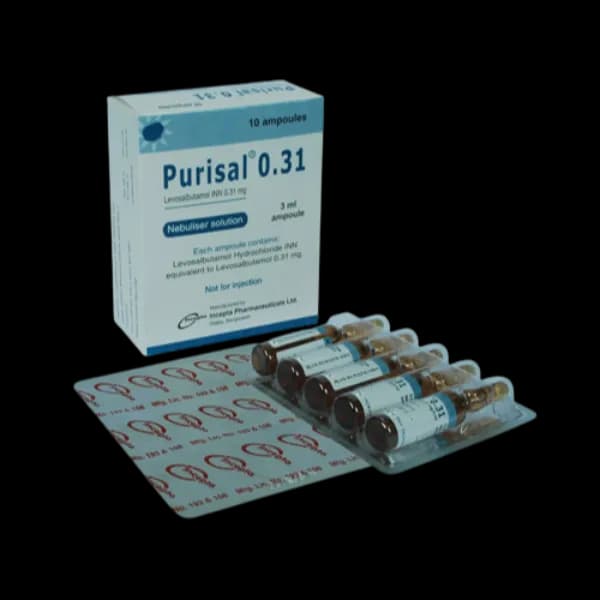

Medicine overview
Indications of Purisal
Purisal is indicated for the treatment or prevention of bronchospasm in adults, adolescents, and children 6 years of age and older with reversible obstructive airway disease, including asthma and chronic obstructive pulmonary disease (COPD).
- Established/FDA-approved use: Relief (rescue therapy) of acute bronchospasm associated with asthma and COPD.
- Guideline-supported use: As a reliever medication used on an as-needed basis alongside maintenance inhaled corticosteroid therapy in asthma management guidelines.
- Prophylactic use: Prevention of exercise-induced bronchospasm when administered shortly before exertion.
Purisal is a bronchodilator only; it does not treat the underlying airway inflammation and is not a substitute for anti-inflammatory therapy such as inhaled corticosteroids in persistent asthma.
Composition
Each dose of Levosalbutamol contains levosalbutamol (as levosalbutamol hydrochloride/sulphate), the single active (R)-enantiomer of racemic salbutamol, formulated as a metered-dose inhaler (typically 50 mcg/puff) or as a nebuliser solution (available as 0.31 mg/3 mL, 0.63 mg/3 mL, and 1.25 mg/3 mL respirator solution ampoules).
Description
Purisal is a short-acting selective beta-2 adrenergic receptor agonist bronchodilator. It is the purified, pharmacologically active (R)-enantiomer of racemic salbutamol (albuterol), developed with the aim of providing effective bronchodilation while limiting exposure to the (S)-enantiomer, which lacks bronchodilator activity and has been proposed to contribute to certain side effects. Purisal is used as a quick-relief inhaled medicine in the management of reversible airway obstruction such as asthma and COPD.
Therapeutic Class
Purisal belongs to the class of short-acting beta-2 adrenergic agonists (SABA), a subgroup of bronchodilator drugs used for the relief of bronchospasm.
Pharmacology
Levosalbutamol acts as a selective agonist at beta-2 adrenergic receptors on bronchial smooth muscle. Receptor activation stimulates adenylate cyclase, increasing intracellular cyclic AMP (cAMP), which in turn relaxes smooth muscle throughout the airways, from the trachea to the terminal bronchioles, and inhibits release of mediators of immediate hypersensitivity from mast cells.
Pharmacokinetics
- Onset of action: Approximately 10-17 minutes
- Peak effect: Around 1.5 hours
- Duration of action: Approximately 5-6 hours, up to 8 hours in some patients
- Metabolism: Primarily via the sulfotransferase enzyme SULT1A3
- Elimination: Predominantly renal (approximately 80-100% of the dose)
Dosage & Administration of Purisal
Nebuliser Solution
| Age group | Dose | Frequency |
|---|---|---|
| Children 6-11 years | 0.31 mg (may increase to 0.63 mg if needed) | Three times daily, by nebulization |
| Adolescents and adults (≥12 years) | 0.63 mg, increased up to 1.25 mg in severe cases | Three times daily (every 6-8 hours) |
Metered-Dose Inhaler
- Relief of acute bronchospasm: 1-2 puffs (approx. 50 mcg/puff), repeated as needed; maximum 8 puffs in 24 hours.
- Prevention of exercise-induced bronchospasm: 2 puffs approximately 15 minutes before exercise or anticipated allergen exposure.
Doses should be individualized to the lowest effective dose. An increasing need for Purisal indicates deteriorating asthma control and requires medical reassessment.
Administration of Purisal
Purisal nebuliser solution is administered by oral inhalation using a jet nebulizer connected to an air compressor with adequate airflow, over approximately 5-15 minutes, until the chamber is empty. Do not mix with other drugs in the nebulizer unless directed by a physician. For the metered-dose inhaler: shake well before use, breathe out fully, place the mouthpiece in the mouth, and press the canister while inhaling slowly and deeply; hold breath for about 10 seconds before exhaling. Wait about 1 minute between puffs. Purisal is for inhalation only and must never be injected or taken orally.
Interaction of Purisal
Purisal has clinically significant interactions with the following:
- Other sympathomimetic agents (e.g., epinephrine): Concomitant use may increase the risk of adverse cardiovascular effects; avoid unless clearly needed.
- Beta-blockers (e.g., propranolol): Non-selective beta-blockers may block the bronchodilator effect of Purisal and can produce severe bronchospasm in patients with asthma; if a beta-blocker is required, a cardioselective agent should be used with caution.
- Diuretics (non-potassium-sparing, e.g., loop or thiazide diuretics): May worsen Purisal-induced hypokalemia; monitor serum potassium.
- Digoxin: Purisal may lower serum digoxin concentrations; monitoring of digoxin levels is advised.
- Monoamine oxidase inhibitors (MAOIs) and tricyclic antidepressants: May potentiate the cardiovascular effects of Purisal; use with extreme caution, including within 2 weeks of MAOI discontinuation.
Contraindications
Levosalbutamol is contraindicated in patients with known hypersensitivity to levosalbutamol, racemic salbutamol, or any component of the formulation. Prior hypersensitivity reactions have included urticaria, angioedema, rash, bronchospasm, and anaphylaxis.
Side Effects of Purisal
The most commonly reported side effects of Purisal include:
- Tremor (especially of the hands), nervousness, and headache
- Palpitations, tachycardia, and chest pain
- Dizziness, fatigue, and insomnia
- Muscle cramps
- Rhinitis and, in children, asthma exacerbation
Less commonly, Purisal can cause hypokalemia (particularly with high or frequent doses), and rarely, paradoxical bronchospasm or hypersensitivity reactions (see Precautions and Warnings and Contraindications). Seek prompt medical attention for chest pain, irregular heartbeat, or worsening breathing difficulty after use.
Pregnancy & Lactation
Pregnancy: There are no adequate, well-controlled studies of Purisal in pregnant women. Animal reproduction studies have not shown clear evidence of harm, but the related racemic compound has produced abnormalities in some animal species at high doses. Poorly controlled asthma during pregnancy is associated with risks to both mother and fetus, so Purisal should be used during pregnancy only if the potential benefit justifies the potential risk to the fetus, and only under medical supervision.
Lactation: It is not known whether Purisal is excreted in human breast milk. Because many drugs are excreted in breast milk, caution should be exercised and a physician consulted before use while breastfeeding, weighing the benefits of treatment against potential risk to the infant.
Precautions & Warnings
Paradoxical bronchospasm: Inhaled Purisal can, rarely, cause a life-threatening paradoxical bronchospasm; discontinue immediately if this occurs and seek an alternative therapy.
Deteriorating asthma control: Increasing or unusually frequent use of Purisal for symptom relief signals worsening disease control and warrants prompt medical reassessment of the overall treatment plan; it is not a substitute for anti-inflammatory therapy (e.g., inhaled corticosteroids).
Cardiovascular effects: Use with caution in patients with cardiovascular disorders (especially coronary insufficiency, arrhythmias, and hypertension), as beta-agonists can produce effects on the cardiovascular system including changes in heart rate and blood pressure.
Hypokalemia: High or frequent doses of Purisal may produce clinically significant hypokalemia, potentially exacerbated by concomitant diuretic use; monitor potassium in at-risk patients.
Use with caution in patients with hyperthyroidism, diabetes mellitus, or convulsive disorders. Fatalities have been reported in association with excessive use of inhaled short-acting beta-agonists; do not exceed the recommended dose or frequency.
Overdose Effects of Purisal
Overdose of Purisal may cause exaggerated beta-adrenergic effects such as seizures, angina, hypertension or hypotension, marked tachycardia (rates up to 200 beats/minute), arrhythmias, nervousness, headache, tremor, dry mouth, muscle cramps, and hypokalemia. If an overdose is suspected, seek immediate medical attention or contact a poison control center; treatment is generally supportive, involving discontinuation of the drug and cardiac monitoring, with a cardioselective beta-blocker considered only with extreme caution due to the risk of bronchospasm.
Storage Conditions
Store at room temperature (below 30°C), protected from light and moisture. Do not refrigerate or freeze. Keep the inhaler canister or nebuliser ampoules out of reach of children. Once a nebuliser solution vial pouch is opened, use within the manufacturer-specified time and discard any unused solution as directed.
Use In Special Populations
Pediatric Use
Purisal is approved for use in children 6 years of age and older; safety and efficacy in children below 6 years have not been established. Pediatric patients may be more prone to asthma-related adverse effects.
Geriatric Use
Elderly patients may be more sensitive to the cardiovascular effects of Purisal; use with caution, particularly in those with pre-existing cardiovascular disease.
Renal/Hepatic Impairment
No specific dose adjustment guidance for renal or hepatic impairment is well established; use with caution and clinical monitoring, especially given predominantly renal elimination.
Duration Of Treatment
Purisal is typically used as needed for relief of acute symptoms or shortly before exercise for prevention of exercise-induced bronchospasm; it is not intended for regular, scheduled long-term use as monotherapy. If regular daily use is required to control symptoms, the overall asthma or COPD treatment plan should be reviewed by a physician, as this may indicate a need for additional maintenance therapy.
Drug Classes
Short-acting beta-2 adrenergic agonist (SABA); bronchodilator.
Mode Of Action
Levosalbutamol, the active (R)-enantiomer of salbutamol, selectively stimulates beta-2 adrenergic receptors in bronchial smooth muscle. This activates adenylate cyclase, raising intracellular cyclic AMP levels, which relaxes bronchial smooth muscle and produces bronchodilation, while also inhibiting the release of bronchoconstricting mediators from mast cells.
Pregnancy
C
Pediatric Uses
Purisal is indicated for treatment or prevention of bronchospasm in children 6 years of age and older with reversible obstructive airway disease. The recommended nebulized dose in children 6-11 years is 0.31 mg three times daily (may be increased to 0.63 mg three times daily if needed under medical supervision). Safety and efficacy of Purisal in children younger than 6 years have not been established, and use in this age group is not recommended outside specific medical guidance.
Frequently Asked Questions
Q: What is Purisal 3 ml Nebuliser Solution used for?
A: Purisal 3 ml Nebuliser Solution is used to relieve and prevent bronchospasm (airway narrowing) in people with asthma or COPD, and to prevent exercise-induced bronchospasm when taken shortly before physical activity.
Q: How is Purisal 3 ml Nebuliser Solution different from salbutamol (albuterol)?
A: Purisal 3 ml Nebuliser Solution is the purified, active (R)-enantiomer of racemic salbutamol. It is proposed to provide similar bronchodilator benefit while reducing exposure to the inactive (S)-enantiomer, which some studies suggest may otherwise contribute to certain side effects, though clinical superiority over salbutamol has not been definitively established for all patients.
Q: Can Purisal 3 ml Nebuliser Solution be used during pregnancy?
A: Purisal 3 ml Nebuliser Solution should be used during pregnancy only if the potential benefit justifies the potential risk to the fetus, as adequate controlled studies in pregnant women are lacking. Poorly controlled asthma itself poses risks to mother and baby, so a physician should be consulted to weigh the benefits and risks before use.
Q: What should I do if I need Purisal 3 ml Nebuliser Solution more often than usual?
A: Needing Purisal 3 ml Nebuliser Solution more frequently than prescribed, or needing it every day, can be a sign that your asthma or COPD is not well controlled. Do not simply increase the dose or frequency on your own; contact your physician promptly for reassessment of your treatment plan.
Q: What are the common side effects of Purisal 3 ml Nebuliser Solution?
A: Common side effects of Purisal 3 ml Nebuliser Solution include tremor, nervousness, headache, palpitations, fast heartbeat, dizziness, and muscle cramps. Most are mild and dose-related. Seek medical attention if you experience chest pain, irregular heartbeat, or worsening breathing difficulty.
Q: What should I do if I accidentally use too much Purisal 3 ml Nebuliser Solution?
A: An overdose of Purisal 3 ml Nebuliser Solution can cause a fast or irregular heartbeat, chest pain, tremor, seizures, and low potassium levels. If an overdose is suspected, seek immediate medical attention or contact a poison control center right away.
Disclaimer
The information provided is accurate to the best of our knowledge, but it does not replace professional medical advice. We cannot guarantee its completeness or accuracy, and the absence of specific information about a drug should not be taken as an endorsement. We are not responsible for any consequences arising from this information, so please consult a healthcare professional for any concerns or questions.
