
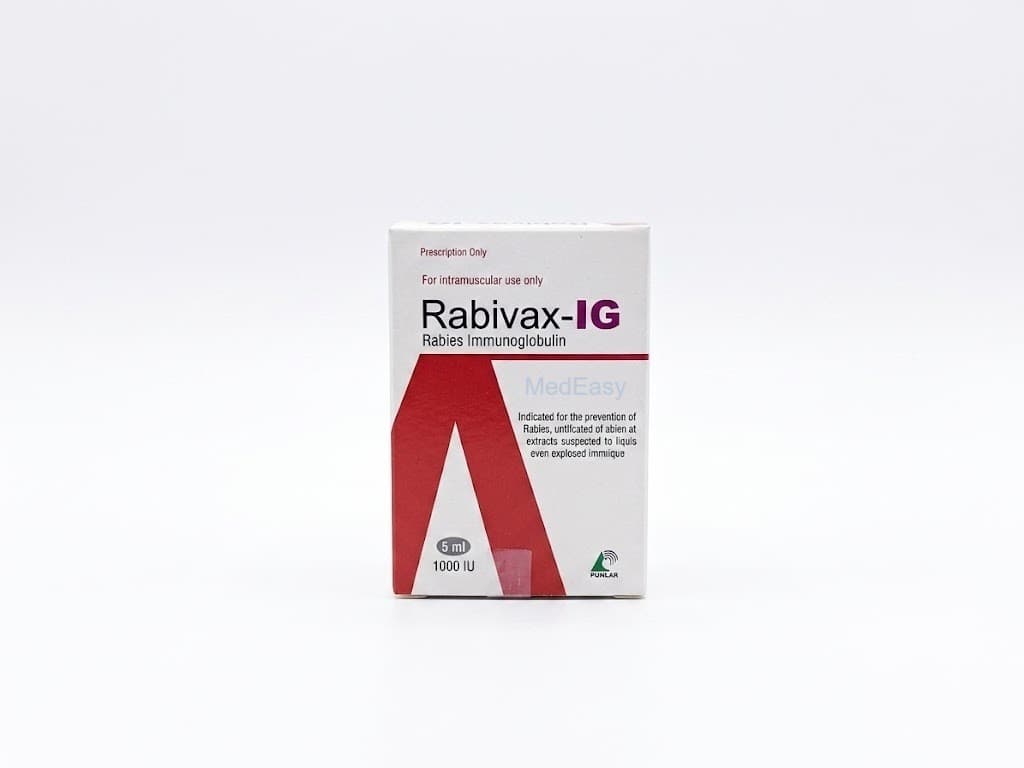

Medicine overview
Indications of Rabivax-IG
Rabivax-IG is indicated as part of post-exposure prophylaxis (PEP) for rabies in persons of all ages who have been bitten, scratched, or otherwise exposed to saliva or neural tissue from an animal suspected or confirmed to be rabid, and who have not previously received a complete pre-exposure or post-exposure rabies vaccination series.
Established Use
- Rabies post-exposure prophylaxis: Given once, as soon as possible after exposure, together with the first dose of rabies vaccine, to provide immediate passive (preformed) antibody protection while the patient's own active immune response to the vaccine develops.
Important Limitations
- Rabivax-IG must always be used in conjunction with a complete rabies vaccine series and is never a substitute for the vaccine.
- Not indicated in persons with a documented history of complete pre-exposure or post-exposure rabies vaccination, since an anamnestic (booster) antibody response to vaccine alone is expected to be adequate in that setting.
- Should generally not be administered beyond the 7th day after the first dose of rabies vaccine, since an active antibody response is presumed to have started by then and immunoglobulin could suppress it.
Composition
Each vial/ampoule of Rabies Immunoglobulin contains a purified immunoglobulin (antibody) fraction prepared from the plasma of hyperimmunized human donors (human rabies immunoglobulin) or from hyperimmunized horses/donor animals (equine/purified equine rabies immunoglobulin), standardized to a specified potency of rabies-neutralizing antibody expressed in International Units (IU) per mL, together with excipients such as glycine or other stabilizers. Exact strength and formulation vary by manufacturer/brand; refer to the specific product label for the labelled IU/mL potency.
Description
Rabivax-IG is a passive immunization biologic product containing pre-formed, virus-neutralizing antibodies directed against the rabies virus. It is prepared either from the pooled plasma of human donors hyperimmunized against rabies (human Rabivax-IG, HRIG) or from hyperimmune animal (usually equine) serum that has been purified and processed to reduce the risk of hypersensitivity reactions (equine/purified equine Rabivax-IG, ERIG). Rabivax-IG supplies immediate, temporary antibody protection at the wound site and systemically during the days-to-weeks period before the patient's own active immunity, induced by the rabies vaccine, becomes protective.
Therapeutic Class
Rabivax-IG belongs to the therapeutic class of passive immunizing agents / immune sera and immunoglobulins, specifically an antirabies serum/immunoglobulin used for post-exposure prophylaxis of rabies.
Pharmacology
Mechanism
Rabies Immunoglobulin works by passive immunization: it supplies ready-made, virus-neutralizing antibodies that bind to and neutralize rabies virus present at or near the site of exposure/wound before the virus can enter peripheral nerve endings and travel to the central nervous system. Because rabies has a variable but potentially short incubation period and is almost universally fatal once symptomatic, this immediate passive protection is critical during the window before active immunity from the rabies vaccine series becomes established.
Pharmacokinetics
After local infiltration and intramuscular injection, antibody from Rabies Immunoglobulin is absorbed into the circulation and local tissue over hours to days; the antibody has a biological half-life of roughly 3 weeks, consistent with other immunoglobulin (IgG) products, providing a bridge of passive protection until active antibody titers from vaccination rise to protective levels (typically within 7-14 days).
Dosage & Administration of Rabivax-IG
Dosing by Product Type
| Product Type | Recommended Dose |
|---|---|
| Human Rabivax-IG (HRIG) | 20 IU/kg body weight, given once |
| Equine/Purified Equine Rabivax-IG (ERIG) | 40 IU/kg body weight, given once |
Administration Technique
- Give the full calculated dose of Rabivax-IG once, ideally on the same day as the first dose of rabies vaccine (Day 0), or as soon as possible thereafter (up to Day 7 after the first vaccine dose).
- As much of the dose as is anatomically feasible should be carefully infiltrated into and around all wound(s); any remainder is given by intramuscular injection at a site distant from the vaccine injection site.
- Rabivax-IG must never be drawn into the same syringe as, mixed with, or injected into the same anatomical site as the rabies vaccine.
- The calculated dose must not be exceeded, as excess immunoglobulin can suppress the patient's own active antibody response to the vaccine.
- Not for intravenous administration.
Administration of Rabivax-IG
Rabivax-IG is administered once by local wound infiltration (as much of the dose as is anatomically possible) with any remaining volume given intramuscularly at a site away from the vaccine injection site, under the supervision of a qualified healthcare professional in conjunction with the rabies vaccine series. See Dosage and Administration for full details.
Interaction of Rabivax-IG
Rabies Vaccine
Rabivax-IG must be given at a different anatomical site from the rabies vaccine and never in the same syringe, as mixing or co-localized injection can neutralize the vaccine antigen and blunt the patient's active immune response. Doses of Rabivax-IG exceeding the recommended amount can likewise suppress the active antibody response to the vaccine series.
Other Immune Globulins / Live Vaccines
Because Rabivax-IG contains antibodies, it may interfere with the immune response to live attenuated vaccines (e.g., MMR, varicella) given around the same time; where possible, live vaccines should be separated from immunoglobulin administration per standard immunization guidelines, in consultation with a physician.
Contraindications
Rabies Immunoglobulin is contraindicated in patients with a known history of severe hypersensitivity (e.g., anaphylaxis) to Rabies Immunoglobulin or to any component of the specific product (including, for equine-derived products, prior reaction to equine serum/protein).
Because rabies is almost universally fatal once symptoms develop, no absolute contraindication should be allowed to prevent life-saving post-exposure prophylaxis in a genuinely exposed individual; in a patient with a prior severe reaction, this should be managed by a specialist (for example, using the alternative human- or equine-derived product where available, premedication, and administration under close medical supervision) rather than withholding therapy outright.
Side Effects of Rabivax-IG
- Common: Pain, tenderness, redness, or swelling at the injection/infiltration site; low-grade fever; headache; mild malaise.
- Less common: Urticaria (hives), mild allergic skin reactions.
- Rare but serious: Serum sickness (more frequent with equine-derived product; typically 7-14 days after administration, presenting with fever, rash, joint pain, lymphadenopathy); anaphylaxis/severe hypersensitivity reaction; angioedema.
Patients should be observed for an appropriate period after administration of Rabivax-IG, and any signs of a serious allergic reaction require immediate medical attention.
Pregnancy & Lactation
Pregnancy and breastfeeding are not contraindications to rabies post-exposure prophylaxis. Because untreated rabies is almost universally fatal, Rabivax-IG should be given to pregnant and breastfeeding individuals when there has been a genuine rabies exposure, as the benefit of preventing rabies clearly outweighs any theoretical risk. As with any biologic product, use should be under medical supervision, and the treating physician should be informed of the pregnancy or breastfeeding status; consult a physician for individualized guidance.
Precautions & Warnings
- Time-critical intervention: Any suspected rabies exposure (bite, scratch, or mucous-membrane/broken-skin contact with saliva from a suspected or confirmed rabid animal) is a medical emergency; do not delay wound care and evaluation for Rabivax-IG and vaccination.
- Wound care first: Immediate and thorough washing of the wound with soap and water for several minutes is essential before or alongside administration of Rabivax-IG.
- Site and technique: Must not be given in the same syringe or same anatomical site as the rabies vaccine; the calculated dose must not be exceeded (see Interactions).
- Hypersensitivity/serum sickness risk: Equine-derived products carry a higher risk of hypersensitivity and serum sickness than human-derived product; skin testing may be considered per the specific product's labeling in some settings, and the human-derived product is generally preferred when available, particularly in patients with a history of allergy.
- Not a substitute for vaccine: Rabivax-IG alone does not provide durable protection and must always be paired with the complete rabies vaccine series.
- Bleeding disorders: Use the intramuscular route with caution in patients with thrombocytopenia or other bleeding disorders, as with any intramuscular injection.
Overdose Effects of Rabivax-IG
There is limited data on overdose with Rabivax-IG because dosing is weight-based and administered once under medical supervision. Administration of doses substantially exceeding the recommended amount may increase the risk of local or systemic hypersensitivity reactions and could theoretically blunt the active antibody response to the concurrently administered rabies vaccine. If an excessive dose is given or an adverse reaction is suspected, seek immediate medical attention; the patient should be monitored closely and treated symptomatically in a healthcare facility. In case of any adverse reaction or suspected overdose, contact a physician, hospital emergency department, or poison control immediately.
Storage Conditions
Store Rabivax-IG refrigerated at 2°C to 8°C (36°F to 46°F). Do not freeze; discard if the product has been frozen. Protect from light. Keep out of reach of children. Do not use beyond the expiry date printed on the pack.
Use In Special Populations
Pregnancy and Breastfeeding
Recommended when clinically indicated; see Pregnancy and Lactation.
Pediatric Patients
Rabivax-IG is used in infants and children of all ages when indicated for rabies post-exposure prophylaxis, using the same weight-based (IU/kg) dosing as adults (20 IU/kg for human-derived product, 40 IU/kg for equine-derived product), since the risk of untreated rabies far outweighs the risks of treatment.
Elderly Patients
No dose adjustment based on age alone; dosing remains weight-based. Use with the same precautions as in younger adults.
Renal or Hepatic Impairment
No specific dose adjustment is established for renal or hepatic impairment, as Rabivax-IG is not primarily cleared by these organs; use standard weight-based dosing.
Immunocompromised Patients
Rabies exposure in an immunocompromised patient still requires full PEP, including Rabivax-IG; additional vaccine doses or antibody titer monitoring may be recommended by a physician, as the immune response to vaccine may be blunted.
Duration Of Treatment
Rabivax-IG is given as a single dose, once only, at the start of post-exposure prophylaxis (Day 0 of the vaccine series, or as soon as possible up to Day 7 after the first vaccine dose). It is not repeated with subsequent vaccine doses. The complete rabies vaccine series (typically given over 14-28 days depending on the regimen) must still be finished after the single dose of Rabivax-IG.
Drug Classes
Immune sera and immunoglobulins; passive immunizing agent; antirabies serum/immunoglobulin.
Mode Of Action
Rabies Immunoglobulin provides passive immunity by directly supplying pre-formed antibodies that bind to and neutralize rabies virus particles at the exposure site, reducing the viral load available to enter peripheral nerves, during the period before the patient's own active antibody response to the rabies vaccine develops (usually 1-2 weeks).
Pediatric Uses
Rabivax-IG is indicated in pediatric patients of any age, including infants, when there has been a genuine rabies exposure, using the same weight-based dosing as in adults (20 IU/kg for human-derived product; 40 IU/kg for equine-derived product). Because rabies is almost universally fatal without treatment, the benefit of prompt post-exposure prophylaxis, including Rabivax-IG, clearly outweighs the risks in children, and treatment should not be withheld or delayed based on age. As in adults, the calculated pediatric dose must not be exceeded, and administration must avoid the same site/syringe as the vaccine.
Frequently Asked Questions
Q: What is Rabivax-IG 1000 IU/5 ml IM Injection used for?
A: Rabivax-IG 1000 IU/5 ml IM Injection is given as part of post-exposure prophylaxis (PEP) after a bite, scratch, or other exposure to saliva from an animal suspected or confirmed to have rabies. It provides immediate, ready-made antibodies that neutralize the rabies virus at the wound site while the rabies vaccine series stimulates the body's own long-term protection. It is always given together with the rabies vaccine, never as a replacement for it.
Q: How is Rabivax-IG 1000 IU/5 ml IM Injection given?
A: Rabivax-IG 1000 IU/5 ml IM Injection is given once, ideally on the same day as the first rabies vaccine dose. The dose (20 IU/kg for human-derived product, or 40 IU/kg for equine-derived product) is calculated by body weight; as much as possible is carefully injected into and around the wound(s), and any remaining amount is given as an intramuscular injection at a different site from the vaccine. It must never be given in the same syringe or same spot as the rabies vaccine, and the calculated dose must never be exceeded.
Q: Is Rabivax-IG 1000 IU/5 ml IM Injection safe during pregnancy or breastfeeding?
A: Yes. Pregnancy and breastfeeding do not prevent the use of Rabivax-IG 1000 IU/5 ml IM Injection when there has been a genuine rabies exposure. Because rabies is almost always fatal once symptoms start, the benefit of receiving Rabivax-IG 1000 IU/5 ml IM Injection and the rabies vaccine clearly outweighs any theoretical risk to the pregnancy or nursing infant. Always inform the treating physician of the pregnancy or breastfeeding status so care can be individualized.
Q: What are the side effects of Rabivax-IG 1000 IU/5 ml IM Injection?
A: Most people experience only mild reactions such as pain, tenderness, redness, or swelling at the injection site, along with occasional low-grade fever or headache. Less commonly, hives or mild allergic skin reactions can occur. Rarely, serum sickness (fever, rash, joint pain appearing 7-14 days after the injection, more common with equine-derived product) or a severe allergic reaction (anaphylaxis) can occur, which requires immediate medical attention.
Q: Who should not receive Rabivax-IG 1000 IU/5 ml IM Injection?
A: The only true contraindication to Rabivax-IG 1000 IU/5 ml IM Injection is a known history of a severe allergic reaction (such as anaphylaxis) to Rabivax-IG 1000 IU/5 ml IM Injection itself or to a component of the specific product used, including prior reactions to equine serum for equine-derived products. Because rabies is almost universally fatal if untreated, even patients with such a history should still be evaluated urgently by a specialist, since alternative products or supervised administration with precautions may still be possible rather than withholding life-saving treatment entirely.
Q: Can Rabivax-IG 1000 IU/5 ml IM Injection be given to children?
A: Yes. Rabivax-IG 1000 IU/5 ml IM Injection is given to infants and children of any age who have a genuine rabies exposure, using the same weight-based dosing as adults. Because rabies is almost always fatal without treatment, doctors do not withhold or delay Rabivax-IG 1000 IU/5 ml IM Injection in children based on age.
Disclaimer
The information provided is accurate to the best of our knowledge, but it does not replace professional medical advice. We cannot guarantee its completeness or accuracy, and the absence of specific information about a drug should not be taken as an endorsement. We are not responsible for any consequences arising from this information, so please consult a healthcare professional for any concerns or questions.
