
8% Off
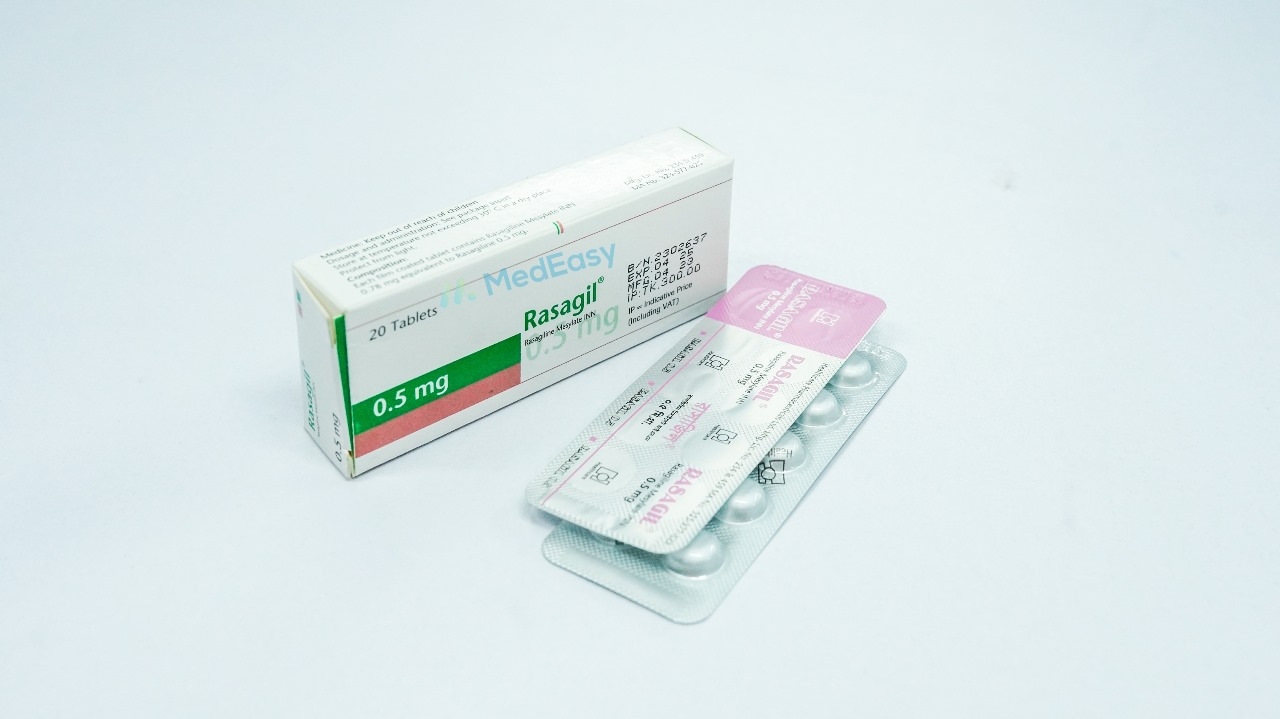
Rasagil0.5 mg
Healthcare Pharmaceuticals Ltd.
৳138.00
Add to cart


Ralect is a selective irreversible inhibitor of monoamine oxidase type B (MAO-B), approved for the treatment of idiopathic Parkinson's disease (PD).
Ralect has been studied for possible disease-modifying (neuroprotective) effects in Parkinson's disease, but this benefit has not been definitively established, and it is not an approved indication.
Each tablet contains Rasagiline (as rasagiline mesylate) 0.5 mg or 1 mg as the active ingredient, along with pharmaceutically acceptable excipients such as mannitol, colloidal silicon dioxide, magnesium stearate, and starch.
Ralect is a propargylamine derivative that acts as a potent, selective, and irreversible inhibitor of the monoamine oxidase type B (MAO-B) enzyme. By reducing the breakdown of dopamine in the brain, it helps improve motor function in patients with Parkinson's disease. It is administered orally as tablets and is used either alone in early disease or in combination with levodopa in more advanced stages.
Ralect belongs to the class of anti-Parkinson's agents, specifically the selective monoamine oxidase type B (MAO-B) inhibitors.
Rasagiline irreversibly and selectively inhibits MAO-B, the enzyme primarily responsible for the metabolic breakdown of dopamine in the brain. By blocking this enzyme, Rasagiline increases extracellular dopamine levels in the striatum, which helps compensate for the dopamine deficiency characteristic of Parkinson's disease and improves motor symptoms.
Pharmacokinetics: Rasagiline is rapidly absorbed after oral administration, with peak plasma concentrations reached within about 1 hour; absolute bioavailability is approximately 36%. It is extensively metabolized in the liver, primarily via the CYP1A2 enzyme, to inactive metabolites, and is excreted mainly in urine. Recovery of MAO-B activity after stopping treatment takes about 1-2 weeks, consistent with irreversible enzyme inhibition.
| Indication | Dose |
|---|---|
| Monotherapy (early Parkinson's disease) | 1 mg orally once daily |
| Adjunct to levodopa (advanced Parkinson's disease) | Initiate at 0.5 mg once daily; may increase to 1 mg once daily based on response and tolerability |
Ralect may be taken with or without food, at approximately the same time each day. A reduction in the levodopa dose may be considered in patients receiving combination therapy who develop dopaminergic side effects (e.g., dyskinesia).
Take Ralect tablets orally, once daily, at approximately the same time each day, with or without food. Swallow the tablet whole; do not crush or chew unless otherwise advised by a physician.
Ralect has several clinically significant drug interactions related to its MAO-B inhibitory activity:
Rasagiline is contraindicated in:
An adequate washout period (at least 14 days) is required between stopping Rasagiline and starting any of these contraindicated agents, and vice versa (5 weeks for fluoxetine).
Patients should promptly report any unusual behavioral changes, fainting spells, or skin lesions to their physician.
Pregnancy: There are no adequate and well-controlled studies of Ralect in pregnant women. Animal studies have shown adverse developmental effects at doses relevant to human exposure. Ralect should be used during pregnancy only if the potential benefit justifies the potential risk to the fetus; consult a physician before use.
Lactation: It is not known whether Ralect is excreted in human breast milk. Because many drugs are excreted in breast milk and the effects on a nursing infant are unknown, a decision should be made whether to discontinue breastfeeding or discontinue the drug, taking into account the importance of treatment to the mother; consult a physician.
Use Ralect with caution and under close medical supervision in the following situations:
Limited clinical experience with Ralect overdose is available. Reported and theoretically expected symptoms include severe hypotension or hypertension, dizziness, hallucinations, serotonin syndrome features (agitation, hyperthermia, muscle rigidity), and central nervous system depression or excitation. There is no specific antidote.
In case of a suspected overdose, seek immediate medical attention or contact a poison control center right away. Treatment is supportive and should be provided in a hospital setting with close monitoring of vital signs and cardiovascular status.
Store at room temperature (below 30°C), away from light and moisture. Keep out of reach of children.
No overall differences in safety or effectiveness have been observed between elderly and younger patients, but as with any medication, use with appropriate monitoring given the higher likelihood of hepatic or renal impairment and concomitant medications in this population.
Dose adjustment required in mild impairment (maximum 0.5 mg daily); not recommended in moderate to severe hepatic impairment (see Contraindications).
No specific dose adjustment is established, but clinical data are limited; use with caution.
Safety and efficacy of Ralect in pediatric patients have not been established; it is not indicated for use in children.
Ralect is intended for long-term, typically indefinite use as part of the ongoing management of Parkinson's disease, since it does not cure the underlying condition but helps control symptoms. Duration of treatment should be determined and periodically reassessed by the treating physician based on individual response and tolerability. Discontinuation should be discussed with a physician, and an appropriate washout period observed before starting other interacting medications.
Anti-Parkinson's agent; Selective Monoamine Oxidase Type B (MAO-B) Inhibitor.
Rasagiline works by selectively and irreversibly inhibiting the enzyme monoamine oxidase type B (MAO-B) in the brain. This enzyme normally breaks down dopamine; by blocking it, Rasagiline increases the availability of dopamine in the brain, helping to reduce the motor symptoms of Parkinson's disease such as tremor, rigidity, and bradykinesia.
The safety and efficacy of Ralect in pediatric patients (below 18 years of age) have not been established. Ralect is not approved or recommended for use in children or adolescents, and its use in this population should be avoided outside of specific clinical circumstances directed by a specialist.
Q: What is Ralect 0.5 mg Tablet used for?
A: Ralect 0.5 mg Tablet is used to treat Parkinson's disease, either alone in early stages or together with levodopa in more advanced stages, to help control symptoms such as tremor, stiffness, and slowness of movement.
Q: Can I take Ralect 0.5 mg Tablet with antidepressants?
A: Combining Ralect 0.5 mg Tablet with antidepressants such as SSRIs, SNRIs, or tricyclics is generally not recommended because it can increase the risk of a serious condition called serotonin syndrome. Always inform your doctor about all medications you take before starting Ralect 0.5 mg Tablet.
Q: Do I need to avoid certain foods while taking Ralect 0.5 mg Tablet?
A: At the recommended doses, strict dietary tyramine restriction is usually not required, but it is still wise to avoid excessive amounts of aged cheeses, cured meats, and fermented foods, as very high tyramine intake could rarely trigger a dangerous rise in blood pressure.
Q: What should I do if I miss a dose of Ralect 0.5 mg Tablet?
A: If you miss a dose, take it as soon as you remember unless it is almost time for your next dose, in which case skip the missed dose. Do not take a double dose to make up for a missed one, and contact your doctor if you are unsure.
Q: Is Ralect 0.5 mg Tablet safe during pregnancy?
A: There is not enough human safety data on Ralect 0.5 mg Tablet use during pregnancy, and animal studies have shown some risk to the developing fetus. It should only be used in pregnancy if your doctor decides the benefit clearly outweighs the potential risk, so always consult your physician.
Q: Can Ralect 0.5 mg Tablet cause sudden sleepiness or behavioral changes?
A: Yes, some patients taking Ralect 0.5 mg Tablet have experienced sudden episodes of falling asleep during daily activities, including driving, as well as new or worsening impulsive behaviors like gambling or compulsive shopping. Report any such changes to your doctor promptly and use caution with driving or operating machinery until you know how the medicine affects you.
Disclaimer
The information provided is accurate to the best of our knowledge, but it does not replace professional medical advice. We cannot guarantee its completeness or accuracy, and the absence of specific information about a drug should not be taken as an endorsement. We are not responsible for any consequences arising from this information, so please consult a healthcare professional for any concerns or questions.

