
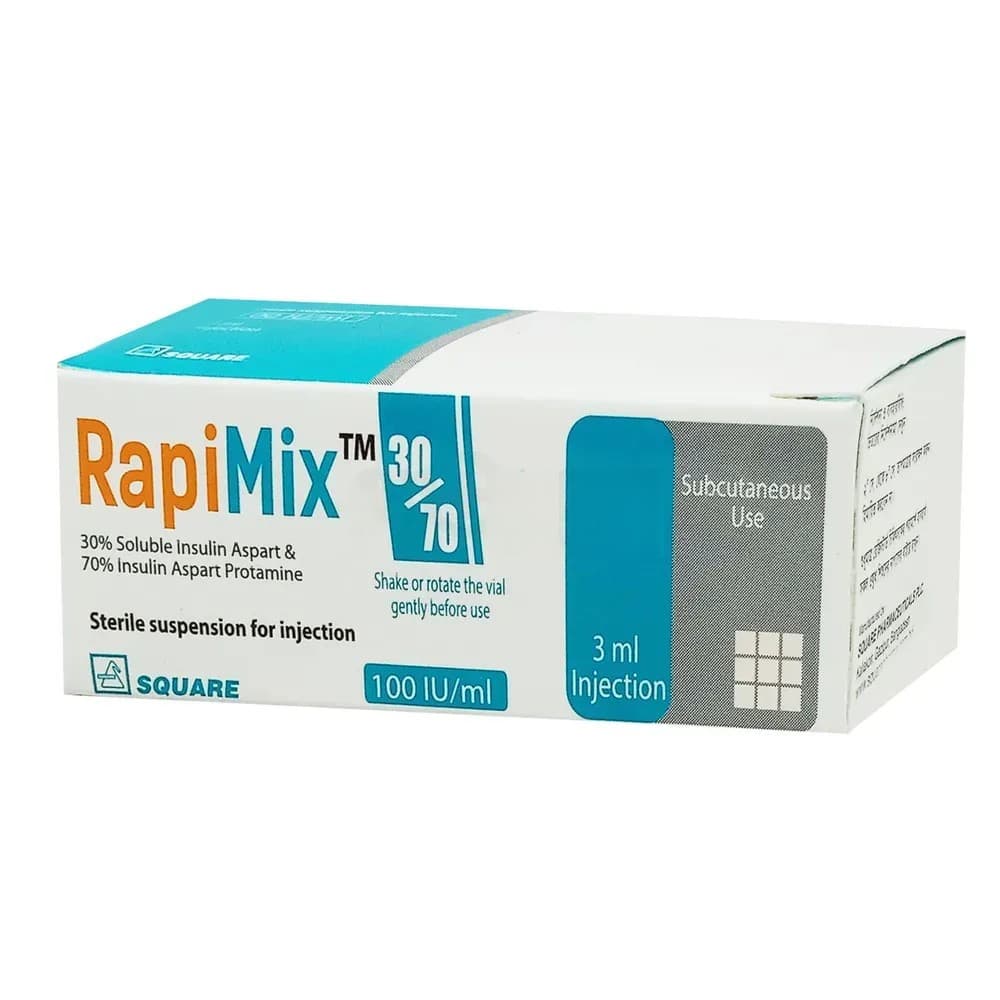

Medicine overview
Indications of RapiMix Pen Cartridge 3 ml
RapiMix Pen Cartridge 3 ml is a premixed (biphasic) insulin combining a rapid-acting component (insulin aspart) with an intermediate-acting, protamine-complexed component (insulin aspart protamine) in a single injection.
Established/FDA-approved use
- Improvement of glycemic control in adults and children with type 1 diabetes mellitus (as part of a regimen with a longer-acting basal insulin if needed) and in adults with type 2 diabetes mellitus who require insulin for glycemic control.
It is intended for patients who need both mealtime (prandial) and intermediate basal coverage but prefer or require fewer daily injections than a full basal-bolus regimen. It is not intended for continuous subcutaneous infusion (insulin pumps) and is not a substitute for a long-acting basal insulin in all patients.
Composition
Each mL of the premixed suspension typically contains a fixed ratio of rapid-acting insulin aspart and intermediate-acting insulin aspart protamine (commonly supplied as a 30% insulin aspart / 70% insulin aspart protamine suspension, i.e., a 30/70 mix), with zinc, phenol, metacresol, glycerol, and water for injection as excipients, and protamine sulfate forming the intermediate-acting crystalline complex.
Description
RapiMix Pen Cartridge 3 ml is a biphasic (premixed) human insulin analogue suspension for subcutaneous injection. Insulin aspart is a rapid-acting analogue produced by recombinant DNA technology in which proline at position B28 is substituted with aspartic acid, giving it a faster onset than regular human insulin. Insulin aspart protamine is a crystalline complex of insulin aspart with protamine that delays absorption, providing an intermediate-acting basal-like effect. Combined, the suspension provides both a rapid post-prandial glucose-lowering effect and a longer, intermediate-duration background effect from a single injection.
Theropeutic Class
RapiMix Pen Cartridge 3 ml belongs to the therapeutic class of antidiabetic agents - premixed (biphasic) insulin analogue preparations, combining rapid-acting and intermediate-acting insulin components.
Pharmacology
RapiMix Pen Cartridge 3 ml lowers blood glucose by binding to insulin receptors on target tissues (skeletal muscle, adipose tissue, liver), stimulating peripheral glucose uptake, and inhibiting hepatic glucose production. The rapid-acting insulin aspart fraction has an onset of action of approximately 10-20 minutes, allowing it to be given close to a meal, while the protamine-complexed fraction dissolves and is absorbed more slowly, producing an intermediate duration of action of up to 24 hours with a peak effect typically between 1 and 4 hours after injection. This biphasic profile is designed to cover both the glucose excursion from a meal and background insulin needs between meals.
Dosage & Administration of RapiMix Pen Cartridge 3 ml
Dosing of RapiMix Pen Cartridge 3 ml must always be individualized and titrated by a physician based on the patient's blood glucose monitoring, metabolic needs, meal pattern, and activity level. There is no fixed universal dose.
| Population | General dosing approach |
|---|---|
| Adults (type 1 or type 2 diabetes) | Total daily insulin requirement is individualized; typically given as one or two subcutaneous injections per day, shortly before (0-10 minutes) a meal, timed to match the injection with a meal of consistent carbohydrate content. |
| Switching from another insulin regimen | Requires close medical supervision and blood glucose monitoring during transition; dose and timing adjusted by the prescriber. |
| Renal or hepatic impairment | Insulin requirements may be reduced due to altered insulin clearance or metabolism; more frequent glucose monitoring and dose adjustment by the physician is required. |
Because the product contains a fixed ratio of rapid- and intermediate-acting insulin, the ratio itself cannot be individually adjusted; if a different ratio of rapid- to intermediate-acting insulin is needed, a physician may prescribe the components separately.
Dosage of RapiMix Pen Cartridge 3 ml
Dose must be individualized by the treating physician based on blood glucose monitoring; there is no standard fixed dose. See Dosage and Administration for the general approach by population.
Administration of RapiMix Pen Cartridge 3 ml
RapiMix Pen Cartridge 3 ml is given by subcutaneous injection only (into the abdomen, thigh, buttock, or upper arm), typically 0-10 minutes before a meal. It must never be given intravenously or intramuscularly. Injection sites should be rotated within the same body region to reduce the risk of lipodystrophy. The suspension must be gently rolled/tipped (not shaken vigorously) to re-suspend evenly before each dose, and should look uniformly white and cloudy; it should not be used if it remains clear, contains clumps, or has particulate matter after mixing. It should not be mixed with other insulins in the same syringe.
Interaction of RapiMix Pen Cartridge 3 ml
Several medicines can alter blood glucose control and the effect of RapiMix Pen Cartridge 3 ml:
- Increased hypoglycemia risk: oral antidiabetic agents, ACE inhibitors, angiotensin II receptor blockers, disopyramide, fibrates, fluoxetine, MAO inhibitors, pentoxifylline, propoxyphene, salicylates, and alcohol.
- Reduced insulin effect (may increase blood glucose): corticosteroids, danazol, diuretics (e.g., thiazides), sympathomimetics, isoniazid, niacin, oral contraceptives/estrogens, protease inhibitors, and atypical antipsychotics.
- Masking of hypoglycemia symptoms: beta-blockers, clonidine, guanethidine, and reserpine may blunt the warning signs of hypoglycemia.
- Thiazolidinediones (e.g., pioglitazone): concomitant use with insulin increases the risk of fluid retention and heart failure, particularly in patients with pre-existing cardiac risk factors.
Any change in dose of concomitant medication should prompt closer glucose monitoring under physician guidance.
Contraindications
RapiMix Pen Cartridge 3 ml is contraindicated in:
- Known hypersensitivity to insulin aspart, insulin aspart protamine, or any excipient in the formulation.
- During episodes of hypoglycemia (active low blood glucose).
Side Effects of RapiMix Pen Cartridge 3 ml
The most common and clinically important adverse effect of RapiMix Pen Cartridge 3 ml is:
- Hypoglycemia - the most frequent and potentially serious adverse effect, which can occur with dose errors, missed or delayed meals, unplanned exercise, or alcohol intake. Symptoms include sweating, tremor, palpitations, hunger, confusion, and, if severe, loss of consciousness or seizures.
Other reported effects include:
- Injection-site reactions - redness, swelling, itching, or lipodystrophy (thickening or pitting of fat) with repeated injection at the same site.
- Weight gain, common with insulin therapy in general.
- Peripheral edema, especially when insulin therapy is intensified after a period of poor control.
- Allergic reactions - localized or, rarely, generalized rash, itching, or (rarely) anaphylaxis.
- Hypokalemia (low blood potassium) with high doses or intensified therapy.
Pregnancy & Lactation
Insulin requirements often change during pregnancy (may decrease in the first trimester and increase in later trimesters) and glycemic control is important for both maternal and fetal outcomes. RapiMix Pen Cartridge 3 ml should be used in pregnancy only under close medical supervision, with dose adjustments guided by frequent blood glucose monitoring; use only if clearly needed and the potential benefit justifies the potential risk, and consult a physician. Insulin is generally considered compatible with breastfeeding since it does not appear to pass into breast milk in a manner that affects the infant, but breastfeeding mothers using this product should continue to be monitored by their physician, as insulin dose and diet may need adjustment.
Precautions & Warnings
Hypoglycemia is the primary and most serious risk with RapiMix Pen Cartridge 3 ml; patients and caregivers should be trained to recognize and treat it promptly (see Side Effects).
- Consistent meal timing: because this product combines a rapid- and an intermediate-acting insulin, injections must be given close to a meal with a fairly consistent carbohydrate content and timing to avoid mismatched glucose lowering.
- Do not interchange with other premixed insulin products, insulin pens, or insulin types without explicit medical guidance, as onset, peak, and duration of action can differ significantly between products.
- Illness, stress, or changes in diet/exercise/travel may require dose adjustment under medical supervision.
- Hypokalemia: monitor potassium in patients at risk (e.g., those on potassium-lowering medications).
- Renal or hepatic impairment may necessitate more frequent monitoring and dose adjustment (see Dosage and Administration).
- Do not administer intravenously or intramuscularly.
- Never share insulin pens/devices between patients, even with a new needle, due to risk of disease transmission.
Overdose Effects of RapiMix Pen Cartridge 3 ml
Overdose of RapiMix Pen Cartridge 3 ml can cause severe, prolonged hypoglycemia, which may be life-threatening. Mild episodes can often be managed with oral fast-acting carbohydrate, but more severe episodes with confusion, seizure, or unconsciousness require immediate medical attention - contact a physician, go to the nearest emergency department, or call local emergency services right away. Do not attempt to manage a severe overdose at home without professional guidance.
Storage Conditions
Store unopened vials/pens/cartridges in a refrigerator (2°C to 8°C); do not freeze, and discard if it has been frozen. Once in use, the pen/vial currently in use may generally be kept at room temperature (below 30°C), away from direct heat and light, for the duration specified by the manufacturer, and should not be returned to the refrigerator. Keep out of reach of children. Do not use after the expiry date or if the suspension does not mix to a uniform white, cloudy appearance.
Use In Special Populations
Pediatric use: RapiMix Pen Cartridge 3 ml may be used in children with type 1 diabetes under close medical supervision; dosing is individualized and titrated based on the child's needs, growth, and glucose monitoring, and safety/efficacy in very young children may not be fully established (see Pediatric Uses).
Elderly: insulin requirements may be less predictable due to declining renal function and variable food intake; more frequent glucose monitoring is advised and doses should be conservatively titrated to reduce hypoglycemia risk.
Renal/hepatic impairment: insulin needs may be reduced due to altered clearance/metabolism; monitor closely and adjust dose (see Dosage and Administration).
Duration Of Treatment
Diabetes mellitus generally requires long-term, ongoing insulin therapy. There is no fixed treatment duration; therapy continues as long as needed to maintain glycemic control, with dose and regimen periodically reassessed by the treating physician based on blood glucose monitoring, HbA1c, and clinical status.
Drug Classes
Antidiabetic agent; premixed (biphasic) insulin analogue combining rapid-acting insulin aspart and intermediate-acting insulin aspart protamine.
Mode Of Action
RapiMix Pen Cartridge 3 ml acts by binding to insulin receptors, promoting cellular glucose uptake (particularly in muscle and fat tissue) and suppressing hepatic glucose output, thereby lowering blood glucose. The rapid-acting fraction dissociates quickly after subcutaneous injection for a fast onset, while the protamine-complexed fraction dissolves more slowly to provide an intermediate, longer-lasting basal-like effect.
Pediatric Uses
RapiMix Pen Cartridge 3 ml may be used in children with type 1 diabetes mellitus who require premixed insulin therapy, under close pediatric/endocrinology supervision. Dosing is individualized based on age, weight, growth, diet, activity, and blood glucose monitoring - there is no fixed pediatric dose. Safety and efficacy in very young children (e.g., below the age ranges studied in clinical trials) have not been fully established, and use in this age group should be guided by a pediatric specialist.
Frequently Asked Questions
Q: What is RapiMix Pen Cartridge 3 ml used for?
A: It is a premixed insulin used to help control blood glucose in adults and children with type 1 diabetes and in adults with type 2 diabetes who need insulin, providing both rapid mealtime and intermediate background glucose control from a single injection.
Q: How and when should I inject RapiMix Pen Cartridge 3 ml?
A: It is injected under the skin (subcutaneously) into the abdomen, thigh, buttock, or upper arm, usually 0-10 minutes before a meal. It must never be injected into a vein or muscle, and the suspension should be gently rolled to mix evenly before each dose.
Q: What is the biggest risk with this insulin?
A: The biggest risk is hypoglycemia (low blood sugar), which can occur with dose errors, skipped or delayed meals, extra exercise, or alcohol. Symptoms include sweating, shakiness, confusion, and hunger; severe hypoglycemia can cause seizures or loss of consciousness and needs urgent treatment.
Q: Can I use RapiMix Pen Cartridge 3 ml during pregnancy or while breastfeeding?
A: It should be used in pregnancy only under close medical supervision, with dosing adjusted based on frequent blood glucose monitoring, and only if the benefit justifies the potential risk - consult your physician. It is generally considered compatible with breastfeeding, but continued medical monitoring is advised.
Q: Can I switch between different premixed insulins on my own?
A: No. Do not interchange RapiMix Pen Cartridge 3 ml with other premixed insulin products or insulin types without your doctor's guidance, because different products have different onset, peak, and duration profiles that can affect blood glucose control.
Q: What should I do if I think I've taken too much?
A: An overdose can cause severe, prolonged low blood sugar. If you have symptoms like confusion, seizure, or loss of consciousness, seek emergency medical attention immediately or contact your local emergency services; do not try to manage a severe episode alone.
Disclaimer
The information provided is accurate to the best of our knowledge, but it does not replace professional medical advice. We cannot guarantee its completeness or accuracy, and the absence of specific information about a drug should not be taken as an endorsement. We are not responsible for any consequences arising from this information, so please consult a healthcare professional for any concerns or questions.
