
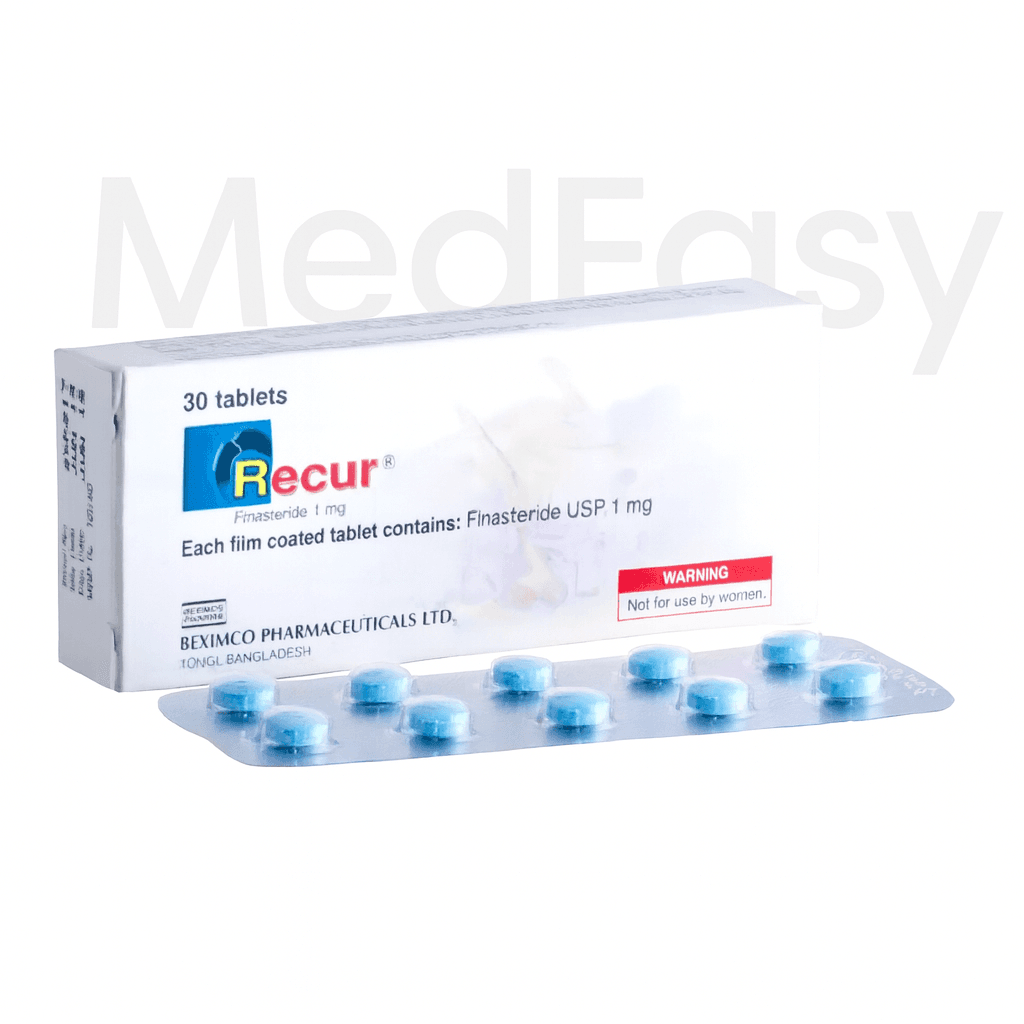

Medicine overview
Indications of Recur
Recur is indicated for the treatment of male pattern hair loss (androgenic alopecia) in men only, at the low 1 mg dose specifically formulated for this purpose.
Established/FDA-approved use
- Treatment of mild to moderate androgenic alopecia (male pattern baldness) in men, involving the vertex and anterior mid-scalp area, to promote hair growth and prevent further hair loss.
Important notes on evidence and scope
- Recur at this 1 mg dose is not indicated for women or children and has not been shown to be effective in frontal (receding hairline) hair loss alone or in bitemporal recession.
- Benefit is generally seen after continuous use for 3-6 months or longer; hair regrowth is lost within about 12 months of stopping treatment.
- Recur is sometimes used off-label in combination with topical minoxidil for enhanced results, though this combination use is not itself an FDA-approved indication.
Composition
Each film-coated tablet of Finasteride [For Androgenic Alopecia] contains Finasteride 1 mg as the active pharmaceutical ingredient, along with standard pharmaceutical excipients (e.g., lactose monohydrate, microcrystalline cellulose, pregelatinized starch, sodium starch glycolate, hydroxypropyl cellulose, magnesium stearate, and a film coating).
Description
Recur is an oral synthetic 4-azasteroid compound that acts as a selective inhibitor of the enzyme type II 5-alpha-reductase. At the low 1 mg dose, it is specifically formulated and approved for the treatment of male pattern hair loss (androgenic alopecia) in men, as distinguished from the higher 5 mg dose of finasteride used for benign prostatic hyperplasia.
It is supplied as a film-coated oral tablet and is intended for long-term, continuous daily use to maintain hair regrowth benefits.
Therapeutic Class
Recur belongs to the therapeutic class of 5-alpha-reductase inhibitors, specifically used at low dose as an anti-androgenic alopecia agent (hair loss treatment).
Pharmacology
Mechanism of Action
Finasteride [For Androgenic Alopecia] is a competitive and specific inhibitor of type II 5-alpha-reductase, the intracellular enzyme that converts testosterone into dihydrotestosterone (DHT). DHT is the androgen primarily responsible for the miniaturization of scalp hair follicles that occurs in genetically susceptible men, leading to androgenic alopecia.
By blocking this conversion, Finasteride [For Androgenic Alopecia] reduces scalp and serum DHT levels (scalp DHT reduced by roughly 60%), which slows or reverses follicular miniaturization and promotes regrowth of terminal hair in affected areas.
Pharmacokinetics
- Absorption: Well absorbed orally; bioavailability is not significantly affected by food.
- Protein binding: Approximately 90%.
- Metabolism: Extensively metabolized in the liver via the cytochrome P450 3A4 enzyme system.
- Elimination half-life: Approximately 5-6 hours in younger men; slightly longer in men over 70 years.
- Excretion: Primarily as metabolites, roughly 57% in feces and 40% in urine.
Dosage & Administration of Recur
Recommended Dose
| Indication | Dose |
|---|---|
| Male pattern hair loss (androgenic alopecia) in men | 1 mg by mouth once daily |
Recur may be taken with or without food. It should be taken continuously and consistently, generally for at least 3-6 months, before a response can be reliably assessed. Continued daily use is required to maintain benefit; hair loss typically resumes within 9-12 months of stopping treatment.
See Use in Special Populations for pediatric, renal, and hepatic considerations, and Contraindications for who must not use this medicine.
Administration of Recur
Swallow the Recur tablet whole with a glass of water. Do not split, crush, or chew the tablet, as women and children should avoid contact with crushed or broken tablets (see Contraindications and Precautions). Missing an occasional dose is not expected to cause harm; simply resume the normal schedule at the next dose rather than doubling up.
Interaction of Recur
Recur has a low potential for clinically significant drug interactions. No dose adjustment is required for commonly co-administered drugs. Well-documented interaction considerations include:
- CYP3A4 inhibitors/inducers: Finasteride is metabolized via CYP3A4; strong inhibitors (e.g., ketoconazole, ritonavir) may theoretically increase finasteride levels, but no dose adjustment is established as necessary based on available clinical data.
- PSA-based prostate cancer screening tests: Not a pharmacologic drug interaction, but a clinically important interaction with laboratory testing — Recur lowers serum PSA levels by approximately 50%, which must be accounted for when interpreting PSA results in men on this medication (see Precautions).
No other well-established, clinically significant drug-drug interactions have been identified in labeling. Always inform your physician or pharmacist about all other medicines you are taking.
Contraindications
Finasteride [For Androgenic Alopecia] is contraindicated in:
- Women, particularly women who are or may become pregnant. Finasteride [For Androgenic Alopecia] is not indicated for use in women. It carries a risk of causing abnormal development of external genitalia in a male fetus if taken by or absorbed by a pregnant woman.
- Known hypersensitivity to finasteride or any component of the formulation.
Finasteride [For Androgenic Alopecia] is not indicated for use in children.
Side Effects of Recur
Most men tolerate Recur well. Reported side effects include:
Common
- Decreased libido (sex drive)
- Erectile dysfunction
- Decreased volume of ejaculate
- Ejaculation disorders
Less common/other reported effects
- Breast tenderness and/or enlargement (gynecomastia)
- Depression, mood changes, and rarely, suicidal ideation have been reported post-marketing
- Skin rash, hypersensitivity reactions including lip swelling
- Testicular pain
Sexual side effects usually resolve on stopping the medicine, but have rarely been reported to persist after discontinuation. Report any persistent or bothersome side effects, or any changes in mood, to your physician promptly.
Pregnancy & Lactation
Recur is not indicated for use in women under any circumstance, including pregnancy and breastfeeding.
Recur is classified as carrying a significant risk of fetal harm (abnormal development of external genitalia in a male fetus) if a pregnant woman is exposed to the active ingredient, whether by ingestion or by absorption through the skin from handling crushed or broken tablets. Women who are pregnant or who may become pregnant should not handle crushed or broken Recur tablets. If a pregnant woman is exposed to finasteride, she should consult her physician promptly.
There is no established safety information regarding breastfeeding, as Recur is not intended for use in women; it should not be used during lactation.
Precautions & Warnings
- Not for use in women or children — Recur is intended for men only (see Contraindications).
- Handling of tablets: Women who are or may become pregnant should not handle crushed or broken Recur tablets due to potential absorption and fetal risk.
- Sexual dysfunction: May cause decreased libido, erectile dysfunction, or ejaculation disorders; rarely these have been reported to persist after stopping treatment. Discuss any such symptoms with your physician.
- Mood changes: Depression and mood alteration have been reported; seek prompt medical attention for new or worsening mood symptoms, including suicidal thoughts.
- Effect on PSA screening: Recur lowers serum PSA levels by roughly 50% within about 6-12 months, even in the presence of prostate cancer. Men on this medication should establish a new PSA baseline and inform their physician they are taking Recur before any PSA-based prostate cancer screening.
- Breast changes: Report any lumps, pain, nipple discharge, or enlargement of breast tissue promptly, as these have rarely been associated with breast cancer.
- Blood donation: Men taking Recur should not donate blood until at least one month after their last dose, to prevent exposure of a pregnant transfusion recipient.
Overdose Effects of Recur
There is limited clinical experience with overdose of Recur. In studies, single doses far higher than the recommended 1 mg dose were tolerated without significant adverse effects. If an overdose is suspected, seek immediate medical attention or contact a poison control center. There is no specific antidote; treatment should be symptomatic and supportive, as directed by a physician.
Storage Conditions
Store at room temperature (below 30°C), away from light and moisture. Keep out of reach of children, and out of reach of women who are or may become pregnant.
Use In Special Populations
Pediatric Use
Recur is not indicated for use in children. Safety and effectiveness in patients under 18 years of age have not been established.
Geriatric Use
No overall differences in effectiveness were observed between older and younger men in clinical trials of finasteride for hair loss; no dosage adjustment is necessary based on age alone. Note that androgenic alopecia treatment is generally studied and used in men up to age 41 in pivotal trials.
Hepatic Impairment
Recur is extensively metabolized in the liver; use with caution in patients with hepatic impairment, as plasma concentrations may be increased. Consult a physician before use in significant liver disease.
Renal Impairment
No dosage adjustment is considered necessary in patients with renal impairment, based on available pharmacokinetic data.
Women
Recur is contraindicated for use in women (see Contraindications and Pregnancy and Lactation).
Duration Of Treatment
Recur is intended for long-term, continuous daily use. A visible response typically requires at least 3-6 months of regular use, and maximal benefit may take up to 12 months or longer. Because androgenic alopecia is a progressive condition, treatment benefit is only maintained with ongoing daily use — hair regrowth is generally lost within about 9-12 months after discontinuation. Duration of therapy should be discussed with and monitored by a physician.
Drug Classes
5-alpha-reductase inhibitor (Type II selective); anti-androgenic alopecia agent.
Mode Of Action
Finasteride [For Androgenic Alopecia] selectively and competitively inhibits the type II isoenzyme of 5-alpha-reductase, blocking the conversion of testosterone to dihydrotestosterone (DHT) in the scalp and other tissues. Since DHT drives the progressive miniaturization of genetically susceptible scalp hair follicles in androgenic alopecia, lowering local DHT levels halts this process and allows regrowth of thicker, longer terminal hairs over time.
Pregnancy
X
Pediatric Uses
Recur is not approved for use in children or adolescents under 18 years of age. Safety and efficacy in this population have not been established, and it should not be prescribed for pediatric patients.
Frequently Asked Questions
Q: What is Recur 1 mg Tablet used for?
A: Recur 1 mg Tablet (finasteride 1 mg) is used to treat male pattern hair loss (androgenic alopecia) in men, helping to slow further hair loss and promote regrowth on the crown and mid-scalp.
Q: How long does it take for Recur 1 mg Tablet to work?
A: Most men need to take Recur 1 mg Tablet continuously for at least 3-6 months before noticing improvement, with fuller results seen after 12 months of consistent daily use.
Q: What happens if I stop taking Recur 1 mg Tablet?
A: Any hair regrowth achieved is gradually lost, usually within 9-12 months of stopping, as the underlying hormonal process (DHT-driven follicle miniaturization) resumes.
Q: Can women use Recur 1 mg Tablet?
A: No. Recur 1 mg Tablet is not indicated for women and is contraindicated, especially in women who are or may become pregnant, due to the risk of abnormal genital development in a male fetus. Pregnant women should also avoid handling crushed or broken tablets.
Q: Does Recur 1 mg Tablet cause sexual side effects?
A: Some men experience decreased libido, erectile dysfunction, or reduced ejaculate volume while taking Recur 1 mg Tablet. These effects usually resolve after stopping the medicine, though rare cases of persistence have been reported. Discuss any concerns with your physician.
Q: Will Recur 1 mg Tablet affect my prostate (PSA) test results?
A: Yes. Recur 1 mg Tablet can lower PSA blood test levels by about 50%, even if prostate cancer is present. Tell your doctor you are taking Recur 1 mg Tablet before any PSA-based screening so results can be interpreted correctly.
Disclaimer
The information provided is accurate to the best of our knowledge, but it does not replace professional medical advice. We cannot guarantee its completeness or accuracy, and the absence of specific information about a drug should not be taken as an endorsement. We are not responsible for any consequences arising from this information, so please consult a healthcare professional for any concerns or questions.
