

10% Off
Reluren40 mg+1 mg
Renata Limited
৳450.00
Add to cart
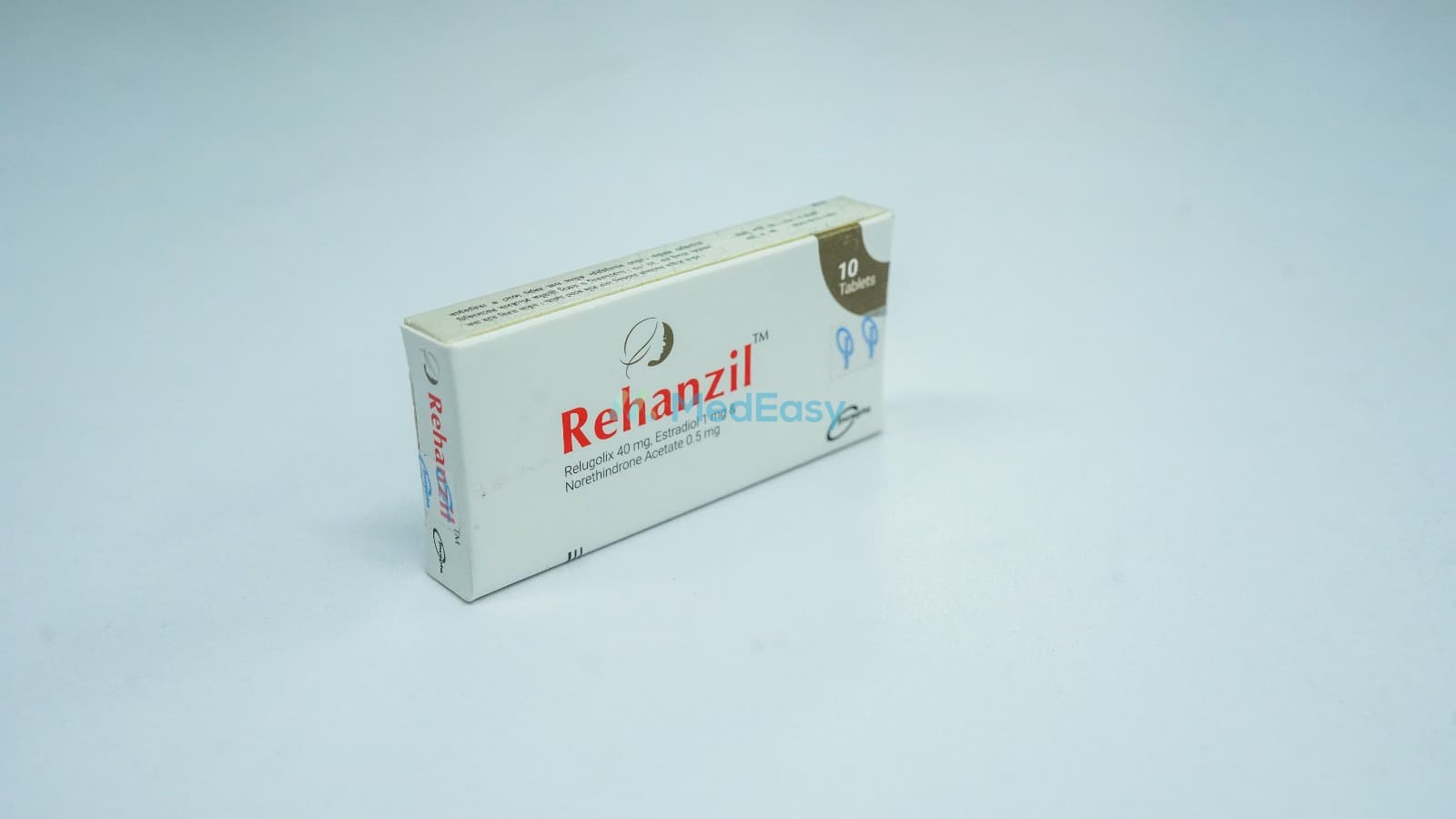

Rehanzil is a fixed-dose combination of a GnRH receptor antagonist (relugolix) with low-dose "add-back" hormone therapy (estradiol and norethindrone acetate), indicated in premenopausal women for:
Rehanzil is not indicated for use in men; it is a women's-health combination product distinct from relugolix monotherapy used for advanced prostate cancer. It is not intended as a contraceptive, and effective non-hormonal contraception should be used if pregnancy is possible.
Each film-coated tablet of Relugolix + Estradiol + Norethindrone contains relugolix 40 mg, estradiol 1 mg, and norethindrone acetate 0.5 mg as active ingredients, combined in a single fixed-dose tablet taken once daily.
Rehanzil combines a gonadotropin-releasing hormone (GnRH) receptor antagonist (relugolix) with low-dose estrogen (estradiol) and a progestin (norethindrone acetate) as "add-back" hormone therapy. Relugolix suppresses ovarian estrogen production by blocking pituitary GnRH receptors, which reduces estrogen-dependent pain and bleeding; the added low-dose estradiol and norethindrone acetate help offset hypoestrogenic effects such as bone mineral density loss and vasomotor symptoms that would otherwise occur with GnRH suppression alone.
Rehanzil belongs to the therapeutic class of GnRH receptor antagonists combined with hormone add-back therapy, used in reproductive endocrinology and gynecology for hormonally-driven gynecologic conditions.
Relugolix + Estradiol + Norethindrone works through two complementary mechanisms:
Relugolix is absorbed orally with low bioavailability and is metabolized mainly via CYP3A4, with some involvement of P-glycoprotein transport. Estradiol and norethindrone acetate undergo hepatic metabolism typical of oral estrogen/progestin combinations. Steady-state suppression of ovarian estradiol is generally achieved within the first month of continuous once-daily dosing.
| Indication | Dose |
|---|---|
| Heavy menstrual bleeding associated with uterine fibroids | One tablet (relugolix 40 mg/estradiol 1 mg/norethindrone acetate 0.5 mg) by mouth once daily |
| Moderate to severe endometriosis-associated pain | One tablet by mouth once daily |
Treatment with Rehanzil should be started within the first 7 days of the onset of menses. If estrogen-containing contraceptives were used previously, Rehanzil should generally be started the day after the last active pill/ring/patch is stopped, per physician guidance.
If a dose of Rehanzil is missed, it should be taken as soon as remembered on the same day, then the regular once-daily schedule resumed the next day. Do not take two doses on the same day to make up for a missed dose.
Not established; Rehanzil is not indicated in pediatric or premenarchal patients.
No dose adjustment has been established for renal impairment. Rehanzil is contraindicated in patients with hepatic impairment or active liver disease (see Contraindications).
Rehanzil is administered orally, swallowed whole with water, once daily at approximately the same time each day, with or without food. Consistent daily timing helps maintain steady hormone suppression.
Rehanzil has the following well-established, clinically significant interactions:
Relugolix + Estradiol + Norethindrone is contraindicated in patients with:
Adverse effects of Rehanzil differ somewhat by indication:
Other effects include changes in bone mineral density and lipid parameters (see Precautions and Warnings for details, which are not repeated here).
Pregnancy: Rehanzil is contraindicated in pregnancy. It may cause early pregnancy loss based on its mechanism of action and animal reproduction data. Pregnancy should be excluded before starting treatment, and effective non-hormonal contraception is recommended during use, since Rehanzil does not reliably prevent ovulation-related fertility in all patients and its estrogen/progestin components are not intended as a standalone contraceptive. If pregnancy occurs or is suspected during treatment, Rehanzil should be discontinued immediately and a physician consulted.
Lactation: There is limited data on the presence of Rehanzil components in human milk or its effects on milk production or the breastfed infant. Use during breastfeeding is not recommended unless the potential benefit clearly justifies the potential risk to the infant; a physician should be consulted before use while breastfeeding.
Rehanzil contains estrogen and is associated with an increased risk of venous and arterial thromboembolic events, including deep vein thrombosis, pulmonary embolism, stroke, and myocardial infarction. Caution is warranted in patients with risk factors such as smoking, obesity, or migraine with aura; Rehanzil is contraindicated in those with current or prior thromboembolic disease (see Contraindications).
Use of Rehanzil is associated with dose-dependent loss of bone mineral density, which may not be fully reversible, particularly with treatment duration beyond the labeled maximum. Treatment should generally be limited to 24 months, and baseline and periodic bone mineral density monitoring is recommended, especially for extended use.
Depression, anxiety, and, rarely, suicidal ideation have been reported. Patients should be monitored for new or worsening mood symptoms, and evaluated promptly if these occur.
Elevations in liver enzymes and hepatic injury have been reported; periodic hepatic monitoring is advised, and Rehanzil is contraindicated in active liver disease.
Blood pressure should be monitored during treatment; Rehanzil should be discontinued if a significant increase in blood pressure occurs.
Rehanzil often improves heavy menstrual bleeding, but irregular spotting or bleeding can occur, particularly during the initial months of treatment. Altered bleeding patterns may also delay recognition of pregnancy.
Effective non-hormonal contraception is recommended during treatment, as discussed under Pregnancy and Lactation.
There is limited clinical experience with overdose of Rehanzil. In case of suspected overdose, seek immediate medical attention or contact a poison control center. Management should be supportive and symptomatic; there is no specific antidote. Do not attempt unsupervised home treatment for a suspected overdose.
Store at room temperature (below 30°C), away from light and moisture. Keep out of reach of children.
No dose adjustment is established; data in patients with severe renal impairment are limited, and Rehanzil should be used with caution in this group.
Rehanzil is contraindicated in patients with active liver disease or hepatic impairment (see Contraindications).
Rehanzil is indicated only in premenopausal women; it is not intended for use in postmenopausal women.
Safety and efficacy have not been established in pediatric or premenarchal patients.
Rehanzil is not indicated for use in men; this fixed-dose combination is distinct from relugolix monotherapy used for prostate cancer.
Use of Rehanzil should generally be limited to 24 months due to the risk of continued, potentially irreversible bone mineral density loss with longer treatment duration. The need for continued therapy should be reassessed periodically by the prescribing physician, weighing symptom control against bone health monitoring.
Relugolix + Estradiol + Norethindrone is classified as a GnRH receptor antagonist (relugolix) combined with hormone add-back therapy (estrogen/progestin), used in gynecologic and reproductive endocrine disorders.
Relugolix + Estradiol + Norethindrone acts by having relugolix competitively block pituitary GnRH receptors, suppressing LH/FSH release and consequently ovarian estradiol and progesterone production, which reduces estrogen-driven uterine bleeding and endometriosis pain; the co-formulated low-dose estradiol and norethindrone acetate partially replace lost hormone levels to limit hypoestrogenic side effects such as vasomotor symptoms and bone loss.
Rehanzil is not indicated for use in pediatric patients. Safety and efficacy in patients who have not reached menarche, or in children and adolescents generally, have not been established.
Q: What is Rehanzil 40 mg+1 mg+0.5 mg Tablet used for?
A: Rehanzil 40 mg+1 mg+0.5 mg Tablet is used in premenopausal women to manage moderate to severe pain from endometriosis and to manage heavy menstrual bleeding caused by uterine fibroids.
Q: How is Rehanzil 40 mg+1 mg+0.5 mg Tablet taken?
A: Rehanzil 40 mg+1 mg+0.5 mg Tablet is taken as one tablet by mouth once daily, at about the same time each day, with or without food, generally starting within the first 7 days of a menstrual period.
Q: Can Rehanzil 40 mg+1 mg+0.5 mg Tablet be used during pregnancy?
A: No. Rehanzil 40 mg+1 mg+0.5 mg Tablet is contraindicated in pregnancy and may cause early pregnancy loss. Pregnancy should be ruled out before starting, and effective non-hormonal contraception should be used during treatment; if pregnancy occurs, stop Rehanzil 40 mg+1 mg+0.5 mg Tablet and consult a physician immediately.
Q: What are the main risks of Rehanzil 40 mg+1 mg+0.5 mg Tablet?
A: The main risks include an increased chance of blood clots, stroke, or heart attack (especially in smokers, those with obesity, or migraine with aura), bone mineral density loss with longer use, and mood changes such as depression or anxiety. Report any leg swelling/pain, chest pain, sudden severe headache, vision changes, or worsening mood promptly.
Q: How long can I stay on Rehanzil 40 mg+1 mg+0.5 mg Tablet?
A: Treatment with Rehanzil 40 mg+1 mg+0.5 mg Tablet should generally be limited to 24 months because of the risk of bone mineral density loss, which may not fully reverse. Your physician will periodically reassess whether continued treatment is appropriate.
Q: What if I miss a dose of Rehanzil 40 mg+1 mg+0.5 mg Tablet?
A: If you miss a dose, take it as soon as you remember that same day, then resume your normal once-daily schedule the next day. Do not take two tablets in one day to make up for a missed dose.
Disclaimer
The information provided is accurate to the best of our knowledge, but it does not replace professional medical advice. We cannot guarantee its completeness or accuracy, and the absence of specific information about a drug should not be taken as an endorsement. We are not responsible for any consequences arising from this information, so please consult a healthcare professional for any concerns or questions.
