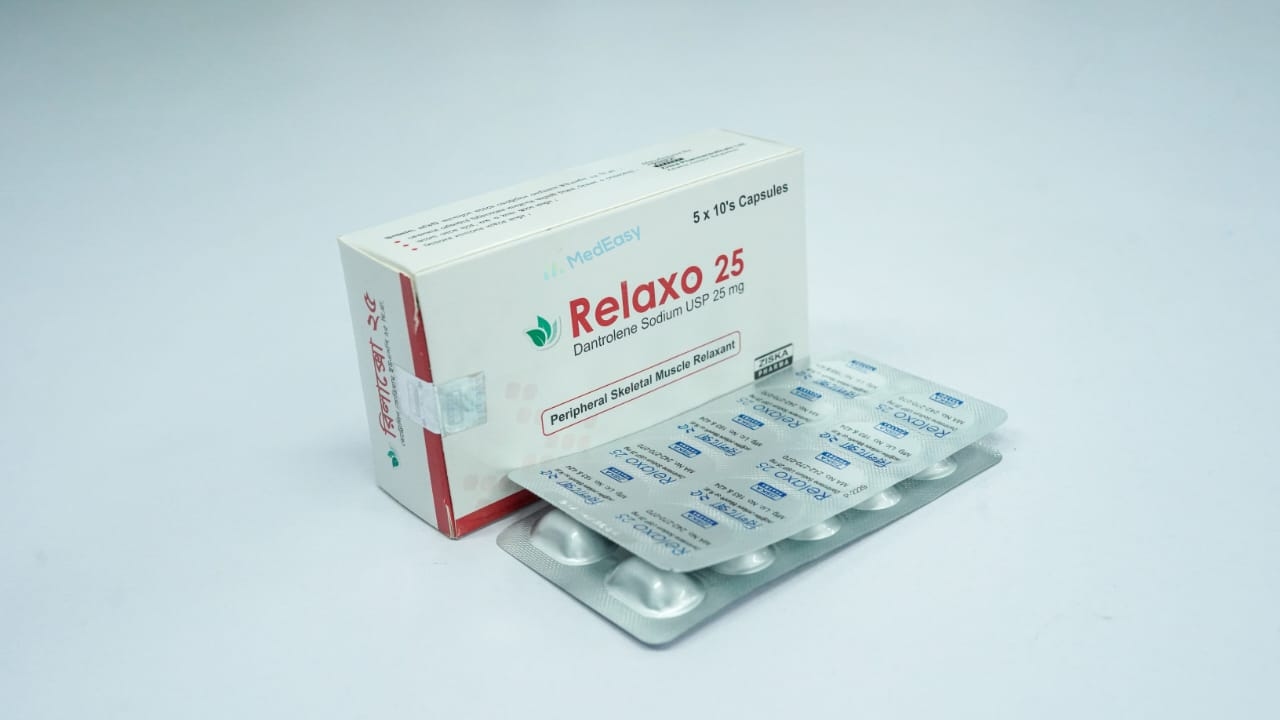
In Chronic Spasticity: Dantrolene is indicated in controlling the manifestations of clinical spasticity resulting from upper motor neuronal disorders (e.g., spinal cord injury, stroke, cerebral palsy, or multiple sclerosis). It is of particular benefit to the patients whose functional ... Read moreIn Chronic Spasticity: Dantrolene is indicated in controlling the manifestations of clinical spasticity resulting from upper motor neuronal disorders (e.g., spinal cord injury, stroke, cerebral palsy, or multiple sclerosis). It is of particular benefit to the patients whose functional rehabilitation has been retarded by the sequelae of spasticity. Such patients must have presumably reversible spasticity where relief of spasticity will aid in restoring residual function. Dantrolene is not indicated in the treatment of skeletal muscle spasm resulting from rheumatic disorders. Occasionally, subtle but meaningful improvement in spasticity may occur with Dantrolene therapy. In such instances, information regarding improvement should be solicited from the patient. Brief withdrawal of Dantrolene for a period of 2 to 4 days will frequently demonstrate exacerbation of the manifestations of spasticity and may serve to confirm a clinical impression.A decision to continue the administration of Dantrolene on a long-term basis is justified if introduction of the drug into the patient's regimen:
produces a significant reduction in painful and/or disabling spasticity such as clonus, or
permits a significant reduction in the intensity and/or degree of nursing care required, or
rids the patient of any annoying manifestation of spasticity considered important by the patient himself.
In Malignant Hyperthermia: Oral Dantrolene is also indicated preoperatively to prevent or attenuate the development of signs of malignant hyperthermia in known, or strongly suspect, malignant hyperthermia susceptible patients who require anesthesia and/or surgery. Oral Dantrolene should be administered following a malignant hyperthermic crisis to prevent recurrence of the signs of malignant hyperthermia.
Theropeutic Class
Centrally acting Skeletal Muscle Relaxants
Pharmacology
Dantrolene produces relaxation by affecting the contractile response of the skeletal muscle. In skeletal muscle, Dantrolene dissociates the excitation-contraction coupling, probably by interfering with the release of Ca++ from the sarcoplasmic reticulum.
Dosage & Administration of Relatro 25 mg
For Use in Chronic Spasticity: It is important that the dosage be titrated and individualized for maximum effect. The lowest dose compatible with optimal response is recommended. Each dosage level should be maintained for seven days to determine the patient’s response. If no further benefit is observed at the next higher dose, dosage should be decreased to the previous lower dose.Adults: 25 mg once daily for seven days, then 25 mg t.i.d. for seven days, 50 mg t.i.d. for seven days, 100 mg t.i.d.Pediatric Patients: 0.5 mg/kg once daily for seven days, then 0.5 mg/kg t.i.d. for seven days, 1 mg/kg t.i.d. for seven days, 2 mg/kg t.i.d. Therapy with a dose four times daily may be necessary for some individuals. Doses higher than 100 mg four times daily should not be used.For Malignant Hyperthermia:
Preoperatively: 4 to 8 mg/kg/day of oral Dantrolene in 3 or 4 divided doses for one or two days prior to surgery, with the last dose being given approximately 3 to 4 hours before scheduled surgery with a minimum of water.
Post Crisis Follow-up: Oral Dantrolene should also be administered following a malignant hyperthermia crisis, in doses of 4 to 8 mg/kg per day in four divided doses, for a one to three day period to prevent recurrence of the manifestations of malignant hyperthermia.
Dosage of Relatro 25 mg
For Use in Chronic Spasticity:
Adults: The following gradual titration schedule is suggested. Some patients will not respond until higher daily dosage is achieved. Each dosage level should be maintained for seven days to determine the patient's response. If no further benefit is observed at the next higher dose, dosage should be decreased to the previous lower dose.
Starting dose is 25 mg twice per day and it can be increased to 25-50 mg per day per week. Maximum accepted dosage is 400 mg per day.
Paediatric Patients: The following gradual titration schedule is suggested. Some patients will not respond until higher daily dosage is achieved. Each dosage level should be maintained for seven days to determine the patient's response. If no further benefit is observed at the next higher dose, dosage should be decreased to the previous lower dose.
0.5 mg/kg once daily for seven days, then 0.5 mg/kg 3 times for 7 days, 1 mg/kg 3 times for 7 days, 2 mg/kg 3 times a day, Therapy with a dose 4 times daily may be necessary for some individuals.
For Malignant Hyperthermia
Preoperatively: Administer 4 to 8 mg/kg/day of oral Dantrolene in 3 or 4 divided doses for one or two days prior to surgery, with the last dose being given approximately 3 to 4 hours before scheduled surgery with a minimum of water.
Post Crisis Follow-up: Oral Dantrolene should also be administered following a malignant hyperthermia crisis, in doses of 4 to 8 mg/kg per day in four divided doses, for a one to three day period to prevent recurrence of the manifestations of malignant hyperthermia.
Interaction of Relatro 25 mg
Drowsiness may occur with Dantrolene therapy, and the concomitant administration of CNS depressants such as sedatives and tranquilizing agents may result in further drowsiness. Hepatotoxicity has occurred more often in women over 35 years of age receiving concomitant estrogen therapy.
Contraindications
Active hepatic disease, such as hepatitis and cirrhosis.
Side Effects of Relatro 25 mg
The most frequently occurring side effects of Dantrolene have been drowsiness, dizziness, weakness, general malaise, fatigue, and diarrhea. These are generally transient, occurring early in treatment, and can often be obviated by beginning with a low dose and increasing dosage gradually until an optimal regimen is established. Diarrhea may be severe and may necessitate temporary withdrawal of Dantrolene therapy. If diarrhea recurs upon readministration of Dantrolene, therapy should probably be withdrawn permanently
Pregnancy & Lactation
Pregnancy Category C. Dantrolene should not be used in nursing mothers.
Precautions & Warnings
In view of the potential for liver damage in long-term Dantrolene use, therapy should be stopped if benefits are not evident within 45 days. Patients should be cautioned against driving a motor vehicle or participating in hazardous occupations while taking Dantrolene. Caution should be exercised in the concomitant administration of tranquilizing agents. Dantrolene might possibly evoke a photosensitivity reaction; patients should be cautioned about exposure to sunlight while taking it. It is important to recognize that fatal and non-fatal liver disorders of an idiosyncratic or hypersensitivity type may occur with Dantrolene therapy. At the start of Dantrolene therapy, it is desirable to do liver function studies (SGOT, SGPT, alkaline phosphatase, total bilirubin) for a baseline or to establish whether there is preexisting liver disease. Liver function studies (e.g., SGOT or SGPT) should be performed at appropriate intervals during Dantrolene therapy. Some patients have revealed a return to normal laboratory values in the face of continued therapy while others have not. If symptoms compatible with hepatitis, accompanied by abnormalities in liver function tests or jaundice appear, Dantrolene should be discontinued. If caused by Dantrolene and detected early, the abnormalities in liver function characteristically have reverted to normal when the drug was discontinued. Dantrolene therapy has been reinstituted in a few patients who have developed clinical and/ or laboratory evidence of hepatocellular injury. If such reinstitution of therapy is done, it should be attempted only in patients who clearly need Dantrolene and only after previous symptoms and laboratory abnormalities have cleared. The patient should be hospitalized and the drug should be restarted in very small and gradually increasing doses. Laboratory monitoring should be frequent and the drug should be withdrawn immediately if there is any indication of recurrent liver involvement. Dantrolene should be used with particular caution in females and in patients over 35 years of age in view of apparent greater likelihood of drug-induced, potentially fatal, hepatocellular disease in these groups.Dantrolene should be used with caution in patients with impaired pulmonary function, and in patients with severely impaired cardiac function due to myocardial disease. It should be used with caution in patients with a history of previous liver disease or dysfunction.
Storage Conditions
Store in a cool & dry place, protected from light.
Use In Special Populations
The long-term safety of Dantrolene in pediatric patients under the age of 5 years has not been established.
Drug Classes
Centrally acting Skeletal Muscle Relaxants
Mode Of Action
Dantrolene produces relaxation by affecting the contractile response of the skeletal muscle at a site beyond the myoneural junction, directly on the muscle itself. In skeletal muscle, Dantrolene dissociates the excitation-contraction coupling, probably by interfering with the release of Ca++ from the sarcoplasmic reticulum.
Pregnancy
Pregnancy Category C. Dantrolene capsules should be used during pregnancy only if the potential benefit justifies the potential risk to the fetus. Dantrolene should not be used in nursing mothers.
Pediatric Uses
Usage in Paediatric Patients: The long-term safety of Dantrolene in paediatric patients under the age of 5 years has not been established. Because of the possibility that adverse effects of the drug could become apparent only after many years, a benefit-risk consideration of the long-term use of Dantrolene is particularly important in pediatric patients.
Frequently Asked Questions
What is Relatro 25 mg used for?
In Chronic Spasticity: Dantrolene is indicated in controlling the manifestations of clinical spasticity resulting from upper motor neuronal disorders (e.g., spinal cord injury, stroke, cerebral palsy, or multiple sclerosis). It is of particular benefit to the patients whose functional ... Read moreIn Chronic Spasticity: Dantrolene is indicated in controlling the manifestations of clinical spastici…
What is the dosage of Relatro 25 mg?
For Use in Chronic Spasticity: Adults: The following gradual titration schedule is suggested. Some patients will not respond until higher daily dosage is achieved. Each dosage level should be maintained for seven days to determine the patient's response. If no further benefit is observed at the next higher dose, dosage should be decreased to the previous lower dose. Starting dose is 25 mg twice pe…
What are the side effects of Relatro 25 mg?
The most frequently occurring side effects of Dantrolene have been drowsiness, dizziness, weakness, general malaise, fatigue, and diarrhea. These are generally transient, occurring early in treatment, and can often be obviated by beginning with a low dose and increasing dosage gradually until an optimal regimen is established. Diarrhea may be severe and may necessitate temporary withdrawal of Dant…
Who should not take Relatro 25 mg?
Active hepatic disease, such as hepatitis and cirrhosis.
What precautions should be taken with Relatro 25 mg?
In view of the potential for liver damage in long-term Dantrolene use, therapy should be stopped if benefits are not evident within 45 days. Patients should be cautioned against driving a motor vehicle or participating in hazardous occupations while taking Dantrolene. Caution should be exercised in the concomitant administration of tranquilizing agents. Dantrolene might possibly evoke a photosensi…
Is Relatro 25 mg safe during pregnancy and breastfeeding?
Pregnancy Category C. Dantrolene should not be used in nursing mothers.
Disclaimer
The information provided is accurate to our best practices, but it does not replace professional medical advice. We cannot guarantee its completeness or accuracy. The absence of specific information about a drug should not be seen as an endorsement. We are not responsible for any consequences resulting from this information, so consult a healthcare professional for any concerns or questions.