
Key facts
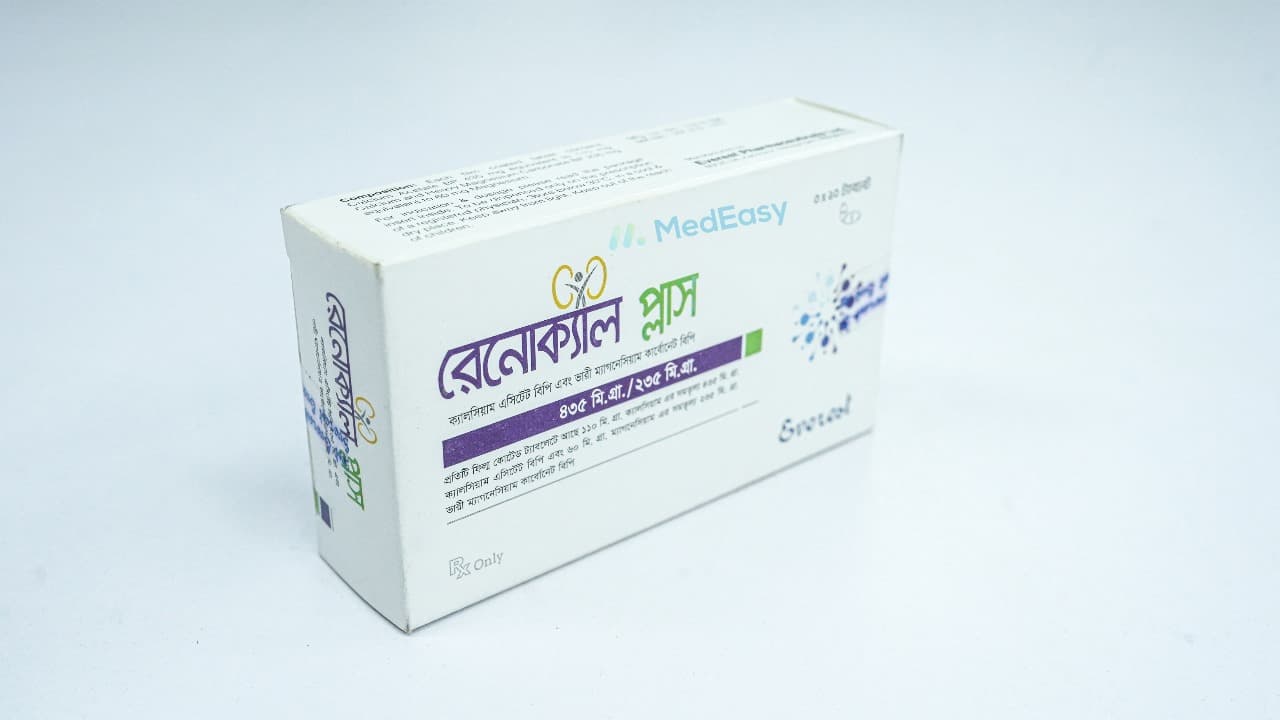
Renocal Plus 435 mg+ 235 mg Tablet is available on MedEasy for ৳92.00 per 10's Strip, with home delivery anywhere in Bangladesh. It is manufactured by Everest Pharmaceuticals Ltd. Its generic name is Calcium acetate + Magnesium carbonate.
- Pack sizes
- 10's Strip, 30's pack
- Prescription
- Not required (over-the-counter).
- Delivery
- Home delivery across Bangladesh. Same-day delivery in Dhaka, Chattogram, Sylhet and Bogura city areas; 2-3 days elsewhere.
- Payment
- Cash on delivery, bKash, cards and mobile banking.
- Brand
- Renocal Plus
- Generic name
- Calcium acetate + Magnesium carbonate
- Manufacturer
- Everest Pharmaceuticals Ltd.
- Form & strength
- Tablet 435 mg+ 235 mg
- Availability
- In stock
- Authenticity
- Sourced from licensed suppliers and the manufacturer's authorised distributors in Bangladesh.

Medicine overview
Indications of Renocal Plus
Renocal Plus is a combination phosphate-binding agent indicated for:
- Control of hyperphosphatemia (elevated blood phosphate) in patients with chronic kidney disease (CKD), particularly those on maintenance dialysis (haemodialysis or peritoneal dialysis). This is the established, guideline-supported use of Renocal Plus, based on its ability to bind dietary phosphate in the gut and reduce its absorption.
Renocal Plus is used as part of a broader chronic kidney disease/dialysis management plan and does not treat the underlying kidney disease itself; it must be used together with dietary phosphate restriction and regular monitoring by the treating nephrology team.
Composition
Each tablet of Calcium acetate + Magnesium carbonate typically contains calcium acetate and magnesium carbonate (heavy), providing elemental calcium and magnesium ions that combine with dietary phosphate in the gastrointestinal tract. Exact strengths vary by manufacturer/brand; refer to the product packaging for the specific composition.
Description
Renocal Plus is a fixed-dose combination phosphate binder that combines two calcium- and magnesium-based salts to control elevated serum phosphorus (hyperphosphataemia) in people with chronic kidney disease, particularly those on dialysis. Combining calcium acetate with magnesium carbonate allows a lower overall calcium exposure compared with calcium-only phosphate binders, while still effectively binding dietary phosphate, which may help reduce the risk of calcium-related complications such as vascular calcification when used appropriately and monitored.
Therapeutic Class
Renocal Plus belongs to the therapeutic class of phosphate-binding agents (antihyperphosphataemic agents) used in the management of chronic kidney disease-related mineral and bone disorder.
Pharmacology
Calcium acetate + Magnesium carbonate works locally within the gastrointestinal tract. When taken with meals, the calcium and magnesium ions released from Calcium acetate + Magnesium carbonate combine with dietary phosphate to form insoluble calcium phosphate and magnesium phosphate complexes, which are not absorbed and are eliminated in the faeces. This reduces the amount of phosphate absorbed into the bloodstream, helping to lower serum phosphate levels in patients whose kidneys can no longer excrete phosphate efficiently. Calcium acetate + Magnesium carbonate has no significant systemic pharmacological action of its own beyond the small fraction of calcium and magnesium that is absorbed.
Dosage & Administration of Renocal Plus
Hyperphosphataemia in chronic kidney disease/dialysis (Adults)
| Population | Typical Starting Dose | Titration |
|---|---|---|
| Adults on dialysis | Individualised starting dose taken with each main meal | Dose is titrated gradually based on serum phosphate response, typically at intervals of 2–3 weeks, up to the maximum recommended daily dose established by the prescriber |
The exact starting dose and maximum daily dose of Renocal Plus should be individualised by the treating physician based on serum phosphate, calcium, and magnesium levels.
Administration of Renocal Plus
Renocal Plus must be taken by mouth with or immediately after meals (with each main meal), swallowed whole with a sufficient amount of liquid. Renocal Plus is not effective if taken apart from food, since its phosphate-binding action depends on being present in the gut at the same time as dietary phosphate. Other oral medicines should be taken at least 1–2 hours before or after Renocal Plus where interaction is a concern (see Interactions).
Interaction of Renocal Plus
Renocal Plus can reduce the absorption of a number of oral medicines by binding to them in the gastrointestinal tract or by altering gut pH, which may reduce their clinical effectiveness. Clinically significant interactions include:
- Tetracycline and fluoroquinolone antibiotics – absorption may be significantly reduced; separate dosing by at least 2–3 hours.
- Oral iron, levothyroxine, and bisphosphonates – absorption may be reduced; separate dosing and monitor therapeutic response (e.g., thyroid function on levothyroxine).
- Vitamin D analogues and calcium- or magnesium-containing supplements/antacids – concurrent use increases the risk of hypercalcaemia and/or hypermagnesaemia; requires closer monitoring if co-administered with Renocal Plus.
- Digoxin – hypercalcaemia arising from Renocal Plus may increase the risk of digoxin toxicity/arrhythmia; monitor calcium and cardiac status.
As a general precaution, other oral medicines with a narrow therapeutic index or where reduced absorption would be clinically significant should be taken well apart from Renocal Plus, on the advice of a physician or pharmacist.
Contraindications
Calcium acetate + Magnesium carbonate is contraindicated in patients with:
- Known hypersensitivity to calcium acetate, magnesium carbonate, or any component of the formulation.
- Hypercalcaemia.
- Hypermagnesaemia.
- Bowel obstruction or ileus.
Side Effects of Renocal Plus
The most commonly reported side effects of Renocal Plus are gastrointestinal and generally mild:
- Diarrhoea (related to the magnesium component)
- Constipation (related to the calcium component)
- Nausea, vomiting, dyspepsia, flatulence, abdominal discomfort
Less commonly, Renocal Plus can cause hypercalcaemia or hypermagnesaemia, particularly with excessive dosing or concurrent use of calcium/magnesium supplements or vitamin D analogues (see Precautions and Warnings). Report persistent or severe symptoms such as muscle weakness, confusion, irregular heartbeat, or severe constipation/diarrhoea to your physician promptly.
Pregnancy & Lactation
Data on the use of Renocal Plus in pregnancy are limited. Renocal Plus should be used during pregnancy only if clearly needed and if the potential benefit justifies the potential risk to the fetus; consult a physician before use. Small amounts of calcium and magnesium may pass into breast milk; caution is advised and a physician should be consulted before using Renocal Plus while breastfeeding, weighing the benefits of treatment against any potential risk to the infant.
Precautions & Warnings
Renocal Plus must be taken with meals; it is not effective if taken apart from food, because its phosphate-binding mechanism relies on being present in the gut together with dietary phosphate.
Risk of hypercalcaemia and hypermagnesaemia: Regular monitoring of serum calcium, magnesium, and phosphate is required during treatment with Renocal Plus, particularly during dose titration. This risk is increased with concurrent use of calcium or magnesium supplements, or vitamin D analogues.
Renal impairment: In patients with kidney disease, magnesium excretion is reduced, which increases the risk of hypermagnesaemia with Renocal Plus specifically — a notable consideration distinguishing it from calcium-only phosphate binders. Serum magnesium should be monitored closely.
Not a treatment for kidney disease: Renocal Plus controls serum phosphate but does not treat the underlying chronic kidney disease; it must be used as part of a broader management plan under the supervision of the treating nephrology team, including dietary phosphate restriction and regular laboratory monitoring.
Gastrointestinal effects: GI side effects such as constipation, diarrhoea, and nausea are common with Renocal Plus (see Side Effects).
Drug spacing: Renocal Plus can reduce absorption of certain oral medications if taken at the same time; separate dosing from other oral medicines, especially those with a narrow therapeutic index (see Interactions).
Overdose Effects of Renocal Plus
Overdose of Renocal Plus may cause hypercalcaemia and/or hypermagnesaemia, with symptoms such as nausea, vomiting, muscle weakness, confusion, lethargy, low blood pressure, and cardiac arrhythmias. If overdose of Renocal Plus is suspected, seek immediate medical attention or contact emergency services/poison control; do not attempt specific home treatment. Management in a medical facility may include stopping the medicine, intravenous fluids, and dialysis with a low-calcium/low-magnesium dialysate if the patient is on dialysis, under close monitoring of serum electrolytes and cardiac status.
Storage Conditions
Store Renocal Plus at room temperature (below 30°C), away from light and moisture. Keep out of reach of children.
Use In Special Populations
Renal impairment: Renocal Plus is specifically used in patients with chronic kidney disease, particularly those on dialysis; magnesium excretion is reduced in these patients, increasing the risk of hypermagnesaemia (see Precautions and Warnings).
Hepatic impairment: No specific dose adjustment of Renocal Plus is established for hepatic impairment; use with usual caution.
Elderly: Elderly patients may be more susceptible to hypermagnesaemia and hypercalcaemia; monitor serum electrolytes closely.
Children: Safety and efficacy of Renocal Plus in children have not been established; use in paediatric patients only under specialist supervision.
Duration Of Treatment
Renocal Plus is generally used long-term, for as long as the patient has hyperphosphataemia related to chronic kidney disease/dialysis, under ongoing monitoring and dose adjustment by the treating physician. Do not stop Renocal Plus without medical advice, as phosphate levels may rise again.
Drug Classes
Calcium acetate + Magnesium carbonate belongs to the phosphate binder / antihyperphosphataemic drug class, combining a calcium salt (calcium acetate) with a magnesium salt (magnesium carbonate).
Mode Of Action
Calcium acetate + Magnesium carbonate acts locally in the gastrointestinal tract, where calcium and magnesium ions bind dietary phosphate to form insoluble, non-absorbable calcium and magnesium phosphate complexes that are excreted in the stool, thereby lowering serum phosphate levels.
Pediatric Uses
The safety and efficacy of Renocal Plus in children and adolescents have not been established. Renocal Plus should only be used in paediatric patients under the direct supervision of a paediatric nephrology specialist, with close monitoring of growth, serum calcium, magnesium, and phosphate.
Frequently Asked Questions
Q: What is Renocal Plus 435 mg+ 235 mg Tablet used for?
A: Renocal Plus 435 mg+ 235 mg Tablet is used to control high blood phosphate levels (hyperphosphataemia) in patients with chronic kidney disease, particularly those on dialysis, by binding phosphate from food in the gut.
Q: How should I take Renocal Plus 435 mg+ 235 mg Tablet?
A: Renocal Plus 435 mg+ 235 mg Tablet should be taken with or immediately after meals, exactly as prescribed by your physician. Taking it apart from food reduces its effectiveness because it needs to be in the gut at the same time as dietary phosphate.
Q: What are the main side effects of Renocal Plus 435 mg+ 235 mg Tablet?
A: The most common side effects of Renocal Plus 435 mg+ 235 mg Tablet are gastrointestinal, including diarrhoea, constipation, nausea, and abdominal discomfort. Less commonly, it can cause high blood calcium or magnesium levels, so regular blood tests are needed.
Q: Can Renocal Plus 435 mg+ 235 mg Tablet be taken during pregnancy?
A: Renocal Plus 435 mg+ 235 mg Tablet should be used during pregnancy only if clearly needed and if the potential benefit justifies the potential risk to the baby; always consult your physician before use during pregnancy or breastfeeding.
Q: Who should not take Renocal Plus 435 mg+ 235 mg Tablet?
A: Renocal Plus 435 mg+ 235 mg Tablet should not be taken by people with high blood calcium (hypercalcaemia), high blood magnesium (hypermagnesaemia), bowel obstruction, or known hypersensitivity to its components.
Q: Does Renocal Plus 435 mg+ 235 mg Tablet interact with other medicines?
A: Yes. Renocal Plus 435 mg+ 235 mg Tablet can reduce the absorption of certain oral medicines, such as tetracycline or fluoroquinolone antibiotics, levothyroxine, and bisphosphonates. Take other oral medicines at least 1–2 hours apart from Renocal Plus 435 mg+ 235 mg Tablet unless your doctor advises otherwise.
Disclaimer
The information provided is accurate to the best of our knowledge, but it does not replace professional medical advice. We cannot guarantee its completeness or accuracy, and the absence of specific information about a drug should not be taken as an endorsement. We are not responsible for any consequences arising from this information, so please consult a healthcare professional for any concerns or questions.