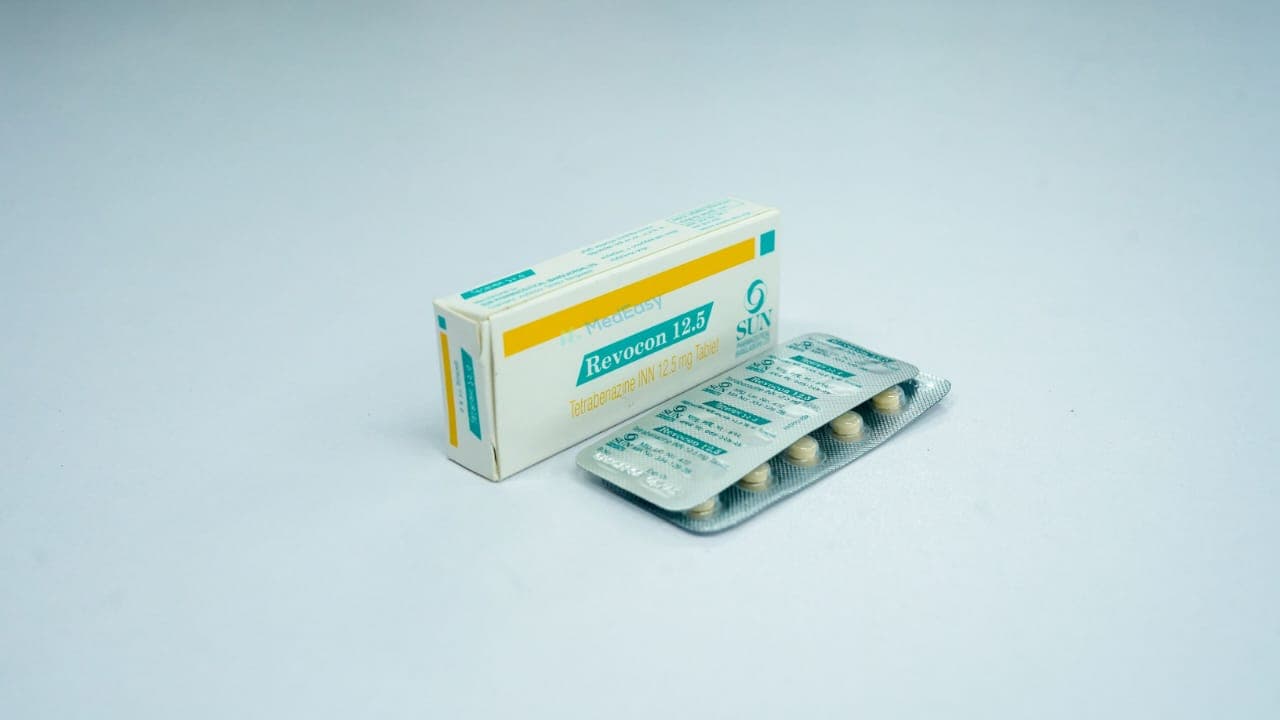
Revocon 12.5 mg is indicated for the treatment of chorea associated with Huntington's disease,
Theropeutic Class
Atypical neuroleptic drugs
Pharmacology
Prolongation of the QTc interval has been observed at doses of 50 mg. In rats, it has been observed that Revocon 12.5 mg or its metabolites bind to melanin-containing tissues such as the eyes and skin. After a single oral dose of radiolabeled Revocon 12.5 mg, radioactivity was still detected in eye and fur at 21 days post dosing.Revocon 12.5 mg is a reversible human vesicular monoamine transporter type 2 inhibitor (Ki = 100 nM). It acts within the basal ganglia and promotes depletion of monoamine neurotransmitters serotonin, norepinephrine, and dopamine from stores. It also decreases uptake into synaptic vesicles. Dopamine is required for fine motor movement, so the inhibition of its transmission is efficacious for hyperkinetic movement. Revocon 12.5 mg exhibits weak in vitro binding affinity at the dopamine D2 receptor (Ki = 2100 nM).
Dosage & Administration of Revocon 12.5 mg
General Dosing Considerations:
The chronic daily dose of Revocon 12.5 mg used to treat chorea associated with Huntington's disease (HD) is determined individually for each patient. When first prescribed, Revocon 12.5 mg therapy should be titrated slowly over several weeks to identify a dose of XENAXINE that reduces chorea and is tolerated. Revocon 12.5 mg can be administered without regard to food.
Individualization Of Dose:
Dosing Recommendations Up to 50 mg per day: The starting dose should be 12.5 mg per day given once in the morning. After one week, the dose should be increased to 25 mg per day given as 12.5 mg twice a day. Revocon 12.5 mg should be titrated up slowly at weekly intervals by 12.5 mg daily, to allow the identification of a tolerated dose that reduces chorea. If a dose of 37.5 to 50 mg per day is needed, it should be given in a three times a day regimen. The maximum recommended single dose is 25 mg. If adverse reactions such as akathisia, restlessness, parkinsonism, depression, insomnia, anxiety or sedation occur, titration should be stopped and the dose should be reduced. If the adverse reaction does not resolve, consideration should be given to withdrawing Revocon 12.5 mg treatment or initiating other specific treatment (e.g., antidepressants).Dosing Recommendations Above 50 mg per day: Patients who require doses of Revocon 12.5 mg greater than 50 mg per day should be first tested and genotyped to determine if they are poor metabolizers (PMs) or extensive metabolizers (EMs) by their ability to express the drug metabolizing enzyme, CYP2D6. The dose of Revocon 12.5 mg should then be individualized accordingly to their status as PMs or EMs
Extensive and Intermediate CYP2D6 Metabolizers:
Genotyped patients who are identified as extensive (EMs) or intermediate metabolizers (IMs) of CYP2D6, who need doses of Revocon 12.5 mg above 50 mg per day, should be titrated up slowly at weekly intervals by 12.5 mg daily, to allow the identification of a tolerated dose that reduces chorea. Doses above 50 mg per day should be given in a three times a day regimen. The maximum recommended daily dose is 100 mg and the maximum recommended single dose is 37.5 mg. If adverse reactions such as akathisia, parkinsonism, depression, insomnia, anxiety or sedation occur, titration should be stopped and the dose should be reduced. If the adverse reaction does not resolve, consideration should be given to withdrawing Revocon 12.5 mg treatment or initiating other specific treatment (e.g., antidepressants)
Dosage of Revocon 12.5 mg
Recommended dosing for Revocon 12.5 mg: Revocon 12.5 mg can be taken with or without food. Individualization of dose with careful weekly titration is required.
1st week's starting dose: 12.5 mg daily.
2nd week: 25 mg (12.5 mg twice daily).
Then slowly titrate at weekly intervals by 12.5 mg to a tolerated done that reduces chorea. Doses of 37.5 mg and up to 50 mg per day should be administered in three divided doses per day with a maximum recommended single dose not to exceed 25 mg.
Patients requiring doses above 50 mg per day should be genotyped for the drug-metabolizing enzyme CYP2D6 to determine if the patient is a poor metabolizer or an extensive metabolizer.
Maximum daily dose in poor metabolizers: 50 mg with a maximum single dose of 25 mg.
Maximum daily dose in Extended and intermediate metabolizers: 100 mg with a maximum single dose of 37.5 mg.
If serious adverse reactions occur, titration should be stopped and the dose should be reduced. If the adverse reactions do not resolve, consider withdrawal of Revocon 12.5 mg.
Pediatric & geriatric use: Safety and effectiveness in pediatric patients have not been established. The pharmacokinetics of Revocon 12.5 mg and its primary metabolites have not been formally studied in geriatric subjects.
Interaction of Revocon 12.5 mg
With medicine: Strong CYP2D6 Inhibitors: A reduction in Revocon 12.5 mg dose may be necessary when adding a strong CYP2D6 inhibitor (e.g., fluoxetine, paroxetine, quinidine) in patients maintained on a stable dose of Revocon 12.5 mg. Reserpine: Reserpine binds irreversibly to VMAT2, and the duration of its effect is several days. At least 20 days should elapse after stopping reserpine before starting Revocon 12.5 mg, Revocon 12.5 mg and Reserpine should not be used concomitantly. With food & others: No interaction with food, can be taken with or without food.
Contraindications
Revocon 12.5 mg is contraindicated in:
Actively suicidal, or who have depression which is untreated or undertreated Hepatic impairment.
Concurrent use of monoamine oxidase inhibitors (MAOIs) or reserpine.
Concurrent use of deuRevocon 12.5 mg or valbenazine.
Side Effects of Revocon 12.5 mg
Common: Most common adverse reactions (>10% and at least 5% greater than placebo) were-Sedation/somnolence, fatigue, insomnia, depression, akathisia, anxiety/anxiety aggravated & nausea.Rare: Suicidal thoughts, neuroleptic malignant syndrome, a reaction characterized by fever, muscle rigidity and confusion & pneumonia.
Pregnancy & Lactation
Pregnancy Category C. There are no adequate and well-controlled studies in pregnant women. Revocon 12.5 mg should be used during pregnancy only if the potential benefit justifies the potential risk to the fetus.Nursing Mothers: It is not known whether Revocon 12.5 mg or its metabolites are excreted in human milk. Since many drugs are excreted into human milk and because of the potential for serious adverse reactions in nursing infants from Revocon 12.5 mg, a decision should be made whether to discontinue nursing or to discontinue Revocon 12.5 mg, taking into account the importance of the drug to the mother.
Precautions & Warnings
The benefit and potential for adverse effects such as worsening mood, cognition, rigidity, and functional capacity should be periodically re-evaluated. The maximum daily dose should not exceed 50 mg/day and the maximum single dose should not exceed 25 mg if administered in conjunction with a strong CYP2D6 inhibitor (e,g., fluoxetine, paroxetine). In case of Neuroleptic Malignant Syndrome, the treatment should be discontinued. The dose should be reduced or discontinued if patient experience restlessness, agitation, akathisia and parkinsonism, The treatment may impair patient's ability to drive or operate complex machinery, Tetrabenzine is not recommended in combination with other drugs that prolong QTc.
Overdose Effects of Revocon 12.5 mg
Signs and symptoms of overdosage of Revocon 12.5 mg may include drowsiness, sweating and hypothermia.
Storage Conditions
Store in a cool & dry place. protect from light & moisture. Keep all medicines out of the reach of the children.
Use In Special Populations
Pediatric Use: The safety and efficacy of Revocon 12.5 mg in pediatric patients have not been established.Geriatric Use: The pharmacokinetics of Revocon 12.5 mg and its primary metabolites have not been formally studied in geriatric subjects.Hepatic Impairment: Because the safety and efficacy of the increased exposure to Revocon 12.5 mg and other circulating metabolites are unknown, it is not possible to adjust the dosage of Revocon 12.5 mg in hepatic impairment to ensure safe use. The use of Revocon 12.5 mg in patients with hepatic impairment is contraindicated
Drug Classes
Atypical neuroleptic drugs
Mode Of Action
Revocon 12.5 mg is a drug formerly used as an antipsychotic but now used primarily in the symptomatic treatment of various hyperkinetic disorders, It is a vesicular monoamine transporter-2 (VMAT-2) inhibitor that used as symptomatic treatment of chorea associated with Huntington's disease.
Pregnancy
There are no adequate data on the developmental risk associated with the use of Revocon 12.5 mg in pregnant women. There are no data on the presence of Revocon 12.5 mg or its metabolites in human milk.
Frequently Asked Questions
What is Revocon 12.5 mg used for?
Revocon 12.5 mg is indicated for the treatment of chorea associated with Huntington's disease,
What is the dosage of Revocon 12.5 mg?
Recommended dosing for Revocon 12.5 mg: Revocon 12.5 mg can be taken with or without food. Individualization of dose with careful weekly titration is required. 1st week's starting dose: 12.5 mg daily. 2nd week: 25 mg (12.5 mg twice daily). Then slowly titrate at weekly intervals by 12.5 mg to a tolerated done that reduces chorea. Doses of 37.5 mg and up to 50 mg per day should be administered in t…
What are the side effects of Revocon 12.5 mg?
Common: Most common adverse reactions (>10% and at least 5% greater than placebo) were-Sedation/somnolence, fatigue, insomnia, depression, akathisia, anxiety/anxiety aggravated & nausea.Rare: Suicidal thoughts, neuroleptic malignant syndrome, a reaction characterized by fever, muscle rigidity and confusion & pneumonia.
Who should not take Revocon 12.5 mg?
Revocon 12.5 mg is contraindicated in: Actively suicidal, or who have depression which is untreated or undertreated Hepatic impairment. Concurrent use of monoamine oxidase inhibitors (MAOIs) or reserpine. Concurrent use of deuRevocon 12.5 mg or valbenazine.
What precautions should be taken with Revocon 12.5 mg?
The benefit and potential for adverse effects such as worsening mood, cognition, rigidity, and functional capacity should be periodically re-evaluated. The maximum daily dose should not exceed 50 mg/day and the maximum single dose should not exceed 25 mg if administered in conjunction with a strong CYP2D6 inhibitor (e,g., fluoxetine, paroxetine). In case of Neuroleptic Malignant Syndrome, the trea…
Is Revocon 12.5 mg safe during pregnancy and breastfeeding?
Pregnancy Category C. There are no adequate and well-controlled studies in pregnant women. Revocon 12.5 mg should be used during pregnancy only if the potential benefit justifies the potential risk to the fetus.Nursing Mothers: It is not known whether Revocon 12.5 mg or its metabolites are excreted in human milk. Since many drugs are excreted into human milk and because of the potential for seriou…
Disclaimer
The information provided is accurate to our best practices, but it does not replace professional medical advice. We cannot guarantee its completeness or accuracy. The absence of specific information about a drug should not be seen as an endorsement. We are not responsible for any consequences resulting from this information, so consult a healthcare professional for any concerns or questions.