
5% Off
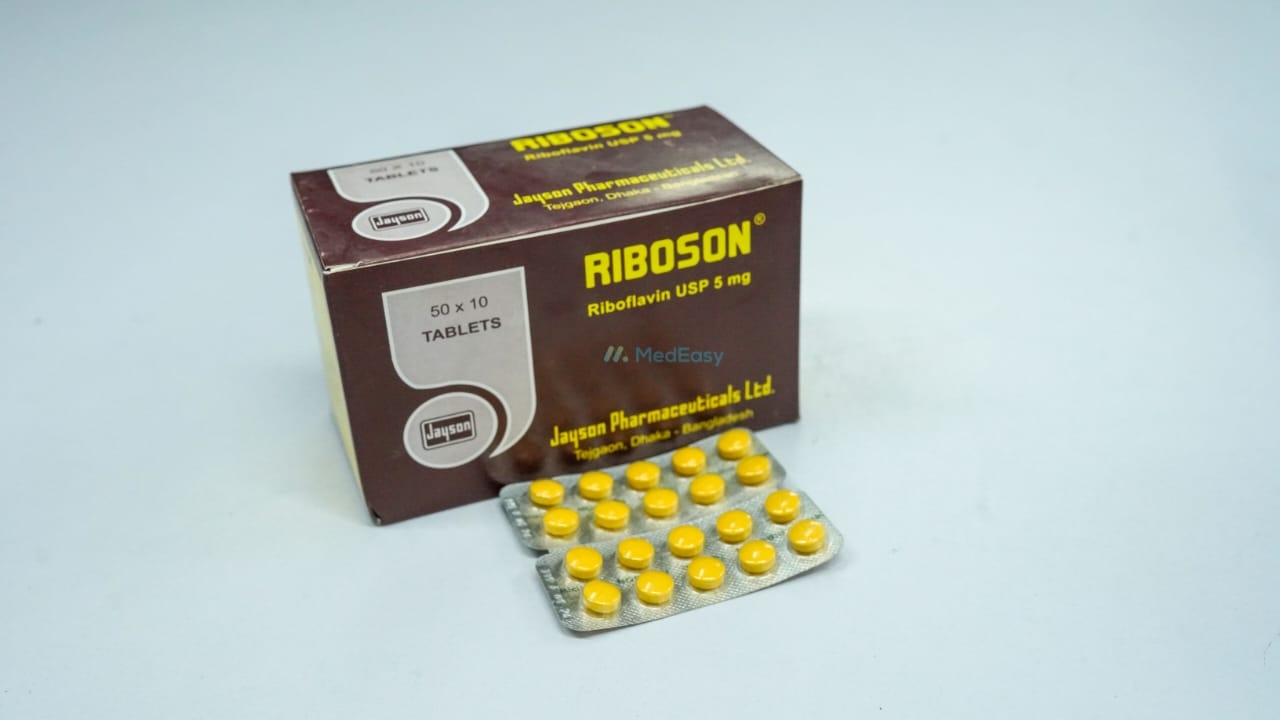
Riboson5 mg
Jayson Pharma Ltd.
৳2.85
Add to cart
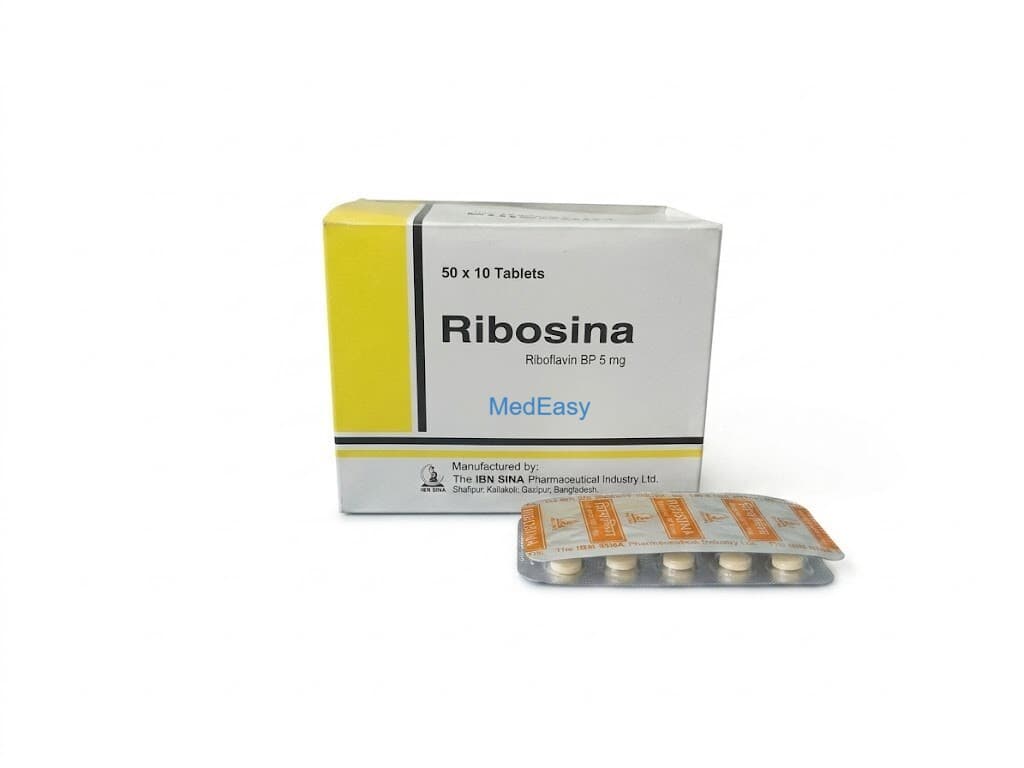

Ribosina (vitamin B2) is indicated for the following:
Ribosina does not treat the underlying cause of malabsorption or malnutrition and should be used alongside management of the primary condition where relevant.
Each tablet/capsule of Riboflavin typically contains Riboflavin (Vitamin B2) as the active ingredient, in strengths commonly ranging from 25 mg to 100 mg. Combination multivitamin products may contain Riboflavin along with other B-complex vitamins and minerals; strength varies by brand and formulation.
Ribosina is a water-soluble B-complex vitamin (vitamin B2) that is essential for normal cellular energy production and metabolism. It is a precursor of the coenzymes flavin mononucleotide (FMN) and flavin adenine dinucleotide (FAD), which are required for numerous oxidation-reduction reactions in carbohydrate, fat, and protein metabolism, as well as for maintenance of healthy skin, mucous membranes, red blood cells, and the nervous system.
Humans cannot synthesize Ribosina and must obtain it from dietary sources (dairy, eggs, lean meats, green vegetables, fortified cereals) or supplementation. Because it is water-soluble, excess Ribosina is excreted in the urine rather than stored in significant amounts in the body, which contributes to its favorable safety profile even at higher doses.
Ribosina belongs to the therapeutic class of Vitamin B-complex preparations, specifically classified as a water-soluble vitamin (Vitamin B2). It is also used, at higher doses, within the broader category of migraine prophylactic agents.
Riboflavin is converted in the body to its active coenzyme forms, flavin mononucleotide (FMN) and flavin adenine dinucleotide (FAD), through phosphorylation. These coenzymes act as essential cofactors for flavoprotein enzymes involved in the mitochondrial electron transport chain and numerous oxidative metabolic pathways, including fatty acid oxidation and the citric acid cycle.
In the context of migraine prophylaxis, the proposed mechanism of Riboflavin is improvement of mitochondrial energy metabolism in neurons, which is thought to be impaired in some migraine sufferers; by supporting mitochondrial oxidative phosphorylation, Riboflavin may help reduce the frequency of migraine attacks, although the exact mechanism is not fully established.
Riboflavin is absorbed primarily in the proximal small intestine via a saturable, carrier-mediated transport process at physiologic doses, with passive diffusion contributing at higher doses. It is transported bound to plasma proteins, metabolized in the liver, and excess amounts are excreted unchanged in the urine, giving urine a characteristic bright yellow-orange color.
| Indication | Adult Dose | Pediatric Dose |
|---|---|---|
| Ribosina deficiency (prevention/treatment) | 5-30 mg per day, in divided doses, depending on severity of deficiency | Individualized by age and severity; typically lower doses (e.g., 3-10 mg/day) under medical/nutritional guidance |
| Migraine prophylaxis (adjunct) | 400 mg once daily, taken consistently for at least 3 months to assess benefit | Not established; used with caution and specialist guidance in adolescents in some settings |
| General nutritional supplementation | Typically 1.1-1.3 mg/day as part of recommended dietary allowance, or per multivitamin formulation | Age-appropriate RDA amounts as part of standard multivitamin products |
Ribosina may be taken with or without food; taking it with food may reduce the mild gastrointestinal upset that can occasionally occur. Tablets should be swallowed with water and not crushed unless the product is specifically formulated to be chewed or dispersed.
Ribosina is administered orally, with or without food. For migraine prophylaxis, consistent daily dosing is important, and effects are typically assessed only after a minimum trial period of 3 months. Doses should not be doubled if a dose is missed; simply resume the normal schedule at the next scheduled dose.
Ribosina has minimal clinically significant drug interactions given its water-soluble nature and wide margin of safety:
No dose adjustment is generally required for these interactions, but patients on long-term phenothiazine or tricyclic antidepressant therapy with signs of deficiency may be monitored by their physician.
Riboflavin is contraindicated only in patients with known hypersensitivity to Riboflavin or any component of the formulation. True hypersensitivity to Riboflavin is rare given its status as an essential water-soluble vitamin.
Ribosina is generally very well tolerated, even at high doses used for migraine prophylaxis, owing to its water solubility and efficient renal excretion of excess amounts.
Patients should be reassured that yellow urine discoloration with Ribosina is a normal, harmless effect and does not require discontinuation.
Ribosina is a normal dietary nutrient and, at standard recommended daily allowance doses, is considered safe and is often specifically recommended during pregnancy and lactation to meet increased physiological requirements. Standard supplemental doses of Ribosina are compatible with breastfeeding.
For higher doses used off-label for migraine prophylaxis (e.g., 400 mg/day), safety data in pregnancy and lactation are limited; such doses should be used only if clearly needed and the potential benefit justifies the potential risk, and only under the guidance of a physician. Pregnant or breastfeeding women should consult their physician before starting high-dose Ribosina therapy.
Ribosina should be used with the following precautions:
Ribosina has a wide margin of safety due to its water solubility and efficient renal excretion, and clinically significant toxicity from oral overdose is extremely rare. Excess amounts are typically excreted unchanged in the urine, producing more pronounced yellow-orange urine discoloration.
If a significantly large overdose of Ribosina is suspected, or if any concerning symptoms occur, seek immediate medical attention or contact a poison control center/emergency services rather than attempting home treatment.
Store Ribosina at room temperature (below 30°C), protected from light and moisture, as Ribosina is light-sensitive and can degrade on exposure to light. Keep out of reach of children.
Renal impairment: Patients with renal impairment may have altered excretion of excess Ribosina; standard nutritional doses are generally safe, but physician guidance is advised for high-dose use.
Hepatic impairment: No specific dose adjustment of Ribosina is well established for hepatic impairment; it is generally considered safe given its metabolic profile.
Elderly: No specific dose adjustment of Ribosina is required in elderly patients; standard nutritional or prophylactic doses are typically well tolerated.
See Pregnancy and Lactation, and Pediatric Uses sections for guidance in those populations.
For deficiency states, Ribosina is typically continued until laboratory and clinical improvement is confirmed, often several weeks, followed by maintenance at dietary reference intake levels. For migraine prophylaxis, a trial of at least 3 months of consistent daily Ribosina use is generally recommended before assessing efficacy, with continuation guided by physician assessment of ongoing benefit.
Vitamin B-complex; water-soluble vitamin; migraine prophylactic agent (adjunct, at high dose).
Riboflavin acts as a precursor to the essential coenzymes FAD and FMN, which support mitochondrial oxidative energy metabolism; in migraine prophylaxis this is thought to improve impaired cerebral mitochondrial energy metabolism, reducing attack frequency. See Pharmacology for full detail.
Ribosina is used in children for prevention and treatment of dietary Ribosina deficiency, with dosing individualized by age, weight, and severity of deficiency under medical or nutritional guidance. Use of high-dose Ribosina for migraine prophylaxis in children and adolescents is not well established by formal labeling; safety and efficacy of high-dose regimens have not been established in this population, and any such use should be under specialist pediatric/neurology guidance. Standard multivitamin doses of Ribosina appropriate for age are generally considered safe in children.
Q: What is Ribosina 5 mg Tablet used for?
A: Ribosina 5 mg Tablet (vitamin B2) is used mainly to prevent and treat Ribosina 5 mg Tablet deficiency, and at higher doses, as an adjunct preventive treatment to reduce the frequency of migraine headaches. It is also included in many multivitamin products to support normal energy metabolism, skin, and nervous system health.
Q: Why does Ribosina 5 mg Tablet turn my urine bright yellow?
A: Bright yellow-orange urine is a harmless and expected effect of Ribosina 5 mg Tablet, especially at higher doses. Ribosina 5 mg Tablet is a water-soluble vitamin, and any amount your body does not use is excreted unchanged in the urine, which naturally has a strong yellow pigment. This is not a sign of a problem and does not require stopping the medicine.
Q: How long does it take for Ribosina 5 mg Tablet to work for migraine prevention?
A: When used for migraine prophylaxis, Ribosina 5 mg Tablet is typically taken at 400 mg once daily, and it may take up to 3 months of consistent daily use before a noticeable reduction in migraine frequency is seen. It should be taken every day as directed, not just during a migraine attack.
Q: Is Ribosina 5 mg Tablet safe during pregnancy and breastfeeding?
A: At standard nutritional doses, Ribosina 5 mg Tablet is considered safe and is often recommended during pregnancy and breastfeeding to meet increased nutritional needs. However, higher doses used for migraine prevention have limited safety data in pregnancy and lactation, and should only be used if clearly needed, with the potential benefit justifying potential risk, and under a physician's guidance.
Q: Can I take Ribosina 5 mg Tablet with other medicines?
A: Ribosina 5 mg Tablet has very few significant drug interactions. Certain medicines such as phenothiazines or tricyclic antidepressants may theoretically increase the body's Ribosina 5 mg Tablet requirements, and probenecid may slightly reduce its absorption, but these interactions are rarely clinically significant at standard doses. Tell your physician about all medicines you take before starting Ribosina 5 mg Tablet, especially at high doses.
Q: What should I do if I miss a dose or take too much Ribosina 5 mg Tablet?
A: If you miss a dose of Ribosina 5 mg Tablet, simply take your next dose at the regular scheduled time; do not double the dose. Ribosina 5 mg Tablet has a wide margin of safety because excess amounts are excreted in the urine, so serious overdose is rare. However, if you suspect a large overdose or experience any concerning symptoms, seek immediate medical attention or contact a poison control center.
Disclaimer
The information provided is accurate to the best of our knowledge, but it does not replace professional medical advice. We cannot guarantee its completeness or accuracy, and the absence of specific information about a drug should not be taken as an endorsement. We are not responsible for any consequences arising from this information, so please consult a healthcare professional for any concerns or questions.
