5% Off
Filastin300 mcg/0.
Incepta Pharmaceuticals Ltd.
৳2745.50
Add to cart

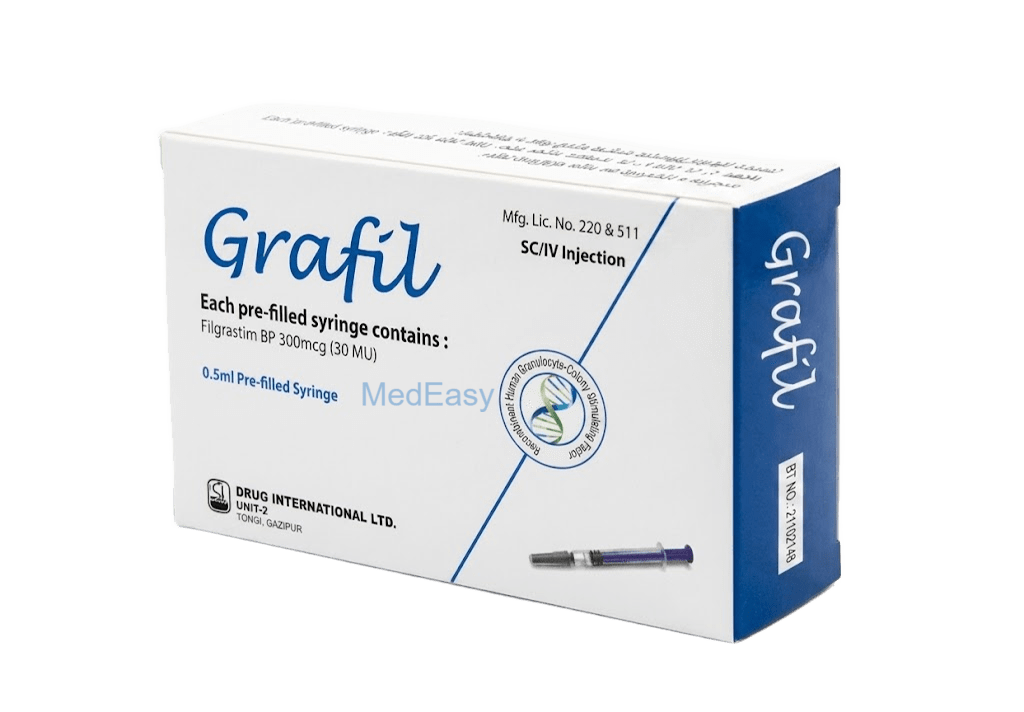
Ropenia 300 mcg/0.5 ml IV/SC Injection is available on MedEasy for ৳3230.00 per 0.5 ml pre-filled syringe, with home delivery anywhere in Bangladesh. It is manufactured by ACI Limited. Its generic name is Filgrastim.

Ropenia is a recombinant human granulocyte colony-stimulating factor (G-CSF) used to stimulate the production of neutrophils (a type of white blood cell) in patients at risk of infection due to low neutrophil counts (neutropenia).
Ropenia is not indicated for mobilizing peripheral blood progenitor cells in patients with cancer whose malignancy has bone marrow involvement, and its safety and efficacy have not been established for use in chronic myeloid leukemia or myelodysplastic syndrome.
Each vial/pre-filled syringe of Filgrastim injection contains recombinant methionyl human granulocyte colony-stimulating factor (r-metHuG-CSF), commonly supplied as 300 mcg/0.5 mL or 120 mcg/0.2 mL solution for injection. It is produced in Escherichia coli (E. coli) using recombinant DNA technology. Excipients typically include acetate buffer, sorbitol, polysorbate 80, and water for injection; formulations may vary slightly by manufacturer.
Ropenia is a biosynthetic (recombinant) form of human granulocyte colony-stimulating factor (G-CSF). It regulates the production, maturation, and functional activation of neutrophils within the bone marrow. By binding to specific receptors on precursor cells, Ropenia stimulates the proliferation and differentiation of neutrophil progenitors, increasing the number of circulating neutrophils available to fight infection.
Ropenia is administered by subcutaneous injection or intravenous infusion and is widely used in oncology and hematology to shorten the duration of chemotherapy-induced neutropenia and reduce the risk of serious infection.
Ropenia belongs to the class of hematopoietic (blood cell) growth factors, specifically the granulocyte colony-stimulating factors (G-CSF), used as supportive care agents in oncology and hematology.
Filgrastim is a recombinant analogue of endogenous human G-CSF. It binds to specific cell-surface G-CSF receptors on myeloid progenitor cells in the bone marrow, triggering intracellular signaling pathways (via JAK/STAT) that stimulate proliferation, differentiation, and maturation of neutrophil precursors into mature, functional neutrophils. Filgrastim also enhances the phagocytic and chemotactic activity of mature neutrophils and stimulates their release from the bone marrow into the peripheral circulation.
After subcutaneous injection, Filgrastim is absorbed with peak serum concentrations typically reached within 2-8 hours; bioavailability after subcutaneous dosing is approximately 60-70%. It is cleared through both a saturable (receptor-mediated, neutrophil-dependent) pathway and non-saturable renal clearance, with an elimination half-life of approximately 3.5 hours. Clearance decreases as neutrophil counts rise because more receptor-mediated uptake occurs.
| Indication | Typical Adult Dose of Ropenia |
|---|---|
| Myelosuppressive chemotherapy (non-myeloid malignancy) | 5 mcg/kg/day subcutaneously or intravenously, starting no earlier than 24 hours after chemotherapy; continue until expected neutrophil nadir has passed and count has recovered to normal range (up to about 2 weeks) |
| Acute myeloid leukemia (post-induction/consolidation) | 5 mcg/kg/day beginning at least 24 hours after chemotherapy, continued until neutrophil recovery |
| Bone marrow transplantation | 10 mcg/kg/day as an intravenous infusion, starting at least 24 hours after chemotherapy and after marrow infusion; dose titrated based on neutrophil response |
| Peripheral blood progenitor cell mobilization | 10 mcg/kg/day subcutaneously for at least 4 days before the first leukapheresis, continued until the last collection |
| Severe chronic neutropenia (congenital) | 6 mcg/kg subcutaneously twice daily |
| Severe chronic neutropenia (cyclic/idiopathic) | 5 mcg/kg subcutaneously once daily |
Doses are individualized based on absolute neutrophil count (ANC) response, and complete blood counts should be monitored regularly during therapy. Ropenia must not be given in the period from 24 hours before to 24 hours after cytotoxic chemotherapy (see Precautions). See Pediatric Uses for weight-based dosing in children.
Ropenia is given as a subcutaneous injection (into the fat layer under the skin of the abdomen, thigh, or upper arm) or as an intravenous infusion, depending on the indication and clinical setting. It should be administered by, or under the supervision of, a qualified healthcare professional, although self-injection at home may be taught to appropriately trained patients/caregivers for chronic use (e.g., severe chronic neutropenia). Allow the vial/syringe to warm to room temperature for about 30 minutes before injection; do not shake vigorously. Rotate injection sites to reduce local irritation. Do not administer Ropenia within 24 hours before or after cytotoxic chemotherapy.
No formal, extensive drug-interaction studies have been conducted with Ropenia. The following interactions are clinically relevant:
Filgrastim is contraindicated in patients with a known history of serious allergic reactions (e.g., anaphylaxis) to Filgrastim, pegfilgrastim, or any other E. coli-derived recombinant protein product.
Pregnancy: Data on the use of Ropenia during human pregnancy have not shown a clear association with major birth defects, miscarriage, or adverse maternal/fetal outcomes, but data remain limited. Ropenia should be used during pregnancy only if clearly needed and the potential benefit justifies the potential risk to the fetus; consult a physician before use.
Lactation: Ropenia has been detected in human milk in limited case reports, without reported adverse effects in breastfed infants, and is not expected to be significantly absorbed orally by the infant. A physician should weigh the benefits of breastfeeding against the mother's clinical need for Ropenia before use during lactation.
Before and during treatment with Ropenia, the following precautions apply:
There is limited clinical experience with Ropenia overdose. Excessive doses may result in an exaggerated increase in white blood cell (neutrophil) count (leukocytosis) and associated bone pain or musculoskeletal symptoms. If an overdose of Ropenia is suspected, seek immediate medical attention or contact emergency services/poison control; the treating physician will monitor blood counts and manage symptoms supportively. Do not attempt to self-treat a suspected overdose at home.
Store Ropenia injection in a refrigerator at 2°C to 8°C (36°F to 46°F). Protect from light. Do not freeze; if accidentally frozen, allow the product to thaw in the refrigerator before use and discard if it has been frozen more than once. Unrefrigerated (room temperature) storage should be limited to the period specified by the manufacturer's product labeling (generally no more than a single 24-hour period) — do not use if this limit is exceeded. Keep out of reach of children. Do not shake vigorously. Discard any unused portion; do not reuse vials/syringes.
No dose adjustment is required in patients with mild-to-moderate renal impairment based on available pharmacokinetic data; specific data in severe renal impairment are limited, so use with caution and physician monitoring.
No specific dose adjustment guidance is established for hepatic impairment; use Ropenia with clinical judgment and monitoring in patients with significant hepatic dysfunction.
Clinical studies of Ropenia have not identified differences in response between elderly and younger patients, but dosing should be individualized, generally starting at the low end of the dosing range with attention to concomitant organ function.
Use with caution; severe sickle cell crises have been reported (see Precautions and Warnings).
Duration of Ropenia therapy depends on the indication: for chemotherapy-induced neutropenia, treatment is typically continued daily until the expected neutrophil nadir has passed and the absolute neutrophil count has returned to a normal range (up to about 2 weeks); for peripheral blood progenitor cell mobilization, therapy is continued through the collection period; for severe chronic neutropenia, Ropenia is often used long-term (chronic daily or alternate-day administration) with the lowest effective dose determined by the treating physician, and periodic reassessment of continued need.
Granulocyte colony-stimulating factor (G-CSF); hematopoietic growth factor; biologic/biosimilar agent.
Filgrastim binds to G-CSF receptors on hematopoietic progenitor cells in the bone marrow, activating intracellular signaling that stimulates the proliferation, differentiation, and maturation of neutrophil precursors, and enhances the functional activity (phagocytosis, chemotaxis) of mature circulating neutrophils, thereby increasing the neutrophil count available to combat infection.
Ropenia has been used in pediatric patients, most extensively in severe chronic neutropenia, where its safety and effectiveness have been demonstrated in children as young as a few months old using weight-based dosing similar to adults (6 mcg/kg twice daily for congenital neutropenia; 5 mcg/kg once daily for cyclic/idiopathic neutropenia), with dose individualized to clinical response. For chemotherapy-induced neutropenia and other oncology indications in children, use of Ropenia follows similar weight-based dosing principles as in adults under specialist supervision, though safety and efficacy have not been as extensively established for every pediatric indication. Long-term use in children should be monitored for growth parameters and bone density given reports of decreased bone density with prolonged therapy. Use in neonates and infants should be directed by a pediatric specialist.
Q: What is Ropenia 300 mcg/0.5 ml IV/SC Injection used for?
A: Ropenia 300 mcg/0.5 ml IV/SC Injection is used to reduce the risk of infection in patients whose white blood cell (neutrophil) count is low, most often due to chemotherapy, bone marrow transplantation, or certain chronic neutropenia conditions. It is also used to mobilize stem cells into the blood before collection for transplant.
Q: How is Ropenia 300 mcg/0.5 ml IV/SC Injection given?
A: Ropenia 300 mcg/0.5 ml IV/SC Injection is given as an injection under the skin (subcutaneous) or into a vein (intravenous), usually once daily, at a dose calculated based on body weight. Your doctor or nurse will determine the correct dose and schedule for your specific condition.
Q: What are the most common side effects of Ropenia 300 mcg/0.5 ml IV/SC Injection?
A: The most common side effect of Ropenia 300 mcg/0.5 ml IV/SC Injection is bone pain, along with headache, fatigue, and mild injection site reactions. These are usually manageable with over-the-counter pain relief as advised by your doctor.
Q: Are there any serious risks with Ropenia 300 mcg/0.5 ml IV/SC Injection?
A: Yes. Rare but serious risks include splenic rupture (sudden left-sided abdominal or shoulder pain requires urgent medical attention), acute respiratory distress syndrome, serious allergic reactions, sickle cell crises in patients with sickle cell disease, and capillary leak syndrome. Contact your doctor or emergency services immediately if you notice unusual pain, swelling, breathing difficulty, or rash while using Ropenia 300 mcg/0.5 ml IV/SC Injection.
Q: Can Ropenia 300 mcg/0.5 ml IV/SC Injection be used during pregnancy or breastfeeding?
A: Ropenia 300 mcg/0.5 ml IV/SC Injection should be used during pregnancy only if clearly needed, since data remain limited; discuss the potential risks and benefits with your physician. For breastfeeding, available data have not shown harm to the infant, but use should still be guided by your doctor.
Q: How should Ropenia 300 mcg/0.5 ml IV/SC Injection be stored?
A: Ropenia 300 mcg/0.5 ml IV/SC Injection must be kept refrigerated at 2-8°C, protected from light, and never frozen. If it has been out of the refrigerator, check the product labeling for the maximum allowed time at room temperature before use, and keep it out of reach of children.
Disclaimer
The information provided is accurate to the best of our knowledge, but it does not replace professional medical advice. We cannot guarantee its completeness or accuracy, and the absence of specific information about a drug should not be taken as an endorsement. We are not responsible for any consequences arising from this information, so please consult a healthcare professional for any concerns or questions.