10% Off
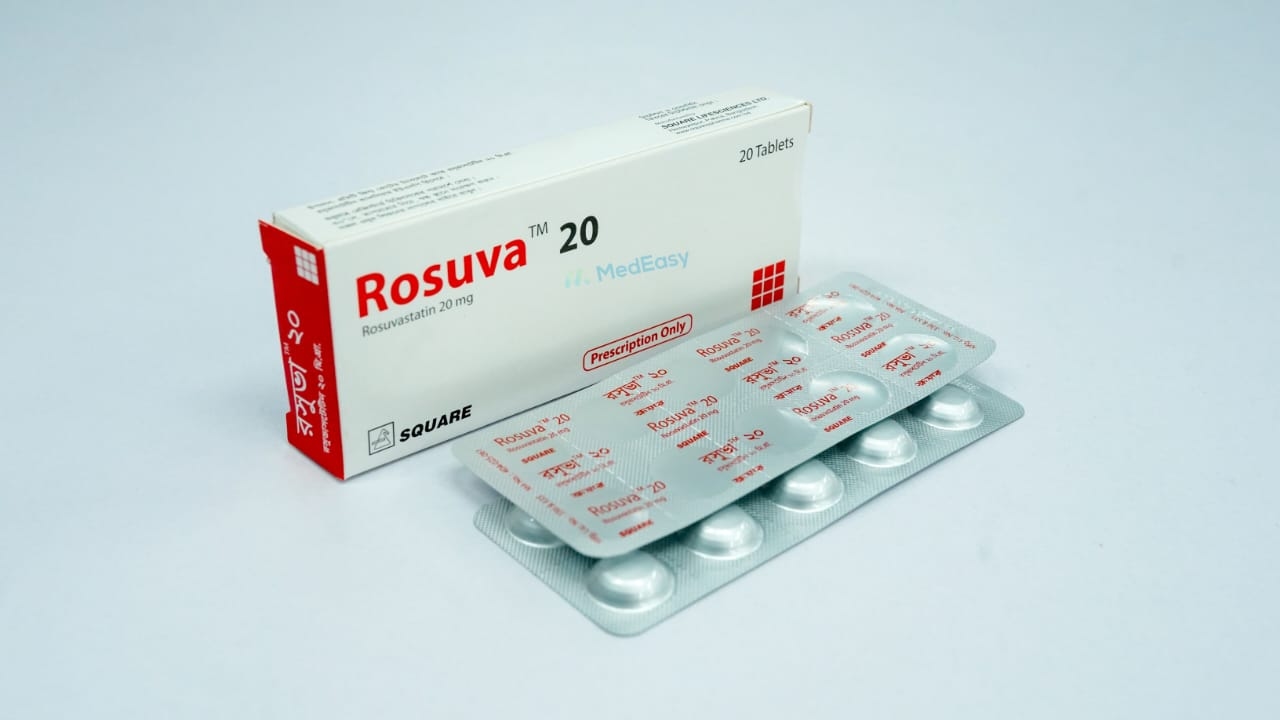
Rosuva20 mg
Square Pharmaceuticals PLC.
৳288.00
Add to cart

Rosu is indicated for the following uses:
Rosu is not indicated for the acute treatment of severe hypertriglyceridemia with pancreatitis, and is not a substitute for diet, exercise, weight management, and other lifestyle measures.
Each tablet contains Rosuvastatin (as rosuvastatin calcium) as the active ingredient. In Bangladesh, Rosuvastatin is commonly available as film-coated tablets in strengths of 5 mg, 10 mg, 20 mg, and 40 mg for oral use.
Rosu is a synthetic lipid-lowering agent belonging to the statin class of medicines and is considered one of the more potent statins in clinical use. It works by inhibiting HMG-CoA reductase, the enzyme responsible for an early, rate-limiting step in the body's production of cholesterol. By reducing hepatic cholesterol synthesis, Rosu lowers blood levels of total cholesterol, LDL ("bad") cholesterol, apolipoprotein B, and triglycerides, while modestly raising HDL ("good") cholesterol.
Rosu is widely used for the long-term management of high cholesterol and mixed dyslipidemia, and for reducing the risk of heart attack, stroke, and other cardiovascular events in people with, or at risk of, atherosclerotic cardiovascular disease.
Rosuvastatin is a selective, competitive inhibitor of HMG-CoA reductase, the rate-limiting enzyme that converts 3-hydroxy-3-methylglutaryl-coenzyme A (HMG-CoA) to mevalonate, an early step in hepatic cholesterol biosynthesis.
By inhibiting this enzyme, Rosuvastatin reduces the amount of cholesterol produced by the liver, prompting hepatocytes to increase the number of LDL receptors on their surface. This enhances the uptake and catabolism of LDL-cholesterol from the bloodstream and reduces circulating LDL particle production, while also decreasing hepatic synthesis of VLDL and triglycerides. The net effect is a marked reduction in total cholesterol, LDL-cholesterol, apolipoprotein B, non-HDL-cholesterol, and triglycerides, with a modest increase in HDL-cholesterol.
Rosuvastatin undergoes limited hepatic metabolism (minimally via CYP2C9) and is taken up preferentially by the liver, its primary site of action. Lipid-lowering effects are apparent within about 1 week of starting therapy, with maximal effect typically reached by around 4 weeks.
| Indication | Adult dose | Notes |
|---|---|---|
| Primary hyperlipidemia / mixed dyslipidemia | Usual starting dose: 10 mg once daily (5 mg may be used for patients requiring smaller LDL-C reductions or with predisposition to myopathy); usual range 5-40 mg once daily | Adjust at intervals of at least 2-4 weeks; the 40 mg dose is reserved for patients who do not achieve LDL-C goals on 20 mg |
| Cardiovascular risk reduction (primary/secondary prevention) | 20 mg once daily | Dose selected based on baseline risk and treatment goals |
| Homozygous familial hypercholesterolemia (adults and children ≥7 years) | 20 mg once daily | Used as an adjunct to other LDL-lowering treatments (e.g. LDL apheresis) or if such treatments are unavailable |
| Heterozygous familial hypercholesterolemia (pediatric, 8-9 years) | 5-10 mg once daily | Maximum 10 mg once daily; see Pediatric Uses |
| Heterozygous familial hypercholesterolemia (pediatric, ≥10 years) | 5-20 mg once daily | Maximum 20 mg once daily; see Pediatric Uses |
| Primary dysbetalipoproteinemia / severe hypertriglyceridemia | 5-40 mg once daily | Titrate based on triglyceride response |
No dose adjustment is required in mild-to-moderate renal impairment. In severe renal impairment (creatinine clearance <30 mL/min) not on hemodialysis, start at 5 mg once daily and do not exceed 10 mg once daily.
Rosu is contraindicated in active liver disease, acute liver failure, or decompensated cirrhosis (see Contraindications). Use with caution in patients with a history of liver disease or substantial alcohol intake.
Because Asian patients have shown roughly two-fold higher Rosu exposure compared with other populations, therapy should be started at 5 mg once daily in this group.
Lower maximum doses apply when Rosu is combined with cyclosporine, gemfibrozil, or certain protease inhibitors — see Interactions.
Rosu tablets may be taken orally once daily, at any time of day, with or without food, and can be taken with or without regard to meals. Dosing should be consistent — taken at approximately the same time each day. Tablets should be swallowed whole with a glass of water and should not be crushed or chewed unless otherwise directed by a physician.
If taking an aluminum- or magnesium-hydroxide-containing antacid, take it at least 2 hours after Rosu, as antacids can reduce Rosu absorption (see Interactions).
The following are well-established, clinically significant interactions with Rosu:
Rosuvastatin is contraindicated in the following situations:
Common and serious side effects associated with Rosu include:
Pregnancy: Rosu is contraindicated in pregnancy. Cholesterol and other products of cholesterol biosynthesis are essential for fetal development, and inhibiting HMG-CoA reductase may cause fetal harm. Rosu should only be given to women of childbearing potential when pregnancy is highly unlikely, and it should be discontinued immediately if pregnancy occurs or is being planned; the patient should be advised of the potential risk to the fetus and should consult her physician promptly.
Lactation: Rosu is contraindicated during breastfeeding, as it is excreted into human/animal milk and there is a potential for serious adverse effects in a nursing infant. Women who require Rosu should not breastfeed and should discuss alternative feeding or treatment options with their physician.
The following precautions apply to the use of Rosu:
There is no specific antidote for Rosu overdose. Symptoms of overdose are not well characterized but could theoretically include an exaggeration of expected pharmacologic effects. If overdose of Rosu is suspected, seek immediate medical attention or contact a poison control center or emergency services right away. Treatment should be supportive and symptomatic, guided by the patient's clinical presentation, with monitoring of liver function and creatine kinase as indicated; hemodialysis is not expected to significantly enhance clearance of Rosu.
Store at room temperature (below 30°C), away from light and moisture. Keep out of reach of children.
Special dosing and monitoring considerations for Rosu apply to the following populations:
Rosu is generally used as a long-term, ongoing therapy for the management of chronic hypercholesterolemia, mixed dyslipidemia, and cardiovascular risk reduction, rather than for a fixed short course. Lipid response is usually assessed 2-4 weeks after starting therapy or after a dose change, with the dose adjusted accordingly. Continued need and tolerability should be reassessed periodically by the prescribing physician. Rosu should not be stopped abruptly without medical advice, as this may lead to a rebound in cholesterol levels and loss of cardiovascular protection.
Rosuvastatin belongs to the statins (HMG-CoA reductase inhibitors) class; also categorized among lipid-lowering agents and antihyperlipidemic agents.
Rosuvastatin competitively inhibits HMG-CoA reductase, the rate-limiting enzyme in hepatic cholesterol biosynthesis, thereby upregulating hepatic LDL receptors and increasing clearance of LDL-cholesterol from the blood, while also reducing VLDL and triglyceride synthesis and modestly raising HDL-cholesterol.
X
Rosu is approved for use in pediatric patients with heterozygous familial hypercholesterolemia aged 8 years and older, as an adjunct to diet, when an adequate trial of diet therapy has failed to adequately lower LDL-cholesterol. The recommended dose is 5-10 mg once daily (maximum 10 mg) in patients aged 8-9 years, and 5-20 mg once daily (maximum 20 mg) in patients 10 years and older. Rosu is also approved for homozygous familial hypercholesterolemia in pediatric patients 7 years and older, at a dose of 20 mg once daily, usually alongside other lipid-lowering treatments.
Safety and effectiveness of Rosu have not been established in children younger than 8 years with heterozygous familial hypercholesterolemia, younger than 7 years with homozygous familial hypercholesterolemia, or in other pediatric dyslipidemias. Growth and pubertal development should be monitored during treatment. Rosu is contraindicated in pregnancy and lactation, which is relevant when treating adolescent girls of reproductive potential — effective contraception should be discussed and pregnancy avoided during treatment.
Q: What is Rosu 20 mg Tablet used for?
A: Rosu 20 mg Tablet is used to lower high cholesterol and triglyceride levels and to reduce the risk of heart attack, stroke, and other cardiovascular events in people with, or at risk of, atherosclerotic cardiovascular disease. It is also used in certain inherited cholesterol disorders (familial hypercholesterolemia) and severe triglyceride elevations.
Q: How should I take Rosu 20 mg Tablet?
A: Rosu 20 mg Tablet is usually taken once daily, at any time of day, with or without food, and should be taken at about the same time each day. Swallow the tablet whole with water. Do not stop taking it without talking to your physician, even if you feel well, because cholesterol control requires ongoing treatment. If you also take an antacid containing aluminum or magnesium, take it at least 2 hours after your Rosu 20 mg Tablet dose.
Q: What side effects should I watch for with Rosu 20 mg Tablet?
A: Most people tolerate Rosu 20 mg Tablet well, but some experience headache, muscle aches, weakness, or digestive upset such as nausea or constipation. Seek prompt medical attention if you develop unexplained muscle pain, tenderness, or weakness, especially with fever or dark urine, as this can rarely signal a serious muscle problem (rhabdomyolysis). Report any yellowing of the skin/eyes or unusual fatigue, which could indicate a liver problem.
Q: Can I take Rosu 20 mg Tablet during pregnancy or while breastfeeding?
A: No. Rosu 20 mg Tablet is contraindicated in pregnancy and during breastfeeding, because cholesterol is essential for normal fetal development and the drug may cause fetal harm. If you become pregnant or are planning pregnancy while taking Rosu 20 mg Tablet, stop the medicine and contact your physician immediately. Women who need this medicine should not breastfeed and should discuss alternatives with their doctor.
Q: Are there any medicines I should avoid with Rosu 20 mg Tablet?
A: Tell your physician about all medicines you take, especially cyclosporine, gemfibrozil or other fibrates, certain HIV/HCV protease inhibitors, and warfarin, since these can increase Rosu 20 mg Tablet levels, raise the risk of muscle-related side effects, or affect blood clotting when combined with Rosu 20 mg Tablet. Antacids containing aluminum or magnesium can reduce absorption of Rosu 20 mg Tablet if taken at the same time.
Q: What happens if I miss a dose or take too much Rosu 20 mg Tablet?
A: If you miss a dose of Rosu 20 mg Tablet, take it as soon as you remember unless it is almost time for your next dose — do not double up. If you or someone else has taken more than the prescribed amount of Rosu 20 mg Tablet, seek immediate medical attention or contact a poison control center right away.
Disclaimer
The information provided is accurate to the best of our knowledge, but it does not replace professional medical advice. We cannot guarantee its completeness or accuracy, and the absence of specific information about a drug should not be taken as an endorsement. We are not responsible for any consequences arising from this information, so please consult a healthcare professional for any concerns or questions.