8% Off
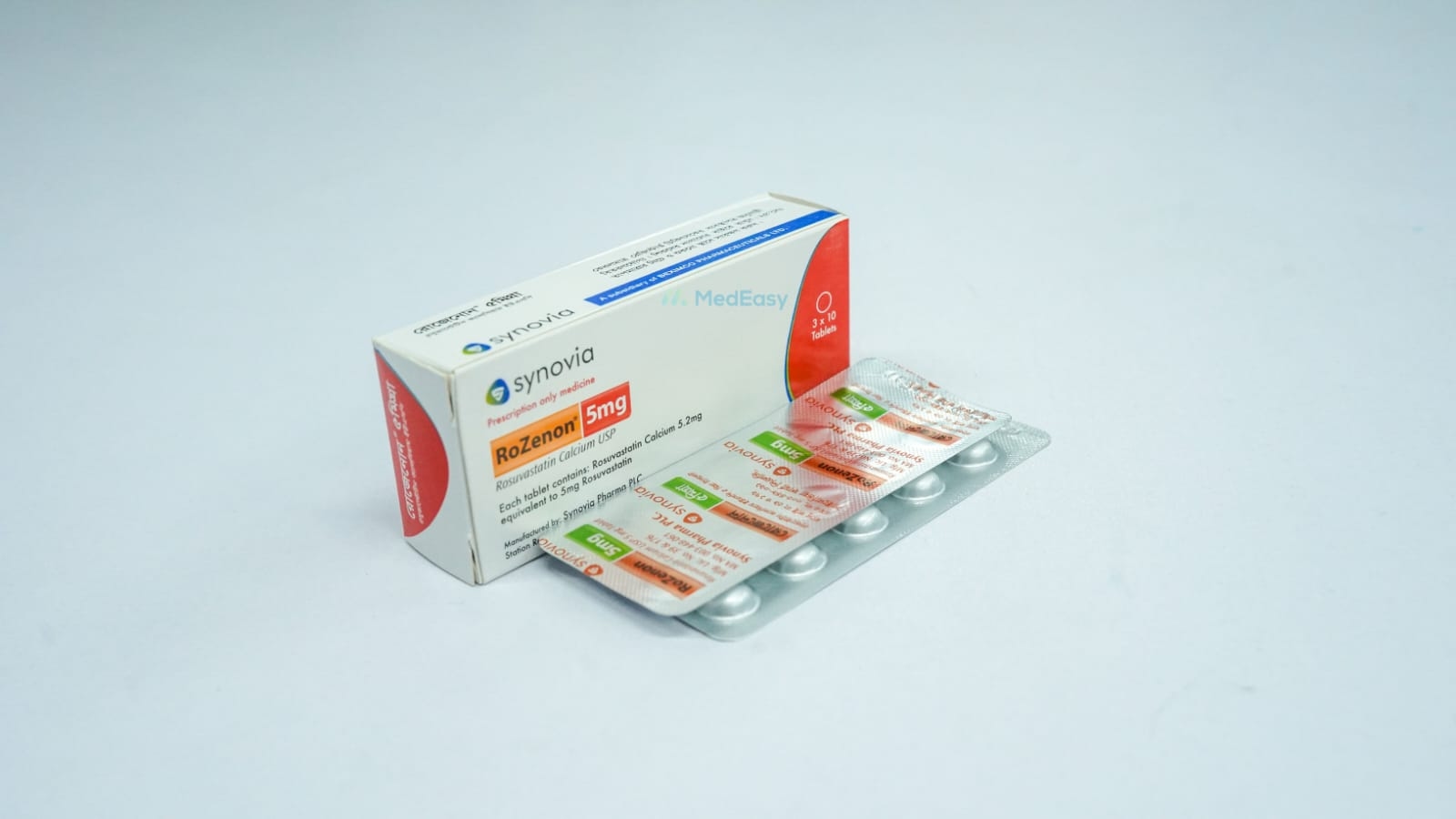
Rozenon5 mg
Synovia Pharma PLC
৳119.60
Add to cart
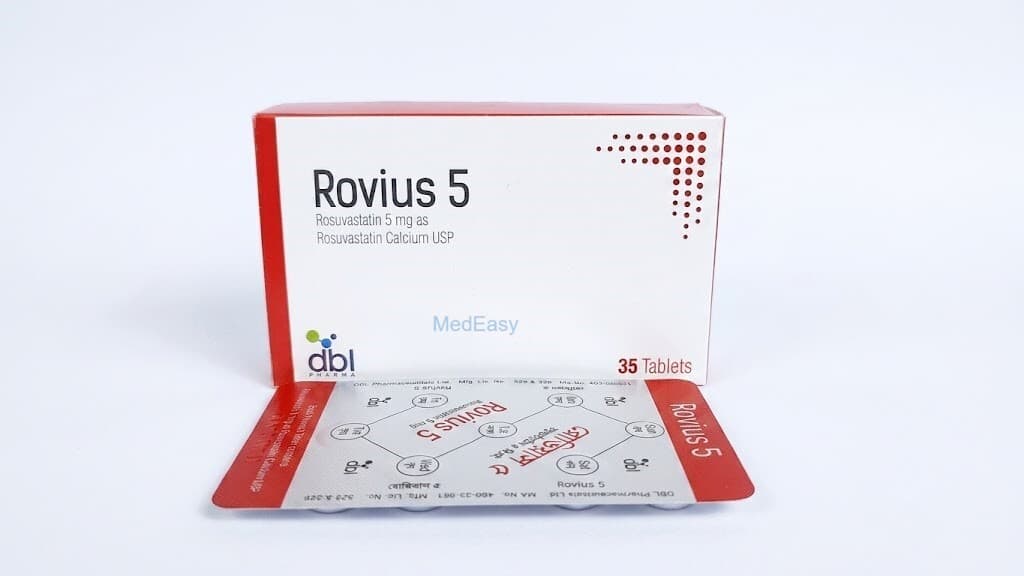
Rovius 5 mg Tablet is available on MedEasy for ৳78.75 per 7's Strip, with home delivery anywhere in Bangladesh. It is manufactured by DBL Pharmaceuticals Ltd. Its generic name is Rosuvastatin Calcium.

Rovius is an HMG-CoA reductase inhibitor (statin) indicated for the following uses:
Rovius is not indicated for the treatment of acute coronary events and does not substitute for diet, exercise, weight control, or other cardiovascular risk-factor management.
Each film-coated tablet contains Rosuvastatin Calcium equivalent to rosuvastatin as the active ingredient, commonly available in strengths of 5 mg, 10 mg, 20 mg, and 40 mg.
Tablets also contain standard pharmaceutical excipients such as microcrystalline cellulose, lactose monohydrate, calcium phosphate, crospovidone, magnesium stearate, and a film-coating system; exact excipients vary by manufacturer.
Rovius is a synthetic lipid-lowering agent belonging to the statin class. It is used for the management of dyslipidemia and for reducing the risk of cardiovascular events in appropriately selected patients.
Rovius works by inhibiting an enzyme in the liver that is essential for cholesterol synthesis, leading to increased uptake and catabolism of LDL-cholesterol. It is administered orally, once daily, with or without food, and is available as immediate-release film-coated tablets.
HMG-CoA Reductase Inhibitor (Statin) — Rovius belongs to this class of lipid-lowering agents.
Rosuvastatin Calcium is a selective and competitive inhibitor of HMG-CoA reductase, the rate-limiting enzyme that converts 3-hydroxy-3-methylglutaryl-coenzyme A to mevalonate, a precursor of cholesterol. Inhibition of this enzyme reduces hepatic cholesterol synthesis, increases the number of hepatic LDL receptors on the cell surface, and enhances uptake and catabolism of LDL from the blood, resulting in reductions in LDL-cholesterol, total cholesterol, apolipoprotein B, and triglycerides, with an increase in HDL-cholesterol.
The dose of Rovius should be individualized according to the indication, baseline LDL-cholesterol level, goal of therapy, and patient response, with periodic reassessment of lipid levels (generally at 2-4 week intervals) allowing dose adjustment.
| Indication | Typical adult dosing |
|---|---|
| Primary hyperlipidemia / mixed dyslipidemia | Usual starting dose 10-20 mg once daily; range 5-40 mg once daily. Patients requiring larger reductions in LDL-C (>45%) may start at 20 mg once daily. |
| Hypertriglyceridemia | 10 mg once daily as an adjunct to diet. |
| Homozygous familial hypercholesterolemia (adults and pediatrics 7-17 years) | 20 mg once daily, up to a maximum of 40 mg once daily, as an adjunct to other lipid-lowering therapies. |
| Heterozygous familial hypercholesterolemia, pediatric 8-17 years | Individualized starting dose of 5-10 mg once daily, up to a maximum of 20 mg once daily, depending on age; see Use in Special Populations / Pediatric Uses. |
| Primary prevention of cardiovascular disease | 20 mg once daily. |
Maximum dose should not be exceeded except under close medical supervision. Do not stop or change the dose without consulting a physician.
Rovius has the following well-documented, clinically significant interactions:
Inform your physician of all prescription medicines, over-the-counter products, and supplements before starting Rovius.
Rosuvastatin Calcium is contraindicated in:
Most patients tolerate Rovius well. Reported adverse effects include:
Seek prompt medical attention for unexplained muscle pain, tenderness or weakness accompanied by fever or dark urine, or signs of an allergic reaction.
Rovius is contraindicated in pregnancy. Statins, including Rovius, may cause fetal harm because cholesterol and other products of cholesterol biosynthesis are essential to fetal development; safety data in pregnant women are insufficient to rule out risk. If a patient becomes pregnant while taking Rovius, the medication should be discontinued immediately and the patient counselled about the potential risk to the fetus.
Rovius is also contraindicated during breastfeeding. It is not known whether Rovius is excreted in human milk, but because of the potential for serious adverse reactions in a nursing infant, women who require Rovius therapy should not breastfeed. A decision should be made, in consultation with a physician, whether to discontinue nursing or the drug, taking into account the importance of the drug to the mother.
Rovius, like other statins, can cause myopathy (muscle pain, tenderness or weakness with creatine kinase elevation) and, rarely, rhabdomyolysis with acute kidney injury, which can be fatal. Risk is increased with higher doses, advanced age (≥65 years), renal impairment, hypothyroidism, and concomitant use of certain interacting drugs (see Interactions). Rare cases of immune-mediated necrotizing myopathy have also been reported. Discontinue promptly if myopathy is diagnosed or suspected, or if markedly elevated creatine kinase occurs.
Persistent elevations in serum transaminases can occur. Liver function tests should be performed before starting therapy and as clinically indicated thereafter. Rovius should be used with caution in patients who consume substantial amounts of alcohol and/or have a history of liver disease, and is contraindicated in active liver disease (see Contraindications).
Plasma concentrations of Rovius are higher in patients of Asian ancestry compared with other populations; a lower starting dose (5 mg once daily) is recommended for these patients.
Increases in HbA1c and fasting serum glucose have been reported with statin use, including Rovius; monitor blood glucose, particularly in patients at risk of diabetes.
Proteinuria and microscopic hematuria have been observed, usually transient, and more frequent at the 40 mg dose; consider dose reduction if unexplained persistent proteinuria develops during routine urinalysis.
Use Rovius only under medical supervision, with periodic monitoring of lipid levels and, when indicated, liver function and renal status.
There is no specific antidote for Rovius overdose. In the event of a suspected overdose, seek immediate medical attention or contact a poison control center. Treatment should be symptomatic and supportive, with monitoring of liver function and creatine kinase as clinically indicated. Hemodialysis is not expected to significantly enhance clearance of Rovius due to its high protein binding.
Store at room temperature (below 30°C), away from light and moisture. Keep out of reach of children.
No dose adjustment is needed in mild to moderate renal impairment. In severe renal impairment (creatinine clearance <30 mL/min) not on hemodialysis, start Rovius at 5 mg once daily and do not exceed 10 mg once daily.
Rovius is contraindicated in active liver disease (see Contraindications). Use with caution in patients with a history of liver disease; it has not been studied in severe hepatic impairment.
No dose adjustment based on age alone is required, but plasma concentrations are higher and the risk of myopathy is increased in patients ≥65 years; use the lowest effective dose and monitor closely.
A lower starting dose (5 mg once daily) is recommended due to higher observed plasma exposure (see Precautions and Warnings).
See Pediatric Uses for age-specific indications and dosing.
Rovius is generally used long-term as part of chronic management of dyslipidemia and cardiovascular risk reduction. Duration of therapy should be determined by a physician based on lipid response, tolerability, and ongoing cardiovascular risk assessment; treatment is often continued indefinitely alongside diet and lifestyle measures unless contraindications, intolerance, or a change in clinical status arises. Do not stop treatment without consulting a physician, even if cholesterol levels normalize, as levels may rise again after discontinuation.
Rosuvastatin Calcium belongs to the HMG-CoA reductase inhibitor (statin) class of lipid-lowering medicines.
Rosuvastatin Calcium competitively inhibits HMG-CoA reductase, the enzyme controlling the rate-limiting step in hepatic cholesterol biosynthesis. This reduces intracellular cholesterol, which upregulates hepatic LDL receptor expression, increasing clearance of LDL-cholesterol from the circulation and lowering total cholesterol, LDL-cholesterol, apolipoprotein B, and triglycerides while modestly raising HDL-cholesterol.
X (FDA legacy pregnancy category) — contraindicated in pregnancy.
Use of Rovius in children is limited to specific, well-defined indications:
Safety and efficacy of Rovius have not been established in children below these age ranges or outside these specific indications. Growth and sexual maturation should be monitored periodically in pediatric patients on long-term therapy, as with other statins.
Q: What is Rovius 5 mg Tablet used for?
A: Rovius 5 mg Tablet is a statin medicine used to lower high cholesterol and triglyceride levels and to reduce the risk of heart attack, stroke, and other cardiovascular events in people with risk factors, alongside diet and lifestyle changes.
Q: How should I take Rovius 5 mg Tablet?
A: Take Rovius 5 mg Tablet exactly as prescribed, once daily, with or without food, at around the same time each day. Swallow the tablet whole with water. Do not change your dose or stop taking it without consulting your physician.
Q: Can Rovius 5 mg Tablet be taken during pregnancy or breastfeeding?
A: No. Rovius 5 mg Tablet is contraindicated in pregnancy and during breastfeeding because it may harm the developing fetus or a nursing infant. If you become pregnant while taking Rovius 5 mg Tablet, stop the medicine and contact your physician immediately.
Q: What side effects should I watch for with Rovius 5 mg Tablet?
A: Common side effects include headache, muscle aches, and stomach upset. Seek urgent medical attention if you notice unexplained muscle pain, tenderness or weakness with fever or dark-colored urine, or signs of an allergic reaction, as these may indicate a serious muscle or liver problem.
Q: Are there foods or medicines I should avoid with Rovius 5 mg Tablet?
A: Avoid taking antacids containing aluminum or magnesium hydroxide at the same time as Rovius 5 mg Tablet; separate them by at least 2 hours. Tell your physician about all other medicines, especially cyclosporine, gemfibrozil or other fibrates, protease inhibitors, warfarin, or niacin, as these can interact with Rovius 5 mg Tablet.
Q: What should I do if I miss a dose or take too much Rovius 5 mg Tablet?
A: If you miss a dose, take it as soon as you remember unless it is almost time for your next dose. If you suspect an overdose of Rovius 5 mg Tablet, seek immediate medical attention or contact a poison control center.
Disclaimer
The information provided is accurate to the best of our knowledge, but it does not replace professional medical advice. We cannot guarantee its completeness or accuracy, and the absence of specific information about a drug should not be taken as an endorsement. We are not responsible for any consequences arising from this information, so please consult a healthcare professional for any concerns or questions.