
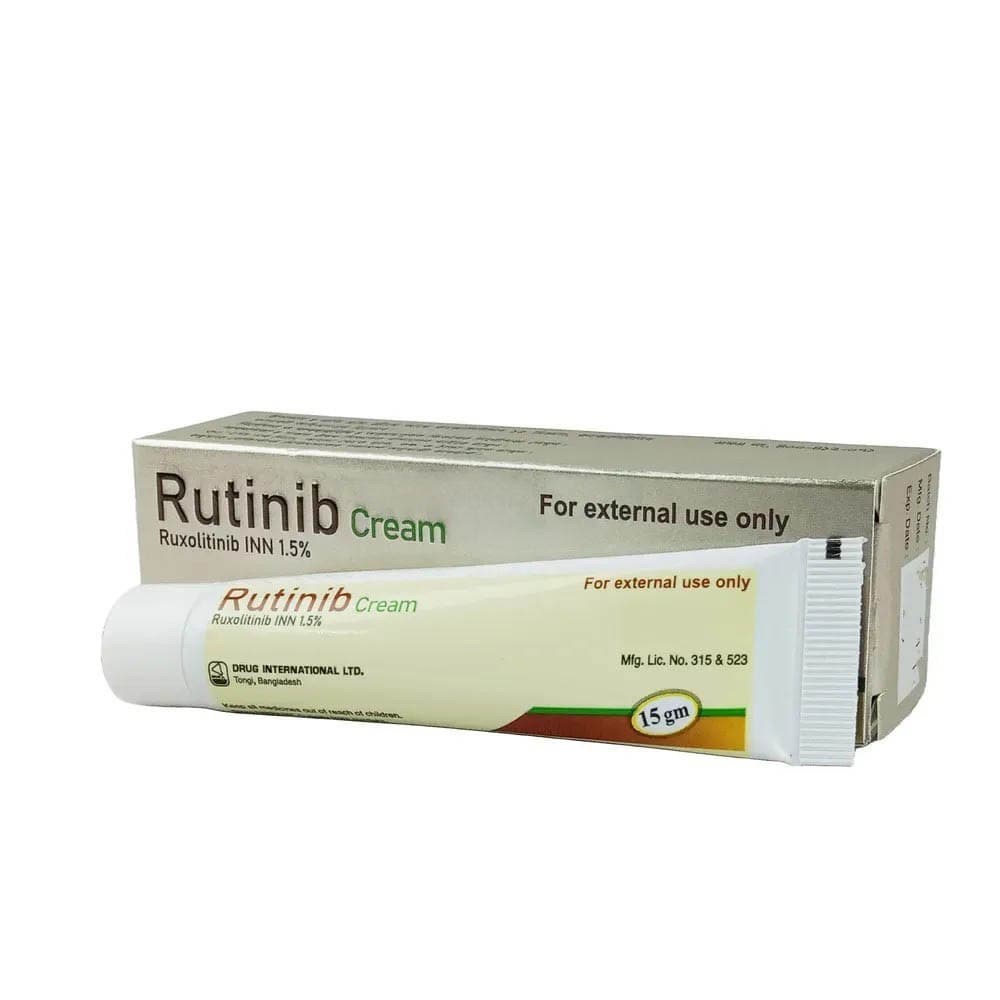

Medicine overview
Indications of Rutinib 1.5%
Rutinib 1.5% is an oral Janus kinase (JAK1/JAK2) inhibitor used in adults (and, for certain indications, adolescents) for the following conditions:
- Established, FDA-approved use: Treatment of intermediate or high-risk myelofibrosis (including primary myelofibrosis, post-polycythemia vera myelofibrosis, and post-essential thrombocythemia myelofibrosis) in adults.
- Established, FDA-approved use: Treatment of polycythemia vera in adults who have had an inadequate response to, or are intolerant of, hydroxyurea.
- Established, FDA-approved use: Treatment of steroid-refractory acute graft-versus-host disease (GVHD) in adult and pediatric patients 12 years of age and older.
- Established, FDA-approved use: Treatment of chronic graft-versus-host disease after failure of one or two prior lines of systemic therapy, in adult and pediatric patients 12 years of age and older.
A separate topical cream formulation of Rutinib 1.5% is approved in some markets for mild-to-moderate atopic dermatitis and for nonsegmental vitiligo in non-immunocompromised patients 12 years and older; this oral-formulation information does not apply to the topical product, which has its own distinct dosing and safety profile.
Rutinib 1.5% is a specialist hematology-oncology medicine (or, for GVHD, transplant-medicine specialty product) and must only be prescribed and monitored by, or in close consultation with, a qualified specialist.
Composition
Each film-coated tablet contains Ruxolitinib (as ruxolitinib phosphate) as the active ingredient, commonly available in strengths of 5 mg, 10 mg, 15 mg, 20 mg, and 25 mg. Tablets contain standard pharmaceutical excipients such as microcrystalline cellulose, lactose monohydrate, magnesium stearate, and film-coating agents; exact formulation can vary by manufacturer.
Description
Rutinib 1.5% is an orally administered, small-molecule inhibitor of Janus kinase 1 and 2 (JAK1/JAK2), enzymes central to the signaling pathways used by many cytokines and growth factors involved in blood cell production and immune regulation. It is used in the treatment of myeloproliferative neoplasms (myelofibrosis and polycythemia vera) and in steroid-refractory or treatment-resistant graft-versus-host disease following allogeneic stem cell transplantation.
Rutinib 1.5% carries a boxed warning shared across the JAK-inhibitor drug class regarding serious infections, mortality, malignancy, major adverse cardiovascular events, and thrombosis, and it is dispensed only against a specialist prescription with regular laboratory monitoring.
Therapeutic Class
Rutinib 1.5% belongs to the JAK1/JAK2 (Janus kinase) inhibitor class of targeted small-molecule agents, used as an antineoplastic in myeloproliferative neoplasms and as an immunomodulatory agent in graft-versus-host disease.
Pharmacology
Mechanism of Action
Ruxolitinib is a reversible, ATP-competitive inhibitor of Janus kinase 1 (JAK1) and Janus kinase 2 (JAK2). JAK1/JAK2 mediate signaling of the JAK-STAT pathway downstream of numerous cytokine and growth-factor receptors involved in hematopoiesis and immune function, including those activated by dysregulated JAK2 signaling (e.g. JAK2V617F mutation) that drives myeloproliferative neoplasms. By blocking this signaling, Ruxolitinib reduces abnormal cytokine production, splenomegaly, and constitutional symptoms in myelofibrosis and polycythemia vera, and dampens the inflammatory cytokine signaling responsible for allogeneic immune-mediated tissue damage in graft-versus-host disease.
Pharmacokinetics
- Absorption: Rapidly absorbed after oral administration; peak plasma concentration reached within about 1-2 hours; can be taken with or without food.
- Distribution: Approximately 97% bound to plasma proteins, mainly albumin.
- Metabolism: Primarily hepatic, mainly via CYP3A4 with a minor contribution from CYP2C9.
- Elimination half-life: Approximately 3 hours, supporting twice-daily dosing of the immediate-release tablet.
- Excretion: Predominantly in urine, with a smaller fraction in feces, mostly as metabolites.
Dosage & Administration of Rutinib 1.5%
Standard Adult Dosing by Indication
| Indication | Rutinib 1.5% Starting Dose | Notes |
|---|---|---|
| Myelofibrosis — platelet count >200 x 109/L | 20 mg orally twice daily | Dose based on baseline platelet count; adjusted thereafter per response and blood counts |
| Myelofibrosis — platelet count 100-200 x 109/L | 15 mg orally twice daily | |
| Myelofibrosis — platelet count 50-<100 x 109/L | 5 mg orally twice daily | Not generally recommended to start if platelets <50 x 109/L |
| Polycythemia vera | 10 mg orally twice daily | Adjusted based on efficacy and safety, up to a maximum |
| Acute graft-versus-host disease | 5 mg orally twice daily | May be increased to 10 mg twice daily after day 3 based on response, per specialist assessment |
| Chronic graft-versus-host disease | 10 mg orally twice daily | May be reduced (e.g. to 5 mg twice daily) with certain interacting drugs or hepatic/renal impairment |
Dose Modification
The dose of Rutinib 1.5% is individualized and adjusted by the treating specialist based on platelet counts, absolute neutrophil count, response, and tolerability. Dose interruption or reduction is commonly required for thrombocytopenia, neutropenia, or other significant toxicity; see Precautions and Side Effects.
Renal Impairment
Dose reduction is required for moderate to severe renal impairment (based on indication and platelet count, per specialist dosing tables). In end-stage renal disease requiring hemodialysis, a single adjusted dose is given after each dialysis session only, on dialysis days.
Hepatic Impairment
Dose reduction (generally by about half of the otherwise indicated starting dose) is required for any degree of hepatic impairment, with dosing individualized further based on platelet count and response.
Concomitant Strong CYP3A4 Inhibitors or Fluconazole
The dose of Rutinib 1.5% should be reduced when co-administered with strong CYP3A4 inhibitors or with fluconazole at doses of 200 mg/day or less; concomitant use with fluconazole doses above 200 mg/day should be avoided (see Interactions).
Missed Dose
If a dose is missed, the next dose should be taken at the regular scheduled time; do not double the dose to make up for a missed one.
Discontinuation
Rutinib 1.5% should not be stopped abruptly, particularly in myelofibrosis and polycythemia vera, as this can cause a withdrawal-like flare of symptoms (return of splenomegaly, worsening constitutional symptoms, and rarely an acute febrile illness resembling cytokine release). If discontinuation is needed, the treating physician will generally taper the dose gradually.
Administration of Rutinib 1.5%
- Take Rutinib 1.5% by mouth, with or without food, at approximately the same times each day (usually about 12 hours apart for twice-daily dosing).
- Swallow tablets whole; if unable to swallow, tablets may be given via nasogastric tube as a suspension in water only under specialist guidance.
- Do not stop, skip, or change the dose on your own — abrupt discontinuation can cause a symptom flare (see Dosage and Administration).
- If a dose is missed, take the next dose at its regular scheduled time; do not take a double dose.
- Attend all scheduled blood tests and follow-up visits required to monitor safety while on Rutinib 1.5%.
Interaction of Rutinib 1.5%
Strong CYP3A4 Inhibitors
Drugs such as ketoconazole, itraconazole, clarithromycin, and ritonavir/boosted protease inhibitors significantly increase blood levels of Rutinib 1.5%, raising the risk of toxicity (especially cytopenias). The dose of Rutinib 1.5% should be reduced when these are co-administered, per specialist dosing guidance.
Fluconazole
Fluconazole inhibits both CYP3A4 and CYP2C9, the main pathways for Rutinib 1.5% metabolism. Concomitant use of fluconazole at doses above 200 mg/day should be avoided; at doses of 200 mg/day or less, the Rutinib 1.5% dose should be reduced.
Strong CYP3A4 Inducers
Drugs such as rifampin, carbamazepine, and phenytoin can lower Rutinib 1.5% blood levels and reduce its effectiveness; a dose increase may be considered under specialist supervision, with close monitoring.
Live Vaccines
Because Rutinib 1.5% is immunosuppressive, live or live-attenuated vaccines should generally be avoided during treatment; discuss vaccination timing and status with the treating physician before starting therapy.
Contraindications
Ruxolitinib is contraindicated only in patients with known hypersensitivity to Ruxolitinib or any component of the formulation. There are no other well-established absolute contraindications; conditions requiring caution (e.g. severe cytopenias, active serious infection, hepatic or renal impairment, pregnancy) are addressed under Precautions and Warnings and Pregnancy and Lactation rather than as absolute contraindications.
Side Effects of Rutinib 1.5%
Very Common
- Thrombocytopenia (low platelet count) and anemia — the most frequent significant laboratory abnormalities; see Precautions for monitoring requirements
- Neutropenia (low neutrophil count)
- Bruising and increased risk of bleeding
- Dizziness and headache
- Diarrhea and nausea
- Elevated liver enzymes and blood lipids (cholesterol/triglycerides)
- Urinary tract infections and other infections
- Edema and weight gain
Less Common but Serious
- Serious infections — bacterial, mycobacterial (including reactivation of latent tuberculosis), fungal, and viral (including reactivation of herpes zoster/shingles); rare cases of progressive multifocal leukoencephalopathy (PML) have been reported
- Increased mortality and major adverse cardiovascular events (MACE) — observed with the JAK-inhibitor drug class in a large trial of another JAK inhibitor in rheumatoid arthritis; this risk is reflected in the class-wide boxed warning
- Thrombosis (deep vein thrombosis, pulmonary embolism, arterial thrombosis)
- Secondary malignancies, including non-melanoma skin cancer and lymphoma
- Withdrawal/discontinuation symptom flare in myeloproliferative disease (see Dosage and Administration)
- Rarely, tumor lysis syndrome
Patients should report any fever, signs of infection, unusual bruising or bleeding, new skin lesions, leg swelling/pain, chest pain, or shortness of breath to their treating physician promptly while taking Rutinib 1.5%.
Pregnancy & Lactation
Pregnancy
Animal studies show that Rutinib 1.5% can cause embryo-fetal harm. Rutinib 1.5% should not be used during pregnancy unless there is no safer alternative and the potential benefit is judged by the treating physician to justify the potential risk to the fetus. Patients of reproductive potential should use effective contraception during treatment and for a period after the last dose as advised by their physician. Consult a physician immediately if pregnancy occurs or is suspected during treatment with Rutinib 1.5%.
Lactation
Rutinib 1.5% and its metabolites pass into the milk of lactating animals; it is not known whether it passes into human breast milk in clinically significant amounts. Because of the potential for serious adverse effects in a breastfeeding infant, breastfeeding is not recommended during treatment with Rutinib 1.5% and for at least 2 weeks after the last dose, as advised by the treating physician.
Precautions & Warnings
Boxed Warning (Class-Wide, JAK Inhibitors)
Rutinib 1.5% carries a boxed warning shared across the JAK-inhibitor class, based on a large safety trial of another JAK inhibitor in rheumatoid arthritis, for: serious infections, increased overall mortality, malignancy (including lymphoma and skin cancers), major adverse cardiovascular events (including cardiovascular death, myocardial infarction, and stroke), and thrombosis (including deep vein thrombosis, pulmonary embolism, and arterial thrombosis). This risk should be discussed with, and weighed against benefit by, the treating specialist, particularly in patients over 50 years of age with cardiovascular risk factors or a smoking history.
- Myelosuppression: Complete blood counts must be monitored before starting Rutinib 1.5%, every 2 to 4 weeks until doses are stabilized, and periodically thereafter as clinically indicated. Dose interruption, reduction, or transfusion support is used to manage significant thrombocytopenia, anemia, or neutropenia.
- Serious infections: Evaluate for active or latent tuberculosis before starting; monitor for signs of infection throughout treatment and manage promptly. Rutinib 1.5% should be interrupted if a serious infection develops until it is controlled.
- Malignancies: Periodic skin examination is recommended, especially in patients with prior skin cancer or significant UV exposure history.
- Thrombosis and cardiovascular risk: Use with caution in patients with known cardiovascular risk factors; evaluate promptly for signs/symptoms of thromboembolism.
- Progressive multifocal leukoencephalopathy (PML): Rare cases reported; monitor for new or worsening neurological symptoms.
- Lipid abnormalities: Monitor blood lipid profile approximately 8-12 weeks after starting therapy and manage per standard lipid-management guidelines.
- Withdrawal/discontinuation symptom flare: Do not stop Rutinib 1.5% abruptly in myeloproliferative neoplasms; taper the dose gradually under specialist guidance if discontinuation is required (see Dosage and Administration).
- Hepatic/renal impairment: Requires dose reduction; see Dosage and Administration and Use in Special Populations.
- Specialist supervision required: Rutinib 1.5% must be prescribed and monitored only by, or under the direct guidance of, a qualified hematologist-oncologist or transplant specialist, with access to regular laboratory monitoring. It should never be self-adjusted or shared with others.
Overdose Effects of Rutinib 1.5%
There is limited clinical experience with Rutinib 1.5% overdose. Based on its known effects, overdose is expected to cause exaggerated pharmacologic effects, principally worsened bone marrow suppression (thrombocytopenia, anemia, neutropenia) and, at very high single doses, gastrointestinal upset. There is no specific antidote for Rutinib 1.5% overdose, and Rutinib 1.5% is not expected to be significantly removed by hemodialysis.
If an overdose is suspected, seek immediate medical attention or contact a poison control center/emergency services right away. Treatment is supportive and symptomatic, including close monitoring of blood counts and transfusion support if needed, under hospital care.
Storage Conditions
Store at room temperature (below 30°C), away from light and moisture. Keep out of reach of children.
Use In Special Populations
Renal Impairment
Dose reduction of Rutinib 1.5% is required for moderate to severe renal impairment, based on indication and platelet count per specialist dosing tables. In end-stage renal disease requiring hemodialysis, a single adjusted dose is given only on dialysis days, after the dialysis session.
Hepatic Impairment
Dose reduction (generally by about half of the standard starting dose) is required for any degree of hepatic impairment, with further individualization based on platelet count and response.
Elderly Patients
No overall differences in effectiveness have been observed between elderly and younger adult patients, but elderly patients (particularly those over 50 years with cardiovascular risk factors) may be at higher risk of the serious adverse effects described in the boxed warning; monitor closely.
Pediatric Patients
Rutinib 1.5% is approved for steroid-refractory acute GVHD and for chronic GVHD after failure of prior therapy in pediatric patients 12 years of age and older, using weight-based or fixed dosing per specialist protocols. Safety and efficacy for myelofibrosis and polycythemia vera have not been established in pediatric patients, and Rutinib 1.5% is not indicated for those conditions in children.
Duration Of Treatment
Treatment with Rutinib 1.5% for myelofibrosis and polycythemia vera is generally continued long-term/indefinitely for as long as the patient continues to benefit clinically and does not experience unacceptable toxicity, as determined by the treating specialist. For graft-versus-host disease, treatment duration is individualized based on disease response and is periodically reassessed by the transplant specialist. Treatment should never be started, extended, shortened, or stopped without the treating physician's guidance, and should be tapered rather than stopped abruptly when discontinuation is planned.
Drug Classes
Ruxolitinib is classified as a JAK1/JAK2 (Janus kinase) inhibitor, a subclass of targeted small-molecule kinase inhibitors used as antineoplastic/myelosuppressive-disease-modifying therapy in myeloproliferative neoplasms and as an immunomodulatory agent in graft-versus-host disease.
Mode Of Action
Ruxolitinib selectively and reversibly inhibits Janus kinase 1 (JAK1) and Janus kinase 2 (JAK2), enzymes that transmit signals from cytokine and growth-factor receptors through the JAK-STAT pathway. In myelofibrosis and polycythemia vera, this signaling is often dysregulated (e.g. by the JAK2V617F mutation), driving excess blood cell production, splenomegaly, and cytokine-mediated constitutional symptoms; Ruxolitinib suppresses this abnormal signaling, reducing spleen size and symptom burden. In graft-versus-host disease, Ruxolitinib dampens JAK1/JAK2-dependent inflammatory cytokine signaling (including interferon-gamma and interleukin pathways) that drives donor-immune-cell-mediated damage to recipient tissues.
Pediatric Uses
Rutinib 1.5% is approved for the treatment of steroid-refractory acute graft-versus-host disease and chronic graft-versus-host disease (after failure of one or two prior lines of systemic therapy) in pediatric patients 12 years of age and older, under specialist transplant-medicine supervision with appropriate dose selection and monitoring. The safety and efficacy of Rutinib 1.5% for myelofibrosis and polycythemia vera have not been established in pediatric patients, and it is not indicated for those conditions in children or adolescents.
Frequently Asked Questions
Q: What is Rutinib 1.5% 15 gm Cream used for?
A: Rutinib 1.5% 15 gm Cream is used to treat intermediate or high-risk myelofibrosis, polycythemia vera (when hydroxyurea has not worked well or is not tolerated), and steroid-refractory acute or chronic graft-versus-host disease after stem cell transplant. It must be prescribed and monitored by a hematology-oncology or transplant specialist.
Q: Why does Rutinib 1.5% 15 gm Cream carry a boxed warning?
A: Rutinib 1.5% 15 gm Cream belongs to the JAK-inhibitor drug class, which carries a shared boxed warning for serious infections, increased overall mortality, malignancy, major cardiovascular events, and blood clots (thrombosis), based on safety data from trials of this drug class. Your physician will weigh these risks against the expected benefit, especially if you are over 50 or have heart disease risk factors, before and during treatment.
Q: Why do I need regular blood tests while taking Rutinib 1.5% 15 gm Cream?
A: Rutinib 1.5% 15 gm Cream commonly lowers platelet counts, red blood cell counts, and white blood cell (neutrophil) counts, which can increase the risk of bleeding, anemia symptoms, and infection. Your specialist will check your complete blood count before starting treatment, every 2 to 4 weeks until your dose is stable, and periodically afterward, adjusting the dose as needed.
Q: Can I stop taking Rutinib 1.5% 15 gm Cream suddenly if I feel better?
A: No. Stopping Rutinib 1.5% 15 gm Cream abruptly, especially if you have myelofibrosis or polycythemia vera, can cause your spleen to enlarge again and your symptoms (fever, pain, general illness) to flare up suddenly. If your physician decides you should stop Rutinib 1.5% 15 gm Cream, the dose will usually be reduced gradually (tapered) rather than stopped all at once.
Q: Is Rutinib 1.5% 15 gm Cream safe during pregnancy or breastfeeding?
A: Rutinib 1.5% 15 gm Cream can harm a developing fetus based on animal studies, so it should be avoided during pregnancy unless your physician determines that the potential benefit outweighs the risk. Effective contraception is needed during treatment and for a period afterward. Breastfeeding is not recommended during treatment with Rutinib 1.5% 15 gm Cream and for at least 2 weeks after the last dose; discuss timing with your physician.
Q: What symptoms should make me contact my doctor immediately while on Rutinib 1.5% 15 gm Cream?
A: Contact your treating specialist promptly if you develop fever, chills, or other signs of infection; unusual bruising or bleeding; new skin lesions or growths; leg swelling or pain; chest pain, sudden shortness of breath, or signs of a stroke; or any new or worsening neurological symptoms while taking Rutinib 1.5% 15 gm Cream.
Disclaimer
The information provided is accurate to the best of our knowledge, but it does not replace professional medical advice. We cannot guarantee its completeness or accuracy, and the absence of specific information about a drug should not be taken as an endorsement. We are not responsible for any consequences arising from this information, so please consult a healthcare professional for any concerns or questions.
