

10% Off
Dopamet250 mg
Opsonin Pharma Ltd.
৳2.77
Add to cart
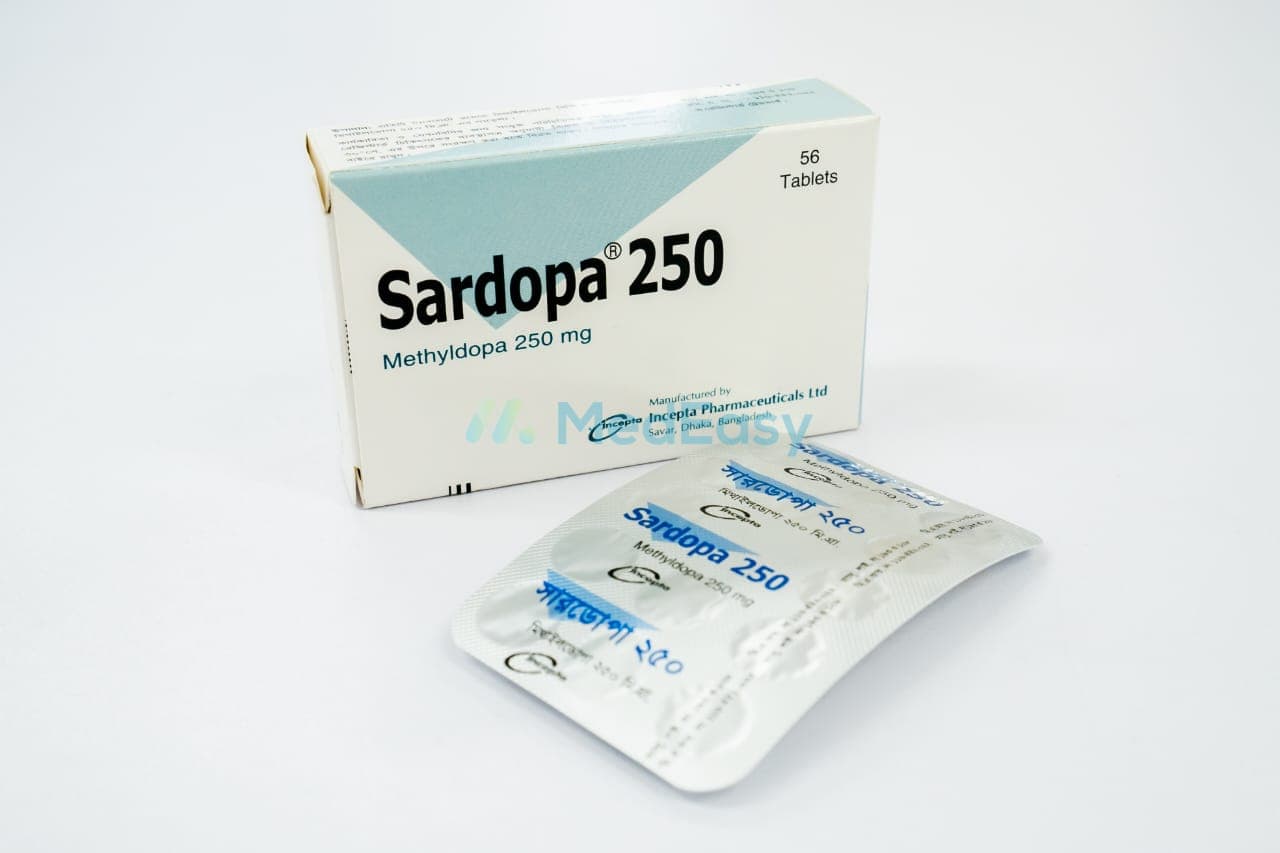

Sardopa is a centrally-acting antihypertensive agent (alpha-2 adrenergic agonist) approved for the treatment of hypertension. Its evidence-based uses include:
Sardopa is not indicated for hypertensive emergencies requiring rapid blood pressure reduction.
Each tablet of Methyldopa contains Methyldopa (as the sesquihydrate) as the active ingredient, commonly available in strengths of 250 mg and 500 mg. Tablets also contain standard inactive excipients such as binders, fillers, and coating agents, which may vary by manufacturer.
Sardopa is an aromatic amino acid derivative that acts as a centrally-acting antihypertensive drug. It has been used clinically for several decades and remains notable for its favorable long-term safety profile in pregnancy compared with many other antihypertensive classes. Sardopa is administered orally and is available as tablets in various strengths.
Sardopa belongs to the therapeutic class of centrally-acting antihypertensive agents (alpha-2 adrenergic agonists).
Methyldopa is metabolized in the central nervous system to alpha-methylnorepinephrine, which stimulates central alpha-2 adrenergic receptors. This reduces sympathetic outflow from the vasomotor centers in the brain, leading to decreased peripheral vascular resistance and lowered blood pressure, generally without significant reflex tachycardia.
Methyldopa is partially absorbed after oral administration (approximately 50%), with peak plasma concentration reached within 3-6 hours. The onset of antihypertensive effect typically occurs within 4-6 hours, with maximal effect at 6-8 hours after a single dose, and the effect may persist for 24-48 hours. It is metabolized in the liver and gut wall and excreted primarily via the kidneys; a portion is eliminated unchanged in urine.
| Phase | Dose |
|---|---|
| Initial (first 48 hours) | 250 mg two to three times daily |
| Titration | Increase as needed at intervals of at least 2 days |
| Maintenance | 500 mg to 2 g daily in 2-4 divided doses |
| Maximum | 3 g per day |
| Combined with other antihypertensives | Limit initial dose to 500 mg daily in divided doses; adjust concomitant drug dose accordingly |
Initial dose: 10 mg/kg body weight per day in 2-4 divided doses, adjusted at intervals of at least 2 days until adequate blood pressure control is achieved. Maximum dose: 65 mg/kg or 3 g per day, whichever is less.
Patients with reduced renal function may be more sensitive to the antihypertensive effect and may respond to lower doses; dose should be individualized with careful monitoring of blood pressure.
Sardopa may be taken with or without food and should be taken at the same time(s) each day. Doses should not be skipped or doubled.
Sardopa tablets are given orally, with or without food, at evenly spaced intervals as prescribed. Tablets should be swallowed whole with water. Do not stop taking Sardopa abruptly without consulting a physician, as this may lead to rebound increases in blood pressure.
Methyldopa is contraindicated in patients with:
Common and important adverse effects of Sardopa include:
Pregnancy: Sardopa has a long history of clinical use in pregnancy and is considered one of the preferred antihypertensive agents for hypertension in pregnancy based on extensive published experience. However, formal controlled trials in the first trimester are limited. Sardopa should be used in pregnancy only if clearly needed, with the decision made by a physician weighing potential benefit against potential risk.
Lactation: Sardopa is excreted in small amounts in breast milk. It is generally considered compatible with breastfeeding under medical supervision, but a physician should be consulted before use while breastfeeding, and the infant should be monitored for any unusual signs.
Rare but potentially severe liver injury, including fatal hepatic necrosis, has been reported with Sardopa. Liver function tests are advisable periodically, particularly during the first 6-12 weeks of treatment or if unexplained fever occurs. Sardopa should be discontinued promptly if fever, jaundice, or abnormal liver function tests develop.
A positive Coombs test may develop in some patients on long-term therapy, occasionally progressing to hemolytic anemia. Periodic blood counts may be considered with prolonged use; Sardopa should be discontinued if hemolytic anemia occurs.
Sardopa may cause or worsen depression; use with caution in patients with a history of depression, and discontinue if depression develops. Reversible involuntary choreoathetotic movements have rarely been reported, particularly in patients with severe bilateral cerebrovascular disease; discontinue Sardopa if these occur.
Sedation is common, especially during initiation of therapy or dose increases, and generally improves with continued treatment. Patients should be cautious with driving or operating machinery until they know how Sardopa affects them.
Patients with impaired renal function may be more sensitive to the antihypertensive effect of Sardopa and may require dose reduction.
Abrupt discontinuation is not generally associated with severe rebound hypertension (unlike some other centrally-acting agents), but gradual dose reduction under medical supervision is advisable.
Overdose of Sardopa may cause excessive lowering of blood pressure, sedation, weakness, dizziness, bradycardia, and in severe cases, coma. If overdose is suspected, seek immediate medical attention or contact a poison control center right away. Management is supportive and symptomatic (including monitoring of vital signs and blood pressure support as needed); Sardopa is dialyzable, so hemodialysis may be considered in severe cases under medical supervision. Do not attempt to manage an overdose at home without professional medical guidance.
Store at room temperature (below 30°C), away from light and moisture. Keep out of reach of children.
Sardopa is a preferred agent for hypertension in pregnancy based on long clinical experience; use only under physician supervision. See Pregnancy and Lactation.
Dose reduction may be required, as patients with reduced renal function are more sensitive to the antihypertensive effect of Sardopa.
Sardopa is contraindicated in active liver disease. Use with caution and close monitoring in patients with any history of hepatic dysfunction.
Elderly patients may be more susceptible to sedation and orthostatic hypotension; start at the lower end of the dosing range and monitor closely.
See Pediatric Uses.
Duration of treatment with Sardopa is individualized based on blood pressure response and clinical indication; hypertension typically requires long-term, often lifelong, therapy under regular physician follow-up. Periodic reassessment of continued need, dose, and monitoring for hepatic/hematologic effects is recommended, especially during the first several months of treatment.
Methyldopa is classified as a centrally-acting antihypertensive agent (alpha-2 adrenergic agonist).
Methyldopa is converted in the brain to alpha-methylnorepinephrine, a potent central alpha-2 adrenergic receptor agonist. This action reduces sympathetic nervous system outflow from the brain's vasomotor center, decreasing peripheral vascular resistance and lowering blood pressure.
Category B (per FDA legacy pregnancy categorization system).
Sardopa is approved for use in pediatric patients with hypertension. The initial dose is 10 mg/kg body weight per day in 2-4 divided doses, titrated at intervals of at least 2 days as needed, up to a maximum of 65 mg/kg or 3 g per day, whichever is less. Use in children should be under close pediatric/pediatric-cardiology supervision, with regular monitoring of blood pressure, liver function, and blood counts given the rare but serious hepatic and hematologic risks described in Precautions and Warnings.
Q: What is Sardopa 250 mg Tablet used for?
A: Sardopa 250 mg Tablet is used to treat high blood pressure (hypertension). It is especially well established for treating hypertension that occurs during pregnancy.
Q: Is Sardopa 250 mg Tablet safe to take during pregnancy?
A: Sardopa 250 mg Tablet has a long history of use in pregnancy and is considered one of the preferred antihypertensive options in this setting, but it should still be used only if clearly needed and under the supervision of a physician, who will weigh the potential benefits against any potential risks.
Q: Can Sardopa 250 mg Tablet cause liver problems?
A: Yes, rarely Sardopa 250 mg Tablet can cause liver injury, including severe hepatitis-like reactions. Your doctor may check your liver function periodically, especially in the first 6-12 weeks of treatment. Seek medical attention immediately if you develop fever, yellowing of the skin/eyes, dark urine, or unusual tiredness.
Q: Why do I feel sleepy after starting Sardopa 250 mg Tablet?
A: Sedation or drowsiness is a common side effect, especially when starting Sardopa 250 mg Tablet or after a dose increase. This usually improves within a few weeks of continued treatment. Avoid driving or operating machinery until you know how it affects you.
Q: Can I take Sardopa 250 mg Tablet with iron tablets?
A: Iron supplements can reduce the absorption and effectiveness of Sardopa 250 mg Tablet. Tell your doctor if you are taking iron supplements, as they may adjust the timing of doses or choose an alternative.
Q: What should I do if I miss a dose of Sardopa 250 mg Tablet?
A: Take the missed dose as soon as you remember, unless it is almost time for your next dose, in which case skip the missed dose. Do not take a double dose to make up for a missed one. Contact your doctor if you have questions about your dosing schedule.
Disclaimer
The information provided is accurate to the best of our knowledge, but it does not replace professional medical advice. We cannot guarantee its completeness or accuracy, and the absence of specific information about a drug should not be taken as an endorsement. We are not responsible for any consequences arising from this information, so please consult a healthcare professional for any concerns or questions.
