
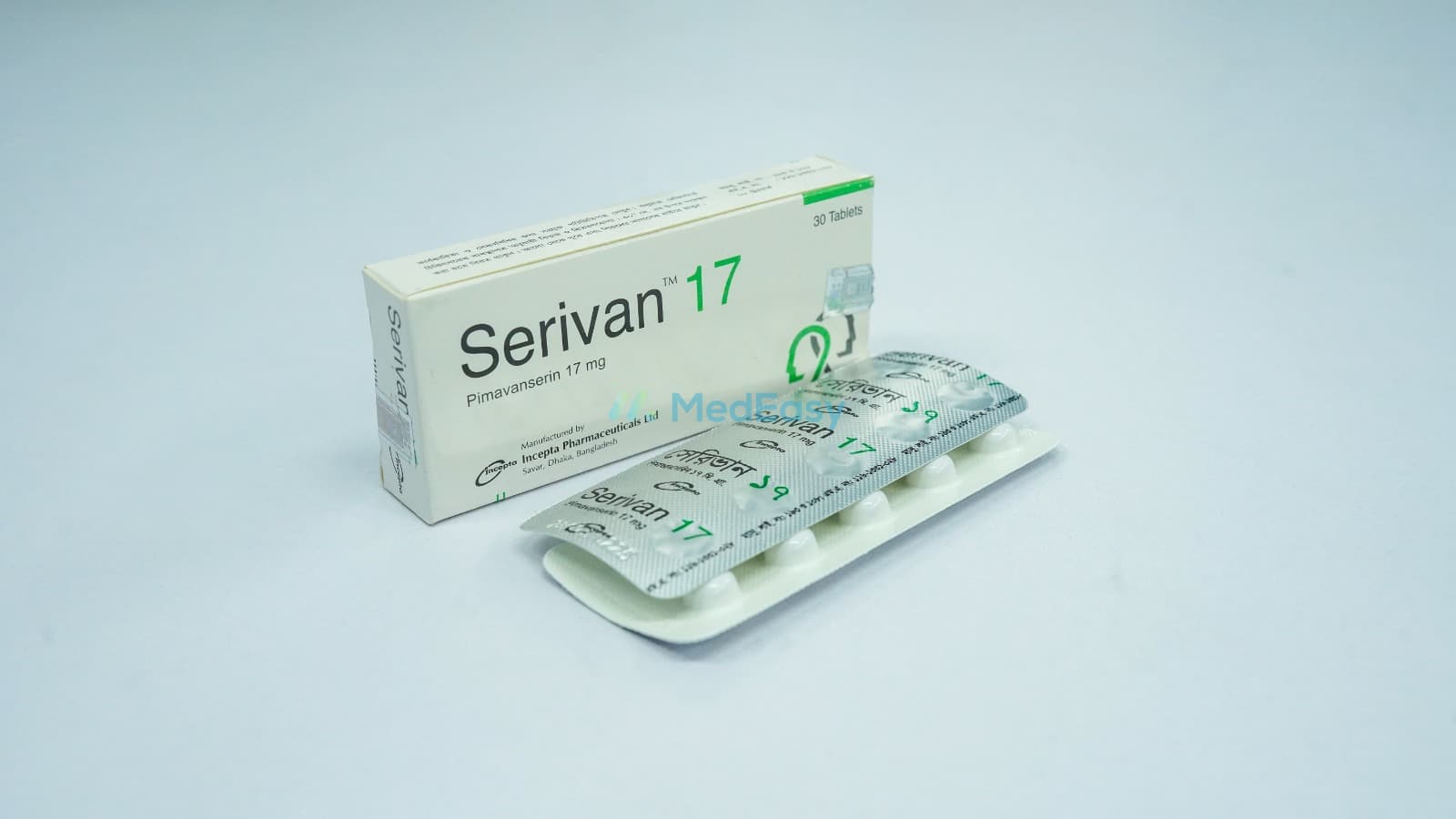

Medicine overview
Indications of Serivan
Serivan is an atypical antipsychotic used specifically for the following indication:
Established / FDA-approved use
- Treatment of hallucinations and delusions associated with Parkinson's disease psychosis (PDP) in adults.
Serivan is not approved for the treatment of psychosis associated with dementia (including Alzheimer's disease) that is unrelated to Parkinson's disease, and is not approved for use in schizophrenia or other primary psychotic disorders. Use outside the approved indication is considered off-label and is not recommended without specialist psychiatric or neurologic guidance.
Composition
Each capsule/tablet contains Pimavanserin (as pimavanserin tartrate) as the active ingredient.
- Capsule: Pimavanserin 34 mg (equivalent oral capsule strength).
- Tablet: Pimavanserin 10 mg (used for dose adjustment in specific clinical situations, e.g. with strong CYP3A4 inhibitors).
Exact excipients and available strengths may vary by manufacturer; refer to the specific product label.
Description
Serivan is an atypical (second-generation) antipsychotic that is pharmacologically distinct from other antipsychotics because it has selective activity at serotonin 5-HT2A receptors and lacks significant affinity for dopamine receptors. This profile allows it to treat psychotic symptoms in Parkinson's disease without worsening the motor symptoms of the disease, which is a major limitation of most other antipsychotics in this population.
Serivan is administered orally, once daily, and is intended for long-term use under the supervision of a physician experienced in managing Parkinson's disease psychosis.
Therapeutic Class
Serivan belongs to the class of atypical antipsychotics, specifically classified as a selective serotonin 5-HT2A receptor inverse agonist/antagonist (with additional lower-affinity activity at 5-HT2C receptors).
Pharmacology
Mechanism
Pimavanserin acts as a selective inverse agonist and antagonist at serotonin 5-HT2A receptors, with lower affinity antagonist activity at 5-HT2C receptors. Unlike most antipsychotics, Pimavanserin has negligible binding affinity for dopaminergic (D2), histaminergic, muscarinic, or adrenergic receptors. This selective serotonergic mechanism is believed to underlie its ability to reduce hallucinations and delusions in Parkinson's disease psychosis without exacerbating parkinsonian motor symptoms.
Pharmacokinetics
- Absorption: Well absorbed orally; food does not significantly affect exposure.
- Metabolism: Extensively metabolized in the liver, primarily via CYP3A4/3A5, and to a lesser extent other CYP enzymes, forming an active metabolite.
- Elimination: Pimavanserin and its active metabolite have long elimination half-lives, which supports once-daily dosing and means steady-state levels take one to two weeks to be reached.
Dosage & Administration of Serivan
Dosage by indication
| Indication | Population | Recommended dose |
|---|---|---|
| Hallucinations and delusions of Parkinson's disease psychosis | Adults | Serivan 34 mg orally once daily, taken without titration |
| Same indication, with concomitant strong CYP3A4 inhibitor | Adults | Reduce Serivan dose to 10 mg orally once daily (see Interactions) |
| Pediatric use | Children/adolescents | Not established — Serivan is not indicated in this population |
Renal/hepatic adjustment
- No dose adjustment is required for mild-to-moderate renal or hepatic impairment.
- Serivan has not been studied in severe renal impairment or severe hepatic impairment; use with caution and close monitoring if unavoidable, as recommended by the treating physician.
Serivan may be taken with or without food, at approximately the same time each day.
Administration of Serivan
Take Serivan by mouth once daily, with or without food. Swallow the capsule or tablet whole with water; do not crush or chew unless specifically directed by a physician or pharmacist. Try to take Serivan at the same time each day to maintain consistent blood levels. Do not stop Serivan abruptly without consulting the prescribing physician, as symptoms of psychosis may return.
Interaction of Serivan
The following are well-established, clinically significant interactions with Serivan:
- Strong CYP3A4 inhibitors (e.g. ketoconazole, itraconazole, clarithromycin, ritonavir): significantly increase Serivan blood levels, raising the risk of side effects including QT prolongation; the Serivan dose should be reduced to 10 mg once daily.
- Strong CYP3A4 inducers (e.g. rifampin, carbamazepine, phenytoin, St. John's Wort): significantly decrease Serivan blood levels and may reduce effectiveness; concomitant use should generally be avoided.
- Other QT-prolonging drugs (e.g. certain antiarrhythmics, some antibiotics, other antipsychotics): additive risk of QT interval prolongation when combined with Serivan; concomitant use should be avoided (see Precautions).
Contraindications
Pimavanserin is contraindicated in patients with known hypersensitivity to Pimavanserin or any component of the formulation.
Side Effects of Serivan
Common side effects reported with Serivan include:
- Peripheral edema (swelling of the legs/ankles)
- Nausea
- Confusion
- Constipation
- Gait disturbance
- Hallucinations (paradoxical worsening in some patients)
Serious but less common risks, including QT interval prolongation and increased mortality risk in elderly patients with dementia-related psychosis, are described in full under Precautions and Warnings.
Pregnancy & Lactation
Pregnancy
Data on the use of Serivan in human pregnancy are limited. Serivan should be used during pregnancy only if clearly needed and if the potential benefit to the mother justifies the potential risk to the fetus. Neonates exposed to antipsychotics during the third trimester are at risk of extrapyramidal and/or withdrawal symptoms after delivery; consult a physician for individualized guidance.
Lactation
It is not known whether Serivan or its metabolites are excreted in human breast milk. Because many drugs are excreted in breast milk, a decision should be made whether to discontinue nursing or discontinue Serivan, taking into account the importance of the drug to the mother, in consultation with a physician.
Precautions & Warnings
Boxed warning: increased mortality in elderly dementia-related psychosis
Elderly patients with dementia-related psychosis treated with antipsychotic drugs, including Serivan, are at an increased risk of death compared with placebo. Serivan is not approved for the treatment of patients with dementia-related psychosis unrelated to the hallucinations and delusions associated with Parkinson's disease psychosis.
QT interval prolongation
Serivan prolongs the QT interval. Avoid use in patients with known QT prolongation, in combination with other drugs known to prolong the QT interval, and in patients with risk factors for torsades de pointes (e.g. bradycardia, hypokalemia, hypomagnesemia, or a family history of QT prolongation). Consider baseline and periodic ECG monitoring in patients with pre-existing cardiac conditions.
Use limited to Parkinson's disease psychosis
Serivan should not be used to treat psychosis unrelated to Parkinson's disease, as its safety and effectiveness have not been established for such use.
Renal and hepatic impairment
Use with caution and only under specialist supervision in severe renal or hepatic impairment, as Serivan has not been studied in these populations.
Overdose Effects of Serivan
Limited data are available on Serivan overdose. In the event of a suspected overdose, seek immediate medical attention or contact a poison control center / emergency services right away. Management should be supportive and symptomatic, with particular attention to cardiac monitoring given the risk of QT prolongation; there is no specific antidote for Serivan. Do not attempt home treatment of a suspected overdose.
Storage Conditions
Store at room temperature, between 20°C and 25°C (68°F–77°F); brief excursions between 15°C and 30°C are permitted during transport. Protect from excess moisture and light. Keep out of reach of children.
Use In Special Populations
Elderly
Serivan carries a boxed warning for increased mortality when used in elderly patients with dementia-related psychosis unrelated to Parkinson's disease; it is not approved for that use (see Precautions).
Renal impairment
No dose adjustment needed for mild-to-moderate renal impairment; not studied in severe renal impairment — use with caution.
Hepatic impairment
No dose adjustment needed for mild-to-moderate hepatic impairment; not studied in severe hepatic impairment — use with caution.
Pediatric patients
Safety and efficacy of Serivan have not been established in pediatric patients.
Duration Of Treatment
The duration of treatment with Serivan is individualized based on the patient's response and ongoing need, as determined by the treating physician. Parkinson's disease psychosis is typically a chronic condition, so Serivan is often continued long-term, with periodic clinical reassessment of continued need, benefit, and tolerability.
Drug Classes
Atypical antipsychotics; Serotonin 5-HT2A receptor inverse agonists/antagonists
Mode Of Action
Pimavanserin works as a selective inverse agonist and antagonist at serotonin 5-HT2A receptors (with additional lower-affinity activity at 5-HT2C receptors), without significant activity at dopaminergic receptors. This selective serotonergic action reduces hallucinations and delusions of Parkinson's disease psychosis while avoiding the worsening of motor symptoms typically seen with dopamine-blocking antipsychotics.
Pediatric Uses
The safety and efficacy of Serivan have not been established in pediatric patients. Serivan is not recommended for use in children or adolescents outside of a clinical trial setting.
Frequently Asked Questions
Q: What is Serivan 17 mg Tablet used for?
A: Serivan 17 mg Tablet is used to treat hallucinations and delusions that occur in people with Parkinson's disease psychosis. It is not approved for other types of psychosis, including dementia-related psychosis unrelated to Parkinson's disease.
Q: How should I take Serivan 17 mg Tablet?
A: Serivan 17 mg Tablet is usually taken as a single dose of 34 mg by mouth once daily, with or without food, at about the same time each day. Do not change your dose or stop taking it without talking to your physician first.
Q: Can Serivan 17 mg Tablet affect my heart?
A: Yes. Serivan 17 mg Tablet can prolong the QT interval of the heart's electrical cycle, which can be dangerous, especially if combined with other QT-prolonging medicines or in people with certain heart risk factors. Tell your physician about all other medications you take and any history of heart rhythm problems.
Q: Is Serivan 17 mg Tablet safe for elderly patients with dementia?
A: Serivan 17 mg Tablet carries a boxed warning because antipsychotic medicines, including Serivan 17 mg Tablet, are associated with an increased risk of death in elderly patients with dementia-related psychosis. Serivan 17 mg Tablet is not approved for this use and should only be used for hallucinations and delusions related to Parkinson's disease psychosis.
Q: Can Serivan 17 mg Tablet be used during pregnancy or breastfeeding?
A: Data in human pregnancy are limited. Serivan 17 mg Tablet should be used during pregnancy only if clearly needed and the benefit outweighs potential risk to the baby, and only under a physician's guidance. It is not known if Serivan 17 mg Tablet passes into breast milk, so a physician should help decide whether to breastfeed or continue Serivan 17 mg Tablet.
Q: What should I do if I miss a dose or take too much Serivan 17 mg Tablet?
A: If you miss a dose, take it as soon as you remember unless it is close to the next dose — do not double up. If you suspect you or someone else has taken too much Serivan 17 mg Tablet, seek immediate medical attention or contact emergency services / poison control right away.
Disclaimer
The information provided is accurate to the best of our knowledge, but it does not replace professional medical advice. We cannot guarantee its completeness or accuracy, and the absence of specific information about a drug should not be taken as an endorsement. We are not responsible for any consequences arising from this information, so please consult a healthcare professional for any concerns or questions.
