
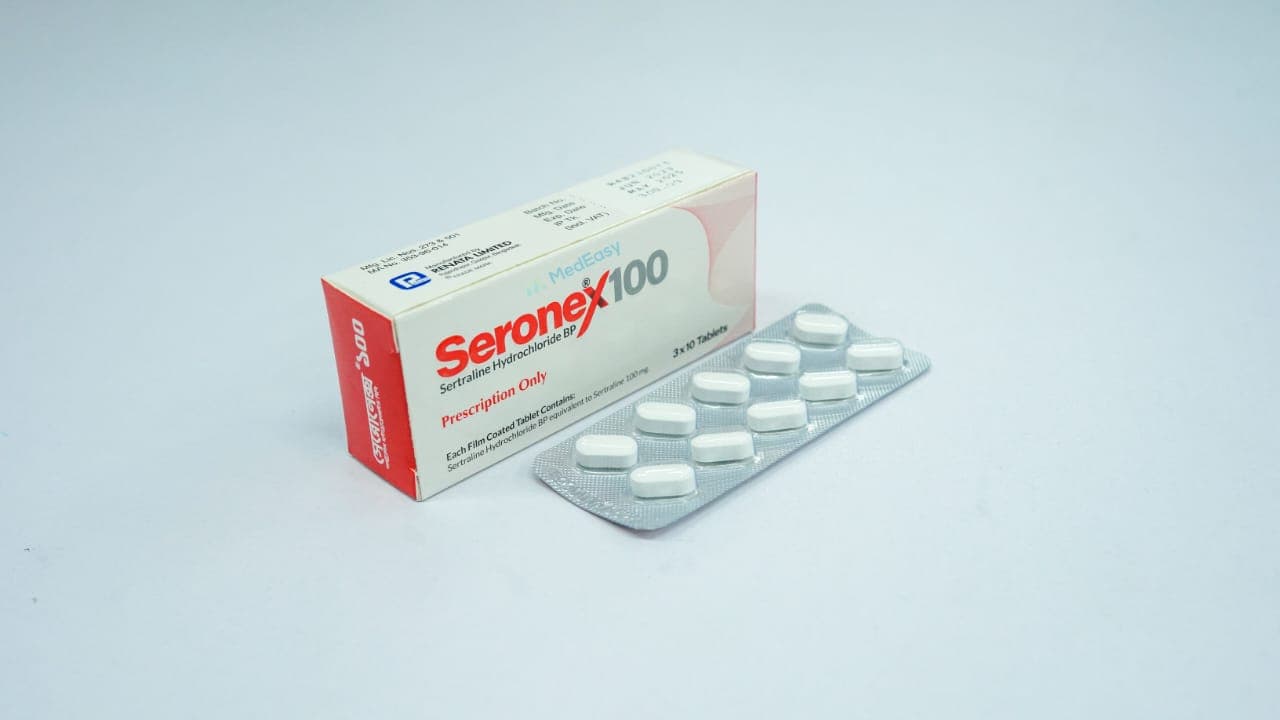

Medicine overview
Indications of Seronex
Seronex is a selective serotonin reuptake inhibitor (SSRI) with the following evidence-based uses:
Established / FDA-approved uses (adults)
- Major Depressive Disorder (MDD) — for the treatment of depression in adults.
- Obsessive-Compulsive Disorder (OCD) — for adults and pediatric patients aged 6–17 years.
- Panic Disorder, with or without agoraphobia.
- Post-Traumatic Stress Disorder (PTSD).
- Social Anxiety Disorder (Social Phobia).
- Premenstrual Dysphoric Disorder (PMDD) — continuous or luteal-phase dosing.
Guideline-supported / commonly used off-label
- Generalized Anxiety Disorder (GAD) — commonly used off-label based on clinical experience and guideline recommendations, though not a formally FDA-approved indication for Seronex.
Seronex should only be initiated and supervised by a qualified physician, who will confirm the diagnosis and weigh the potential benefit against the risks described under Precautions and Warnings.
Composition
Each film-coated tablet contains Sertraline (as Sertraline Hydrochloride BP) in strengths commonly available as 25 mg, 50 mg, and 100 mg; an oral concentrate/solution (e.g. 20 mg/mL) is also available in some markets. "BP" denotes that the active ingredient conforms to British Pharmacopoeia grade/specification. Refer to the specific product pack for exact strength and inactive ingredients.
Description
Seronex is a selective serotonin reuptake inhibitor (SSRI) belonging to the naphthylamine class, chemically unrelated to tricyclic, tetracyclic, or other SSRI antidepressants. Seronex is widely used for depressive and anxiety-related disorders and is available orally as tablets or an oral concentrate.
Seronex carries a boxed warning regarding increased risk of suicidal thinking and behavior in children, adolescents, and young adults; see Precautions and Warnings.
Therapeutic Class
Pharmacology
Mechanism
Sertraline Hydrochloride BP selectively inhibits the neuronal reuptake of serotonin (5-HT) at the presynaptic membrane, increasing serotonergicneurotransmission in the central nervous system. Unlike tricyclic antidepressants, Sertraline Hydrochloride BP has only very weak effects on norepinephrine anddopamine neuronal reuptake and negligible affinity for muscarinic, histaminergic, GABA-ergic, or adrenergic receptors, which accounts for itscomparatively favorable tolerability profile.
Pharmacokinetics
- Absorption: Slowly absorbed after oral dosing; peak plasma concentration reached in about 4.5–8.4 hours. Food modestly increases bioavailability of the tablet.
- Distribution: Highly protein bound (~98%).
- Metabolism: Extensively metabolized in the liver, primarily via CYP2B6, with contributions from CYP2C19, CYP2C9, CYP2D6, and CYP3A4, to its major active metabolite desmethylsertraline (which is substantially less active).
- Half-life: Approximately 26 hours for sertraline (desmethylsertraline has a longer half-life of 62–104 hours), supporting once-daily dosing.
- Excretion: Roughly equally via urine and feces as inactive metabolites.
Dosage & Administration of Seronex
Major Depressive Disorder, OCD (adult), Panic Disorder, PTSD, Social Anxiety Disorder
| Indication | Starting dose | Usual therapeutic range | Maximum dose |
|---|---|---|---|
| MDD, OCD (adult), PTSD, Social Anxiety Disorder | 50 mg once daily | 50–200 mg/day | 200 mg/day |
| Panic Disorder | 25 mg once daily for the first week, then increase to 50 mg once daily | 50–200 mg/day | 200 mg/day |
Dose increases of Seronex should occur at intervals of no less than one week, based on response and tolerability.
Obsessive-Compulsive Disorder — Pediatric patients
| Age group | Starting dose | Maximum dose |
|---|---|---|
| 6–12 years | 25 mg once daily | 200 mg/day |
| 13–17 years | 50 mg once daily | 200 mg/day |
Premenstrual Dysphoric Disorder (PMDD)
Continuous dosing: 50 mg once daily throughout the menstrual cycle, may be increased up to 150 mg/day. Luteal-phase dosing: 50 mg once dailystarting on day 14 of the cycle (the presumed day of ovulation) through the onset of menses, may be increased by 50 mg/day per cycle up to 100 mg/dayin the luteal phase.
Hepatic impairment
Use Seronex with caution in patients with hepatic impairment; a lower starting dose and slower titration, with less frequent dosing, is recommended, and Seronex should be used cautiously in patients with severe hepatic impairment.
Renal impairment
No dose adjustment of Seronex is generally required based on renal impairment alone.
Discontinuation
When stopping Seronex after extended use, the dose should be tapered gradually rather than abruptly discontinued, under physician guidance (see Precautions and Warnings).
Administration of Seronex
Seronex tablets are taken orally, once daily, in the morning or evening, with or without food. The oral concentrate (where available) must be diluted with water, ginger ale, lemon/lime soda, lemonade, or orange juice only — immediately before dosing — and must not be mixed with anything else. Tablets should be swallowed whole; do not change the dose, stop Seronex suddenly, or share it with others without medical advice.
Interaction of Seronex
- Monoamine oxidase inhibitors (MAOIs): Concomitant use of Seronex with an MAOI, or use within 14 days of stopping either drug, is contraindicated due to risk of serious, sometimes fatal, serotonin syndrome.
- Pimozide: Concomitant use with Seronex is contraindicated; Seronex increases pimozide plasma levels, raising the risk of QT prolongation and serious arrhythmia.
- Other serotonergic drugs (other SSRIs/SNRIs, triptans, tramadol, fentanyl, lithium, St. John's Wort): Increased risk of serotonin syndrome when combined with Seronex.
- NSAIDs, aspirin, warfarin, and other anticoagulants/antiplatelets: Seronex affects platelet function; combined use increases the risk of abnormal bleeding.
- CYP2D6 substrates (e.g. certain tricyclic antidepressants, antipsychotics, propafenone, flecainide): Seronex is a moderate CYP2D6 inhibitor and can raise plasma levels of these drugs.
- Disulfiram: The oral concentrate formulation of Seronex contains alcohol and is contraindicated in patients taking disulfiram.
- CNS depressants and alcohol: Additive sedation may occur; caution advised while taking Seronex.
Always inform your physician or pharmacist of all medicines, supplements, and herbal products being used before starting Seronex.
Contraindications
- Known hypersensitivity to Sertraline Hydrochloride BP or any of its formulation components.
- Concomitant use of, or use within 14 days of discontinuing, a monoamine oxidase inhibitor (MAOI), due to the risk of serious serotonin syndrome.
- Concomitant use of pimozide, due to the risk of QT prolongation and serious arrhythmia.
- Concomitant use of intravenous methylene blue, due to the risk of serious serotonin syndrome.
- Concomitant use of disulfiram with the oral concentrate formulation of Sertraline Hydrochloride BP specifically (due to its alcohol content).
Side Effects of Seronex
Common
- Nausea, diarrhea/loose stools, dyspepsia, dry mouth
- Insomnia, somnolence, dizziness, headache, tremor
- Increased sweating
- Sexual dysfunction (decreased libido, delayed ejaculation, anorgasmia)
- Fatigue
Serious (seek medical attention promptly)
- Worsening depression, unusual changes in behavior, or emergence of suicidal thoughts (see Precautions and Warnings)
- Serotonin syndrome (agitation, hallucinations, fever, rapid heart rate, muscle rigidity, incoordination) when Seronex is combined with other serotonergic drugs
- Abnormal bleeding or bruising
- Signs of hyponatremia (confusion, severe weakness, headache, unsteadiness) especially in elderly patients on Seronex
- Activation of mania or hypomania
- Seizures
- Severe allergic reaction (rash, swelling, difficulty breathing) to Seronex
- Angle-closure glaucoma (eye pain, vision changes)
Pregnancy & Lactation
Pregnancy
Seronex should be used during pregnancy only if clearly needed and the potential benefit justifies the potential risk to the fetus. Use of SSRIs, includingSeronex, late in the third trimester has been associated in some infants with complications requiring prolonged hospitalization, respiratory support, and tubefeeding (poor neonatal adaptation), and some epidemiological studies have suggested a possible association between SSRI use after 20 weeks of gestation andpersistent pulmonary hypertension of the newborn (PPHN). Use of Seronex during pregnancy should always be discussed with, and supervised by, a physician; donot stop or start Seronex in pregnancy without medical advice.
Lactation
Seronex is excreted into breast milk in low concentrations. A physician should be consulted to weigh the benefits of breastfeeding against the potentialrisks before using Seronex while nursing, and breastfed infants should be monitored for irritability, poor feeding, or sedation.
Precautions & Warnings
Boxed warning: Suicidality
Antidepressants, including Seronex, increase the risk of suicidal thinking and behavior in children, adolescents, and young adults (up to age 24),particularly during the first few months of treatment or after dose changes. Patients of all ages started on Seronex should be monitored closely forworsening depression, unusual changes in behavior, or emergence of suicidal thoughts, and family members/caregivers should be advised of the need forclose observation. Seronex is not approved for the treatment of depression in pediatric patients (see Pediatric Uses).
Serotonin syndrome
Seronex can cause serotonin syndrome, a potentially life-threatening condition, particularly when combined with other serotonergic drugs (seeInteractions). Symptoms include agitation, hallucinations, rapid heart rate, high fever, muscle rigidity, and loss of coordination; discontinueSeronex immediately if this is suspected and seek medical attention.
Discontinuation syndrome
Abrupt discontinuation of Seronex after regular use can cause symptoms such as dizziness, irritability, sensory disturbances, anxiety, and sleepdisturbance. The dose of Seronex should be tapered gradually under medical supervision rather than stopped suddenly whenever possible.
Hyponatremia
Seronex, like other SSRIs, can cause hyponatremia, sometimes due to the syndrome of inappropriate antidiuretic hormone secretion (SIADH),particularly in elderly patients and those on diuretics or with volume depletion.
Abnormal bleeding
Seronex may increase the risk of bleeding, especially when combined with NSAIDs, aspirin, warfarin, or other anticoagulants/antiplatelets.
Activation of mania/hypomania
Seronex may precipitate a manic or hypomanic episode; screen for bipolar disorder before starting Seronex.
QT prolongation
Caution is advised when using Seronex at higher doses or in combination with other QT-prolonging drugs, or in patients with pre-existing cardiac conduction abnormalities.
Seizures and angle-closure glaucoma
Seronex should be used with caution in patients with a seizure disorder and in those at risk of angle-closure glaucoma due to pupillary dilation.
Overdose Effects of Seronex
Overdose of Seronex can cause nausea, vomiting, drowsiness, dizziness, tremor, agitation, and tachycardia. Serious effects, more common when combined with other drugs or alcohol, may include serotonin syndrome, seizures, QT prolongation/arrhythmias, and coma. There is no specific antidote for Seronex overdose.
If overdose is suspected, seek immediate medical attention or contact emergency services / a poison control center right away. Do not attempt to treat an overdose at home; hospital-based supportive care and monitoring are typically required.
Storage Conditions
Store at room temperature (below 30°C), away from light and moisture. Keep out of reach of children.
Use In Special Populations
Pediatric patients
Seronex is approved for OCD in pediatric patients aged 6–17 years (see Pediatric Uses for dosing). It is not approved for MDD or other indications inpatients under 18 years; safety and efficacy for those uses have not been established, and Seronex carries a boxed warning regarding increased suicidalityrisk in children, adolescents, and young adults.
Elderly patients
Elderly patients may be at greater risk of hyponatremia with Seronex and may require closer monitoring; no routine dose adjustment based on age alone isrequired, but the lowest effective dose should be used.
Hepatic impairment
Seronex is extensively metabolized by the liver; a lower dose and slower titration are recommended in hepatic impairment, with caution in severe cases.
Renal impairment
No specific dose adjustment of Seronex is generally required in renal impairment.
Duration Of Treatment
For MDD, an adequate trial of Seronex is generally at least 4–6 weeks before assessing full response, and treatment is typically continued for several months after remission to reduce relapse risk. For OCD, a longer trial of up to 10–12 weeks may be needed before full benefit is seen, with longer-term maintenance often required. For Panic Disorder, PTSD, and Social Anxiety Disorder, treatment duration is individualized based on response, generally continued for at least 6–12 months. Seronex should not be stopped abruptly; any change in duration or discontinuation should be guided by a physician.
Drug Classes
Mode Of Action
Sertraline Hydrochloride BP selectively inhibits presynaptic neuronal reuptake of serotonin (5-HT) in the central nervous system, increasing serotonin availability at the synapse. It has minimal effect on norepinephrine and dopamine reuptake and negligible affinity for muscarinic, histaminergic, or adrenergic receptors, distinguishing its side-effect profile from older antidepressant classes.
Pregnancy
C
Pediatric Uses
Frequently Asked Questions
Q: What is Seronex 100 Tablet used for?
A: Seronex 100 Tablet is an SSRI antidepressant approved for treating Major Depressive Disorder, Obsessive-Compulsive Disorder, Panic Disorder, PTSD, Social Anxiety Disorder, and Premenstrual Dysphoric Disorder in adults, and OCD in children aged 6–17.
Q: How long does it take for Seronex 100 Tablet to work?
A: It can take 4–6 weeks of regular use at an adequate dose to see the full antidepressant effect of Seronex 100 Tablet for depression, and up to 10–12 weeks for OCD. Do not stop taking Seronex 100 Tablet early just because you don't feel a difference right away — discuss any concerns with your physician.
Q: Can I stop taking Seronex 100 Tablet suddenly?
A: No. Stopping Seronex 100 Tablet abruptly after regular use can cause discontinuation symptoms such as dizziness, irritability, sensory disturbances, and sleep problems. Your physician will usually taper the dose of Seronex 100 Tablet gradually when it is time to stop.
Q: Is Seronex 100 Tablet safe during pregnancy or breastfeeding?
A: Seronex 100 Tablet should be used in pregnancy only if clearly needed, since exposure late in pregnancy has been linked to complications in newborns such as feeding and breathing difficulties. Seronex 100 Tablet passes into breast milk in low amounts; a physician should always be consulted before using Seronex 100 Tablet while breastfeeding, and the infant should be monitored for irritability or poor feeding.
Q: What are the serious risks I should know about with Seronex 100 Tablet?
A: Seronex 100 Tablet carries a boxed warning for increased risk of suicidal thoughts and behavior in children, adolescents, and young adults, especially early in treatment. It can also cause serotonin syndrome when combined with other serotonergic drugs, increase bleeding risk with NSAIDs or blood thinners, and rarely cause low blood sodium (hyponatremia), particularly in elderly patients. Seronex 100 Tablet must never be combined with an MAOI or with pimozide.
Q: What should I do if someone takes too much Seronex 100 Tablet?
A: An overdose of Seronex 100 Tablet can cause severe drowsiness, tremor, rapid heart rate, seizures, or serotonin syndrome. Seek immediate medical attention or contact emergency services / a poison control center right away — do not wait for symptoms to appear or try to treat it at home.
Disclaimer
The information provided is accurate to the best of our knowledge, but it does not replace professional medical advice. We cannot guarantee its completeness or accuracy, and the absence of specific information about a drug should not be taken as an endorsement. We are not responsible for any consequences arising from this information, so please consult a healthcare professional for any concerns or questions.
