
10% Off
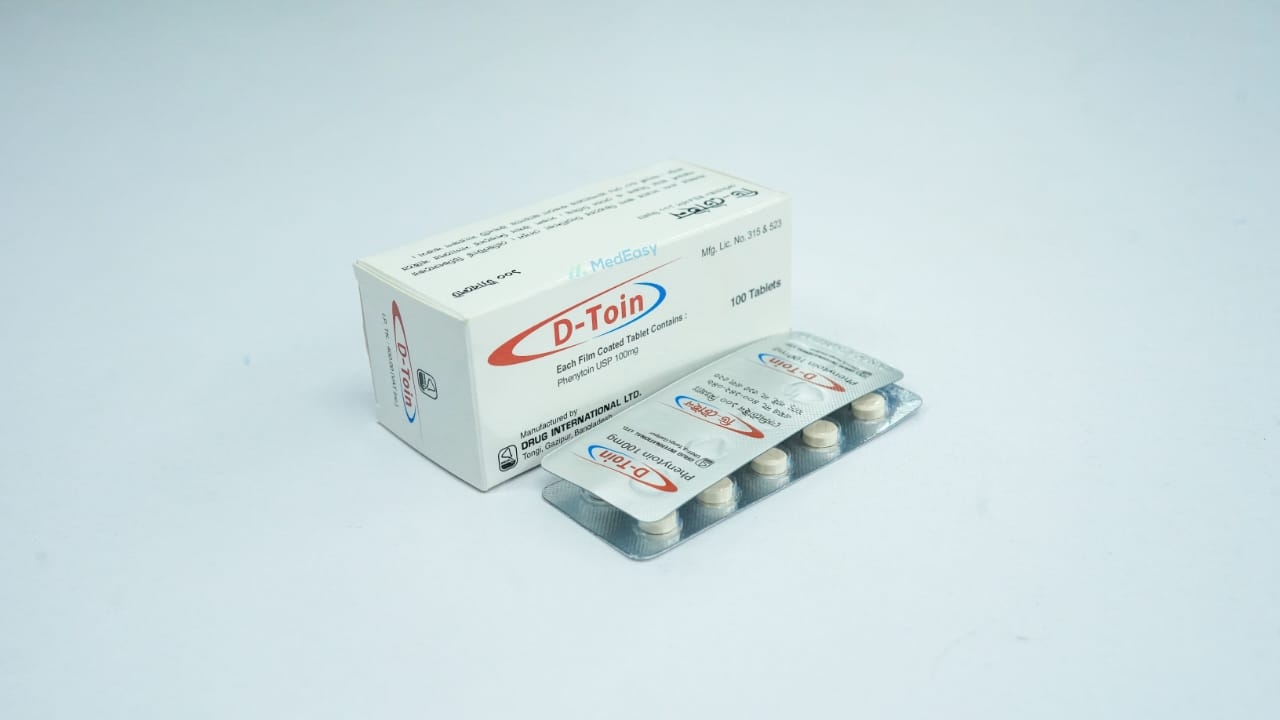
D-Toin100 mg
Drug International Ltd.
৳36.00
Add to cart


Sizatoin is a hydantoin-derivative anticonvulsant indicated for:
Sizatoin is used as monotherapy or as adjunctive therapy alongside other antiepileptic drugs when a single agent does not achieve adequate seizure control.
Each formulation of Phenytoin Sodium contains phenytoin sodium as the active pharmaceutical ingredient, available as oral capsules, tablets, chewable tablets, oral suspension, and sterile injection for intravenous use, with standard pharmaceutical excipients appropriate to each dosage form.
Sizatoin is a hydantoin-class antiepileptic (anticonvulsant) medicine used to prevent and control certain types of seizures. It works by stabilizing electrically excitable neuronal membranes, limiting the spread of seizure activity in the brain without generally depressing overall brain function.
Sizatoin has a narrow therapeutic index and nonlinear (saturable, dose-dependent) pharmacokinetics, meaning small changes in dose can cause disproportionately large changes in blood levels. Because of this, treatment with Sizatoin requires individualized dosing and periodic monitoring of blood levels.
Sizatoin belongs to the hydantoin class of antiepileptic (anticonvulsant) drugs.
Phenytoin Sodium acts primarily by blocking voltage-gated sodium channels in neurons. By prolonging the inactivated state of these channels, Phenytoin Sodium reduces sustained high-frequency repetitive firing of neurons and limits the spread of seizure discharges from an epileptogenic focus to adjacent brain tissue.
Phenytoin Sodium is extensively metabolized in the liver (mainly by CYP2C9 and CYP2C19) via a saturable enzyme pathway. At doses near or above the therapeutic range, small dose increments can saturate metabolism and produce large, unpredictable rises in plasma concentration, so Phenytoin Sodium follows nonlinear kinetics at higher doses rather than simple first-order elimination.
Dosing of Sizatoin must be individualized based on response and, where possible, serum phenytoin levels (target range approximately 10–20 mcg/mL total phenytoin).
| Indication | Population | Typical Dose |
|---|---|---|
| Generalized tonic-clonic / complex partial seizures | Adults | Initial 100 mg orally 2–3 times daily; usual maintenance 300–400 mg/day in divided doses; adjusted gradually based on response and levels |
| Generalized tonic-clonic / complex partial seizures | Children | Initial approximately 5 mg/kg/day in 2–3 divided doses; usual maintenance 4–8 mg/kg/day; generally not exceeding 300 mg/day unless levels indicate otherwise |
| Status epilepticus | Adults and children (IV form only) | Loading dose of 15–20 mg/kg intravenously, given slowly at a controlled rate (not exceeding 50 mg/minute in adults, slower in elderly/cardiac patients), followed by maintenance oral or IV dosing |
| Neurosurgical seizure prophylaxis | Adults | As directed by the treating physician, typically similar to maintenance seizure-control dosing |
Because of its narrow therapeutic index, dose changes with Sizatoin should be made in small increments with physician supervision, and switching between different oral formulations/brands of Sizatoin should be avoided unless directed by a physician, as bioavailability may differ.
Sizatoin oral suspension should be shaken well before each dose. Oral Sizatoin may be taken with food to reduce stomach upset. Chewable tablets must be chewed, not swallowed whole. The intravenous form of Sizatoin must be administered slowly by a healthcare professional, with cardiac and blood pressure monitoring, and should not be mixed with dextrose-containing solutions due to precipitation risk. Do not administer Sizatoin injection intramuscularly for maintenance therapy due to erratic absorption and local tissue damage.
Sizatoin is both a substrate and a potent inducer of hepatic cytochrome P450 enzymes, resulting in numerous clinically significant interactions:
Because of the many potential interactions, inform your physician of all medicines, supplements, and herbal products used together with Sizatoin.
Phenytoin Sodium is contraindicated in patients with:
Side effects of Sizatoin are often dose- and concentration-related.
Seek prompt medical attention for any rash, fever, swollen glands, unusual bruising/bleeding, jaundice, or severe dizziness while taking Sizatoin.
Pregnancy: Sizatoin can cross the placenta and has been associated with fetal hydantoin syndrome (craniofacial abnormalities, growth deficiency, and developmental effects). Sizatoin should be used in pregnancy only if clearly needed, when the potential benefit of seizure control justifies the potential risk to the fetus; abrupt discontinuation is not advised, as uncontrolled seizures pose their own risk to mother and fetus. Folic acid supplementation is generally recommended for patients of childbearing potential taking Sizatoin, and vitamin K may be recommended near delivery to reduce neonatal bleeding risk. Always consult a physician before starting, stopping, or continuing Sizatoin during pregnancy.
Lactation: Sizatoin passes into breast milk in small amounts. Use during breastfeeding should be under medical supervision, with the infant monitored for sedation or feeding difficulty; consult a physician before use.
Use Sizatoin only under medical supervision, with attention to the following:
Overdose of Sizatoin may cause nystagmus, ataxia, slurred speech, tremor, lethargy, and confusion progressing to coma, and, with very high levels or rapid IV administration, severe low blood pressure and cardiac arrhythmias. There is no specific antidote for Sizatoin overdose. If overdose is suspected, seek immediate medical attention or contact emergency services or a poison control center; treatment is supportive, including monitoring of vital signs and phenytoin blood levels in a medical facility.
Store Sizatoin at room temperature (below 30°C), away from light and moisture. Do not refrigerate the injectable form of Sizatoin, as refrigeration may cause precipitation. Keep out of reach of children.
Elderly: may require lower doses and slower titration of Sizatoin due to altered drug binding and increased sensitivity to side effects.
Renal impairment: unbound (active) Sizatoin levels can rise in patients with significant renal impairment or low serum albumin; free phenytoin level monitoring is advised.
Hepatic impairment: dose reduction and closer monitoring are needed, as described under Precautions.
Pediatric patients: see Pediatric Uses.
Pregnancy and lactation: see the Pregnancy and Lactation section.
Duration of treatment with Sizatoin is individualized by the treating physician based on seizure type, control achieved, and response to therapy; epilepsy treatment with Sizatoin is often long-term, and any decision to reduce or stop Sizatoin should be made gradually and under medical supervision.
Phenytoin Sodium belongs to the hydantoin class of antiepileptic (anticonvulsant) agents.
Phenytoin Sodium stabilizes neuronal membranes by blocking voltage-gated sodium channels, prolonging their inactivated state, and thereby limiting the repetitive firing of neurons and the spread of seizure activity, without generally producing overall central nervous system depression at therapeutic doses.
D
Sizatoin is used in pediatric patients for control of generalized tonic-clonic and complex partial seizures, and for status epilepticus, with dosing individualized by weight (approximately 5 mg/kg/day initially, with usual maintenance of 4–8 mg/kg/day in divided doses, generally not exceeding 300 mg/day). Use in neonates and very young infants requires particular caution and close monitoring due to variable absorption and metabolism. Safety and efficacy of specific extended-release or once-daily formulations of Sizatoin in children below certain ages may not be established; a pediatrician should individualize therapy and monitor growth, dental/gum health, and drug levels closely in children on long-term Sizatoin.
Q: What is Sizatoin 100 mg Tablet used for?
A: Sizatoin 100 mg Tablet is an anticonvulsant used to control generalized tonic-clonic and complex partial seizures, to prevent seizures after neurosurgery, and to treat status epilepticus (as an intravenous formulation).
Q: How should I take Sizatoin 100 mg Tablet?
A: Take Sizatoin 100 mg Tablet exactly as prescribed by your physician, at the same time(s) each day. Oral suspension should be shaken well, and chewable tablets should be chewed rather than swallowed whole. Do not change your dose or brand of Sizatoin 100 mg Tablet without consulting your physician, as this can affect blood levels.
Q: What should I avoid while taking Sizatoin 100 mg Tablet?
A: Avoid stopping Sizatoin 100 mg Tablet suddenly, as this can trigger seizures, including status epilepticus. Avoid taking Sizatoin 100 mg Tablet with delavirdine. Inform your doctor about all other medicines you take, as Sizatoin 100 mg Tablet interacts with many drugs, including warfarin and oral contraceptives.
Q: Is Sizatoin 100 mg Tablet safe during pregnancy?
A: Sizatoin 100 mg Tablet should be used in pregnancy only if clearly needed, as it has been associated with fetal hydantoin syndrome; the potential benefit of seizure control must be weighed against potential fetal risk, and a physician should be consulted before starting, stopping, or continuing Sizatoin 100 mg Tablet during pregnancy. Folic acid supplementation is often recommended.
Q: What are the common side effects of Sizatoin 100 mg Tablet?
A: Common side effects of Sizatoin 100 mg Tablet include unsteady gait, nystagmus (eye movements), slurred speech, drowsiness, nausea, gum swelling (gingival hyperplasia), and excess hair growth with long-term use. Severe skin reactions are rare but require immediate medical attention.
Q: What should I do if I miss a dose or take too much Sizatoin 100 mg Tablet?
A: If you miss a dose of Sizatoin 100 mg Tablet, take it as soon as you remember unless it is close to the next dose; do not double the dose. If an overdose of Sizatoin 100 mg Tablet is suspected, seek immediate medical attention or contact a poison control center, as overdose can cause serious neurological and cardiovascular effects.
Disclaimer
The information provided is accurate to the best of our knowledge, but it does not replace professional medical advice. We cannot guarantee its completeness or accuracy, and the absence of specific information about a drug should not be taken as an endorsement. We are not responsible for any consequences arising from this information, so please consult a healthcare professional for any concerns or questions.

