
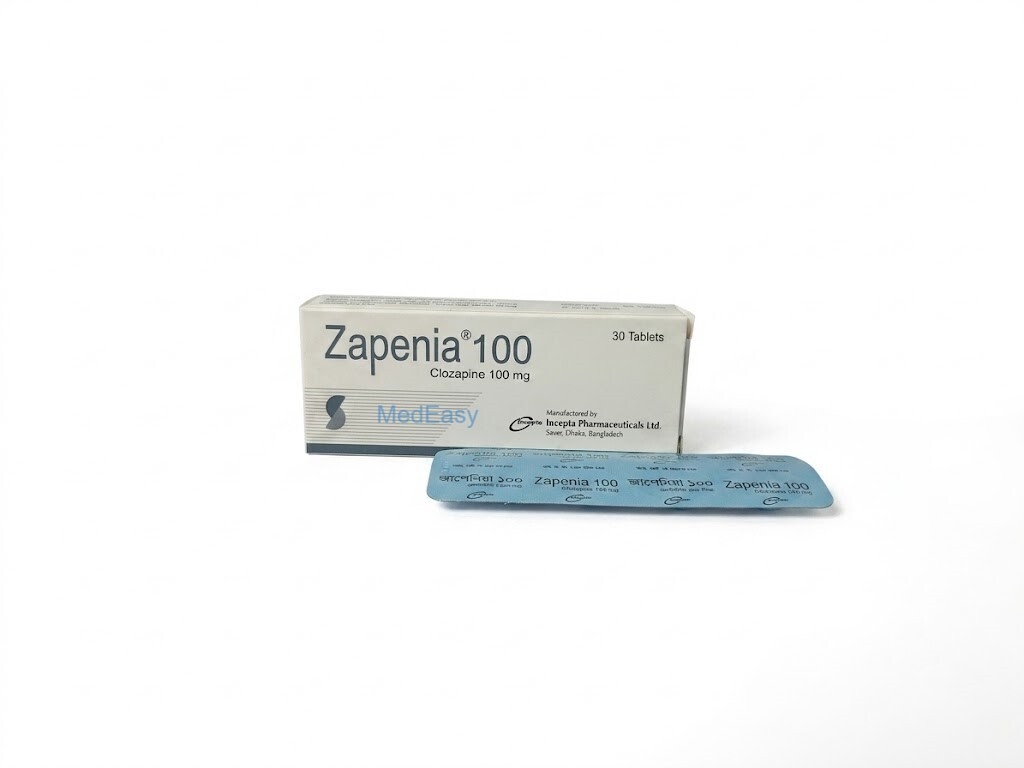
10% Off
Zapenia100 mg
Incepta Pharmaceuticals Ltd.
৳8.10
Add to cart
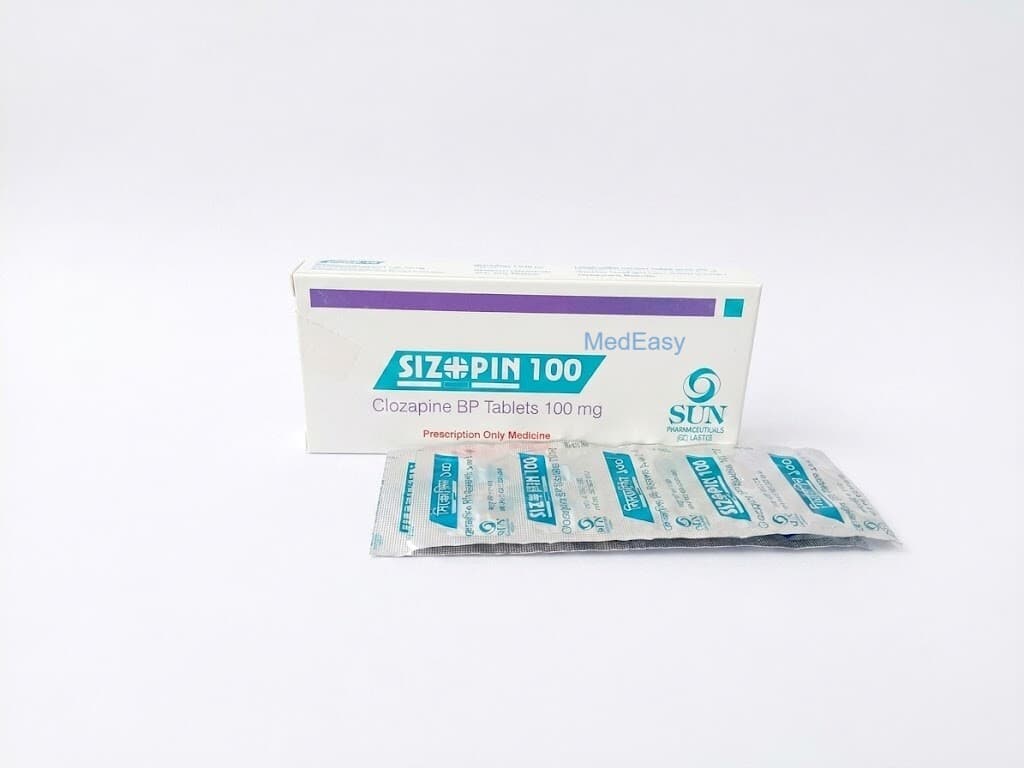

Sizopin is an atypical (second-generation) antipsychotic reserved for specific, difficult-to-treat clinical situations because of its serious safety profile and the intensive monitoring it requires. Indications below are grouped by strength of evidence.
Sizopin is not approved for elderly patients with dementia-related psychosis; a boxed warning specifically advises against use in this population because of increased mortality risk.
Each tablet contains Clozapine INN as the active ingredient, commonly available in strengths of 25 mg, 50 mg, 100 mg, and 200 mg. In some markets, an orally disintegrating tablet and an oral suspension formulation of Clozapine are also available. Excipients vary by manufacturer; refer to the product-specific package insert for the complete excipient list.
Sizopin is a dibenzodiazepine-derivative atypical antipsychotic, historically notable as the first agent shown to be effective in schizophrenia that had not responded to other antipsychotics. Unlike many older ("typical") antipsychotics, Sizopin has a relatively low propensity to cause extrapyramidal symptoms, but this benefit is offset by a distinctive and serious adverse-effect profile — most importantly a risk of severe, potentially fatal neutropenia — which restricts its use to patients who genuinely need it and who can be enrolled in a mandatory blood-count monitoring program.
Because of this risk-benefit balance, Sizopin is considered a "last-line" option in schizophrenia, used only after other antipsychotics have failed, and it is dispensed only through controlled distribution programs that link prescribing and dispensing to regular absolute neutrophil count (ANC) results.
Sizopin belongs to the atypical (second-generation) antipsychotic class, specifically the dibenzodiazepine chemical subgroup.
The precise mechanism by which Clozapine exerts its antipsychotic effect is not fully established. It is believed to act through antagonism at multiple central receptors, including dopamine receptors (D1, D2, D3, D4, D5), serotonin receptors (5-HT2A, 5-HT2C, 5-HT3, 5-HT6), as well as alpha-adrenergic, histaminergic (H1), and muscarinic cholinergic receptors. Its relatively low affinity for D2 receptors compared with typical antipsychotics is thought to explain its low risk of extrapyramidal symptoms, while its broad receptor-binding profile underlies its distinctive side-effect pattern (sedation, hypotension, hypersalivation, anticholinergic effects).
Clozapine is well absorbed orally; food does not significantly affect the extent of absorption, so it can be taken with or without meals. It is extensively metabolized in the liver, principally by the CYP1A2 enzyme, with additional contributions from CYP3A4 and CYP2D6. Metabolites are largely inactive and are excreted in urine and feces. Elimination half-life is variable, generally in the range of 8–12 hours at steady state. Smoking induces CYP1A2 and can lower Clozapine levels, so plasma levels may need to be reassessed after a change in smoking status.
Dosing of Sizopin must be individualized, started at a low dose, and titrated slowly, because the risk of orthostatic hypotension, bradycardia, syncope, and seizures is highest during initial dose escalation.
| Step | Regimen |
|---|---|
| Initiation | 12.5 mg once or twice daily on Day 1 |
| Titration | Increase in increments of 25–50 mg/day, as tolerated, to reach approximately 150–225 mg/day (in divided doses) by the end of about 2 weeks |
| Further increases | If needed, increase further in increments of up to 100 mg once or twice weekly |
| Usual effective range | 300–450 mg/day (in divided doses) |
| Maximum dose | 900 mg/day; doses above 450 mg/day increase the risk of seizures and other adverse effects and require careful monitoring |
Because of the risk of severe neutropenia (see Precautions and Warnings), Sizopin may only be prescribed and dispensed through a monitoring program that requires a baseline ANC before starting and regular ANC checks throughout treatment (typically weekly for the first 6 months, then every 2 weeks for months 7–12, then monthly thereafter if counts remain normal). Dosing must be interrupted or discontinued according to ANC thresholds established by the monitoring program.
If Sizopin has been stopped for 2 days or more, it must be restarted at the initial titration dose (12.5 mg once or twice daily) and re-titrated, because of the renewed risk of orthostatic hypotension, bradycardia, and syncope.
Dose reduction and slower titration may be necessary in patients with significant renal or hepatic impairment; such patients should be monitored more closely.
Whenever possible, Sizopin should be tapered gradually over 1–2 weeks rather than stopped abruptly, to reduce the risk of rebound psychosis and cholinergic rebound symptoms (sweating, headache, nausea, vomiting, diarrhea). If abrupt discontinuation is medically necessary, the patient should be monitored closely.
See Dosage and Administration above for full titration and monitoring detail; see Interaction for dose adjustments needed with certain co-administered drugs.
Sizopin is taken by mouth, with or without food, as food does not meaningfully affect absorption. Standard tablets should be swallowed; where an orally disintegrating tablet formulation is used, it should be placed on the tongue and allowed to disintegrate, then swallowed with saliva or with the aid of liquid, without chewing. Doses are usually divided (e.g., twice daily), with a larger portion often taken at bedtime because of sedation. Patients should not stop or change the dose of Sizopin without medical advice, and must attend all scheduled blood tests required by the monitoring program.
Sizopin is metabolized mainly by CYP1A2, with contributions from CYP2D6 and CYP3A4, so drugs affecting these enzymes can significantly alter its levels.
Clozapine is contraindicated in patients with:
The most commonly reported adverse effects of Sizopin, occurring in a substantial proportion of patients, include:
Serious adverse effects — including severe neutropenia, seizures, myocarditis/cardiomyopathy, severe gastrointestinal hypomotility (constipation progressing to bowel obstruction), neuroleptic malignant syndrome, and marked metabolic changes (hyperglycemia, dyslipidemia) — are covered in detail under Precautions and Warnings, as they require specific monitoring and action rather than being routine side effects.
Pregnancy: Data on the use of Sizopin in pregnancy are limited. Antipsychotics, including Sizopin, used during the third trimester have been associated with extrapyramidal and/or withdrawal symptoms in the newborn, such as agitation, abnormal muscle tone, tremor, drowsiness, or feeding difficulty. Sizopin should be used during pregnancy only if the potential benefit to the mother clearly justifies the potential risk to the fetus, and only under close physician supervision; a pregnancy exposure registry exists in some countries to monitor outcomes. Do not start or stop Sizopin during pregnancy without consulting a physician.
Lactation: Sizopin passes into breast milk. Because of the potential for serious adverse effects in a breastfed infant (including sedation and hematologic effects), a decision should be made, in consultation with a physician, whether to discontinue breastfeeding or discontinue the drug, taking into account the importance of treatment to the mother and monitoring the infant for adverse effects if breastfeeding continues.
Sizopin must never be used casually, without prescription, or outside the mandatory monitoring framework, given the seriousness of its potential adverse effects.
Overdose with Sizopin can cause drowsiness progressing to sedation and coma, hypersalivation, tachycardia, hypotension, respiratory depression, aspiration pneumonia, and seizures; anticholinergic toxicity (dry mouth, blurred vision, urinary retention, delirium) and cardiac arrhythmias can also occur, and fatalities have been reported, particularly with very large ingestions or when combined with other CNS depressants.
Suspected overdose of Sizopin is a medical emergency. Seek immediate medical attention or contact emergency services/a poison control center right away. Treatment is supportive, with close monitoring of cardiac and respiratory status in a hospital setting; there is no specific antidote. Do not attempt to manage an overdose at home.
Store at room temperature (below 30°C), away from light and moisture. Keep out of reach of children.
Use with caution; dose reduction and slower titration may be necessary in significant renal impairment.
Use with caution; dose reduction may be necessary. Sizopin should generally be avoided in patients with severe, active liver disease.
These patients may have higher Sizopin levels; a lower dose may be necessary.
Use with caution because of increased sensitivity to sedation, orthostatic hypotension, and anticholinergic effects; Sizopin is not approved for elderly patients with dementia-related psychosis (see Precautions and Warnings for the associated mortality risk).
Smoking induces the enzyme that metabolizes Sizopin; starting or stopping smoking during treatment can meaningfully change drug levels and may require dose adjustment.
See Pediatric Uses for use in children and adolescents, and Pregnancy and Lactation for use during pregnancy and breastfeeding.
Duration of treatment with Sizopin is individualized by the treating psychiatrist based on response and tolerability. Because it is used for treatment-resistant illness, therapy is often long-term/maintenance once a response is achieved, with continued mandatory blood-count monitoring throughout treatment. Periodic reassessment of ongoing need is recommended. If discontinuation is required, gradual tapering over 1–2 weeks is preferred over abrupt cessation (see Dosage and Administration).
Clozapine is classified as an atypical (second-generation) antipsychotic, dibenzodiazepine chemical class.
Clozapine acts as an antagonist at multiple central nervous system receptors, most notably dopamine (D1–D5) and serotonin (5-HT2A, 5-HT2C, 5-HT3, 5-HT6) receptors, along with alpha-adrenergic, histamine H1, and muscarinic cholinergic receptors. Its comparatively weak D2-receptor blockade relative to typical antipsychotics is thought to underlie its low rate of extrapyramidal symptoms, while its broad multi-receptor activity is believed to contribute both to its unique efficacy in treatment-resistant schizophrenia and to its characteristic side-effect profile (sedation, hypersalivation, hypotension, anticholinergic effects).
B
The safety and effectiveness of Sizopin have not been established in pediatric patients (below 18 years of age). Sizopin is not recommended for use in children or adolescents outside of specialist clinical trial settings, and should only be considered in this age group under the direct supervision of a child/adolescent psychiatrist experienced in its use, with the same mandatory ANC monitoring that applies to adults.
Q: What is Sizopin 100 mg Tablet used for?
A: Sizopin 100 mg Tablet is used for schizophrenia that has not responded to at least two other antipsychotic medicines (treatment-resistant schizophrenia), and to reduce the risk of repeated suicidal behavior in people with schizophrenia or schizoaffective disorder. It is not a first-choice medicine and is used only when other options have failed.
Q: Why does Sizopin 100 mg Tablet require regular blood tests?
A: Sizopin 100 mg Tablet can cause severe, potentially fatal neutropenia (a dangerous drop in a type of white blood cell that fights infection). To catch this early, everyone taking Sizopin 100 mg Tablet must have a baseline blood count before starting and regular blood counts throughout treatment, as part of a mandatory monitoring program. Never skip a scheduled blood test.
Q: Can I stop taking Sizopin 100 mg Tablet suddenly?
A: No. Stopping Sizopin 100 mg Tablet suddenly can cause the return of psychotic symptoms and cholinergic rebound effects such as sweating, headache, nausea, vomiting, and diarrhea. If you and your doctor decide to stop treatment, the dose should usually be reduced gradually over 1–2 weeks, unless a medical emergency requires immediate stopping, in which case your doctor will monitor you closely.
Q: Is Sizopin 100 mg Tablet safe during pregnancy or breastfeeding?
A: Sizopin 100 mg Tablet should be used in pregnancy only if the expected benefit to the mother clearly outweighs the potential risk to the baby, since antipsychotics used late in pregnancy have been linked to withdrawal or movement symptoms in newborns. Sizopin 100 mg Tablet also passes into breast milk, so breastfeeding should only be continued after discussing the risks and benefits with your physician. Never start or stop Sizopin 100 mg Tablet during pregnancy or while breastfeeding without medical advice.
Q: What are the warning signs I should report to my doctor immediately while on Sizopin 100 mg Tablet?
A: Contact your doctor or seek emergency care immediately if, while taking Sizopin 100 mg Tablet, you develop fever, sore throat, or signs of infection (possible neutropenia); chest pain, rapid heartbeat, or breathlessness (possible myocarditis); severe constipation, abdominal pain/bloating, or inability to pass stool or gas (possible bowel obstruction); a seizure; or fainting/severe dizziness. These can be signs of the serious risks associated with Sizopin 100 mg Tablet described in the boxed warnings.
Q: Can I drink alcohol or take sleeping pills while on Sizopin 100 mg Tablet?
A: This is not recommended without your doctor's guidance. Sizopin 100 mg Tablet already causes sedation, and combining it with alcohol, benzodiazepines, opioids, or other sedating medicines can add to drowsiness, breathing difficulty, and low blood pressure, and has rarely been linked to serious cardiorespiratory problems. Always tell your doctor about every medicine, supplement, and substance you use.
Disclaimer
The information provided is accurate to the best of our knowledge, but it does not replace professional medical advice. We cannot guarantee its completeness or accuracy, and the absence of specific information about a drug should not be taken as an endorsement. We are not responsible for any consequences arising from this information, so please consult a healthcare professional for any concerns or questions.
