
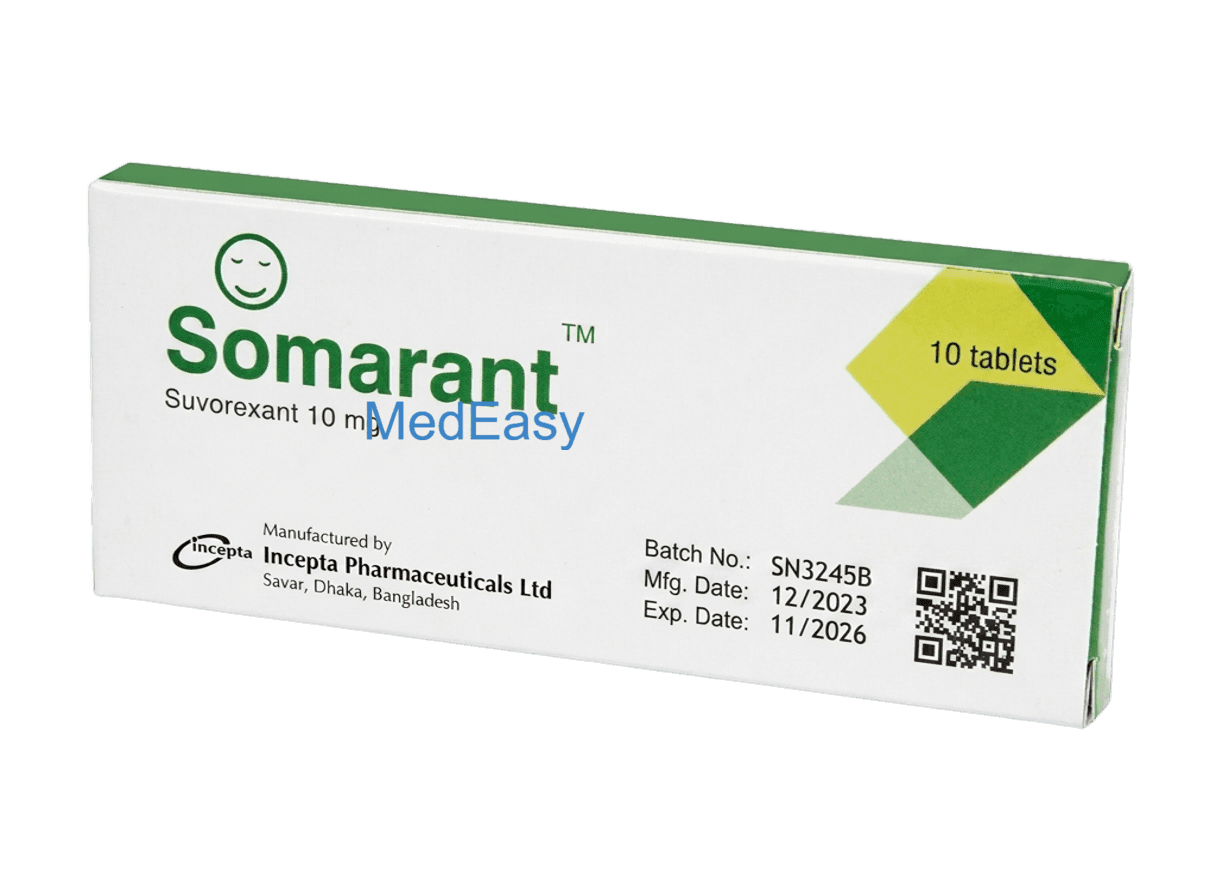

Medicine overview
Indications of Somarant
Somarant is indicated for the treatment of insomnia in adults, characterized by difficulty with sleep onset and/or sleep maintenance.
Evidence-based classification
- Established/FDA-approved use: Short- to medium-term treatment of insomnia (difficulty falling asleep and/or staying asleep) in adult patients, based on randomized controlled trials showing improvement in sleep onset latency and sleep maintenance versus placebo.
- Not established: Somarant has not been shown to be effective, and is not approved, for pediatric insomnia or for insomnia associated with other primary sleep disorders (e.g., obstructive sleep apnea, restless legs syndrome) that have not been separately diagnosed and managed.
- Off-label: Occasional off-label use has been reported for insomnia in patients with mild cognitive impairment or early Alzheimer's disease under specialist supervision; this is not an FDA-approved indication and should only be considered by a physician on a case-by-case basis.
Composition
Each film-coated tablet contains Suvorexant INN as the active ingredient, commonly available in strengths of 5 mg, 10 mg, 15 mg, and 20 mg, along with pharmaceutically approved excipients.
Description
Somarant is an orally administered, dual orexin receptor antagonist (DORA) used for the management of insomnia. Unlike benzodiazepines and benzodiazepine-receptor agonists ("Z-drugs"), which act broadly on GABA-A receptors, Somarant works by blocking the binding of the wake-promoting neuropeptides orexin A and orexin B to their receptors, thereby suppressing the brain's wake drive rather than actively sedating it.
Somarant is classified as a Schedule IV controlled substance due to its potential for abuse and dependence, and it is intended for short- to medium-term use under medical supervision.
Therapeutic Class
Somarant belongs to the therapeutic class of orexin receptor antagonists, a distinct category of hypnotic (sleep-promoting) agents separate from benzodiazepines, non-benzodiazepine 'Z-drugs', and melatonin receptor agonists.
Pharmacology
Mechanism of Action
Suvorexant is a selective, dual antagonist of orexin receptors OX1R and OX2R. Orexin A and orexin B are neuropeptides produced by neurons in the lateral hypothalamus that promote wakefulness by binding to these receptors. By blocking this binding, Suvorexant suppresses the wake drive and facilitates the onset and maintenance of sleep.
Pharmacokinetics
- Absorption: Peak plasma concentration reached approximately 2 hours after oral dosing; a high-fat meal delays absorption.
- Distribution: Highly protein bound (approximately 99%).
- Metabolism: Primarily metabolized by the hepatic enzyme CYP3A4, with a minor contribution from CYP2C19.
- Elimination: Elimination half-life of approximately 12 hours; excreted mainly in feces, with a smaller portion in urine.
Dosage & Administration of Somarant
Adults (younger than 65 years)
| Parameter | Recommendation |
|---|---|
| Starting dose | 10 mg once nightly, taken within 30 minutes of going to bed |
| Maximum dose | 20 mg once nightly if the lower dose is well tolerated but not effective |
| Timing requirement | Only when at least 7 hours are available before the planned time of waking |
Elderly patients (65 years and older)
Recommended dose is 15 mg once nightly (may be increased to a maximum of 20 mg if needed and tolerated), using the same timing precautions as in younger adults.
Hepatic impairment
- Mild to moderate impairment: no dose adjustment required.
- Severe impairment: use of Somarant is not recommended.
Renal impairment
No dose adjustment is required in patients with renal impairment, including those with severe renal impairment.
Dose adjustment with CYP3A4 interacting drugs
See Drug Interactions section for required dose modifications with concomitant CYP3A4 inhibitors.
Pediatric use
Not established; see Pediatric Uses section.
Administration of Somarant
- Take Somarant orally, whole, within 30 minutes of going to bed.
- Take only when at least 7 hours remain before the planned time of waking.
- Avoid taking with or immediately after a heavy or high-fat meal, as this delays the onset of action.
- Do not take more than one dose per night.
Interaction of Somarant
Clinically significant interactions
- Strong CYP3A4 inhibitors (e.g., ketoconazole, itraconazole, clarithromycin, ritonavir): significantly increase Somarant plasma levels; concomitant use is not recommended.
- Moderate CYP3A4 inhibitors (e.g., fluconazole, erythromycin, diltiazem, verapamil): increase Somarant exposure; reduce Somarant dose (starting dose 5 mg, maximum 10 mg once nightly).
- Strong CYP3A4 inducers (e.g., rifampin, carbamazepine, phenytoin): substantially reduce Somarant efficacy; concomitant use is not recommended.
- Alcohol and other CNS depressants (opioids, benzodiazepines, other sedative-hypnotics): additive central nervous system depression, impaired motor coordination, and next-day sedation; avoid concurrent use.
- Digoxin: Somarant may slightly increase digoxin concentrations; monitoring of digoxin levels is advised with concomitant use.
Contraindications
Suvorexant is contraindicated in:
- Patients with narcolepsy.
- Patients with known hypersensitivity to Suvorexant or any component of the formulation.
Side Effects of Somarant
Common side effects
- Somnolence (next-day drowsiness)
- Headache
- Dizziness
- Dry mouth
- Upper respiratory tract infection
- Diarrhea
- Cough
- Abnormal dreams
Less common but important effects
- Complex sleep behaviors (sleep-walking, sleep-driving, preparing and eating food while not fully awake) — discontinue Somarant immediately if these occur.
- Mild worsening of depressive symptoms or, rarely, emergence of suicidal ideation in patients with underlying depression.
- Sleep paralysis, hypnagogic/hypnopompic hallucinations, and mild cataplexy-like symptoms have been reported, related to the orexin-blocking mechanism.
Pregnancy & Lactation
Pregnancy
Data on the use of Somarant in pregnant women are insufficient to establish safety. Animal studies at doses much higher than the maximum recommended human dose showed decreased maternal and fetal body weight. Somarant should be used during pregnancy only if clearly needed and the potential benefit justifies the potential risk to the fetus; a physician should always be consulted before use in pregnancy.
Lactation
Somarant and its metabolites are present in low concentrations in human breast milk (estimated relative infant dose less than 1%). Because of the potential for sedation in the nursing infant, a physician should be consulted to weigh the benefits of treatment against potential risks before use while breastfeeding.
Precautions & Warnings
- CNS depression and next-day impairment: Somarant can impair driving skills and mental alertness the morning after use, particularly at higher doses; patients who feel impaired should avoid driving or other activities requiring full mental alertness.
- Complex sleep behaviors: As with other sedative-hypnotics, complex sleep behaviors such as sleep-walking and sleep-driving have been reported with Somarant; discontinue immediately if these occur.
- Respiratory depression risk: Use with caution in patients with compromised respiratory function, such as severe COPD or obstructive sleep apnea, as Somarant may worsen respiratory status.
- CYP3A4 interactions: Concomitant strong CYP3A4 inhibitors or inducers significantly affect Somarant levels; see Drug Interactions.
- Adequate sleep time required: Somarant should not be taken unless the patient can devote at least 7 hours to sleep before needing to be active again, due to prolonged sedative effects.
- Worsening depression/suicidal ideation: Monitor patients with depression for worsening of symptoms.
- Abuse and dependence potential: Somarant is a Schedule IV controlled substance; use the lowest effective dose and avoid abrupt discontinuation after prolonged use.
Overdose Effects of Somarant
Overdose with Somarant may cause dose-dependent somnolence; in clinical studies, doses up to 240 mg were associated with increasing sedation. There is no specific antidote. In case of suspected overdose, seek immediate medical attention or contact emergency services/poison control. Management is symptomatic and supportive, with monitoring of vital signs and level of consciousness; because Somarant is highly protein-bound, hemodialysis is not expected to be effective in enhancing its removal.
Storage Conditions
Store at room temperature (below 30°C), away from light and moisture. Keep out of reach of children.
Use In Special Populations
Elderly
Recommended dose is 15 mg (maximum 20 mg) once nightly; no additional dose reduction required based on age alone, but elderly patients should be monitored for increased sensitivity to sedative effects and fall risk.
Hepatic impairment
No adjustment needed in mild-to-moderate impairment; not recommended in severe hepatic impairment. See Dosage and Administration.
Renal impairment
No dose adjustment required, including in severe renal impairment.
Obese patients
Obesity does not require a specific dose change, but clearance may be reduced in obese women; use the lowest effective dose.
Pediatric patients
Safety and efficacy of Somarant have not been established in patients under 18 years of age; see Pediatric Uses.
Respiratory disease
Use with caution in patients with compromised respiratory function (e.g., severe COPD, obstructive sleep apnea); see Precautions and Warnings.
Duration Of Treatment
Somarant is generally intended for short- to medium-term management of insomnia. Clinical trials have evaluated continuous nightly use for up to 3 months, with some longer-term extension data available. The need for continued treatment should be reassessed periodically by the prescribing physician, and the lowest effective dose should be used for the shortest duration consistent with treatment goals.
Drug Classes
Suvorexant is classified under orexin receptor antagonists, a subclass of sedative-hypnotic agents used in the management of insomnia.
Mode Of Action
Suvorexant acts as a selective antagonist at both orexin type-1 (OX1R) and orexin type-2 (OX2R) receptors, blocking the wake-promoting neuropeptides orexin A and orexin B from binding to these receptors. This suppresses the orexin-mediated wake drive, allowing the onset and maintenance of sleep, rather than causing generalized central nervous system sedation as seen with GABA-A receptor agonists.
Pediatric Uses
The safety and effectiveness of Somarant in pediatric patients (under 18 years of age) have not been established. Somarant is not recommended for use in children or adolescents outside of a clinical trial setting.
Frequently Asked Questions
Q: What is Somarant 10 mg Tablet used for?
A: Somarant 10 mg Tablet is used to treat insomnia in adults who have trouble falling asleep, staying asleep, or both.
Q: How and when should I take Somarant 10 mg Tablet?
A: Take Somarant 10 mg Tablet once nightly, within 30 minutes of going to bed, and only if you can devote at least 7 hours to sleep before you need to be active again. Avoid taking it with or right after a heavy or fatty meal.
Q: Can I drive the morning after taking Somarant 10 mg Tablet?
A: Somarant 10 mg Tablet can impair alertness and driving skills the next morning, especially at higher doses. If you feel drowsy or impaired, avoid driving or other activities that require full mental alertness.
Q: Is Somarant 10 mg Tablet safe during pregnancy or breastfeeding?
A: Data on Somarant 10 mg Tablet use in pregnancy are limited, and it passes into breast milk in small amounts. It should be used during pregnancy or breastfeeding only if clearly needed and a physician has confirmed the benefits outweigh the potential risks to the baby.
Q: What are the serious risks of taking Somarant 10 mg Tablet?
A: Somarant 10 mg Tablet can rarely cause complex sleep behaviors such as sleep-walking or sleep-driving while not fully awake; stop the medicine and contact your doctor immediately if this happens. It should not be used by people with narcolepsy, and caution is needed in people with severe breathing problems such as COPD or sleep apnea.
Q: Can I take Somarant 10 mg Tablet with other sleep medicines or alcohol?
A: No. Combining Somarant 10 mg Tablet with alcohol or other central nervous system depressants (such as opioids, benzodiazepines, or other sleep aids) increases the risk of excessive sedation and impaired coordination, and should be avoided.
Disclaimer
The information provided is accurate to the best of our knowledge, but it does not replace professional medical advice. We cannot guarantee its completeness or accuracy, and the absence of specific information about a drug should not be taken as an endorsement. We are not responsible for any consequences arising from this information, so please consult a healthcare professional for any concerns or questions.
