
10% Off
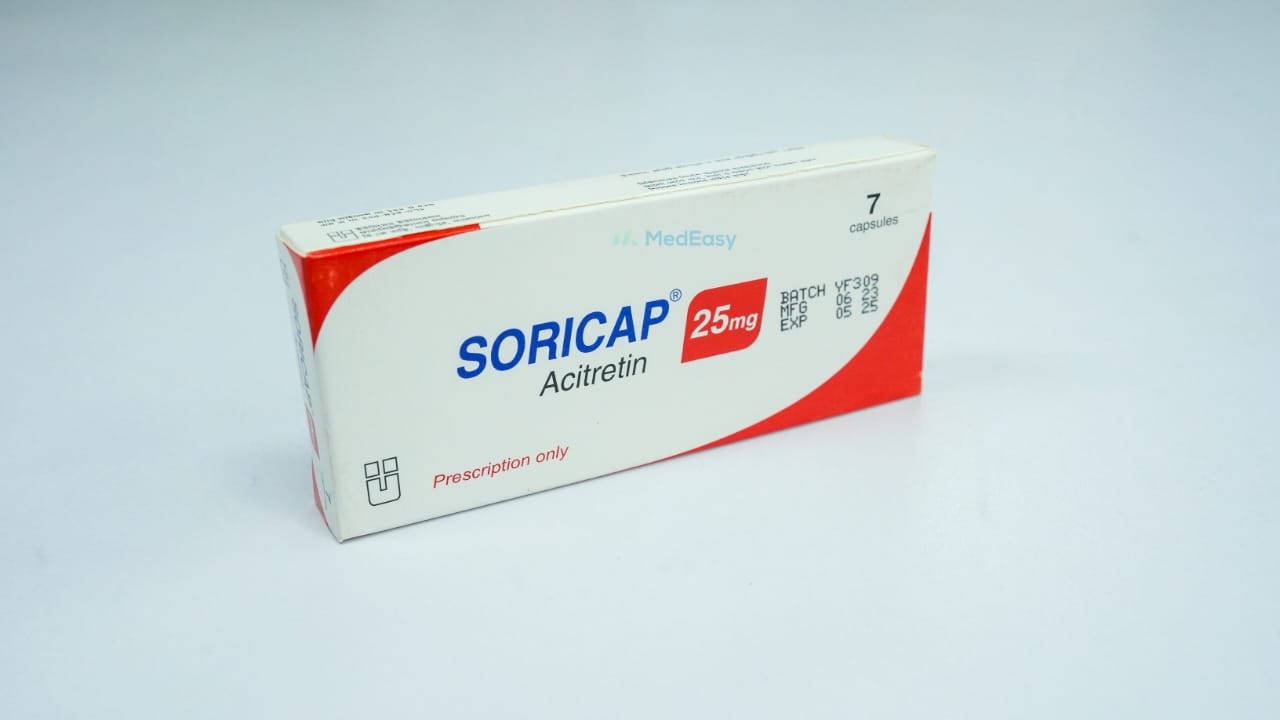
Soricap25 mg
Unimed Unihealth MFG. Ltd.
৳76.50
Add to cart
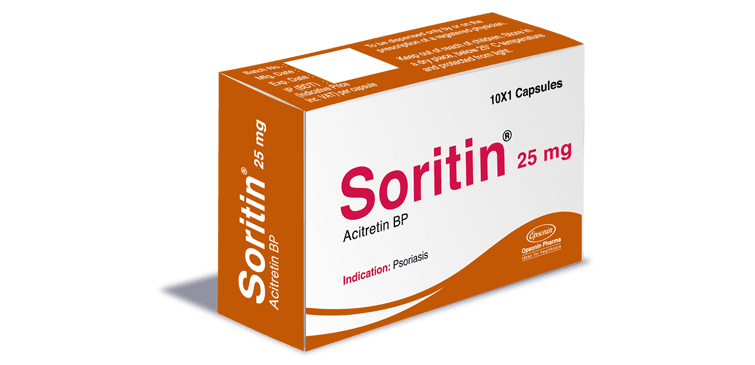

Note: Soritin must only be prescribed by, or under the supervision of, a physician experienced in the use of systemic retinoids, because of its serious teratogenic risk (see Contraindications and Pregnancy & Lactation).
Each capsule contains Acitretin as the active pharmaceutical ingredient, commonly available in strengths of 10 mg and 25 mg. Inactive ingredients typically include gelatin capsule shells and excipients such as sorbitol, maltodextrin, and, in some formulations, parabens as preservatives (relevant for patients with paraben hypersensitivity).
Soritin is a second-generation, synthetic oral retinoid (a metabolite of etretinate) chemically related to vitamin A. It is used to treat severe, treatment-resistant forms of psoriasis and certain other disorders of skin keratinization. Soritin works by normalizing the abnormal growth and maturation of skin cells (keratinocytes) that underlie these conditions.
Soritin carries a boxed warning for severe birth defects (teratogenicity) and must be used only under close medical supervision, with mandatory pregnancy prevention measures in women of childbearing potential.
Soritin belongs to the class of systemic (oral) retinoids, used in dermatology for severe keratinization and psoriatic disorders.
Acitretin is a retinoid that binds to and activates nuclear retinoic acid receptors (RARs), which regulate gene transcription controlling epidermal cell growth, differentiation, and keratinization. This normalizes the excessive proliferation and abnormal differentiation of keratinocytes seen in psoriasis and disorders of keratinization, and produces anti-inflammatory and immunomodulatory effects in the skin.
| Phase | Dose |
|---|---|
| Initial (2–4 weeks) | 25–30 mg orally once daily, taken with the main meal |
| Maintenance (based on response/tolerability) | 25–50 mg once daily, adjusted individually; some patients may require up to 75 mg/day for a limited period |
Lower starting doses (around 10 mg/day) are typically used, with cautious, gradual increases based on response and tolerability, under specialist supervision.
When used for severe, disabling disorders of keratinization in children under specialist care, dosing is weight-based, approximately 0.5 mg/kg/day, not exceeding the maximum adult dose. Soritin is not approved for pediatric psoriasis in most regulatory labels; see Use in Special Populations.
Soritin capsules should be swallowed whole with a meal or with milk to enhance absorption; do not crush or chew. Take at the same time each day.
Initial response is usually assessed over 2–4 weeks, with continued treatment for 6–8 weeks or longer as needed; total duration and need for repeat/maintenance courses should be determined by the treating dermatologist. See Duration of Treatment.
Soritin should be taken orally, once daily, with a meal or with milk to improve absorption. Swallow the capsule whole; do not open, crush, or chew it.
Patients should report severe headache, visual disturbance, mood changes, or yellowing of the skin/eyes promptly to their physician.
Soritin is absolutely contraindicated in pregnancy. It is a potent human teratogen; use during pregnancy carries a very high risk of serious birth defects (craniofacial, cardiac, thymic, and central nervous system malformations) and miscarriage.
Because Soritin can be converted in the body to etretinate — a metabolite with an extremely long elimination half-life (potentially exceeding 100 days), especially when alcohol is consumed — women of childbearing potential must use effective contraception for at least 1 month before starting treatment, throughout treatment, and continuously for 3 years after stopping Soritin. Two reliable, simultaneous forms of contraception are generally recommended, and alcohol must be strictly avoided during this same period.
Soritin is also contraindicated during breastfeeding, as it is expected to pass into breast milk and could harm the nursing infant. A woman who becomes pregnant while taking Soritin, or within 3 years of stopping it, should contact her physician immediately.
Blood donation is prohibited during Soritin treatment and for 3 years afterward, because of the risk of exposing a pregnant transfusion recipient.
Soritin must not be used by anyone who is pregnant or who may become pregnant, given the extremely high risk and severity of birth defects. Prescribers and patients must strictly follow pregnancy-prevention requirements (see Pregnancy and Lactation and Contraindications). Soritin should only be prescribed by physicians experienced in systemic retinoid therapy and aware of the teratogenic risk.
Alcohol (including in foods, medicines, and cosmetics applied to the lips) must be avoided during Soritin treatment and for 2 months after stopping, as it promotes conversion of Soritin to etretinate, extending the teratogenic risk window.
Liver function tests (at baseline, then periodically, e.g. every 1–2 weeks initially then monthly) and fasting lipid profile (baseline, then periodically) should be monitored throughout treatment, as Soritin can cause hepatotoxicity and elevated triglycerides/cholesterol.
Long-term use has been associated with skeletal hyperostosis; periodic monitoring may be considered with prolonged therapy.
Report any severe headache, nausea, or visual disturbance immediately (possible pseudotumor cerebri); report mood changes or depressive symptoms to the physician.
Patients must not donate blood during treatment and for 3 years after stopping Soritin.
Use sun protection, as Soritin can increase skin sensitivity to sunlight.
Acute overdose with Soritin may cause symptoms of hypervitaminosis A, such as severe headache, dizziness, nausea, vomiting, drowsiness, or irritability. There is no specific antidote. If an overdose is suspected, seek immediate medical attention or contact a poison control center; treatment is supportive and symptomatic under medical supervision. Do not attempt to manage a suspected overdose at home.
Store at room temperature (below 30°C), away from light and moisture. Keep out of reach of children.
Soritin is not approved for the treatment of psoriasis in children. Use in children for severe, disabling disorders of keratinization is off-label, reserved for specialist care when benefits clearly outweigh risks, using conservative weight-based dosing. Long-term safety, including effects on bone growth, has not been fully established in this population.
No specific dose adjustment is established for elderly patients, but they should be monitored closely for hepatic, renal, and lipid abnormalities, and for skeletal effects with long-term use.
Contraindicated in severe hepatic impairment (see Contraindications); use with caution and close monitoring in mild-to-moderate impairment.
Contraindicated in severe renal impairment; use with caution in mild-to-moderate impairment, with monitoring.
Must strictly comply with pregnancy-prevention measures before, during, and for 3 years after treatment (see Pregnancy and Lactation).
Initial response to Soritin is generally assessed after 2–4 weeks; treatment commonly continues for 6–8 weeks or longer depending on response. For chronic or relapsing psoriasis and disorders of keratinization, longer-term or repeated courses may be used under continued specialist supervision, with regular monitoring of liver function, lipids, and (with prolonged use) skeletal status. The treating physician determines the total duration based on response and tolerability.
Acitretin is classified as a systemic (oral) retinoid, a synthetic vitamin A derivative used in dermatologic therapy.
Acitretin binds nuclear retinoic acid receptors (RARs) to modulate gene expression, normalizing keratinocyte proliferation and differentiation and reducing the epidermal hyperproliferation and inflammation characteristic of psoriasis and related keratinization disorders.
X
Soritin is not approved for pediatric psoriasis. Its use in children is generally limited to severe, disabling inherited disorders of keratinization (e.g., severe congenital ichthyosis) under the supervision of a specialist, using cautious weight-based dosing (approximately 0.5 mg/kg/day). Safety and efficacy in children have not been formally established for most indications, and long-term effects on bone growth and development are not fully known, so use requires careful risk-benefit assessment and ongoing monitoring by the treating specialist.
Q: What is Soritin 25 mg Capsule used for?
A: Soritin 25 mg Capsule is an oral retinoid used mainly to treat severe, extensive psoriasis (including pustular and erythrodermic forms) that has not responded to other treatments. It is also used by specialists for certain severe skin disorders such as Darier's disease and severe congenital ichthyosis.
Q: Can I take Soritin 25 mg Capsule if I am pregnant or planning pregnancy?
A: No. Soritin 25 mg Capsule is absolutely contraindicated in pregnancy because it causes severe birth defects. Women of childbearing potential must use effective contraception for at least 1 month before starting, throughout treatment, and for 3 years after stopping Soritin 25 mg Capsule, because it can convert in the body to a long-lasting metabolite (etretinate).
Q: Can I drink alcohol while taking Soritin 25 mg Capsule?
A: No. Alcohol must be avoided during Soritin 25 mg Capsule treatment and for 2 months after stopping, because it increases conversion of Soritin 25 mg Capsule to etretinate, which prolongs the risk of birth defects if pregnancy occurs later.
Q: What are the most common side effects of Soritin 25 mg Capsule?
A: The most common side effects of Soritin 25 mg Capsule are dryness and peeling of the skin and lips (cheilitis), dry eyes and nose, hair thinning, and itching. Blood tests may also show raised liver enzymes or cholesterol/triglycerides, so regular monitoring is required during treatment with Soritin 25 mg Capsule.
Q: Why do I need regular blood tests while on Soritin 25 mg Capsule?
A: Soritin 25 mg Capsule can affect liver function and raise blood lipid (cholesterol/triglyceride) levels in some patients. Your doctor will check liver function tests and a fasting lipid profile before starting and periodically during treatment with Soritin 25 mg Capsule to catch any problems early.
Q: What should I do if I think I have taken too much Soritin 25 mg Capsule?
A: If you suspect an overdose of Soritin 25 mg Capsule, seek immediate medical attention or contact your local emergency/poison control services. Do not try to treat it at home; symptoms of overdose (such as severe headache, nausea, or dizziness) require prompt medical evaluation.
Disclaimer
The information provided is accurate to the best of our knowledge, but it does not replace professional medical advice. We cannot guarantee its completeness or accuracy, and the absence of specific information about a drug should not be taken as an endorsement. We are not responsible for any consequences arising from this information, so please consult a healthcare professional for any concerns or questions.
