8% Off
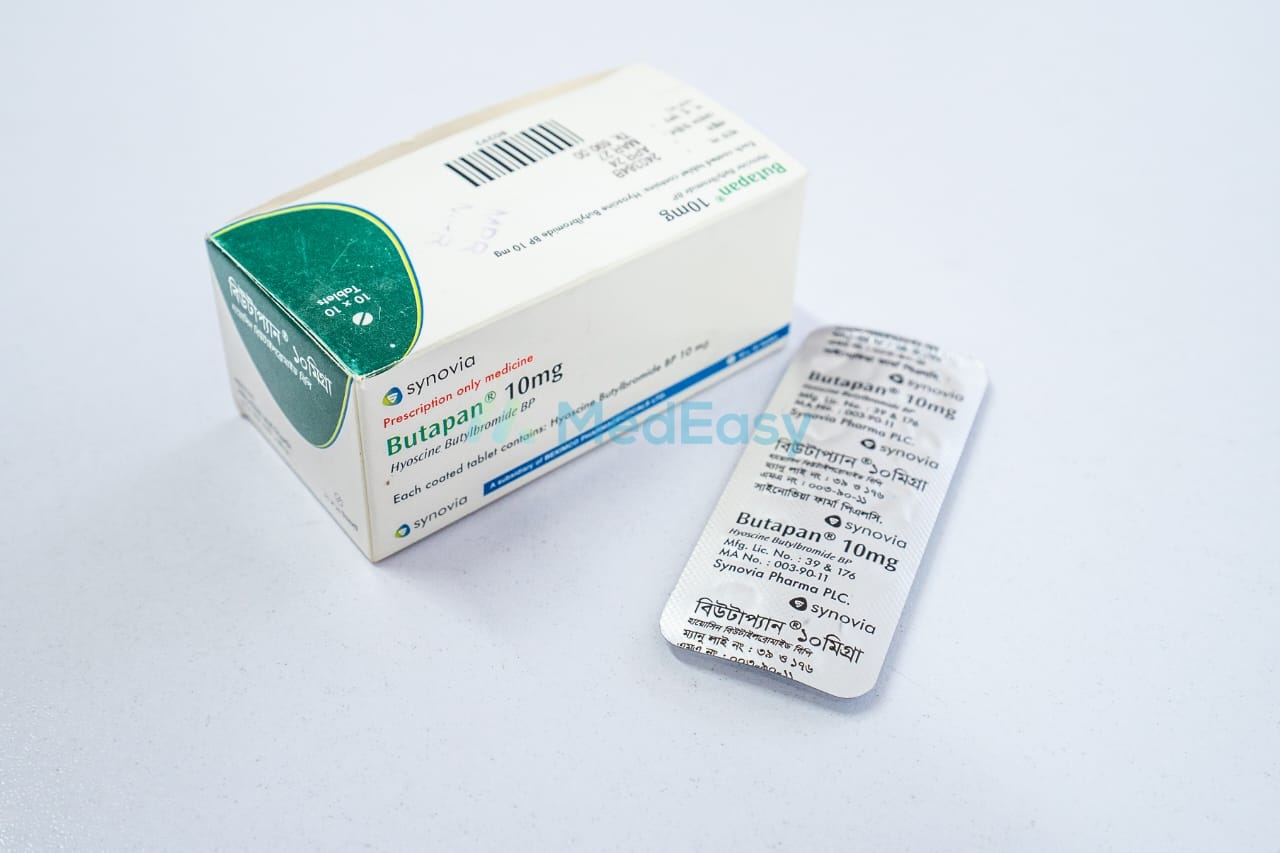
Butapan10 mg
Synovia Pharma PLC
৳634.80
Add to cart

Spanil 10 mg Tablet is available on MedEasy for ৳62.10 per 10's Strip, with home delivery anywhere in Bangladesh. It is manufactured by Beximco Pharmaceuticals Ltd. Its generic name is Hyoscine Butylbromide.

Spanil is an antimuscarinic (anticholinergic) antispasmodic used to relieve smooth-muscle spasm and colic arising in the gastrointestinal and genitourinary tracts. It is widely used and marketed internationally (including in Bangladesh) for this purpose; it is not an FDA-approved product for human use in the United States, where an antimuscarinic-class oral or injectable equivalent may instead be prescribed.
Spanil only relieves the spasm and pain; it does not treat the underlying cause, so persistent or recurrent abdominal pain should always be medically investigated.
Each film-coated tablet contains Hyoscine Butylbromide INN 10 mg. Each mL of injection (ampoule) contains Hyoscine Butylbromide INN 20 mg (20 mg/mL). Strength and available dosage forms may vary by manufacturer/brand; refer to the specific product label.
Spanil (also known as N-butylscopolammonium bromide or butylscopolamine) is a semi-synthetic quaternary ammonium derivative of the naturally occurring alkaloid hyoscine (scopolamine). Because it carries a permanent positive charge, Spanil is poorly absorbed and does not readily cross the blood-brain barrier, so its antimuscarinic action is largely confined to peripheral smooth muscle (gastrointestinal, biliary and genitourinary tracts) with minimal central nervous system effect at usual doses. It is available as oral tablets and as a parenteral (injectable) solution.
Spanil belongs to the antimuscarinic (anticholinergic) antispasmodic class of drugs, specifically the synthetic quaternary ammonium antimuscarinics used for smooth-muscle relaxation.
Hyoscine Butylbromide is a competitive antagonist at muscarinic acetylcholine receptors located on the smooth muscle of the gastrointestinal, biliary and genitourinary tracts. By blocking the action of acetylcholine at these receptors, Hyoscine Butylbromide reduces smooth-muscle tone and motility, producing an antispasmodic (spasmolytic) effect that relieves cramping pain associated with visceral spasm. Its quaternary ammonium structure limits oral bioavailability (generally low, estimated under 10%) and restricts penetration across the blood-brain barrier, so systemic anticholinergic and central effects are typically mild at recommended doses compared with tertiary antimuscarinics such as atropine. Onset of action after intravenous administration is rapid (minutes); after oral administration onset is slower. Hyoscine Butylbromide is metabolised mainly by ester hydrolysis and eliminated chiefly via the renal and biliary routes.
| Indication/Population | Route | Typical Dose |
|---|---|---|
| Adults & adolescents ≥12 years - GI/GU spasm, colic | Oral (tablet) | 10-20 mg, 3-4 times daily (maximum 100 mg/day) |
| Adults - dysmenorrhoea | Oral (tablet) | 10-20 mg, 3-4 times daily, starting a day or two before expected onset of menses and continued through the first days of the period |
| Children 6-12 years - GI spasm | Oral (tablet) | 10 mg, 3 times daily, under medical supervision |
| Children under 6 years | Oral | Not recommended; safety and efficacy not established |
| Adults - acute spasm/colic, pre-procedure | IM/SC/slow IV injection | 10-20 mg (0.5-1 mL) as a single dose, may be repeated after 20-30 minutes if needed (maximum 100 mg/day) |
| Children - injection | Parenteral | Not currently recommended; use only under specialist medical supervision if no alternative |
Treat with the lowest effective dose for the shortest period needed to control symptoms. If abdominal pain persists or recurs despite Spanil, the underlying cause should be medically investigated rather than continuing indefinite use.
Tablets should be swallowed whole with a glass of water, preferably before meals; do not chew. Injections of Spanil should be given slowly (approximately 1 mL/minute for IV administration) by a trained healthcare professional, and the patient should be observed for a short period afterwards because of the small risk of hypersensitivity reactions. Antacids and adsorbent antidiarrhoeal products, if used, should be taken at least 1 hour apart from oral Spanil as they may reduce its absorption.
Spanil has the following clinically significant interactions:
Always tell your physician or pharmacist about all other medicines you are taking before starting Spanil.
Hyoscine Butylbromide is contraindicated in patients with:
Hyoscine Butylbromide should not be used in any of these conditions; other cautions (e.g. prostatic hypertrophy without retention, cardiac disease, ulcerative colitis) require careful physician judgement rather than absolute avoidance - see Precautions and Warnings.
Side effects of Spanil arise mainly from its antimuscarinic action and are usually mild and reversible.
Seek urgent medical attention for any signs of a serious allergic reaction (facial/throat swelling, severe rash, breathing difficulty) while using Spanil.
Pregnancy: Data on the use of Spanil in human pregnancy are limited. Animal reproduction studies have not shown teratogenic effects, but human safety has not been firmly established. Spanil should be used during pregnancy only if clearly needed and if the potential benefit justifies the potential risk to the fetus; consult a physician before use, especially in the first trimester.
Lactation: It is not known whether Spanil or its metabolites are excreted in human breast milk in clinically significant amounts. As a precaution, use during breastfeeding should only occur under medical advice, weighing the benefit to the mother against any potential risk to the infant.
Use Spanil with caution in the following situations, under physician supervision:
Spanil may cause blurred vision or dizziness; patients should avoid driving or operating machinery until they know how it affects them, and avoid alcohol. Continuous long-term use to mask unexplained abdominal pain is discouraged - the underlying cause should be investigated. A small risk of hypersensitivity/anaphylactic reactions exists, particularly with the injectable form; patients should be observed after administration and treatment given by trained personnel with resuscitation facilities available. See Contraindications for situations in which Spanil must not be used.
Overdose with Spanil produces an anticholinergic toxidrome: dry mouth and skin, thirst, flushing, tachycardia, blurred vision and dilated pupils, urinary retention, reduced bowel sounds, restlessness or drowsiness. In severe cases this can progress to agitation, hyperthermia, respiratory depression, circulatory collapse and coma.
Suspected overdose of Spanil is a medical emergency: seek immediate medical attention or contact the nearest emergency department/poison control centre. Do not attempt to treat an overdose at home. Management is supportive and must be carried out by medical professionals (which may include gastric decontamination if presenting early, monitoring, and specific antidotal therapy such as a cholinesterase inhibitor when indicated by a physician).
Store at room temperature (below 30°C), away from light and moisture. Do not freeze the injection. Keep out of reach of children.
Renal impairment: No formal dose adjustment guidance is well established, but Spanil should be used cautiously as elimination may be reduced; consult a physician. Hepatic impairment: Use with caution; specific dose-adjustment data are limited. Elderly: More susceptible to anticholinergic adverse effects (urinary retention, constipation, confusion); use the lowest effective dose. Children: Oral use may be considered from 6 years under medical supervision at reduced dose (see Dosage); use in children under 6 years, and injectable use in children generally, is not recommended as safety and efficacy have not been established. Pregnancy and lactation: see the dedicated section above.
Spanil is generally intended for short-term, symptomatic relief of acute spasm or colic - typically a few days, or as directed for a specific short course (e.g. around the menstrual period for dysmenorrhoea, or as a single procedural dose). It should not be used continuously for prolonged periods to mask recurrent or persistent abdominal pain without medical evaluation of the underlying cause. Follow the physician's specific instructions on how long to continue Spanil, and seek medical review if symptoms do not improve within 2-3 days or if they worsen.
Antimuscarinic (anticholinergic) antispasmodic; quaternary ammonium derivative of scopolamine (hyoscine).
Hyoscine Butylbromide acts as a competitive antagonist at muscarinic acetylcholine receptors on gastrointestinal, biliary and genitourinary smooth muscle. By blocking acetylcholine at these receptors it inhibits smooth-muscle contraction, reducing spasm, motility and associated pain. Its quaternary ammonium structure limits systemic absorption and central nervous system penetration, so its action is predominantly peripheral (anti-spasmodic) rather than central.
Oral Spanil may be used in children 6-12 years of age for gastrointestinal spasm at a reduced dose (10 mg three times daily) under medical supervision. Use in children younger than 6 years is not recommended because safety and efficacy have not been established in this age group. The injectable form of Spanil is generally not recommended for use in children; if considered necessary, it should only be given under specialist medical supervision. Parents/caregivers should not give Spanil to a child without a physician's advice.
Q: What is Spanil 10 mg Tablet used for?
A: Spanil 10 mg Tablet is used to relieve painful spasm and cramping in the stomach, intestines, gallbladder/bile ducts and urinary tract, and for painful menstrual cramps (dysmenorrhoea). It is also used to relax bowel spasm before certain diagnostic procedures such as endoscopy.
Q: How should I take Spanil 10 mg Tablet?
A: Adults typically take 10-20 mg of Spanil 10 mg Tablet by mouth 3-4 times daily (maximum 100 mg/day), swallowed with water, preferably before meals. The injectable form is given by a healthcare professional. Always follow your physician's specific instructions.
Q: Who should not take Spanil 10 mg Tablet?
A: Spanil 10 mg Tablet should not be used by people with myasthenia gravis, mechanical bowel obstruction or paralytic ileus, megacolon, untreated angle-closure glaucoma, urinary retention due to prostatic or bladder outlet obstruction, significant uncontrolled fast heart rhythms, or known hypersensitivity to the drug. Tell your doctor about your full medical history before starting Spanil 10 mg Tablet.
Q: Can Spanil 10 mg Tablet be used during pregnancy or breastfeeding?
A: Data are limited. Spanil 10 mg Tablet should be used in pregnancy only if clearly needed, when potential benefit justifies potential risk to the fetus, and only under medical advice, particularly in the first trimester. It is not known whether it passes into breast milk in significant amounts, so use while breastfeeding should also be guided by a physician.
Q: What are the common side effects of Spanil 10 mg Tablet?
A: The most common side effects of Spanil 10 mg Tablet are dry mouth, reduced sweating, dizziness and drowsiness. Less commonly it can cause a fast heartbeat, blurred vision, constipation, or difficulty passing urine. Rarely, serious allergic reactions (including anaphylaxis) can occur, especially with the injection - seek urgent medical help if this happens.
Q: What should I do if I take too much Spanil 10 mg Tablet?
A: An overdose of Spanil 10 mg Tablet can cause dry mouth, blurred vision, a fast heart rate, urinary retention, agitation or drowsiness, and in severe cases more serious effects. Seek immediate medical attention or contact emergency services/poison control right away; do not try to manage an overdose at home.
Disclaimer
The information provided is accurate to the best of our knowledge, but it does not replace professional medical advice. We cannot guarantee its completeness or accuracy, and the absence of specific information about a drug should not be taken as an endorsement. We are not responsible for any consequences arising from this information, so please consult a healthcare professional for any concerns or questions.