10% Off
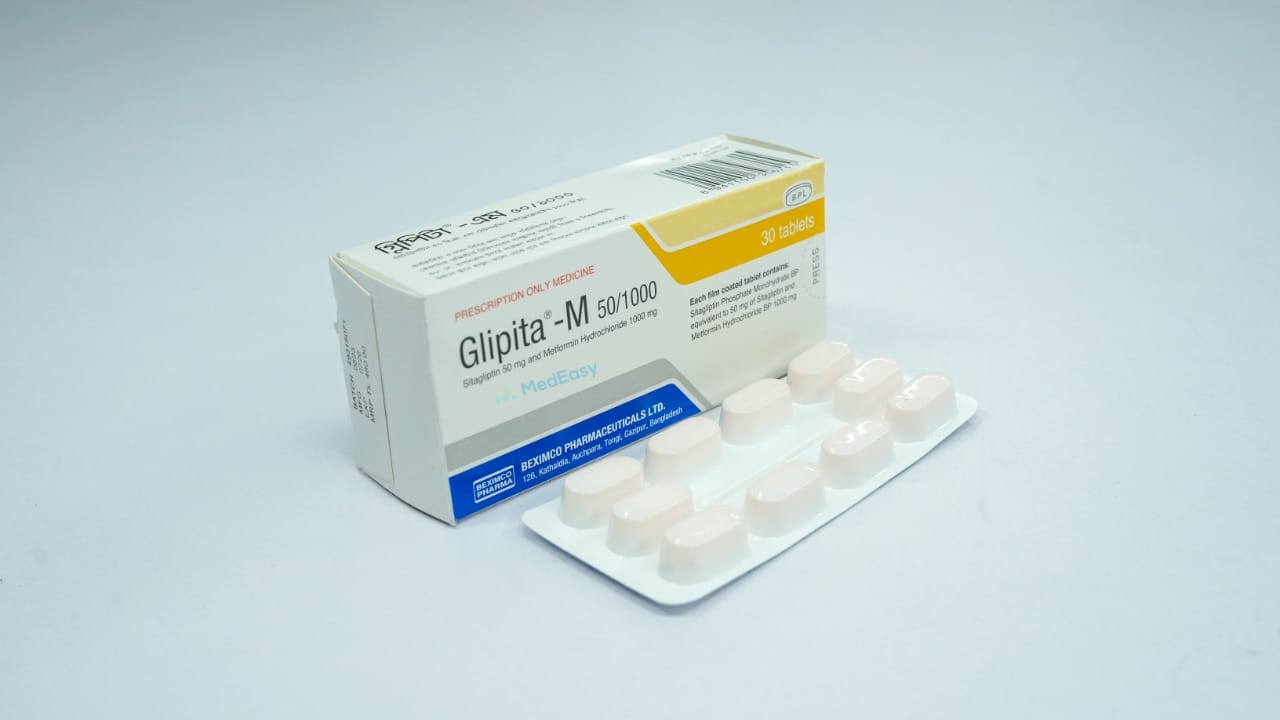
Glipita M50 mg+1000
Beximco Pharmaceuticals Ltd.
৳162.00
Add to cart


Sucosit M is indicated, together with diet and exercise, to improve blood sugar (glycemic) control in adults with type 2 diabetes mellitus. Sucosit M may be used:
After oral dosing, sitagliptin is well absorbed, with peak blood levels reached within 1 to 4 hours and an absolute bioavailability of about 87%; food does not meaningfully affect its absorption. It distributes throughout the body with moderate plasma protein binding (about 38%). Only a small portion (about 16%) is metabolized in the liver, mainly involving the enzyme CYP3A4; the majority (about 79%) is eliminated unchanged by the kidneys, with a terminal half-life of roughly 12 hours. Because it is cleared mainly by the kidneys, blood levels of sitagliptin rise substantially in people with reduced kidney function.
Metformin is absorbed more slowly and incompletely, with an absolute bioavailability of roughly 50-60% under fasting conditions; food modestly reduces and delays its absorption. It is not significantly bound to plasma proteins and does not undergo liver metabolism - it is eliminated essentially unchanged by the kidneys, mainly through active tubular secretion, with a plasma half-life of around 6 hours. Because metformin depends on the kidneys for clearance, kidney function is a key factor in determining safe dosing.
Diarrhea, nausea/vomiting, flatulence, abdominal discomfort, indigestion, headache, and upper respiratory tract infection are commonly reported. Low blood sugar (hypoglycemia) can occur, particularly when Sucosit M is combined with insulin or a sulfonylurea.
There are no adequate and well-controlled studies of Sucosit M in pregnant women. Poorly controlled diabetes during pregnancy increases the risk of complications for both mother and baby, including a higher background risk of major birth defects and miscarriage compared with a pregnancy without diabetes. Limited published data on the metformin component have not shown a clear increase in major birth defects or miscarriage risk, and animal studies with both components have not shown harm at doses relevant to human use, but human data on the combination itself remain limited. Sucosit M should be used during pregnancy only if a doctor decides the benefit clearly outweighs the risk, with good blood sugar control maintained throughout pregnancy under close medical supervision.
Metformin passes into breast milk in small amounts, generally reported at less than 1% of the mother's weight-adjusted dose, and available data have not shown adverse effects in breastfed infants. Whether sitagliptin passes into human breast milk is not well established, although it has been detected in the milk of lactating animals. Because of this limited data on the combination, a doctor should be consulted to weigh the benefits of breastfeeding against the mother's need for Sucosit M, and the breastfed infant should be monitored for any unusual symptoms.
Safety and effectiveness of Sucosit M have not been established in children, and Sucosit M is not recommended for pediatric use (see Pediatric Uses).
Older adults, especially those aged 65 and above, may be more likely to have reduced kidney, liver, or heart function, and are at higher risk of lactic acidosis. Treatment with Sucosit M is usually started at the lower end of the dosing range, with more frequent monitoring of kidney function.
Dosing of Sucosit M depends on kidney function. Sucosit M is contraindicated in severe renal impairment (eGFR below 30 mL/min/1.73 m²) and generally not recommended for starting treatment when eGFR is between 30 and 45 mL/min/1.73 m² (see Dosage and Precautions and Warnings).
Use of Sucosit M is not recommended in patients with hepatic impairment, because reduced ability to clear lactate can increase the risk of lactic acidosis (see Precautions and Warnings).
Patients undergoing surgery, those who are seriously ill, dehydrated, or with conditions that reduce tissue oxygen supply (such as acute heart failure or a recent heart attack) require careful assessment, as these situations raise the risk of lactic acidosis and may require temporary discontinuation of Sucosit M.
Sitagliptin is a dipeptidyl peptidase-4 (DPP-4) inhibitor. It slows the breakdown of incretin hormones (such as GLP-1 and GIP) released by the gut after meals. By raising the active levels of these hormones, sitagliptin increases insulin release from the pancreas and reduces glucagon release from the liver, both in a glucose-dependent manner, helping to lower blood sugar after meals and overall.
Metformin belongs to the biguanide class. It lowers blood sugar mainly by reducing glucose production by the liver, decreasing the amount of sugar absorbed from the intestine, and improving the sensitivity of muscle and fat tissue to insulin, which increases the uptake and use of glucose by the body.
Sucosit M 50 mg+1000 mg Tablet is used, along with diet and exercise, to help control blood sugar levels in adults with type 2 diabetes. Sucosit M 50 mg+1000 mg Tablet combines two medicines, sitagliptin and metformin, that work in different ways to lower blood sugar; Sucosit M 50 mg+1000 mg Tablet is not used for type 1 diabetes or diabetic ketoacidosis.
Sucosit M 50 mg+1000 mg Tablet is usually taken twice daily with meals, swallowed whole with water, to help reduce stomach upset. The exact dose depends on individual factors such as current diabetes treatment and kidney function, and should be prescribed by a doctor.
The maximum recommended daily dose of Sucosit M 50 mg+1000 mg Tablet is 100 mg of sitagliptin and 2000 mg of metformin, usually divided into two doses taken with meals. A doctor determines the right dose for each patient based on blood sugar control and kidney function.
Sucosit M 50 mg+1000 mg Tablet is generally taken with meals rather than with a specific drink, and taking Sucosit M 50 mg+1000 mg Tablet with food (which may include milk) can help reduce stomach upset. There is no specific restriction on having milk with Sucosit M 50 mg+1000 mg Tablet, but Sucosit M 50 mg+1000 mg Tablet should always be taken as part of a meal, following a doctor's instructions.
The most common side effects of Sucosit M 50 mg+1000 mg Tablet include diarrhea, nausea, flatulence, stomach discomfort, indigestion, headache, and upper respiratory tract infection. Low blood sugar (hypoglycemia) can occur, particularly when Sucosit M 50 mg+1000 mg Tablet is combined with insulin or a sulfonylurea (see Side Effects for the full list, including rare but serious reactions).
There is not enough data to confirm the safety of Sucosit M 50 mg+1000 mg Tablet during pregnancy, and Sucosit M 50 mg+1000 mg Tablet should only be used if a doctor decides the benefit clearly outweighs the risk, since uncontrolled diabetes itself carries risks for mother and baby. Anyone who is pregnant or planning pregnancy while taking Sucosit M 50 mg+1000 mg Tablet should discuss their treatment with a doctor (see Pregnancy and Lactation).
No. Safety and effectiveness of Sucosit M 50 mg+1000 mg Tablet have not been established in children, and Sucosit M 50 mg+1000 mg Tablet is not recommended for pediatric use (see Pediatric Uses).
Sucosit M 50 mg+1000 mg Tablet can interact with iodinated contrast dyes used in imaging, alcohol, certain diuretics or seizure medicines (carbonic anhydrase inhibitors), some drugs that reduce metformin clearance, and other diabetes medicines such as insulin or sulfonylureas, which can increase the risk of low blood sugar or lactic acidosis. Always tell your doctor about all medicines, supplements, and health conditions before starting Sucosit M 50 mg+1000 mg Tablet (see Interaction).
If a dose of Sucosit M 50 mg+1000 mg Tablet is missed, take it as soon as remembered unless it is almost time for the next dose, in which case the missed dose should be skipped. Do not take two doses together to make up for a missed one; if doses are missed often, consult a doctor.
Disclaimer
The information provided is accurate to the best of our knowledge, but it does not replace professional medical advice. We cannot guarantee its completeness or accuracy, and the absence of specific information about a drug should not be taken as an endorsement. We are not responsible for any consequences arising from this information, so please consult a healthcare professional for any concerns or questions.