
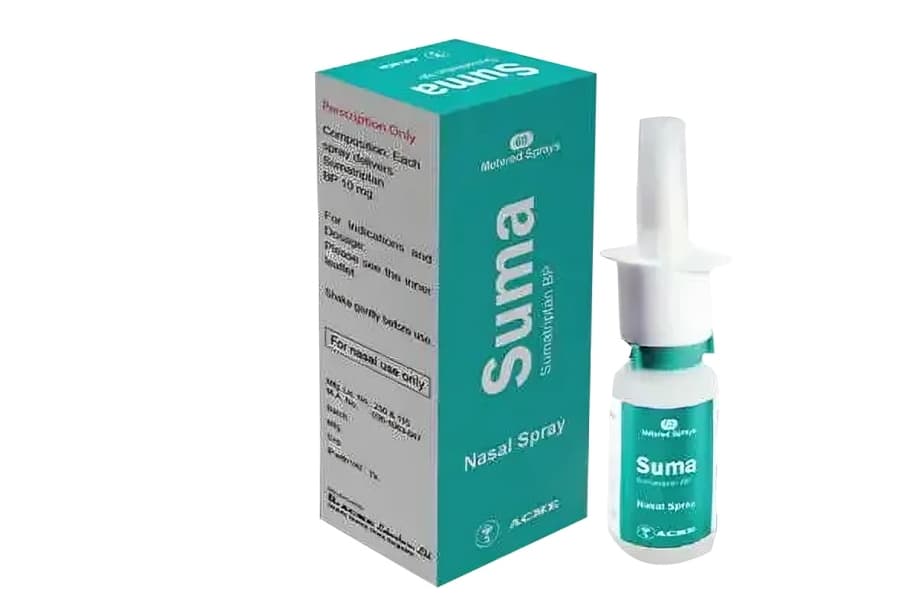

Medicine overview
Indications of Suma
Suma is a triptan medicine used for the acute (abortive) treatment of certain headache disorders. It does not prevent attacks and is not for daily/prophylactic use.
| Indication | Evidence / Status | Formulation typically used |
|---|---|---|
| Acute treatment of migraine attacks, with or without aura, in adults | Established / FDA-approved | Oral tablet, subcutaneous injection, nasal spray |
| Acute treatment of migraine attacks in adolescents (12–17 years) | FDA-approved for this formulation only | Nasal spray |
| Acute treatment of cluster headache episodes in adults | Established / FDA-approved | Subcutaneous injection |
Suma is not indicated for prevention (prophylaxis) of migraine, for hemiplegic or basilar migraine, or for tension-type or other non-migraine headaches.
Composition
Sumatriptan (as sumatriptan succinate, or as sumatriptan base in nasal formulations) is available in several strengths and dosage forms:
- Oral tablets: 25 mg, 50 mg, and 100 mg
- Subcutaneous injection: 4 mg/0.5 mL and 6 mg/0.5 mL (prefilled syringe/auto-injector)
- Nasal spray: 5 mg, 10 mg, and 20 mg per single spray
Available strengths and dosage forms may vary by manufacturer and by market.
Description
Suma is a selective serotonin (5-HT1B/1D) receptor agonist belonging to the triptan class of medicines, used for the acute relief of migraine and cluster headache attacks. It works by narrowing dilated blood vessels around the brain and reducing the release of substances that trigger migraine pain and inflammation.
Suma is intended to treat an attack that has already started; it is taken (or administered) as early as possible after the onset of headache and is not used to prevent attacks from occurring.
Therapeutic Class
Suma belongs to the triptan class of drugs — selective serotonin 5-HT1B/1D receptor agonists, classified therapeutically as anti-migraine agents.
Pharmacology
Mechanism of Action
Sumatriptan is a selective agonist at 5-HT1B and 5-HT1D serotonin receptors. Activation of 5-HT1B receptors on cranial blood vessels produces vasoconstriction of dilated, dural blood vessels believed to be distended during a migraine attack. Activation of 5-HT1D receptors on trigeminal nerve terminals inhibits the release of pro-inflammatory and vasoactive neuropeptides (such as calcitonin gene-related peptide), reducing neurogenic inflammation and blocking pain transmission along the trigeminovascular pathway.
Pharmacokinetics
- Absorption: Oral bioavailability is low (about 14%) due to extensive first-pass metabolism and incomplete absorption; peak plasma concentration is reached in about 2–2.5 hours. Subcutaneous injection has much higher bioavailability (~96%) with a rapid peak (~10–15 minutes). Nasal spray has intermediate bioavailability and onset.
- Distribution: Plasma protein binding is low (14–21%).
- Metabolism: Predominantly metabolized by monoamine oxidase A (MAO-A) to an inactive indole acetic acid metabolite.
- Elimination: Elimination half-life is approximately 2.5 hours; metabolites are excreted mainly in urine.
Dosage & Administration of Suma
Adults — Migraine
| Formulation | Usual single dose | Repeat dosing | Maximum |
|---|---|---|---|
| Oral tablet | 25 mg, 50 mg, or 100 mg | May repeat once after ≥2 hours if migraine returns | 200 mg per 24 hours |
| Subcutaneous injection | 4 mg or 6 mg | May repeat once after ≥1 hour if migraine returns | 12 mg (two 6 mg doses) per 24 hours |
| Nasal spray | 5 mg, 10 mg, or 20 mg in one nostril | May repeat once after ≥2 hours if migraine returns | 40 mg per 24 hours |
Adults — Cluster Headache
Subcutaneous injection 6 mg for an acute episode; may repeat once after at least 1 hour if needed. Maximum 12 mg (two 6 mg injections) in 24 hours. Oral and nasal forms are not established for cluster headache.
Adolescents (12–17 years) — Migraine
Nasal spray only: a single 10 mg or 20 mg spray in one nostril, based on body weight, at the onset of migraine. The safety and effectiveness of a second dose in this age group have not been established (see Pediatric Uses).
Hepatic Impairment
In mild-to-moderate hepatic impairment, use the lowest recommended dose and monitor closely. Suma is not recommended in severe hepatic impairment (see Contraindications).
Doses should be taken as early as possible after migraine symptom onset, but Suma is effective when taken at any point during an attack. Do not use for a headache with atypical features suggestive of stroke or other serious neurological cause without medical evaluation.
Administration of Suma
- Tablets: Swallow whole with water; may be taken with or without food.
- Subcutaneous injection: Administer using the prefilled auto-injector/syringe exactly as instructed by a healthcare provider, into the thigh or outer upper arm; do not inject intravenously.
- Nasal spray: Administer one full spray into a single nostril; do not shake; prime according to the package instructions if it is the first use of that device; blow the nose gently before use if needed.
- Use Suma as soon as possible after migraine or cluster headache symptoms begin.
Interaction of Suma
Serotonergic drugs (SSRIs, SNRIs, and other serotonergic agents): Concomitant use with Suma carries a risk of serotonin syndrome (agitation, hallucinations, rapid heart rate, tremor, muscle rigidity, incoordination, diarrhea, in rare cases life-threatening). Use with caution and monitor closely if combined.
Ergot-containing medicines, other triptans, and MAO inhibitors: Do not combine — these are absolute contraindications with defined time restrictions; see Contraindications.
Other 5-HT1 agonists: Additive vasospastic effects are possible; avoid concurrent use.
No clinically significant interaction has been established with propranolol, or with common CYP450 enzyme pathways, as Suma is metabolized predominantly by monoamine oxidase A rather than cytochrome P450 enzymes.
Contraindications
Sumatriptan is contraindicated in patients with:
- Ischemic heart disease (history of myocardial infarction, angina pectoris, or documented silent ischemia) or coronary artery vasospasm, including Prinzmetal's angina
- History of stroke or transient ischemic attack, or history of hemiplegic or basilar migraine
- Peripheral vascular disease
- Ischemic bowel disease
- Uncontrolled hypertension
- Severe hepatic impairment
- Use of another triptan or an ergotamine-type medication (ergotamine or methysergide) within the preceding 24 hours
- Use of, or use within 2 weeks of stopping, a monoamine oxidase (MAO) inhibitor
- Known hypersensitivity to Sumatriptan or any component of the formulation
Side Effects of Suma
Common side effects of Suma include:
- Tingling, numbness, or pins-and-needles sensation (paresthesia)
- Flushing or feeling of warmth
- Mild sensation of pain, pressure, or tightness in the chest, neck, jaw, or throat — usually transient and not of cardiac origin, but should be evaluated promptly if severe, persistent, or occurring with risk factors for heart disease (see Precautions and Warnings)
- Dizziness or drowsiness
- Injection site reactions (with subcutaneous use) or nasal discomfort, throat irritation, and altered taste (with nasal spray)
- Fatigue and mild nausea
Rare but serious effects — including cardiac ischemia, stroke, serotonin syndrome, seizures, and anaphylaxis — are discussed under Precautions and Warnings.
Pregnancy & Lactation
Pregnancy: Suma should be used during pregnancy only if clearly needed and if the potential benefit justifies the potential risk to the fetus. Data from pregnancy exposure registries have generally been reassuring for this class, but formal safety in human pregnancy has not been established, and a physician should always be consulted before use.
Breastfeeding: Suma passes into breast milk in small amounts. Because effects on a nursing infant are not fully established, caution is advised; some guidance suggests avoiding breastfeeding for about 12 hours after a dose (expressing and discarding milk during this period) to minimize infant exposure. Consult a physician before use while breastfeeding.
Precautions & Warnings
- Cardiac risk evaluation: Suma should not be given to patients with unrecognized coronary artery disease without prior cardiovascular evaluation, particularly those with risk factors (e.g. diabetes, smoking, hypertension, high cholesterol, obesity, strong family history, postmenopausal women, men over 40). Serious cardiac events (myocardial ischemia/infarction, arrhythmia) have occurred rarely, even in patients without known cardiac disease.
- Cerebrovascular and peripheral vasospastic events: Stroke, hemorrhage, and other cerebrovascular events, as well as peripheral vasospastic reactions (including ischemic colitis and Raynaud's-type symptoms), have been reported rarely.
- Serotonin syndrome: Risk increases when combined with other serotonergic drugs (see Interactions).
- Medication-overuse headache: Frequent use (more than about 10 days per month) can lead to worsening headache; limit frequency of use per medical advice.
- Seizures: Use with caution in patients with a history of seizure disorder or conditions that lower seizure threshold.
- Hypersensitivity/anaphylaxis: Discontinue immediately if signs of a serious allergic reaction occur.
- Hepatic impairment: Use the lowest dose in mild-to-moderate impairment; avoid in severe impairment (see Contraindications).
Overdose Effects of Suma
Reported effects of Suma overdose include seizures, tremor, cyanosis, weakness, ataxia (incoordination), significant changes in blood pressure, and loss of consciousness, particularly with injectable formulations.
There is no specific antidote. If an overdose is suspected, seek immediate medical attention or contact emergency services / a poison control center. Continued observation, including cardiac (ECG) monitoring for at least 10 hours, and supportive/symptomatic treatment should be provided by medical professionals; do not attempt specific home treatment.
Storage Conditions
Store at room temperature (below 30°C), away from light and moisture. Do not freeze injectable or nasal spray formulations. Keep out of reach of children.
Use In Special Populations
- Renal impairment: No specific dose adjustment is well established; use with caution, as Suma and its metabolites are partly renally eliminated.
- Hepatic impairment: Use the lowest available dose in mild-to-moderate impairment; contraindicated in severe hepatic impairment (see Contraindications).
- Elderly: Use with caution, as older adults are more likely to have undiagnosed coronary artery disease; cardiovascular risk should be assessed before use.
- Pediatric patients: See Pediatric Uses.
Duration Of Treatment
Suma is intended only for the acute (as-needed) treatment of an individual migraine or cluster headache attack, not for daily or preventive use. A dose (and, if needed, one repeat dose per the interval and maximum described in Dosage and Administration) is used for each attack. Use on more than about 10 days per month should be avoided, as this can itself cause medication-overuse headache (see Precautions and Warnings).
Drug Classes
Triptans (selective serotonin 5-HT1B/1D receptor agonists); anti-migraine preparations (ATC class N02CC01). Sumatriptan is not an antibiotic or antimicrobial.
Mode Of Action
Sumatriptan selectively stimulates 5-HT1B and 5-HT1D serotonin receptors, causing constriction of dilated cranial (dural) blood vessels and inhibiting the release of pro-inflammatory neuropeptides from trigeminal nerve endings. This dual action interrupts the vascular dilation and neurogenic inflammation that underlie migraine and cluster headache pain.
Pregnancy
C
Pediatric Uses
Oral tablets and subcutaneous injection: Safety and efficacy of Suma have not been established in patients under 18 years of age; these formulations are not recommended in children or adolescents.
Nasal spray: Approved for the acute treatment of migraine in adolescents aged 12–17 years, as a single weight-based dose (10 mg or 20 mg) in one nostril. The safety and effectiveness of a second dose in this age group have not been established. Suma is not approved for migraine prevention or for cluster headache in any pediatric patient, and is not studied in children under 12 years.
Frequently Asked Questions
Q: What is Suma 10 mg/spray Nasal Spray used for?
A: Suma 10 mg/spray Nasal Spray is used for the acute treatment of a migraine attack (with or without aura) once it has started, and — as a subcutaneous injection — for acute cluster headache episodes in adults. It is not used to prevent migraine or cluster headache attacks.
Q: Can I take Suma 10 mg/spray Nasal Spray for a regular headache or every day for migraine prevention?
A: No. Suma 10 mg/spray Nasal Spray is only for treating an individual migraine or cluster headache attack, not for daily or preventive use, and not for ordinary tension-type headaches. Using it more than about 10 days a month can itself lead to worsening, medication-overuse headache, so it should be used strictly as directed.
Q: Who should not take Suma 10 mg/spray Nasal Spray?
A: Suma 10 mg/spray Nasal Spray must not be used by people with ischemic heart disease (such as a history of heart attack or angina) or coronary artery vasospasm, a history of stroke or transient ischemic attack, hemiplegic or basilar migraine, peripheral vascular disease, ischemic bowel disease, uncontrolled high blood pressure, or severe liver impairment. It also must not be combined with an ergotamine-type medicine or another triptan within 24 hours, or with an MAO inhibitor (or within 2 weeks of stopping one), or used by anyone with a known allergy to it. Always share your full medical history with your physician before starting Suma 10 mg/spray Nasal Spray.
Q: Is it safe to use Suma 10 mg/spray Nasal Spray during pregnancy or while breastfeeding?
A: Suma 10 mg/spray Nasal Spray should be used in pregnancy only if clearly needed, since the potential benefit must be weighed against any potential risk to the fetus; although available pregnancy-registry data are reassuring, formal safety has not been established, so a physician should be consulted first. Suma 10 mg/spray Nasal Spray passes into breast milk in small amounts, so caution is advised while breastfeeding — some guidance recommends waiting about 12 hours after a dose before nursing again — and a doctor should be consulted.
Q: What are the common side effects of Suma 10 mg/spray Nasal Spray?
A: Common effects of Suma 10 mg/spray Nasal Spray include tingling or numbness, flushing or a feeling of warmth, mild tightness or pressure in the chest, neck, jaw, or throat (usually brief and not heart-related, but should be checked if severe or persistent), dizziness, drowsiness, and mild nausea. Injection use can cause site reactions, and nasal spray can cause nasal discomfort or an unusual taste. Serious but rare effects include heart-related events, stroke, serotonin syndrome, seizures, and allergic reactions — seek medical help immediately if these occur.
Q: What should I do if I take too much Suma 10 mg/spray Nasal Spray?
A: An overdose of Suma 10 mg/spray Nasal Spray can cause seizures, tremor, bluish skin discoloration, weakness, poor coordination, marked blood pressure changes, or loss of consciousness. There is no specific antidote, so if an overdose is suspected, seek immediate medical attention or contact emergency services or a poison control center right away rather than attempting to treat it at home.
Disclaimer
The information provided is accurate to the best of our knowledge, but it does not replace professional medical advice. We cannot guarantee its completeness or accuracy, and the absence of specific information about a drug should not be taken as an endorsement. We are not responsible for any consequences arising from this information, so please consult a healthcare professional for any concerns or questions.
