
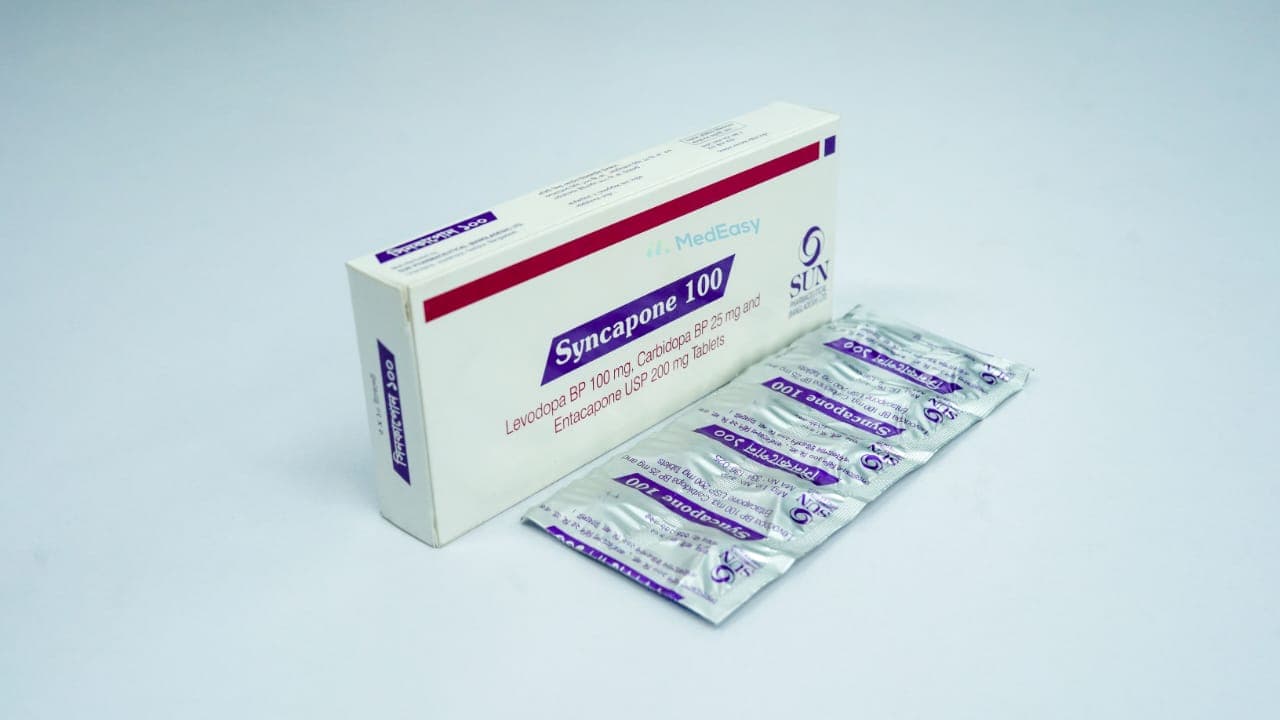

Medicine overview
Indications of Syncapone
Syncapone is a fixed-dose triple combination indicated for the treatment of idiopathic Parkinson's disease in patients who experience signs and symptoms of end-of-dose "wearing-off" motor fluctuations that are not adequately controlled with immediate-release levodopa/carbidopa alone.
Evidence-based indication summary
- FDA-approved/established use: substitution therapy for patients already stabilized on immediate-release levodopa and carbidopa (or another peripheral decarboxylase inhibitor) plus separate entacapone, or for patients on levodopa/carbidopa experiencing predictable end-of-dose wearing-off, in whom addition of a COMT inhibitor is appropriate.
- Not indicated for initial (de novo) treatment of Parkinson's disease; patients should first be titrated on individual levodopa/carbidopa (and, if needed, entacapone) before conversion to a fixed combination product.
- Adjunct therapy requirement: Syncapone is only used as an adjunct to, and never as a substitute for, an individualized levodopa/carbidopa regimen — it does not work as monotherapy because it contains no additional levodopa beyond what is already balanced with carbidopa and entacapone in each tablet strength.
Composition
Levodopa + Carbidopa + Entacapone is a fixed-dose combination oral tablet. Each tablet strength combines three active ingredients: levodopa (the dopamine precursor), carbidopa (a peripheral aromatic L-amino acid decarboxylase inhibitor), and a fixed dose of entacapone 200 mg (a peripheral catechol-O-methyltransferase, COMT, inhibitor). Levodopa strengths are typically available as 50 mg, 75 mg, 100 mg, 125 mg, 150 mg, and 200 mg per tablet, with carbidopa provided in a fixed ratio (approximately 1:4 to 1:8 of carbidopa to levodopa) to ensure adequate peripheral decarboxylase inhibition at each levodopa dose.
Description
Syncapone is an antiparkinsonian combination product that brings together a dopamine precursor with two enzyme inhibitors that block the two major peripheral pathways by which levodopa is broken down before it can reach the brain. By combining levodopa with carbidopa (a dopa-decarboxylase inhibitor) and entacapone (a COMT inhibitor), more levodopa remains available in the bloodstream to cross the blood-brain barrier and be converted to dopamine in the striatum, translating clinically into longer, steadier symptom control and reduced "off" time in patients with motor fluctuations.
Syncapone is intended for patients with Parkinson's disease who are already being treated with levodopa/carbidopa and continue to experience end-of-dose wearing-off, rather than for patients who have not yet started dopaminergic therapy.
Therapeutic Class
Syncapone belongs to the antiparkinsonian agents class, specifically the subclass of dopamine precursor / decarboxylase-inhibitor / COMT-inhibitor combinations used for motor fluctuation management in Parkinson's disease.
Pharmacology
Levodopa + Carbidopa + Entacapone works through three complementary mechanisms:
- Levodopa is the metabolic precursor of dopamine. Unlike dopamine itself, levodopa crosses the blood-brain barrier, where it is decarboxylated to dopamine, replenishing striatal dopamine stores that are depleted in Parkinson's disease.
- Carbidopa inhibits peripheral (extracerebral) aromatic L-amino acid decarboxylase, the enzyme that would otherwise convert most orally administered levodopa to dopamine before it reaches the brain. By blocking this peripheral conversion, carbidopa increases the fraction of levodopa available to enter the central nervous system and reduces peripheral dopamine-related adverse effects such as nausea.
- Entacapone selectively and reversibly inhibits peripheral catechol-O-methyltransferase (COMT), the enzyme responsible for the alternate peripheral degradation pathway of levodopa (to 3-O-methyldopa). By blocking this pathway, entacapone increases the area under the plasma levodopa concentration curve and prolongs the clinical benefit of each levodopa dose, without itself having direct antiparkinsonian activity.
Together, these three components in Levodopa + Carbidopa + Entacapone increase and prolong levodopa's bioavailability and central effect, which clinically extends "on" time and shortens "off" time in patients with end-of-dose fluctuations.
Dosage & Administration of Syncapone
General dosing principle
The dose of Syncapone must be individualized by titrating the levodopa component to the lowest dose that provides satisfactory symptom control, based on the patient's prior levodopa/carbidopa requirement. Patients are typically converted to the tablet strength that matches their current levodopa dose per administration, taken with each levodopa/carbidopa dose.
| Indication | Adult dose | Notes |
|---|---|---|
| Parkinson's disease with end-of-dose wearing-off | One tablet (matching the patient's current levodopa dose) with each scheduled levodopa/carbidopa administration, up to a maximum of 8 tablets/day (entacapone 1600 mg/day) | Entacapone component should not exceed 200 mg per dose or 1600 mg/day (8 doses); interval between doses is individualized based on response |
| Conversion from separate levodopa/carbidopa + entacapone | Matched tablet strength for the equivalent levodopa dose, given at the same dosing interval | Physician-supervised switch only |
Renal impairment
No dose adjustment is established as routinely necessary for renal impairment, but caution is advised and clinical response should be monitored, as levodopa and carbidopa are partly renally eliminated.
Hepatic impairment
Entacapone is extensively hepatically metabolized; Syncapone should be used with caution in patients with hepatic impairment, and dose reduction or closer monitoring may be needed. Not formally studied in severe hepatic impairment.
Missed dose
Take the missed dose as soon as remembered unless it is close to the next scheduled dose; do not double the dose. Never stop Syncapone abruptly (see Precautions and Warnings).
Administration of Syncapone
Syncapone is taken orally, generally at the same times the patient's individual levodopa/carbidopa doses would otherwise be taken. Tablets may be taken with or without food; however, a high-protein meal taken at the same time may reduce absorption and effect of the levodopa component and should be spaced apart where possible (see Interactions). Tablets should be swallowed whole and should not be broken or crushed unless specifically instructed, since the combination ratio in each tablet is fixed. Do not discontinue or reduce the dose abruptly without physician guidance.
Interaction of Syncapone
Clinically significant interactions
- Nonselective MAO inhibitors (e.g., phenelzine, tranylcypromine): concurrent use or use within 14 days is contraindicated because of the risk of hypertensive crisis. (Selective MAO-B inhibitors such as selegiline or rasagiline may be used with caution and closer monitoring.)
- Antipsychotics and other dopamine-receptor antagonists (e.g., typical antipsychotics, some antiemetics such as metoclopramide): may reduce the antiparkinsonian effectiveness of Syncapone by blocking dopamine receptors; concurrent use should be avoided when possible.
- Iron salts/supplements: can form chelates with levodopa and carbidopa, reducing their bioavailability; iron products should be separated in timing from Syncapone administration.
- Drugs metabolized by COMT (e.g., methyldopa, dobutamine, epinephrine, norepinephrine, isoproterenol): entacapone may increase the heart rate and blood pressure effects of these agents; concurrent use requires monitoring, particularly with catecholamine-based drugs.
- High-protein meals: large neutral amino acids compete with levodopa for intestinal absorption and transport across the blood-brain barrier, which may reduce the clinical effect of Syncapone; consistent meal timing relative to doses is recommended.
Contraindications
Levodopa + Carbidopa + Entacapone is contraindicated in:
- Known hypersensitivity to levodopa, carbidopa, entacapone, or any component of the formulation.
- Patients receiving nonselective monoamine oxidase (MAO) inhibitors, or within 14 days of stopping one, because of the risk of hypertensive crisis.
- Narrow-angle glaucoma (uncontrolled angle-closure glaucoma), because of the risk of increased intraocular pressure.
Side Effects of Syncapone
Adverse effects reported with Syncapone include both dopaminergic effects (shared with levodopa/carbidopa) and effects specific to the entacapone component.
- Very common/common: dyskinesia, nausea, diarrhea, urine discoloration (reddish-brown; harmless, caused by entacapone metabolites), orthostatic hypotension/dizziness, hyperhidrosis (excess sweating), abdominal pain.
- Neuropsychiatric: hallucinations, confusion, vivid dreams, and other psychotic-like symptoms, more common in elderly patients.
- Impulse control disorders: pathological gambling, hypersexuality, compulsive shopping/eating, and other compulsive behaviors have been reported with dopaminergic therapy including Syncapone.
- Less common but important: somnolence and sudden onset of sleep, syncope, worsening of pre-existing dyskinesia.
Pregnancy & Lactation
Data on the use of Syncapone in human pregnancy are limited. Syncapone should be used during pregnancy only if the potential benefit to the mother clearly justifies the potential risk to the fetus, and only under close physician supervision. Levodopa and carbidopa are known to suppress prolactin secretion and may inhibit lactation; it is not known whether entacapone is excreted in human milk. Because of the potential for adverse effects in a nursing infant and the effect on lactation, a decision should be made whether to discontinue breastfeeding or discontinue Syncapone, taking into account the importance of treatment to the mother — consult a physician before use during breastfeeding.
Precautions & Warnings
Do not stop abruptly
Syncapone should never be discontinued or have its dose reduced abruptly. Rapid dose reduction or withdrawal has been associated with a symptom complex resembling neuroleptic malignant syndrome, including hyperpyrexia, muscle rigidity, altered mental status, and elevated creatine phosphokinase, and rhabdomyolysis has been reported. Any dose reduction or discontinuation must be done gradually and under physician supervision.
Hepatic monitoring context
The related COMT inhibitor tolcapone carries a boxed warning for rare but potentially fatal hepatocellular injury and requires mandatory liver enzyme monitoring. Entacapone (the COMT-inhibitor component of Syncapone) has not been associated with the same magnitude of hepatotoxicity risk in clinical experience, and routine liver enzyme monitoring is not mandated for entacapone; nonetheless, patients on Syncapone should be monitored for any signs or symptoms of liver dysfunction, and caution is warranted in those with pre-existing hepatic impairment.
Melanoma
Patients with Parkinson's disease have a higher background risk of melanoma. Levodopa-containing products, including Syncapone, should be used with caution in patients with a history of melanoma or suspicious, undiagnosed skin lesions; periodic skin monitoring by a qualified professional is recommended for all patients on Syncapone.
Impulse control disorders
Patients and caregivers should be monitored for the development of intense urges (gambling, sexual, spending, eating) while on Syncapone; dose reduction or discontinuation should be considered if such behaviors occur.
Orthostatic hypotension and cardiovascular disease
Syncapone can cause orthostatic hypotension and, rarely, arrhythmia-related effects via the entacapone component; use with caution in patients with cardiovascular or cerebrovascular disease.
Somnolence
Patients may experience somnolence or sudden onset of sleep during daily activities; caution is required when driving or operating machinery.
Overdose Effects of Syncapone
Symptoms of Syncapone overdose may include severe dyskinesia, agitation, confusion, exaggerated cardiovascular effects (arrhythmia, marked hypotension or hypertension), and gastrointestinal upset. There is no specific antidote for Syncapone overdose. In case of suspected overdose, seek immediate medical attention or contact emergency services / a poison control center; treatment is supportive, with careful monitoring of vital signs, cardiac rhythm, and mental status in a hospital setting. Do not attempt home treatment for a suspected overdose.
Storage Conditions
Store at room temperature (below 30°C), away from light and moisture. Keep out of reach of children.
Use In Special Populations
Elderly
Elderly patients are more susceptible to confusion, hallucinations, and orthostatic hypotension with Syncapone; a cautious, individualized dosing approach and close monitoring are recommended.
Hepatic impairment
Use with caution; entacapone is extensively metabolized in the liver (see Dosage and Administration).
Renal impairment
No specific dose adjustment established, but caution and monitoring are advised.
Pediatric patients
Safety and efficacy of Syncapone have not been established in patients under 18 years of age; Parkinson's disease is rare in this population and Syncapone is not indicated for pediatric use.
Duration Of Treatment
Syncapone is used as long-term, chronic therapy for Parkinson's disease under ongoing physician supervision, with periodic reassessment of dose and continued need. There is no fixed treatment duration; therapy is generally continued indefinitely as part of the individualized management of motor fluctuations, and any discontinuation must be done gradually rather than abruptly (see Precautions and Warnings).
Drug Classes
Antiparkinsonian agent; dopamine precursor (levodopa); peripheral decarboxylase inhibitor (carbidopa); catechol-O-methyltransferase (COMT) inhibitor (entacapone).
Mode Of Action
Levodopa + Carbidopa + Entacapone increases the amount of levodopa reaching the brain, and prolongs its action, by simultaneously blocking the two principal peripheral enzymatic pathways of levodopa breakdown: carbidopa inhibits peripheral dopa-decarboxylase, and entacapone inhibits peripheral COMT. Levodopa itself is decarboxylated to dopamine within the central nervous system, replenishing dopaminergic transmission in the striatum that is deficient in Parkinson's disease. The net clinical effect of adding entacapone to levodopa/carbidopa is a longer duration of levodopa action per dose, translating into extended "on" time and reduced "off" time.
Pregnancy
C
Pediatric Uses
Syncapone is not indicated for use in pediatric patients. Safety and efficacy of Syncapone in patients under 18 years of age have not been established, as Parkinson's disease predominantly affects adults, typically in mid-to-late life. Syncapone should not be used in children or adolescents outside of specialist clinical judgment for rare pediatric parkinsonism, and only then with extreme caution and close monitoring.
Frequently Asked Questions
Q: What is Syncapone 100 mg Tablet used for?
A: Syncapone 100 mg Tablet is used in Parkinson's disease to treat end-of-dose "wearing-off" motor fluctuations in patients who are already taking levodopa/carbidopa but continue to experience a return of symptoms before their next dose is due. It is not used to start Parkinson's disease treatment from scratch.
Q: Can I stop taking Syncapone 100 mg Tablet suddenly if I feel better?
A: No. Syncapone 100 mg Tablet must never be stopped or reduced abruptly. Sudden discontinuation can cause a serious reaction with high fever, muscle rigidity, and confusion, similar to neuroleptic malignant syndrome, and can also cause muscle breakdown (rhabdomyolysis). Always talk to your physician before changing or stopping your dose.
Q: Why does my urine turn a reddish-brown color while taking Syncapone 100 mg Tablet?
A: Reddish-brown urine discoloration is a known, harmless effect of the entacapone component of Syncapone 100 mg Tablet. It does not indicate kidney damage or bleeding, but if you are concerned or notice other symptoms, discuss it with your physician.
Q: Can Syncapone 100 mg Tablet be taken with iron tablets or a high-protein meal?
A: Iron supplements and high-protein meals can both reduce the absorption and effect of the levodopa in Syncapone 100 mg Tablet. It is best to separate the timing of iron tablets from your Syncapone 100 mg Tablet dose and to keep your protein intake consistent and spaced from your doses, as advised by your physician or dietitian.
Q: Is Syncapone 100 mg Tablet safe during pregnancy or breastfeeding?
A: Data are limited. Syncapone 100 mg Tablet should be used in pregnancy only if the potential benefit clearly outweighs the potential risk to the baby, and only under close medical supervision. It may also reduce breast milk production and its passage into breast milk is not well characterized, so discuss breastfeeding plans with your physician before use.
Q: What should I do if I notice new gambling urges, hypersexuality, or compulsive behavior while on Syncapone 100 mg Tablet?
A: These can be impulse control disorders associated with dopaminergic medicines including Syncapone 100 mg Tablet. Report any such changes to your physician promptly, as dose adjustment or a change in therapy may be needed.
Disclaimer
The information provided is accurate to the best of our knowledge, but it does not replace professional medical advice. We cannot guarantee its completeness or accuracy, and the absence of specific information about a drug should not be taken as an endorsement. We are not responsible for any consequences arising from this information, so please consult a healthcare professional for any concerns or questions.
