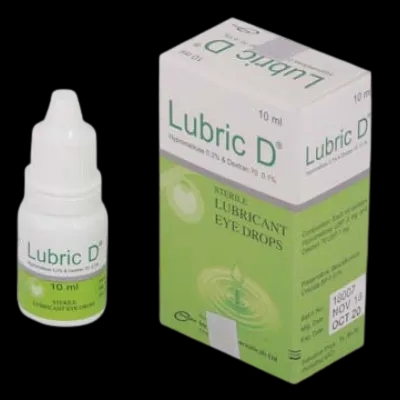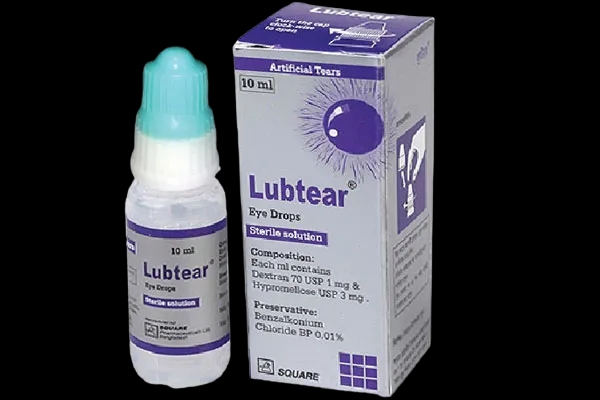
10% Off
Lubtear0.1%+0.3%
Square Pharmaceuticals PLC.
৳85.50
Add to cart


Syntar ophthalmic solution is an over-the-counter (OTC) artificial tear / ocular lubricant preparation, established for the following use:
This is an established, guideline-supported OTC indication (ophthalmic demulcent monograph); it is not intended to treat infections, allergies, or underlying ocular disease.
Each mL of Dextran + Hypromellose ophthalmic solution typically contains:
Along with preservative(s) (e.g., benzalkonium chloride in multi-dose preparations, or preservative-free single-use formulations) and other inactive/buffering ingredients. Exact strengths and excipients may vary slightly by manufacturer; refer to the specific product label.
Syntar is a combination ophthalmic lubricant (artificial tear) preparation used for the symptomatic relief of dry and irritated eyes. Dextran is a high-molecular-weight polysaccharide that increases the viscosity of the tear film, while Hypromellose is a cellulose-derivative demulcent that coats and lubricates the ocular surface.
Together, these ingredients form a stable, protective film over the cornea and conjunctiva, helping to retain moisture, reduce friction during blinking, and relieve the discomfort associated with insufficient natural tear production. Syntar is available as an over-the-counter ophthalmic solution and does not require a prescription in most markets, including Bangladesh.
Syntar belongs to the therapeutic class of Ophthalmic Lubricants / Artificial Tear Preparations (Ocular Demulcents), used for the management of dry eye and ocular surface irritation.
Dextran + Hypromellose works through complementary physical (non-pharmacological) mechanisms rather than a receptor-based pharmacologic action:
Together, the combination stabilizes the pre-corneal tear film, reduces tear evaporation, and provides symptomatic comfort. Systemic absorption after topical ophthalmic application is negligible.
Syntar is intended for topical ophthalmic use only.
| Indication | Dose |
|---|---|
| Dry eye / ocular irritation (adults and children) | Instill 1 to 2 drops in the affected eye(s) as needed, typically 3-4 times daily or more frequently if required for symptom relief. |
Administration technique: Wash hands before use. Tilt the head back, gently pull down the lower eyelid to form a pouch, and instill the drop(s) without letting the dropper tip touch the eye, eyelid, or any surface (to avoid contamination). Close the eye gently for 1-2 minutes after instillation. If wearing contact lenses, remove them before use unless the product is specifically labeled safe for use with lenses, and wait as directed before reinserting. If more than one ophthalmic product is being used, space administration at least 5-10 minutes apart.
Syntar is for topical ophthalmic (eye) use only and must not be injected or taken orally.
Syntar has minimal systemic absorption when used topically in the eye, so clinically significant systemic drug interactions are not expected.
Dextran + Hypromellose is contraindicated in patients with known hypersensitivity to dextran, hypromellose, or any other component of the formulation.
Syntar is generally well tolerated. Reported side effects are mostly local and transient:
If irritation, eye pain, vision changes, or redness worsens or persists, discontinue use and seek medical advice.
Syntar is applied topically to the eye with minimal systemic absorption. While significant fetal or infant risk is not expected, as with any medication, it should be used during pregnancy and breastfeeding only if clearly needed, and a physician or pharmacist should be consulted before use to confirm appropriateness for the individual situation.
Observe the following precautions when using Syntar:
Overdose with Syntar is unlikely to cause serious systemic toxicity because of its topical route and minimal systemic absorption. Excessive ocular application may cause transient watering, blurred vision, or local irritation, which typically resolves on its own.
If accidentally ingested in large amounts, or if a severe or unexpected reaction occurs, seek immediate medical attention or contact a poison control center rather than attempting home treatment.
Store at room temperature (below 30°C), away from light and moisture. Do not freeze. Keep the container tightly closed when not in use, and keep out of reach of children. Discard any unused solution after the manufacturer's recommended period following first opening.
Elderly: No special dose adjustment is required; Syntar is commonly used in elderly patients for age-related dry eye.
Renal/hepatic impairment: No dose adjustment is expected to be necessary given the negligible systemic absorption of Syntar after topical ophthalmic use.
Children: See Pediatric Use.
Contact lens wearers: Remove lenses before instillation unless the product is specifically labeled compatible with contact lens wear.
Syntar may be used as needed for symptomatic relief of dry eye and can be continued long-term for chronic dry eye under medical guidance. If symptoms persist or worsen after 72 hours of regular use, or if the condition appears to require more than temporary relief, a physician should be consulted to evaluate for an underlying cause.
Dextran + Hypromellose falls under the drug class of Ophthalmic Lubricants / Artificial Tear Substitutes (Ocular Demulcents), combining a viscosity-enhancing agent (dextran) with a cellulose-based demulcent (hypromellose).
Dextran + Hypromellose acts through physical, non-receptor-mediated mechanisms:
The combined effect is enhanced ocular surface lubrication, moisture retention, and symptomatic relief of dryness and irritation.
Syntar may be used in children for temporary relief of dry or irritated eyes in a manner similar to adults, as it is a topical lubricant with minimal systemic absorption. However, formal safety and efficacy data from controlled clinical trials in infants and young children are limited, so use in this age group should be under the guidance of a physician or pharmacist, particularly in infants.
Q: What is Syntar 0.1%+0.3% Ophthalmic Solution used for?
A: Syntar 0.1%+0.3% Ophthalmic Solution is an artificial tear (ophthalmic lubricant) solution used to temporarily relieve burning, stinging, and irritation caused by dry eyes, and to protect the eye surface from further irritation.
Q: How often can I use Syntar 0.1%+0.3% Ophthalmic Solution eye drops?
A: Syntar 0.1%+0.3% Ophthalmic Solution can generally be used as needed, typically 1-2 drops, 3-4 times daily, or more frequently if required for comfort. Follow the product label or your physician's instructions.
Q: Can I use Syntar 0.1%+0.3% Ophthalmic Solution while wearing contact lenses?
A: Contact lenses should be removed before instilling Syntar 0.1%+0.3% Ophthalmic Solution unless the specific product is labeled as safe for use with contact lenses. Check the label or ask your pharmacist.
Q: Is Syntar 0.1%+0.3% Ophthalmic Solution safe during pregnancy and breastfeeding?
A: Syntar 0.1%+0.3% Ophthalmic Solution has minimal systemic absorption when used in the eye, so significant risk is not expected, but it should be used during pregnancy or breastfeeding only if clearly needed, and a physician or pharmacist should be consulted first.
Q: What should I do if my eyes still feel irritated after using Syntar 0.1%+0.3% Ophthalmic Solution?
A: If eye pain, vision changes, redness, or irritation persists or worsens, or does not improve within 72 hours of using Syntar 0.1%+0.3% Ophthalmic Solution, stop use and consult a physician, as this may indicate an underlying condition needing evaluation.
Q: What if I accidentally swallow Syntar 0.1%+0.3% Ophthalmic Solution?
A: Syntar 0.1%+0.3% Ophthalmic Solution is intended only for use in the eye. If accidentally swallowed in a significant amount, or if any unusual reaction occurs, seek immediate medical attention or contact a poison control center.
Disclaimer
The information provided is accurate to the best of our knowledge, but it does not replace professional medical advice. We cannot guarantee its completeness or accuracy, and the absence of specific information about a drug should not be taken as an endorsement. We are not responsible for any consequences arising from this information, so please consult a healthcare professional for any concerns or questions.