
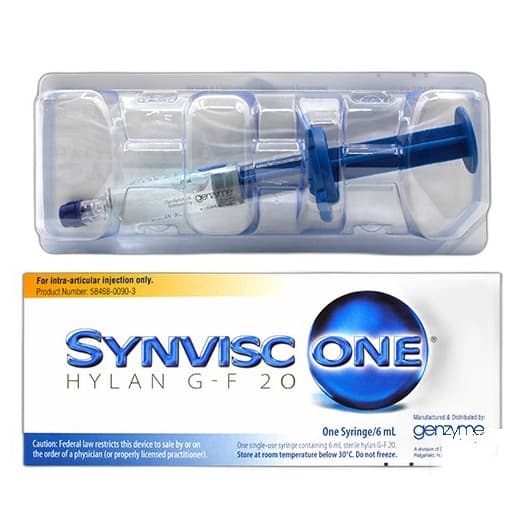

Medicine overview
Indications of Synvisc-One
Synvisc-One is indicated for the treatment of pain associated with osteoarthritis (OA) of the knee, specifically in patients who have not responded adequately to conservative non-pharmacologic therapy (e.g. physical therapy, weight reduction, exercise) and to simple analgesics (e.g. acetaminophen).
- Established/approved use: Intra-articular injection into the knee joint for pain relief in knee osteoarthritis, as part of a stepwise treatment approach after failure of conservative measures.
- Not established: Synvisc-One has not been shown to be effective for osteoarthritis of joints other than the knee, and is not indicated for inflammatory types of arthritis (e.g. rheumatoid arthritis) or for systemic disease.
Synvisc-One is a medical device/viscosupplement, not a systemic analgesic, and its use should be individualized by a physician based on clinical assessment.
Composition
Hylan G-F 20 is a sterile, non-pyrogenic, viscoelastic fluid containing hylan polymers (hylan A and hylan B), which are high molecular weight, cross-linked derivatives of purified natural hyaluronan. The hyaluronan used to manufacture Hylan G-F 20 is derived from rooster combs (avian source).
Each syringe contains hylan polymers dissolved in a buffered physiological sodium chloride solution, supplied as a ready-to-use, single-use prefilled syringe for intra-articular injection.
Description
Synvisc-One is an elastoviscous, high molecular weight hyaluronan derivative used as a viscosupplement for the knee joint. It is supplied as a sterile injectable gel in prefilled syringes intended for intra-articular administration by a trained healthcare professional.
Synvisc-One works locally within the joint space to help restore the viscoelastic properties of osteoarthritic synovial fluid, which are typically reduced in patients with knee osteoarthritis.
Therapeutic Class
Synvisc-One belongs to the class of viscosupplements (hyaluronic acid/hyaluronan derivatives) used for intra-articular injection. It is regulated and used as a medical device/biologic rather than a conventional systemic pharmaceutical.
Pharmacology
Hylan G-F 20 is not absorbed systemically to exert a pharmacologic effect; its action is local and mechanical/biochemical within the injected joint.
Mode of action
- Supplements and restores the elastoviscous properties of synovial fluid, which are diminished in osteoarthritic knees.
- Provides lubrication and shock absorption during joint movement and loading.
- May modulate local inflammatory mediators and pain signaling within the joint, contributing to symptomatic pain relief.
Clinical benefit from Hylan G-F 20 is typically assessed by reduction in knee pain and improvement in function over the weeks following injection.
Dosage & Administration of Synvisc-One
Knee Osteoarthritis (adults)
| Regimen | Dose | Schedule |
|---|---|---|
| Multi-injection course | 2 mL per injection | Once weekly for a total of 3 injections |
| Single-injection formulation | 6 mL | Single intra-articular injection |
Synvisc-One must be injected directly into the knee joint (intra-articular space) by a physician or other qualified healthcare professional trained in intra-articular injection technique, using strict aseptic precautions.
Pediatric dosing: Not established (see Pediatric Use).
Renal/hepatic adjustment: Not applicable; Synvisc-One acts locally within the joint and has no established requirement for renal or hepatic dose adjustment.
Administration of Synvisc-One
Synvisc-One is administered only by intra-articular injection into the knee joint, performed by a trained healthcare professional under aseptic conditions.
- Any joint effusion should be aspirated/removed before injecting Synvisc-One.
- The skin at the injection site should be disinfected; antiseptics containing quaternary ammonium salts (e.g. benzalkonium chloride) should not be used to prepare the skin, as these can cause hyaluronan to precipitate (see Interactions).
- Synvisc-One must not be injected into extra-articular tissues, ligaments, tendons, or the synovial capsule/tissue.
- Patients should be advised to avoid strenuous, weight-bearing activities (e.g. jogging, heavy lifting, prolonged standing) for about 48 hours after injection.
Interaction of Synvisc-One
Synvisc-One is administered locally into the joint and is not known to interact systemically with orally or parenterally administered medicines.
- Antiseptics containing quaternary ammonium salts (e.g. benzalkonium chloride): should not be used to prepare the injection site, as they may cause the hyaluronan in Synvisc-One to precipitate, reducing its effectiveness.
- Concurrent intra-articular use of other injectable products in the same joint at the same time as Synvisc-One is not recommended unless directed by a physician.
Contraindications
Hylan G-F 20 is contraindicated in patients with:
- Known hypersensitivity to hyaluronan preparations.
- Known hypersensitivity to avian proteins, feathers, or egg products, since Hylan G-F 20 is derived from rooster combs.
- Infections or skin diseases in the area of the injection site, or infected joints (septic arthritis).
Hylan G-F 20 should not be used in these situations; other cautions (e.g. joint effusion) are addressed under Precautions and Warnings rather than being absolute contraindications.
Side Effects of Synvisc-One
The most common adverse reactions associated with Synvisc-One are local, related to the injection itself.
- Very common/common: Injection-site pain, swelling, warmth, joint effusion, and stiffness.
- Common: Arthralgia (joint pain), back pain, and localized skin reactions.
- Uncommon/rare: Acute inflammatory ("pseudoseptic") reactions with marked joint swelling, pain, and effusion, occurring most often after repeat injections; hypersensitivity reactions (rash, itching); rarely, joint infection related to the injection procedure.
Patients should seek medical attention promptly if severe or worsening joint pain, swelling, redness, warmth, or fever develop after receiving Synvisc-One, as these may indicate infection or a pseudoseptic reaction requiring evaluation.
Pregnancy & Lactation
Pregnancy: There are no adequate and well-controlled studies of Synvisc-One use in pregnant women. Synvisc-One should be used during pregnancy only if clearly needed and if the potential benefit justifies the potential risk; a physician should be consulted before use.
Lactation: It is not known whether Synvisc-One or its components are excreted in human milk. Because Synvisc-One acts locally within the joint with minimal expected systemic exposure, risk to a breastfeeding infant is considered low, but a physician should be consulted before use during breastfeeding.
Precautions & Warnings
- Synvisc-One should be administered only by a healthcare professional trained in intra-articular injection technique, using strict aseptic technique to minimize the risk of joint infection.
- Any joint effusion present should be aspirated before injecting Synvisc-One.
- Synvisc-One must not be injected into extra-articular tissues or into the synovial tissues/capsule; accidental extra-articular injection may cause local pain or reaction.
- Do not use skin antiseptics containing quaternary ammonium salts (e.g. benzalkonium chloride) before injection, as these can cause the product to precipitate (see Interactions).
- Patients should avoid strenuous weight-bearing activity for about 48 hours after injection.
- Use with caution in patients with known sensitivity to hyaluronan preparations or avian proteins/feathers/egg products (see Contraindications).
- Safety and effectiveness have not been established in patients under 18 years of age, or for joints other than the knee.
- Use in pregnancy and lactation only if clearly needed (see Pregnancy and Lactation).
Overdose Effects of Synvisc-One
Synvisc-One is administered as a fixed, physician-controlled intra-articular injection, so a conventional systemic overdose is not expected. Administration of an excessive volume, repeated injections outside the recommended schedule, or accidental extra-articular injection may increase the likelihood of local reactions such as pain, swelling, or joint effusion.
If excessive dosing or an adverse reaction is suspected after administration of Synvisc-One, the patient should seek immediate medical attention or contact a physician, emergency services, or a poison control center for evaluation; no specific antidote exists.
Storage Conditions
Store Synvisc-One prefilled syringes at room temperature, below 25°C (77°F). Do not freeze. Protect from direct light and moisture. Keep out of reach of children. Do not use if the syringe packaging is damaged or the expiry date has passed.
Use In Special Populations
- Renal impairment: No specific dose adjustment is established or expected to be necessary, as Synvisc-One acts locally within the joint.
- Hepatic impairment: No specific dose adjustment is established or expected to be necessary.
- Elderly: Synvisc-One is commonly used in older adults with knee osteoarthritis; no dose adjustment is required based on age alone.
- Pediatric patients: Safety and efficacy have not been established (see Pediatric Use).
- Pregnancy/lactation: See Pregnancy and Lactation section.
Duration Of Treatment
A single treatment course of Synvisc-One consists of either 3 weekly intra-articular injections (2 mL each) or one single 6 mL injection, depending on the formulation used. Symptomatic relief typically develops over the following weeks.
Repeat treatment courses may be considered after approximately 6 months if clinically indicated, at the discretion of the treating physician; long-term data on repeated courses beyond this are limited.
Drug Classes
Hylan G-F 20 is classified as a viscosupplement / hyaluronic acid (hyaluronan) derivative for intra-articular use, categorized as a medical device/biologic rather than a conventional small-molecule drug.
Mode Of Action
Hylan G-F 20 acts locally by supplementing the elastoviscous properties of synovial fluid in the osteoarthritic knee joint. It provides lubrication and cushioning during joint movement, helping to reduce friction and mechanical stress on cartilage surfaces. Hylan G-F 20 may also exert local biochemical effects that reduce pain-related inflammatory signaling within the joint, contributing to reduction in osteoarthritis knee pain.
Pediatric Uses
The safety and effectiveness of Synvisc-One have not been established in pediatric patients. Synvisc-One is indicated and studied only in adult patients with osteoarthritis of the knee, and its use in children and adolescents is not recommended.
Frequently Asked Questions
Q: What is Synvisc-One 48 mg/10 ml Injection used for?
A: Synvisc-One 48 mg/10 ml Injection is an intra-articular injection used to relieve knee pain caused by osteoarthritis in patients who have not responded adequately to conservative treatments such as physical therapy and simple painkillers like acetaminophen.
Q: How is Synvisc-One 48 mg/10 ml Injection given?
A: Synvisc-One 48 mg/10 ml Injection is injected directly into the knee joint by a doctor, either as three weekly injections or as a single injection, depending on the specific product formulation used.
Q: Is Synvisc-One 48 mg/10 ml Injection a painkiller I can take by mouth?
A: No. Synvisc-One 48 mg/10 ml Injection is not an oral medicine or a systemic painkiller; it is a viscoelastic gel given only by intra-articular (in-joint) injection by a trained healthcare professional.
Q: Who should not receive Synvisc-One 48 mg/10 ml Injection?
A: Synvisc-One 48 mg/10 ml Injection should not be given to patients with known hypersensitivity to hyaluronan preparations or to avian proteins, feathers, or egg products (since it is derived from rooster combs), or to patients who have an infection or skin disease at the injection site or an infected joint.
Q: What are the common side effects of Synvisc-One 48 mg/10 ml Injection?
A: The most common side effects are local reactions at the injected knee, such as pain, swelling, warmth, stiffness, or fluid buildup (effusion) in the joint. Rarely, more marked inflammatory reactions with significant swelling and pain can occur and should be reported to a physician promptly.
Q: Can Synvisc-One 48 mg/10 ml Injection be used during pregnancy or breastfeeding?
A: There is limited data on the use of Synvisc-One 48 mg/10 ml Injection during pregnancy or breastfeeding. It should be used in these situations only if clearly needed and after consulting a physician, who will weigh the potential benefits against any potential risks.
Disclaimer
The information provided is accurate to the best of our knowledge, but it does not replace professional medical advice. We cannot guarantee its completeness or accuracy, and the absence of specific information about a drug should not be taken as an endorsement. We are not responsible for any consequences arising from this information, so please consult a healthcare professional for any concerns or questions.
