
8% Off
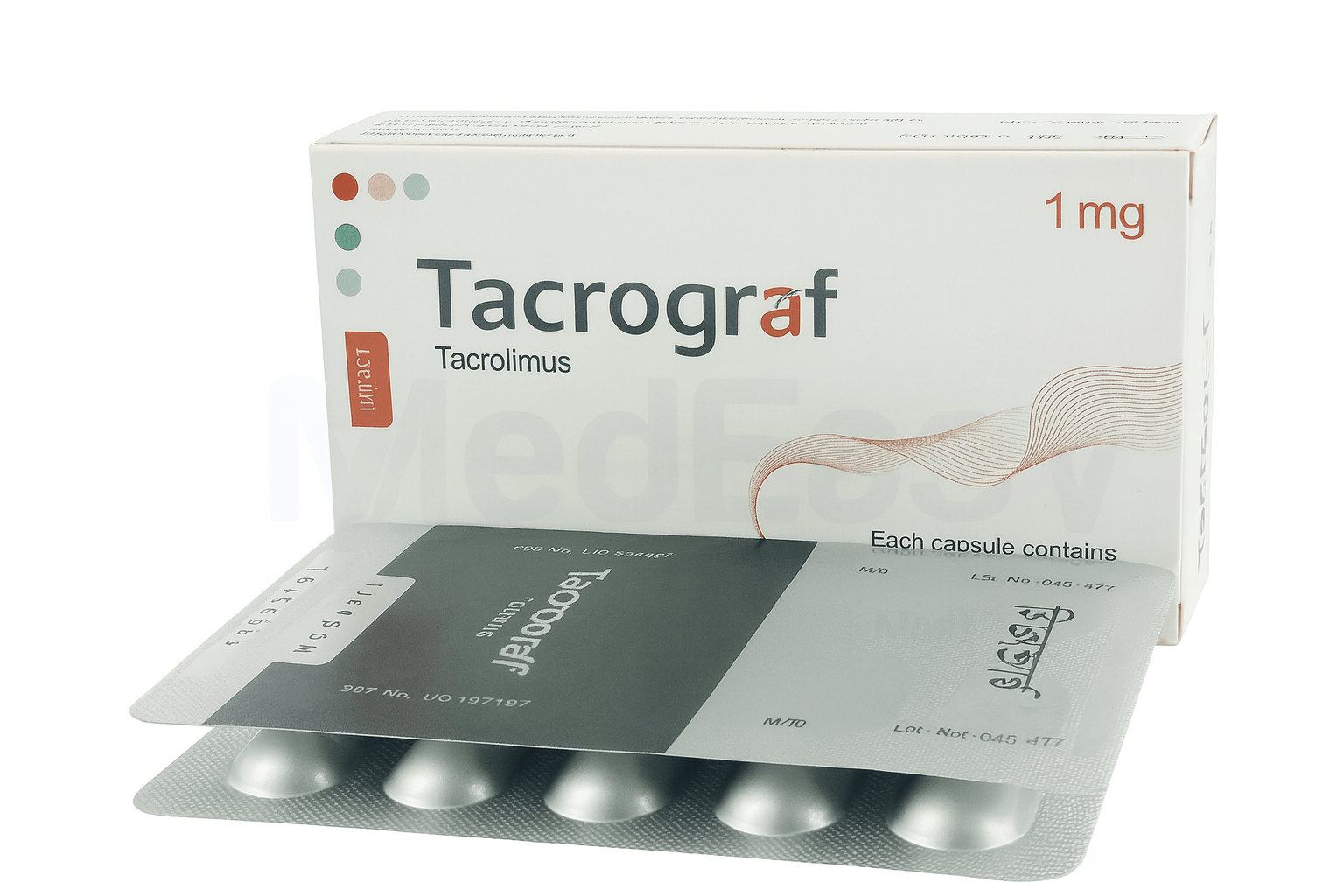
Tacrograf1 mg
Beacon Pharmaceuticals PLC
৳460.00
Add to cart


Tacrocap must only be prescribed and monitored by physicians experienced in immunosuppressive therapy and management of transplant patients.
Each unit dosage form contains Tacrolimus Monohydrate as the active pharmaceutical ingredient, equivalent to the labeled strength of tacrolimus. Tacrolimus Monohydrate is available in multiple formulations, including immediate-release oral capsules, extended-release oral capsules/tablets, intravenous injection concentrate, and topical ointment (0.03% and 0.1%), each with formulation-specific inactive ingredients (excipients).
Tacrocap is the monohydrate salt form of tacrolimus, a macrolide-class calcineurin-inhibitor immunosuppressant originally derived from the soil fungus Streptomyces tsukubaensis. It is used systemically to prevent rejection of transplanted organs and, in a topical ointment formulation, to treat moderate-to-severe atopic dermatitis. Tacrocap works by suppressing T-lymphocyte activation, thereby reducing the immune response responsible for graft rejection and inflammatory skin disease.
Boxed Warning (systemic use): Increased risk of infections and malignancies (particularly lymphoma and skin cancers) due to immunosuppression. Only physicians experienced in immunosuppressive therapy and management of transplant patients should prescribe Tacrocap.
Boxed Warning (topical use): Rare cases of malignancy (skin cancer, lymphoma) have been reported in patients using topical Tacrocap, although a causal relationship has not been established. Topical Tacrocap should be used only as second-line therapy, for short-term and intermittent (not continuous long-term) treatment, at the lowest effective dose.
Tacrocap belongs to the calcineurin-inhibitor class of immunosuppressant agents (macrolide immunosuppressants). It is pharmacologically distinct from, but mechanistically similar to, cyclosporine.
Tacrolimus Monohydrate binds to an intracellular protein, FK-binding protein-12 (FKBP-12), forming a complex that inhibits calcineurin, a calcium/calmodulin-dependent phosphatase. Inhibition of calcineurin prevents dephosphorylation of the nuclear factor of activated T-cells (NFAT), blocking its translocation into the nucleus. This suppresses transcription of interleukin-2 (IL-2) and other cytokines, inhibiting T-lymphocyte activation and proliferation. This reduces both cellular and humoral immune responses responsible for transplant rejection and for the T-cell-mediated inflammation of atopic dermatitis.
Oral Tacrolimus Monohydrate is variably and incompletely absorbed (average bioavailability ~20-25%, food reduces absorption), is extensively bound to erythrocytes and plasma proteins, and is metabolized almost entirely by hepatic and intestinal CYP3A4/CYP3A5 enzymes, with elimination mainly via bile/feces. Whole-blood trough concentration monitoring is required to individualize systemic dosing because of a narrow therapeutic index and wide inter-patient pharmacokinetic variability. Topical Tacrolimus Monohydrate ointment has minimal, formulation- and severity-dependent systemic absorption, which decreases further as skin barrier function improves during treatment.
| Transplant Type | Typical Adult Oral Starting Dose |
|---|---|
| Kidney | 0.2 mg/kg/day in two divided doses (with azathioprine) or approximately 0.1 mg/kg/day (with mycophenolate mofetil), started within 24 hours post-transplant |
| Liver | 0.10-0.15 mg/kg/day in two divided doses |
| Heart | Approximately 0.075 mg/kg/day in two divided doses |
Doses are subsequently individualized and adjusted based on whole-blood trough concentration monitoring, organ function, concomitant immunosuppressants, signs of rejection, and tolerability, as directed by the transplant specialist. Intravenous Tacrocap is reserved for patients unable to take oral medication and is given as a continuous infusion at roughly one-third to one-quarter of the oral dose, with conversion to oral therapy as soon as feasible.
See Precautions and Warnings and Interaction for essential monitoring and interaction-avoidance information.
Systemic interactions are unlikely with topical Tacrocap due to minimal absorption, but excessive alcohol intake may cause facial flushing/skin irritation shortly after application.
Tacrolimus Monohydrate is contraindicated in patients with known hypersensitivity to tacrolimus or to any component of the specific formulation. The intravenous injection formulation is additionally contraindicated in patients with hypersensitivity to polyoxyl 60 hydrogenated castor oil (HCO-60), an excipient in the injection vehicle, due to risk of anaphylaxis. Topical Tacrolimus Monohydrate ointment is contraindicated in patients with Netherton syndrome or other congenital or acquired conditions with a compromised skin barrier, because of the risk of markedly increased systemic drug absorption.
Tacrocap crosses the placenta. Data in pregnant transplant recipients suggest it can be used when the potential benefit to the mother (maintaining graft function) justifies the potential risk to the fetus, but only under close specialist obstetric and transplant monitoring; transient neonatal hyperkalemia and renal dysfunction have been reported with systemic use in pregnancy. Tacrocap is excreted into human breast milk; breastfeeding is generally not recommended during systemic therapy due to potential effects on the infant. For topical use, application should be avoided on the nipple/areola area if breastfeeding, and use in pregnancy should be limited to situations where clearly needed, under physician guidance. Use only if clearly needed and only under direct medical supervision.
Overdose with Tacrocap may present with exaggerated pharmacologic effects, including nephrotoxicity, tremor, and other neurotoxic symptoms. There is no specific antidote. In case of a suspected overdose of Tacrocap, seek immediate medical attention or contact a poison control center right away; supportive care and, where clinically appropriate, general measures to reduce further absorption may be instituted by medical professionals. Do not attempt to manage a suspected overdose at home.
Store at room temperature (below 30°C), away from light and moisture. Injectable formulations may require refrigeration prior to dilution as per the product label. Keep out of reach of children.
For transplant rejection prophylaxis, systemic Tacrocap is typically continued long-term (often lifelong) as directed by the transplant specialist, with dose adjustments over time based on trough levels and clinical status. For atopic dermatitis, topical Tacrocap should be used short-term to clear active lesions, then discontinued; continuous, uninterrupted long-term use is not recommended, and intermittent courses for flare management should only be used under physician guidance.
Tacrolimus Monohydrate is classified as a calcineurin-inhibitor immunosuppressant (macrolide immunosuppressant).
Tacrolimus Monohydrate inhibits calcineurin phosphatase activity by binding FKBP-12, blocking dephosphorylation and nuclear translocation of NFAT, thereby suppressing IL-2 gene transcription and T-lymphocyte activation and proliferation. This action underlies both its immunosuppressive effect in organ transplantation and its anti-inflammatory effect in atopic dermatitis.
C
Systemic Tacrocap is approved for use in pediatric organ transplant recipients, with weight-based dosing similar to or sometimes higher than adult mg/kg dosing, individualized to trough blood levels under pediatric transplant specialist supervision. Topical Tacrocap 0.03% ointment is approved for short-term and intermittent treatment of moderate-to-severe atopic dermatitis in children aged 2 to 15 years; it is not recommended for children under 2 years of age, in whom safety and efficacy have not been established. The 0.1% ointment strength is approved only for patients 16 years and older.
Q: What is Tacrocap 1 mg Capsule used for?
A: Tacrocap 1 mg Capsule is used systemically, together with other immunosuppressant medicines, to prevent the body from rejecting a transplanted kidney, liver, or heart. A topical ointment form of Tacrocap 1 mg Capsule is also used to treat moderate-to-severe atopic dermatitis (eczema) in people who have not responded well to, or cannot tolerate, other eczema treatments.
Q: How should I take Tacrocap 1 mg Capsule?
A: Take oral Tacrocap 1 mg Capsule exactly as prescribed by your physician, at the same time(s) each day, and do not change the dose or switch brands/formulations without medical advice, since blood levels must be monitored closely with regular lab tests. If using topical Tacrocap 1 mg Capsule ointment, apply a thin layer to the affected skin twice daily as directed, and avoid covering the area with occlusive bandages unless your doctor tells you to.
Q: What are the main risks of taking Tacrocap 1 mg Capsule?
A: Because Tacrocap 1 mg Capsule suppresses the immune system, it increases the risk of serious infections and certain cancers, including lymphoma and skin cancer. Systemic use can also affect the kidneys, blood pressure, blood sugar, and heart rhythm, which is why regular blood tests and physician follow-up are required throughout treatment.
Q: Can Tacrocap 1 mg Capsule be used during pregnancy or breastfeeding?
A: Tacrocap 1 mg Capsule should be used in pregnancy only if clearly needed and the benefit outweighs the potential risk to the fetus, and only under close specialist supervision, since it crosses the placenta. Breastfeeding is generally not recommended during systemic Tacrocap 1 mg Capsule treatment because the drug passes into breast milk; if using the topical ointment while breastfeeding, avoid applying it to the nipple or breast area, and always consult your physician first.
Q: Is topical Tacrocap 1 mg Capsule ointment safe for long-term daily use?
A: No. Topical Tacrocap 1 mg Capsule ointment is meant for second-line, short-term, and intermittent use rather than continuous long-term application, partly because rare cases of skin cancer and lymphoma have been reported with its use, although a direct cause-and-effect link has not been proven. If your eczema has not improved after about 6 weeks of treatment, your doctor should reassess your diagnosis and treatment plan.
Q: What should I do if I miss a dose or think I've taken too much Tacrocap 1 mg Capsule?
A: If you miss a dose of Tacrocap 1 mg Capsule, contact your physician or pharmacist for guidance rather than doubling your next dose, since levels must stay within a narrow target range. If you or someone else has taken too much Tacrocap 1 mg Capsule, seek immediate medical attention or contact a poison control center right away.
Disclaimer
The information provided is accurate to the best of our knowledge, but it does not replace professional medical advice. We cannot guarantee its completeness or accuracy, and the absence of specific information about a drug should not be taken as an endorsement. We are not responsible for any consequences arising from this information, so please consult a healthcare professional for any concerns or questions.
