
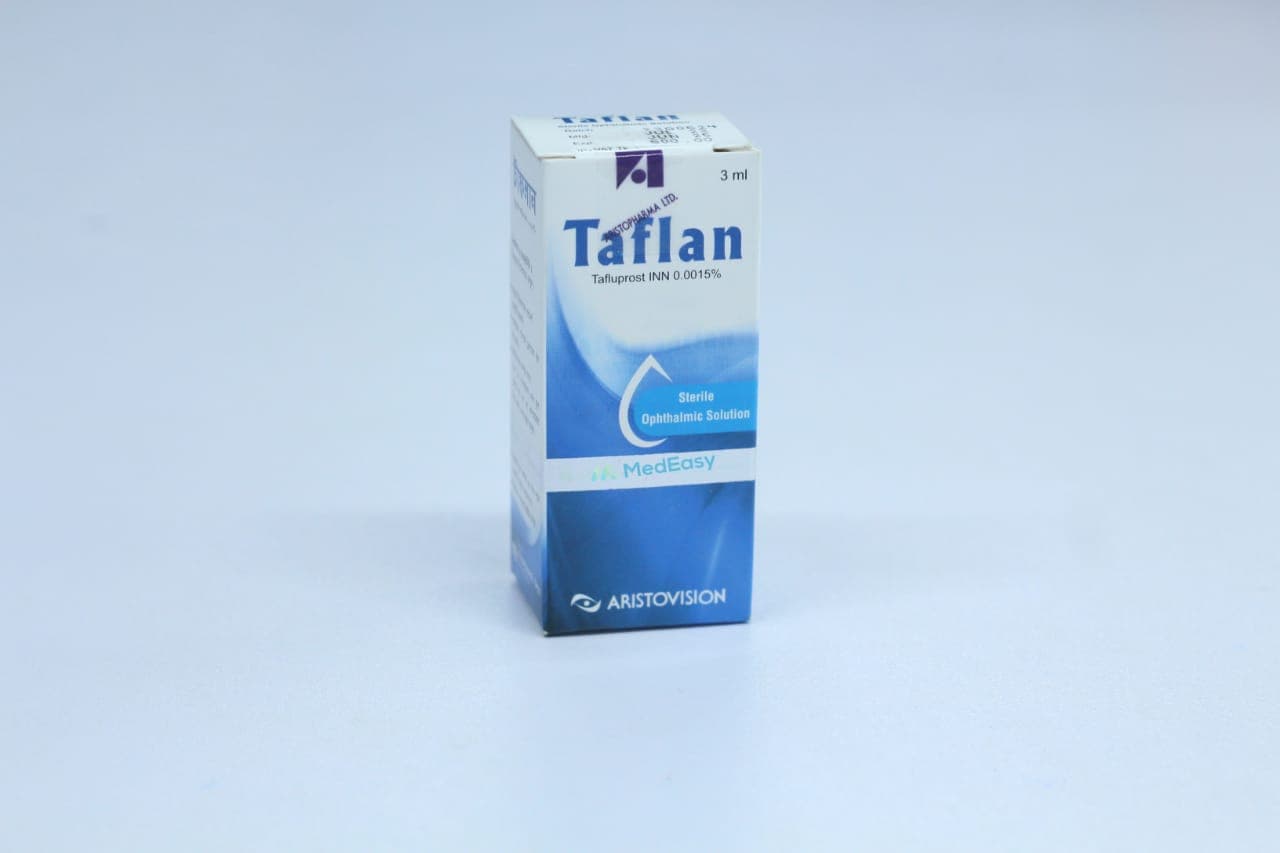

Medicine overview
Indications of Taflan
Taflan ophthalmic solution is indicated for the reduction of elevated intraocular pressure (IOP) in patients with:
- Open-angle glaucoma (established, FDA-approved use)
- Ocular hypertension (established, FDA-approved use)
Taflan may also be used as adjunctive therapy together with other IOP-lowering agents (e.g., beta-blockers, carbonic anhydrase inhibitors) when monotherapy does not achieve the target pressure; this combination use is guideline-supported rather than a separate distinct indication.
Composition
Each mL of Tafluprost ophthalmic solution contains 15 micrograms (0.0015%) of tafluprost as the active ingredient, formulated as a sterile isotonic ophthalmic solution for topical ocular use.
Description
Taflan is a synthetic prostaglandin F2-alpha analog administered topically into the eye to lower intraocular pressure. It is supplied as a sterile ophthalmic solution, commonly packaged in single-use containers to reduce the risk of contamination and preservative-related irritation. Taflan is used as long-term, chronic therapy in patients with elevated intraocular pressure due to open-angle glaucoma or ocular hypertension.
Therapeutic Class
Taflan belongs to the prostaglandin F2-alpha analog class of ophthalmic anti-glaucoma (ocular hypotensive) agents.
Pharmacology
Tafluprost is a prodrug that is hydrolyzed by corneal esterases to its biologically active free acid, tafluprost acid. This active metabolite is a selective agonist at the prostanoid FP receptor. Stimulation of FP receptors increases uveoscleral (and, to a lesser extent, trabecular) outflow of aqueous humor, thereby lowering intraocular pressure. The IOP-lowering effect of Tafluprost begins within a few hours of a single dose, with maximal effect typically seen around 12 hours after administration.
Dosage & Administration of Taflan
Adult Dose
| Indication | Dose |
|---|---|
| Open-angle glaucoma / Ocular hypertension | One drop of Taflan ophthalmic solution in the affected eye(s) once daily, in the evening |
Do not exceed once-daily dosing; more frequent administration of Taflan may reduce its IOP-lowering effect. If a dose is missed, continue with the next scheduled dose; do not double the dose.
Pediatric Dose
Safety and efficacy of Taflan in pediatric patients have not been established (see Use in Special Populations).
Renal/Hepatic Impairment
No dose adjustment of Taflan has been established as necessary in renal or hepatic impairment, since systemic absorption after topical ocular use is minimal.
Administration of Taflan
Instill one drop of Taflan into the conjunctival sac of the affected eye(s). If using a single-use container, discard it immediately after use; do not save it for later. When using more than one topical ophthalmic medicine, space administrations at least 5 minutes apart. Contact lenses should be removed before instilling Taflan and may be reinserted after the interval stated on the product labeling (commonly around 15 minutes), since some formulations contain a preservative that can be absorbed by soft contact lenses.
Interaction of Taflan
Systemic absorption of Taflan after ocular administration is minimal, and clinically significant systemic drug interactions have not been well established. Locally, concurrent use of ophthalmic products containing thimerosal with Taflan should be avoided, as precipitation can occur. When using multiple topical ophthalmic agents together with Taflan, space each administration at least 5 minutes apart to avoid washout or dilution.
Contraindications
Tafluprost is contraindicated in patients with known hypersensitivity to tafluprost or to any component of the formulation.
Side Effects of Taflan
- Ocular hyperemia (redness) - most common
- Eye pruritus (itching)
- Eye irritation and pain
- Growth, thickening, and darkening of eyelashes
- Increased brown pigmentation of the iris
- Periorbital and eyelid skin pigmentation changes
- Dry eye sensation
- Blurred vision
See Precautions and Warnings for details on the pigmentation changes, macular edema, and iris cyst risks associated with Taflan.
Pregnancy & Lactation
Taflan should be used during pregnancy only if clearly needed and the potential benefit justifies the potential risk to the fetus, since adequate, well-controlled studies of Taflan in pregnant women are lacking. It is not known whether Taflan or its metabolites are excreted in human milk; caution should be exercised, and a decision made whether to discontinue nursing or discontinue Taflan, taking into account the drug's importance to the mother. Consult a physician before using Taflan during pregnancy or breastfeeding.
Precautions & Warnings
Pigmentation Changes
Taflan can cause permanent changes to eye color by increasing brown pigmentation of the iris; this change may be more noticeable with asymmetric (one-eye) use and is generally permanent. Taflan can also gradually change eyelashes and periorbital tissue, including increased length, thickness, number, and pigmentation of eyelashes, and periorbital/eyelid skin pigmentation changes, which may be reversible after discontinuation. Patients should be counseled about these cosmetic effects before starting Taflan.
Macular Edema
Taflan should be used with caution in aphakic patients, pseudophakic patients with a torn posterior lens capsule, or patients with known risk factors for macular edema, since macular edema has been reported with prostaglandin analogs.
Iris Cysts
Rare cases of iris cyst formation have been reported with Taflan use.
Contact Lenses
Contact lenses should be removed before instilling Taflan and may be reinserted after the labeled waiting period, since some formulations contain a preservative that can be absorbed by soft lenses.
Skin Contact
Avoid letting Taflan solution contact the skin, as repeated contact may cause unwanted hair growth.
Dosing Frequency
Do not administer Taflan more than once daily; more frequent dosing may reduce its IOP-lowering effect.
Overdose Effects of Taflan
Overdose of Taflan by the topical ophthalmic route is unlikely to cause systemic toxicity, given minimal systemic absorption. If accidental ingestion, excessive ocular exposure, or any unusual symptoms occur after using Taflan, seek immediate medical attention or contact a poison control center. Do not attempt unsupervised home treatment for a suspected overdose.
Storage Conditions
Store unopened foil pouches of Taflan single-use containers in a refrigerator (2°C to 8°C). After opening the foil pouch, single-use containers of Taflan may be kept at room temperature (up to 30°C), protected from light, for the period stated on the product labeling (commonly up to 28 days); discard any remaining solution after that period. Discard each single-use container of Taflan immediately after use. Keep out of reach of children.
Use In Special Populations
Pediatric Use
Safety and efficacy of Taflan have not been established in pediatric patients.
Geriatric Use
No overall differences in safety or effectiveness of Taflan have been observed between elderly and younger adult patients.
Renal/Hepatic Impairment
Taflan has not been specifically studied in renal or hepatic impairment; no dose adjustment is anticipated because systemic absorption is minimal.
Duration Of Treatment
Taflan is typically used long-term (chronically) for as long as intraocular pressure control is needed, as directed by the treating ophthalmologist, with periodic monitoring of intraocular pressure and regular eye examinations.
Drug Classes
Tafluprost is classified as a prostaglandin F2-alpha analog, within the broader category of ophthalmic anti-glaucoma (ocular hypotensive) agents.
Mode Of Action
Tafluprost acid, the active metabolite of Tafluprost, selectively stimulates prostanoid FP receptors on the ciliary body, increasing uveoscleral outflow of aqueous humor and thereby reducing intraocular pressure.
Pregnancy
C
Pediatric Uses
Safety and efficacy of Taflan in pediatric patients below 18 years of age have not been established. Taflan should not be used in children unless specifically directed by a pediatric ophthalmologist.
Frequently Asked Questions
Q: What is Taflan 3 ml Solution used for?
A: Taflan 3 ml Solution is an eye drop used to lower elevated intraocular pressure (eye pressure) in people with open-angle glaucoma or ocular hypertension.
Q: How often should I use Taflan 3 ml Solution?
A: Taflan 3 ml Solution is used as one drop in the affected eye(s) once daily, usually in the evening. Using it more often than once a day may actually reduce how well it lowers eye pressure.
Q: Can Taflan 3 ml Solution change the color of my eyes?
A: Yes. Taflan 3 ml Solution can permanently increase the brown pigmentation of the iris, and this change may be more noticeable if only one eye is treated. It can also cause eyelash growth and pigmentation changes to the skin around the eyes, which may be reversible after stopping the medicine.
Q: Is Taflan 3 ml Solution safe during pregnancy?
A: Taflan 3 ml Solution should be used during pregnancy only if clearly needed, since adequate studies in pregnant women are lacking and potential benefit must be weighed against potential risk to the fetus. Always consult a physician before using Taflan 3 ml Solution if you are pregnant or breastfeeding.
Q: Can children use Taflan 3 ml Solution?
A: The safety and effectiveness of Taflan 3 ml Solution in children have not been established, so it should only be used in pediatric patients under specific direction from a physician.
Q: How should I store Taflan 3 ml Solution?
A: Unopened Taflan 3 ml Solution single-use containers should be kept refrigerated. Once the foil pouch is opened, containers can be kept at room temperature for a limited period stated on the label, and each single-use container should be discarded immediately after use.
Disclaimer
The information provided is accurate to the best of our knowledge, but it does not replace professional medical advice. We cannot guarantee its completeness or accuracy, and the absence of specific information about a drug should not be taken as an endorsement. We are not responsible for any consequences arising from this information, so please consult a healthcare professional for any concerns or questions.
