10% Off
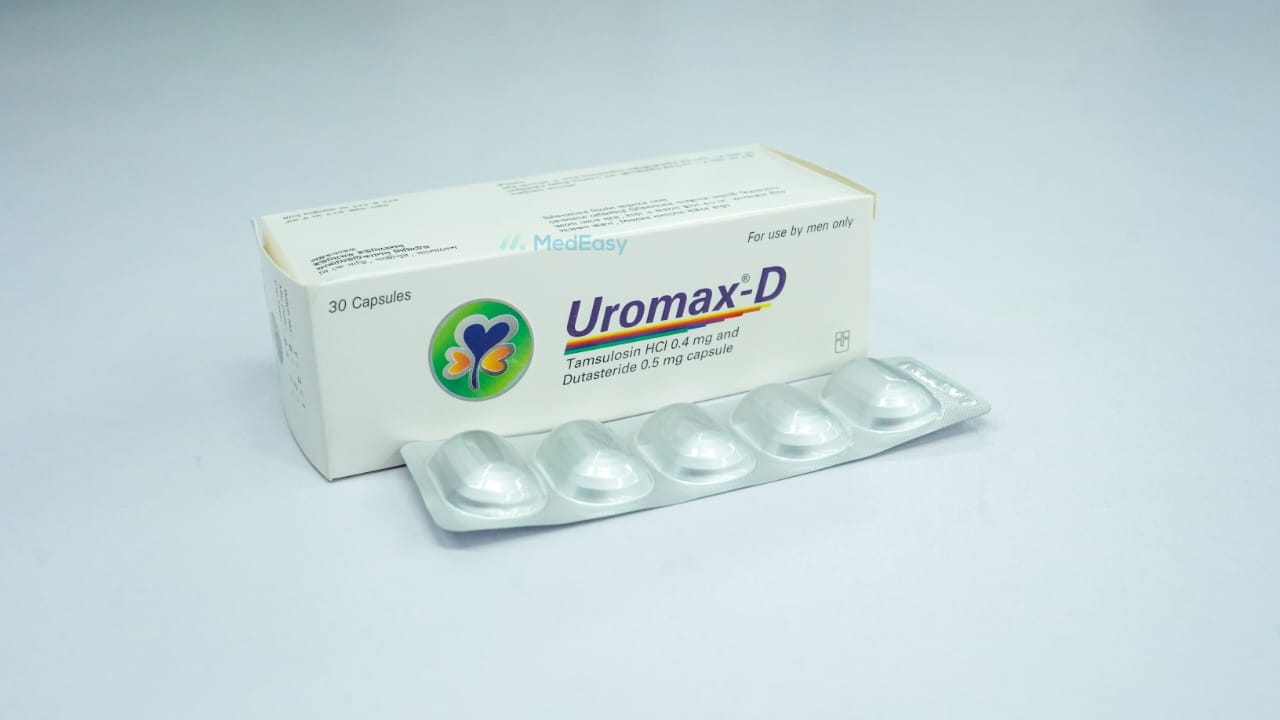
Uromax-D0.4 mg+0.5
Unimed Unihealth MFG. Ltd.
৳103.50
Add to cart

Tamisol D 0.4 mg+0.5 mg Capsule is available on MedEasy for ৳108.00 per 6's Strip, with home delivery anywhere in Bangladesh. It is manufactured by Healthcare Pharmaceuticals Ltd. Its generic name is Tamsulosin Hydrochloride + Dutasteride.

Tamisol D is a fixed-dose combination of an alpha-1 adrenergic receptor antagonist (tamsulosin) and a 5-alpha reductase inhibitor (dutasteride).
Tamisol D is not approved or indicated for the prevention of prostate cancer, and it is not indicated for use in women or children.
Each capsule of Tamsulosin Hydrochloride + Dutasteride typically contains Tamsulosin Hydrochloride 0.4 mg (as a modified/controlled-release component) and Dutasteride 0.5 mg as the two active ingredients, combined in a single hard-shell capsule for once-daily oral use.
Tamisol D is an oral combination product that brings together two complementary mechanisms for the medical management of benign prostatic hyperplasia (BPH): an alpha-1 blocker that relaxes smooth muscle in the prostate and bladder neck to improve urine flow, and a dual 5-alpha reductase inhibitor that shrinks the prostate gland over time by lowering dihydrotestosterone (DHT) levels.
Tamisol D is intended for long-term daily use in men with an enlarged prostate and is not a substitute for surgical or other treatment when those are clinically indicated.
Tamisol D belongs to the combined therapeutic class of Alpha-1 adrenergic receptor antagonists (alpha-blockers) and 5-alpha reductase inhibitors, used together for benign prostatic hyperplasia.
Tamsulosin Hydrochloride + Dutasteride combines two distinct mechanisms of action that act on different aspects of BPH pathophysiology.
Tamsulosin selectively blocks alpha-1A adrenergic receptors located in the smooth muscle of the prostate, prostatic capsule, and bladder neck. This relaxes smooth muscle tone and improves urinary flow relatively quickly, typically within days, but does not reduce prostate size.
Dutasteride inhibits both type 1 and type 2 isoenzymes of 5-alpha reductase, which are responsible for converting testosterone to dihydrotestosterone (DHT), the androgen primarily responsible for prostatic growth. By lowering serum and intraprostatic DHT levels, dutasteride reduces prostate volume over months, decreasing the long-term risk of acute urinary retention and the need for BPH-related surgery.
Used together, Tamsulosin Hydrochloride + Dutasteride provides both rapid symptomatic relief (via tamsulosin) and long-term disease modification (via dutasteride).
| Population | Dose | Frequency |
|---|---|---|
| Adult men with symptomatic BPH | One capsule (dutasteride 0.5 mg / tamsulosin HCl 0.4 mg) | Once daily, approximately 30 minutes after the same meal each day |
No dose adjustment is required in patients with renal impairment; Tamisol D has not been studied in patients with end-stage renal disease.
No dose adjustment is established for mild-to-moderate hepatic impairment; use in patients with severe hepatic impairment has not been studied and is not recommended (see Contraindications).
Tamisol D capsules should be swallowed whole with water and not chewed, crushed, or opened, since the capsule contents may irritate the mouth and throat. Take consistently after the same meal each day to maintain steady drug absorption.
Tamisol D has clinically significant interactions with the following, and no other agent should be substituted for Tamisol D as the object of these interaction warnings:
Tamsulosin Hydrochloride + Dutasteride is contraindicated in:
The most common adverse effects reported with Tamisol D relate to its sexual, hemodynamic, and endocrine effects:
Tamisol D is not indicated for use in women and is contraindicated in pregnancy. Dutasteride is absorbed through the skin and is known to inhibit development of external genitalia in a male fetus; even small amounts absorbed from semen or from handling leaking capsules pose a theoretical risk.
Because this is a well-established absolute contraindication, no risk-benefit exception applies — Tamisol D should never be prescribed to a woman who is pregnant or who may become pregnant.
The alpha-blocker component of Tamisol D has been associated with IFIS during cataract or glaucoma surgery. Patients should inform their ophthalmologist that they are taking or have previously taken Tamisol D before any eye surgery is planned; stopping Tamisol D in advance of surgery has not been shown to be beneficial.
Dutasteride reduces serum prostate-specific antigen (PSA) levels by approximately 50% after 6 months of therapy, even in the presence of prostate cancer. A new baseline PSA should be established after 3–6 months of Tamisol D therapy, and any confirmed rise from that new baseline while on treatment should be evaluated, even if the value appears normal for an untreated man.
5-alpha reductase inhibitors, including the dutasteride component of Tamisol D, have been associated with a slightly increased incidence of high-grade (Gleason score 8–10) prostate cancer in a large clinical trial. Patients should be evaluated for prostate cancer prior to starting therapy and periodically thereafter.
As with other alpha-blockers, syncope and orthostatic hypotension can occur, particularly after the first dose. Patients should avoid situations where injury could result from dizziness or fainting until they know how they respond to Tamisol D.
Tamisol D is intended solely for adult men with symptomatic BPH; see Contraindications and Pregnancy and Lactation.
Use with caution in mild-to-moderate hepatic impairment; not recommended in severe hepatic impairment (see Contraindications).
Dutasteride can reduce sperm count and semen volume; men who wish to father a child should discuss this with their physician before starting Tamisol D.
There is limited clinical experience with deliberate overdose of Tamisol D. Based on the individual components, overdose may present with hypotension (from the tamsulosin component), which can be marked. Dutasteride has been given in single doses far above the therapeutic dose without significant reported toxicity.
If overdose is suspected, seek immediate medical attention or contact a poison control center right away. Management should be supportive, with the patient kept supine, and cardiovascular support (such as intravenous fluids and, if needed, vasopressors) provided as clinically indicated. Because tamsulosin is highly protein-bound, dialysis is unlikely to be of significant benefit. There is no specific antidote for Tamisol D overdose.
Store at room temperature (below 30°C), away from light and moisture. Keep out of reach of children. Women who are pregnant or who may become pregnant should avoid handling leaking Tamisol D capsules.
Tamisol D has been extensively studied in older men with BPH; no overall differences in safety or effectiveness have been observed based on age in this population, and no dose adjustment is required.
No dose adjustment is required in patients with mild-to-severe renal impairment; Tamisol D has not been studied in patients requiring dialysis.
Use with caution in mild-to-moderate hepatic impairment. Tamisol D is not recommended in patients with severe hepatic impairment (see Contraindications).
Tamisol D is not indicated for use in children; safety and efficacy in pediatric patients have not been established.
Tamisol D is not indicated for use in women at any age (see Contraindications and Pregnancy and Lactation).
Tamisol D is intended for long-term, ongoing daily treatment of symptomatic BPH. Symptomatic improvement from the alpha-blocker component may be noticed within days to a few weeks, while the full benefit of the dutasteride component on prostate size and reduction of long-term risk (acute urinary retention, need for surgery) may take up to 6 months or longer to become apparent. Treatment duration should be guided by the prescribing physician based on ongoing symptom control and tolerability.
Tamsulosin Hydrochloride + Dutasteride is classified under Alpha-1 adrenergic receptor antagonists combined with 5-alpha reductase inhibitors — a combination drug class used specifically for BPH.
Tamsulosin Hydrochloride + Dutasteride works through two complementary mechanisms:
X
Tamisol D is not indicated for use in children or adolescents. Safety and efficacy of Tamisol D in pediatric patients have not been established, and BPH is a condition of adult men, so there is no approved pediatric dosing for Tamisol D.
Q: What is Tamisol D 0.4 mg+0.5 mg Capsule used for?
A: Tamisol D 0.4 mg+0.5 mg Capsule is used to treat the symptoms of benign prostatic hyperplasia (BPH), an enlarged prostate, in adult men — including weak urine stream, frequent or urgent urination, and nighttime urination — and to reduce the long-term risk of acute urinary retention and the need for BPH-related surgery.
Q: How should I take Tamisol D 0.4 mg+0.5 mg Capsule?
A: Take one capsule of Tamisol D 0.4 mg+0.5 mg Capsule by mouth once daily, about 30 minutes after the same meal each day. Swallow the capsule whole — do not chew, crush, or open it, as the contents can irritate the mouth and throat.
Q: Can women take Tamisol D 0.4 mg+0.5 mg Capsule?
A: No. Tamisol D 0.4 mg+0.5 mg Capsule is not indicated for use in women and is contraindicated in pregnancy, because the dutasteride component can cause abnormalities in the genitals of a male fetus. Women who are pregnant or may become pregnant should not handle Tamisol D 0.4 mg+0.5 mg Capsule capsules, particularly if they are leaking.
Q: Will Tamisol D 0.4 mg+0.5 mg Capsule affect my PSA test?
A: Yes. Tamisol D 0.4 mg+0.5 mg Capsule lowers PSA levels by about half after several months of use. Tell your doctor that you are taking Tamisol D 0.4 mg+0.5 mg Capsule before any PSA test, so the result can be interpreted correctly, and continue routine prostate cancer screening as advised.
Q: What are the common side effects of Tamisol D 0.4 mg+0.5 mg Capsule?
A: The most common side effects are related to sexual function, including retrograde or reduced ejaculation, erectile dysfunction, and decreased libido, as well as dizziness and, less commonly, breast tenderness or enlargement.
Q: Do I need to tell my eye surgeon that I am taking Tamisol D 0.4 mg+0.5 mg Capsule?
A: Yes. If you are having cataract or other eye surgery, tell your ophthalmologist that you take or have taken Tamisol D 0.4 mg+0.5 mg Capsule, because it can cause a condition called intraoperative floppy iris syndrome (IFIS) that affects surgical planning.
Disclaimer
The information provided is accurate to the best of our knowledge, but it does not replace professional medical advice. We cannot guarantee its completeness or accuracy, and the absence of specific information about a drug should not be taken as an endorsement. We are not responsible for any consequences arising from this information, so please consult a healthcare professional for any concerns or questions.