

8% Off
Tamona20 mg
Beximco Pharmaceuticals Ltd.
৳147.84
Add to cart
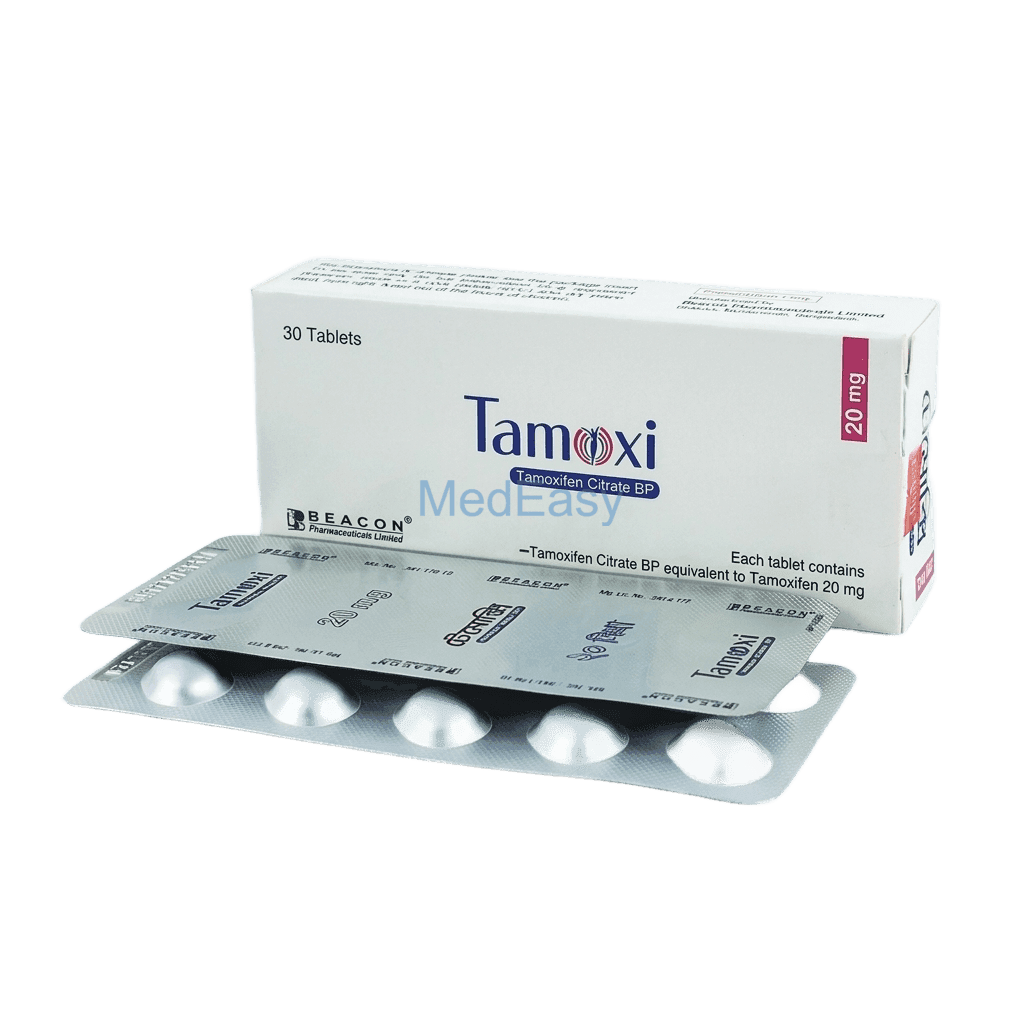

Tamoxi is a nonsteroidal selective estrogen receptor modulator (SERM) indicated in the following settings:
The balance of benefit and serious risk (see Precautions and Warnings) differs substantially between treatment of existing cancer and use for risk reduction in otherwise healthy women, and this should be discussed individually with a physician.
Each tablet contains Tamoxifen Citrate equivalent to a stated amount of tamoxifen base, commonly available in strengths such as 10 mg and 20 mg. Tablets also contain standard pharmaceutical excipients (e.g., lactose, microcrystalline cellulose, starch, magnesium stearate). Exact strengths and excipients vary by manufacturer; refer to the specific marketed product label for the formulation of Tamoxifen Citrate being dispensed.
Tamoxi is the citrate salt of tamoxifen, a nonsteroidal selective estrogen receptor modulator (SERM) used primarily in the management of hormone receptor-positive breast cancer. It acts as an estrogen antagonist in breast tissue while exhibiting partial estrogen-agonist activity in other tissues such as the endometrium and bone, which underlies both its therapeutic benefit and some of its serious risks.
Tamoxi is administered orally as tablets and is used under oncology or gynecologic-oncology supervision for treatment of existing breast cancer, prevention of a second breast cancer, or reduction of breast cancer risk in high-risk women, always with individualized assessment of risks such as uterine cancer and thromboembolic disease.
Tamoxi belongs to the class of Selective Estrogen Receptor Modulators (SERMs), also broadly classified as an antineoplastic hormonal / antiestrogen agent used in oncology and gynecologic practice.
Tamoxifen Citrate competitively binds to estrogen receptors on tumor and other target tissues, forming a nuclear complex that decreases DNA synthesis and inhibits estrogen-mediated cellular effects. Its action is tissue-selective: it behaves as an estrogen-receptor antagonist in breast tissue (reducing growth stimulation of hormone receptor-positive breast cancer cells) but as a partial agonist in the endometrium and bone, which explains its beneficial effect on bone density but also its association with endometrial proliferation and cancer risk.
Tamoxifen Citrate is extensively metabolized in the liver, primarily via CYP3A4 and CYP2D6, to several active metabolites, including 4-hydroxytamoxifen and endoxifen, which have substantially greater affinity for the estrogen receptor than the parent compound and are thought to contribute significantly to overall clinical efficacy. This means drugs that inhibit CYP2D6 can meaningfully reduce the formation of active metabolite and potentially reduce effectiveness (see Drug Interactions).
Tamoxi is taken orally, with or without food, generally once or twice daily depending on total dose. Tablets should be swallowed whole and taken at approximately the same time(s) each day. Treatment duration and total dose depend on the specific indication (see table below) and should be individualized by the prescribing physician.
| Indication | Typical adult dose | Typical duration |
|---|---|---|
| Adjuvant treatment, breast cancer (women and men) | 20 mg once daily (doses above 20 mg/day are usually given in divided doses, morning and evening) | Commonly 5 years; extended therapy up to 10 years may be considered in selected patients based on specialist assessment |
| Metastatic breast cancer | 20 mg once daily, up to 40 mg/day in divided doses in some regimens | Until disease progression or unacceptable toxicity, per oncologist |
| Reduction of contralateral breast cancer risk / DCIS | 20 mg once daily | Typically 5 years |
| Breast cancer risk reduction in high-risk women | 20 mg once daily | Typically 5 years |
Missed dose: if a dose of Tamoxi is missed, it should be taken as soon as remembered unless it is nearly time for the next dose, in which case the missed dose should be skipped; doses should not be doubled. Patients should not stop Tamoxi without discussing with their physician, as premature discontinuation can affect cancer treatment outcomes.
Tamoxi tablets are administered orally, with or without food, swallowed whole with a glass of water. Doses given more than once daily should be spaced evenly (e.g., morning and evening). Tamoxi should be taken exactly as prescribed and not stopped or altered without consulting the prescribing physician, given its role in long-term cancer treatment or risk reduction.
Tamoxi has several clinically significant drug interactions:
Patients should inform their physician of all prescription and over-the-counter medicines, including antidepressants, taken alongside Tamoxi.
Tamoxifen Citrate is contraindicated in:
Tamoxifen Citrate should be used with caution and only after careful individual risk-benefit assessment in women being treated for active breast cancer who have other risk factors for the above conditions; this differs from the absolute contraindications applicable to the risk-reduction/DCIS indications above.
Serious risks (boxed-warning level) associated with Tamoxi include:
These serious risks must be weighed individually against the benefit of Tamoxi, which differs between women being treated for existing breast cancer and healthy high-risk women taking it for prevention.
Patients should seek urgent medical attention for leg swelling/pain, sudden breathlessness, chest pain, sudden vision changes, one-sided weakness, or abnormal vaginal bleeding while on Tamoxi.
Tamoxi is contraindicated during pregnancy because of the potential for fetal harm based on its mechanism of action and animal reproduction data. Women of childbearing potential should use effective, reliable non-hormonal contraception during treatment with Tamoxi and for a period after stopping treatment, as advised by their physician, because Tamoxi can also affect ovulation and may itself have hormonal effects on a developing fetus. Any suspected pregnancy during treatment should be reported to the prescribing physician immediately.
Tamoxi is generally advised to be avoided during breastfeeding, as it is unknown whether it is expressed in significant amounts in human milk and animal data raise concern for adverse effects in a nursing infant; a physician should be consulted to weigh alternatives before breastfeeding while on Tamoxi.
Tamoxi carries serious, well-established risks that require careful discussion between physician and patient before and during treatment (see Side Effects for full detail on uterine cancer, stroke, and blood clot risk). Key precautions include:
Tamoxi should be taken exactly as prescribed by the physician; treatment should not be stopped, doses skipped, or the medicine shared with others without medical advice, since abrupt discontinuation may affect cancer treatment outcomes.
There is limited clinical experience with acute overdose of Tamoxi. Reported effects in overdose have generally been an extension of known pharmacological actions. Any suspected overdose of Tamoxi should be treated as a medical emergency — seek immediate medical attention, contact a poison control center, or go to the nearest emergency department. Do not attempt to manage a suspected overdose at home; treatment is supportive and should be directed by medical professionals.
Store at room temperature (below 30°C), protected from light and moisture. Keep out of reach of children.
Tamoxi is contraindicated in pregnancy; effective non-hormonal contraception is required during treatment (see Pregnancy and Lactation).
Tamoxi should generally be avoided during breastfeeding; consult a physician regarding alternatives (see Pregnancy and Lactation).
Safety and efficacy of Tamoxi have not been established in children, as breast cancer is not a pediatric disease; use in pediatric patients is limited to rare specialist-directed off-label settings and is not routinely recommended.
Tamoxi has been widely used in older women with breast cancer; no specific dose adjustment based on age alone is required, but elderly patients may be at higher baseline risk of stroke and thromboembolic events, so individual risk-benefit assessment is advised.
Use with caution, as Tamoxi is extensively metabolized by the liver; no formal validated dose-adjustment schedule exists, so clinical monitoring is advised.
No well-established dose adjustment is required for renal impairment, though clinical judgment should be used in patients with significant renal disease.
Duration of Tamoxi therapy is indication-specific and determined by the treating physician. For adjuvant breast cancer treatment, a course of 5 years is standard, with extension to 10 years considered in selected patients based on individual recurrence risk and tolerance, per current oncology guidance. For breast cancer risk reduction and DCIS, a 5-year course is typical. For metastatic disease, Tamoxi is generally continued until disease progression or unacceptable toxicity. Patients should not stop Tamoxi early without medical advice, as this can affect treatment outcomes.
Tamoxifen Citrate is classified as a Selective Estrogen Receptor Modulator (SERM), within the broader category of hormonal antineoplastic / antiestrogen agents used in oncology.
Tamoxifen Citrate exerts a tissue-selective effect on estrogen receptors: it competitively blocks estrogen from binding to its receptor in breast tissue, forming a receptor complex with reduced transcriptional activity that slows growth of hormone receptor-positive breast cancer cells, while acting as a partial estrogen-receptor agonist in the endometrium and bone. Its active metabolites, particularly endoxifen, have substantially higher receptor affinity than the parent compound and are largely responsible for its clinical antiestrogenic effect in breast tissue.
D
Tamoxi is not indicated for use in children, as the conditions it treats (hormone receptor-positive breast cancer, breast cancer risk reduction) are essentially adult diseases. Safety and efficacy of Tamoxi in pediatric patients have not been established, and its use in pediatric patients should be restricted to rare, specialist-directed circumstances outside its standard labeling, with careful discussion of risks and benefits with a pediatric specialist.
Q: What is Tamoxi 20 mg Tablet used for?
A: Tamoxi 20 mg Tablet is a selective estrogen receptor modulator (SERM) used to treat hormone receptor-positive breast cancer (in both women and men), to reduce the risk of a new cancer in the opposite breast, to reduce the risk of invasive breast cancer in women with ductal carcinoma in situ (DCIS), and to reduce breast cancer risk in women who are at high risk based on family history and other factors. It is sometimes used off-label for ovulation induction under specialist supervision.
Q: What are the most serious risks of Tamoxi 20 mg Tablet?
A: Tamoxi 20 mg Tablet carries well-established, serious risks that must be discussed with a physician before starting treatment: an increased risk of uterine cancer (endometrial cancer and uterine sarcoma), an increased risk of stroke, and an increased risk of blood clots such as pulmonary embolism and deep vein thrombosis. Patients should promptly report abnormal vaginal bleeding, leg swelling or pain, sudden breathlessness, chest pain, or sudden weakness/vision changes while taking Tamoxi 20 mg Tablet.
Q: Can I take Tamoxi 20 mg Tablet during pregnancy or while breastfeeding?
A: No. Tamoxi 20 mg Tablet is contraindicated during pregnancy because it can cause fetal harm, and effective non-hormonal contraception is required during treatment and for a period afterward, as advised by your physician. Tamoxi 20 mg Tablet should generally be avoided while breastfeeding; discuss feeding options with your doctor before starting or continuing treatment.
Q: Can Tamoxi 20 mg Tablet be taken together with warfarin or antidepressants?
A: Tamoxi 20 mg Tablet can interact significantly with warfarin (and similar anticoagulants), increasing bleeding risk; this combination is contraindicated in women taking Tamoxi 20 mg Tablet for breast cancer risk reduction or DCIS, and requires close monitoring in women being treated for active breast cancer. Certain antidepressants (such as paroxetine and fluoxetine) can reduce the conversion of Tamoxi 20 mg Tablet to its active form and potentially reduce its effectiveness, so your doctor may recommend an alternative antidepressant if one is needed alongside Tamoxi 20 mg Tablet.
Q: How long is Tamoxi 20 mg Tablet usually taken for?
A: Duration depends on the reason for treatment. For adjuvant treatment of breast cancer, Tamoxi 20 mg Tablet is commonly taken for 5 years, and sometimes extended up to 10 years in selected patients based on specialist assessment. For breast cancer risk reduction or DCIS, a 5-year course is typical. For metastatic breast cancer, Tamoxi 20 mg Tablet is usually continued until the disease progresses or side effects become unacceptable. Always follow your physician's specific instructions and do not stop early without medical advice.
Q: What should I do if I miss a dose or suspect an overdose of Tamoxi 20 mg Tablet?
A: If you miss a dose of Tamoxi 20 mg Tablet, take it as soon as you remember unless it is almost time for your next dose, in which case skip the missed dose — do not double up. If you suspect an overdose of Tamoxi 20 mg Tablet, treat it as a medical emergency: seek immediate medical attention or contact a poison control center right away rather than trying to manage it at home.
Disclaimer
The information provided is accurate to the best of our knowledge, but it does not replace professional medical advice. We cannot guarantee its completeness or accuracy, and the absence of specific information about a drug should not be taken as an endorsement. We are not responsible for any consequences arising from this information, so please consult a healthcare professional for any concerns or questions.
