
10% Off
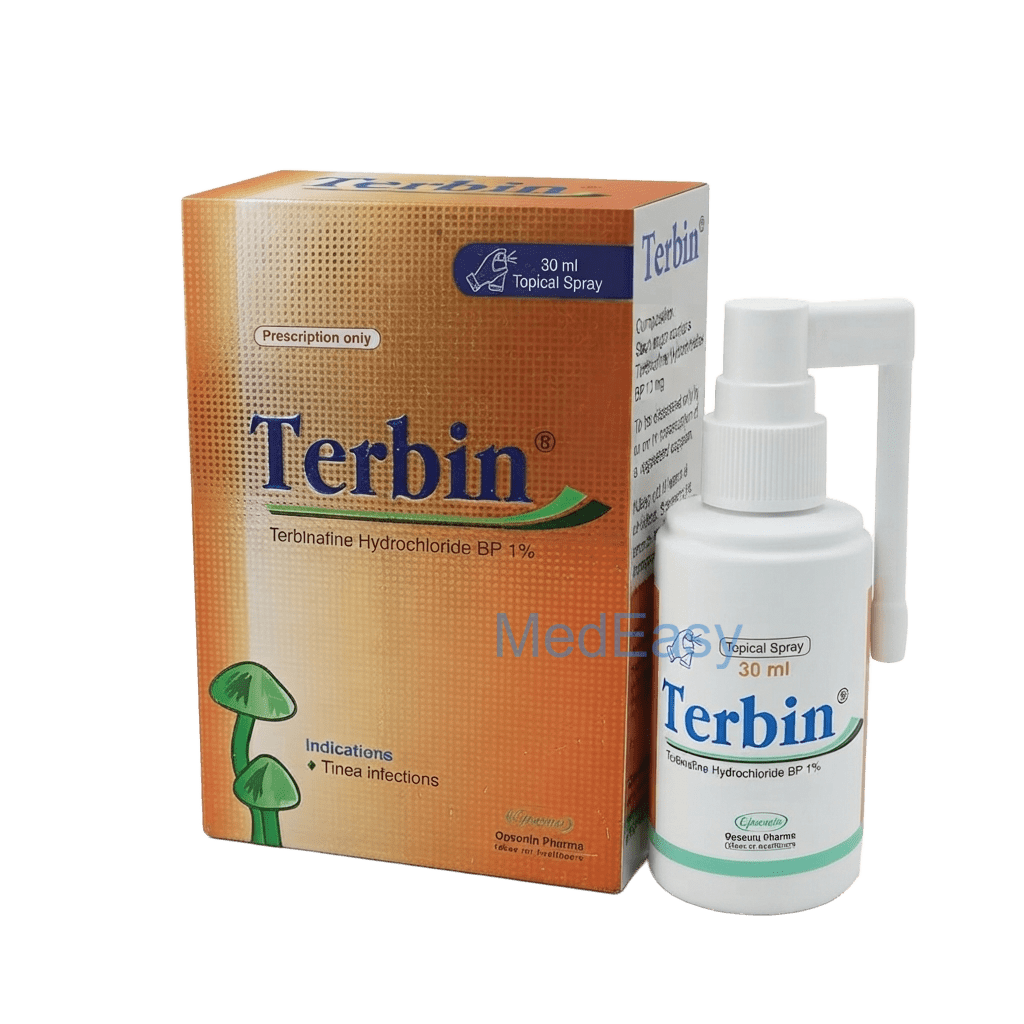
Terbin30 ml
Opsonin Pharma Ltd.
৳540.00
Add to cart


Telfin 1% 250 mg oral tablets are indicated for the treatment of onychomycosis (fungal infection) of the toenail or fingernail caused by dermatophytes (tinea unguium). This is an established, regulatory-approved indication. Appropriate nail specimens should be tested to confirm the fungal diagnosis before Telfin 1% is started, since oral therapy is reserved for confirmed dermatophyte nail infections.
Telfin 1% 1% topical cream, gel, and spray are indicated for the treatment of tinea pedis (athlete's foot), tinea cruris (jock itch), and tinea corporis (ringworm) caused by susceptible dermatophytes. This is an established indication supported by the regulatory labeling of topical Telfin 1% products.
Topical Telfin 1% 1% cream/gel is also used for cutaneous candidiasis and pityriasis versicolor (tinea versicolor), per product labeling of Telfin 1% marketed in Bangladesh. This use is guideline-supported for these specific yeast infections; the exact regimen and expected response can differ from dermatophyte skin infections, so it should be confirmed by a qualified healthcare professional.
Each formulation contains the active ingredient Terbinafine Hydrochloride as follows:
Telfin 1% is an antifungal medicine that belongs to the allylamine class and is used to treat fungal infections of the nails and skin. In Bangladesh, Telfin 1% is available as a 250 mg oral tablet for fungal nail infections (onychomycosis) and as a 1% topical cream, gel, or spray for common skin fungal infections such as athlete's foot, jock itch, and ringworm. Telfin 1% works by stopping fungi from building an essential component of their cell membrane, which leads to fungal cell death. The oral tablet is absorbed into the bloodstream and requires medical supervision because of rare but serious effects on the liver, while the topical forms of Telfin 1% act mainly on the skin surface with only minimal absorption into the body. Because the correct formulation, dose, and treatment duration depend on the type and severity of infection, Telfin 1% should always be used under the guidance of a qualified healthcare professional.
Antifungal (Allylamine)
Terbinafine Hydrochloride is a synthetic allylamine antifungal. It acts by inhibiting the fungal enzyme squalene epoxidase, blocking an early step in ergosterol biosynthesis. This causes squalene to accumulate within the fungal cell and results in fungal cell death, so Terbinafine Hydrochloride is considered fungicidal against common dermatophytes such as Trichophyton species, depending on concentration and organism.
After oral dosing, Terbinafine Hydrochloride is well absorbed (over 70%) but undergoes significant first-pass hepatic metabolism, giving an absolute bioavailability of about 40%. It is more than 99% bound to plasma proteins, is extensively metabolized by multiple CYP450 enzymes (with a notable inhibitory effect on CYP2D6), and is eliminated mainly in the urine; its effective half-life is roughly 36 hours at steady state, with a much longer terminal half-life reflecting slow release from fat and skin tissue. Terbinafine Hydrochloride concentrates in skin, hair, and nails, which supports its efficacy in cutaneous and nail infections.
When Terbinafine Hydrochloride is applied topically as a cream, gel, or spray, systemic absorption through intact skin is minimal, so the drug acts predominantly at the site of application with limited exposure to the rest of the body compared with the oral tablet.
The dose, frequency, and length of treatment with Telfin 1% differ substantially between the oral 250 mg tablet and the topical 1% cream, gel, or spray, and also vary depending on which fungal infection is being treated. The regimens described below are general reference points; the specific dosing schedule for Telfin 1% in any individual patient must always be determined by a qualified healthcare professional.
Oral Tablet: Headache, diarrhea, rash, indigestion (dyspepsia), nausea, abdominal pain, flatulence, itching (pruritus), taste disturbance, and mild liver enzyme elevations are the most commonly reported effects of oral Telfin 1%.
Topical Cream/Gel/Spray: Application-site irritation, burning, stinging, itching, redness, and dryness of the skin are the most commonly reported effects of topical Telfin 1%.
Oral Tablet: Available data on oral Telfin 1% use in pregnant women are insufficient to establish whether it carries a drug-associated risk. Because onychomycosis is not a medically urgent condition, it is generally recommended that oral Telfin 1% not be started during pregnancy; treatment can usually be postponed until after delivery.
Topical Cream/Gel/Spray: Systemic absorption of topical Telfin 1% is minimal, but data specific to pregnancy are limited. Topical Telfin 1% should be avoided during pregnancy unless a healthcare professional judges the benefit to outweigh the potential risk.
Oral Tablet: Telfin 1% passes into human breast milk after oral dosing. Data on effects in the breastfed infant are lacking, so oral Telfin 1% is generally not recommended while breastfeeding; a healthcare professional should weigh the benefits of breastfeeding against the potential risk.
Topical Cream/Gel/Spray: Telfin 1% is also excreted into breast milk with topical use, and product labeling advises against use during breastfeeding; if a healthcare professional determines topical Telfin 1% is necessary, application to the breast/chest area should be avoided.
Reported experience with oral Telfin 1% overdose is limited. Doses of up to 5 grams (about 20 times the usual daily therapeutic dose) have been taken without causing serious adverse reactions; reported symptoms after overdose have included nausea, vomiting, abdominal pain, dizziness, rash, frequent urination, and headache. Specific toxic-dose thresholds beyond this have not been established.
If an overdose of Telfin 1% is suspected, do not induce vomiting unless specifically directed to do so by a doctor or poison control service. Contact emergency medical services or a poison control center immediately, and take the Telfin 1% package or container along for reference. Accidental ingestion of topical Telfin 1% products should also be treated as a medical emergency requiring prompt professional advice.
Oral Tablet: Store Telfin 1% tablets below 25°C, in a tightly closed container, protected from light.
Topical Cream/Gel/Spray: Store Telfin 1% topical products at controlled room temperature, generally 20–25°C.
For any Telfin 1% product, always keep out of reach of children and confirm storage instructions on the specific product's label, as conditions can vary slightly by manufacturer.
Oral Tablet: The safety and effectiveness of oral Telfin 1% have not been established in children for onychomycosis; oral Telfin 1% tablets are generally not used in pediatric patients for this indication without specific medical justification.
Topical Cream/Gel/Spray: Topical Telfin 1% is used in adults and children 12 years of age and older per product labeling; use in children under 12 years should only occur under the direction of a healthcare professional.
Clinical experience with Telfin 1% in patients 65 years and older is limited. No clinically important age-related change in blood levels has been identified, but because elderly patients more often have reduced liver, kidney, or heart function, oral Telfin 1% should be used cautiously, generally starting at the lower end of the dosing range and with attention to concurrent illnesses and medications.
Oral Telfin 1% has not been adequately studied in patients with creatinine clearance of 50 mL/min or less; clearance of Telfin 1% is reduced by roughly half in this population, so oral Telfin 1% should be used with caution and under close medical supervision in significant renal impairment. Topical Telfin 1% has minimal systemic absorption and is not generally restricted on renal grounds, but should still be used as directed by a healthcare professional.
Oral Telfin 1% is contraindicated in patients with chronic or active liver disease; clearance of Telfin 1% is reduced by roughly half in patients with cirrhosis. See the Hepatotoxicity entry under Precautions and Warnings for full detail. Topical Telfin 1% is not systemically restricted in liver disease because of its minimal absorption, but patients with significant liver disease should still discuss any use of Telfin 1%, including topical forms, with their doctor.
Oral Tablet: Fingernail onychomycosis is typically treated with Telfin 1% for 6 weeks; toenail onychomycosis is typically treated for 12 weeks. Visible improvement of the nail continues for several months after the course of Telfin 1% ends, as it takes time for healthy nail to grow out.
Topical Cream/Gel: Tinea pedis between the toes is typically treated with Telfin 1% for 1 week, and tinea pedis on the soles/sides of the foot for 2 weeks; tinea cruris and tinea corporis are typically treated for 1–2 weeks; cutaneous candidiasis and pityriasis versicolor are typically treated for 2 weeks.
Topical Spray: Tinea pedis, tinea cruris, and tinea corporis are typically treated with Telfin 1% spray for 1 week; pityriasis versicolor is typically treated for 1 week with twice-daily application.
Actual duration of Telfin 1% therapy should always be confirmed by the prescribing healthcare professional, as it can vary with infection severity and response to treatment.
Allylamine antifungal
Terbinafine Hydrochloride inhibits the fungal enzyme squalene epoxidase, an early and rate-limiting step in the biosynthesis of ergosterol, an essential component of the fungal cell membrane. This inhibition leads to a deficiency of ergosterol and an accumulation of squalene inside the fungal cell, which increases membrane permeability and results in fungal cell death.
Oral Tablet: Safety and efficacy of oral Telfin 1% have not been established in children for the treatment of onychomycosis; oral Telfin 1% is generally reserved for adults for this indication.
Topical Cream/Gel/Spray: Topical Telfin 1% is labeled for use in adults and children 12 years of age and older for tinea pedis, tinea cruris, and tinea corporis. Use of topical Telfin 1% in children younger than 12 years should be guided by a healthcare professional.
Q: What is Telfin 1% 30 ml Topical Spray used for?
A: Telfin 1% 30 ml Topical Spray is an antifungal medicine used to treat fungal infections of the nails and skin. The 250 mg oral tablet form of Telfin 1% 30 ml Topical Spray treats fungal nail infections (onychomycosis), while the 1% cream, gel, and spray forms of Telfin 1% 30 ml Topical Spray treat fungal skin infections such as athlete's foot (tinea pedis), jock itch (tinea cruris), ringworm (tinea corporis), cutaneous candidiasis, and pityriasis versicolor.
Q: How long does Telfin 1% 30 ml Topical Spray treatment usually take?
A: With the oral tablet, Telfin 1% 30 ml Topical Spray is usually taken once daily for 6 weeks for fingernail infections and 12 weeks for toenail infections. With the topical cream, gel, or spray, Telfin 1% 30 ml Topical Spray is usually applied for 1 to 2 weeks depending on the specific skin infection being treated. A healthcare professional will confirm the exact duration for each patient.
Q: Can I stop Telfin 1% 30 ml Topical Spray once my symptoms improve?
A: No. Telfin 1% 30 ml Topical Spray should be used for the full course recommended by the prescriber, even if symptoms improve earlier, because stopping Telfin 1% 30 ml Topical Spray too soon can allow the fungal infection to return.
Q: Does Telfin 1% 30 ml Topical Spray interact with other medicines?
A: Yes, particularly the oral tablet. Oral Telfin 1% 30 ml Topical Spray inhibits the CYP2D6 liver enzyme and can raise blood levels of drugs such as certain antidepressants and beta-blockers that are broken down by this enzyme. Rifampin lowers Telfin 1% 30 ml Topical Spray levels, while cimetidine raises them. Always tell your doctor or pharmacist about all medicines you take before starting Telfin 1% 30 ml Topical Spray.
Q: Is Telfin 1% 30 ml Topical Spray safe during pregnancy?
A: Telfin 1% 30 ml Topical Spray is generally not recommended during pregnancy. Because fungal nail infections are not urgent, oral Telfin 1% 30 ml Topical Spray is usually postponed until after pregnancy. Topical Telfin 1% 30 ml Topical Spray should also be avoided in pregnancy unless a healthcare professional decides the benefit outweighs the risk.
Q: Can children use Telfin 1% 30 ml Topical Spray?
A: The oral tablet form of Telfin 1% 30 ml Topical Spray has not been established as safe and effective for children with fungal nail infections. The topical cream, gel, and spray forms of Telfin 1% 30 ml Topical Spray may be used in children 12 years and older for common fungal skin infections; use under 12 years should be directed by a healthcare professional.
Q: What are the most serious side effects of Telfin 1% 30 ml Topical Spray?
A: The oral tablet form of Telfin 1% 30 ml Topical Spray carries a rare but serious risk of liver injury, which is why liver function is checked before and during treatment. Oral Telfin 1% 30 ml Topical Spray can also cause severe or long-lasting taste or smell disturbance, low blood cell counts, and rare serious skin reactions. Anyone taking Telfin 1% 30 ml Topical Spray who develops signs of liver problems, severe rash, or unusual bruising/bleeding should seek medical attention immediately.
Q: Does Telfin 1% 30 ml Topical Spray cause taste changes?
A: Yes. Oral Telfin 1% 30 ml Topical Spray is recognized to cause taste disturbance that can be severe and, in some cases, prolonged or even permanent; disturbance or loss of smell can also occur. This should be reported to a doctor promptly if it happens while taking oral Telfin 1% 30 ml Topical Spray.
Q: How should I apply topical Telfin 1% 30 ml Topical Spray?
A: Clean and dry the affected skin, then apply a thin layer of Telfin 1% 30 ml Topical Spray cream or gel (or spray evenly) to cover the infected area and a small margin of surrounding skin, as directed on the product label or by a healthcare professional. Wash your hands after applying Telfin 1% 30 ml Topical Spray, and avoid contact with the eyes and mucous membranes.
Disclaimer
The information provided is accurate to the best of our knowledge, but it does not replace professional medical advice. We cannot guarantee its completeness or accuracy, and the absence of specific information about a drug should not be taken as an endorsement. We are not responsible for any consequences arising from this information, so please consult a healthcare professional for any concerns or questions.
