10% Off
Arbitel Plus40 mg+12.5
ACI Limited
৳112.50
Add to cart
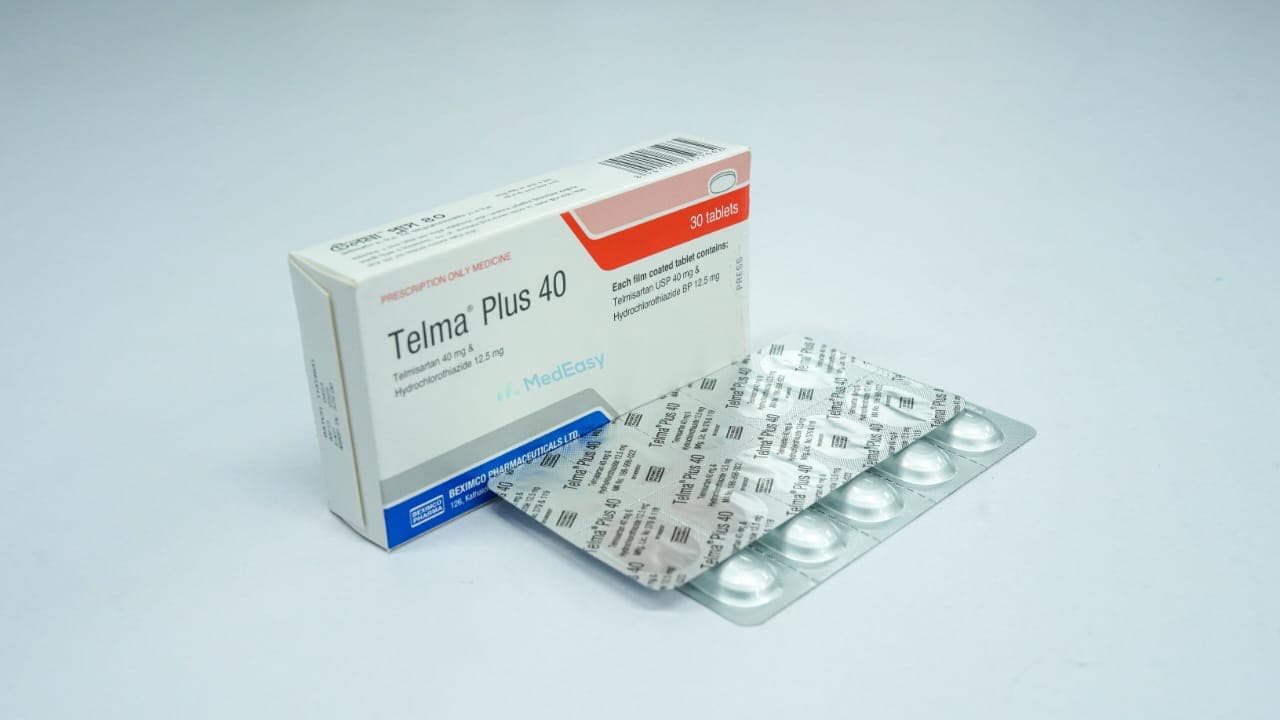

Telma Plus is a fixed-dose combination of telmisartan, an angiotensin II receptor blocker (ARB), and hydrochlorothiazide, a thiazide diuretic, indicated for:
Telma Plus is not indicated for initial (first-line) therapy of hypertension. It is intended for patients who have not achieved adequate blood pressure control on monotherapy with telmisartan or hydrochlorothiazide, or as a convenient replacement for patients already controlled on the individual components given separately.
Each tablet of Telmisartan + Hydrochlorothiazide contains two active ingredients:
Common fixed-dose strength combinations (telmisartan/hydrochlorothiazide) include 40 mg/12.5 mg, 80 mg/12.5 mg, and 80 mg/25 mg tablets. Available strengths may vary by market and manufacturer.
Telma Plus is an oral fixed-dose combination antihypertensive tablet that pairs two complementary blood-pressure-lowering mechanisms in a single dosage form. It combines telmisartan, a selective angiotensin II receptor (AT1) blocker, with hydrochlorothiazide, a thiazide-type diuretic that promotes sodium and water excretion.
Telma Plus is used for the management of hypertension in patients not adequately controlled on either agent alone, allowing many patients to achieve blood pressure targets with a single tablet instead of two separate medicines, which can improve treatment adherence.
Telma Plus belongs to the therapeutic class of antihypertensive combination agents, specifically a fixed-dose combination of an angiotensin II receptor blocker (ARB) and a thiazide diuretic.
Telmisartan + Hydrochlorothiazide lowers blood pressure through two distinct and complementary mechanisms:
Together, the two components produce an additive antihypertensive effect. Telmisartan reaches peak plasma concentrations within 0.5–1 hour and has an elimination half-life of about 24 hours, supporting once-daily dosing; it is eliminated mainly by biliary excretion of unchanged drug, with minimal renal excretion. Hydrochlorothiazide is absorbed rapidly and eliminated largely unchanged by the kidneys, with a half-life of 6–15 hours.
| Clinical Scenario | Recommended Dose |
|---|---|
| Usual starting dose (not adequately controlled on monotherapy) | 80 mg telmisartan/12.5 mg hydrochlorothiazide once daily |
| Dose titration (after 2–4 weeks if blood pressure not controlled) | May increase to 160 mg/25 mg once daily |
| Maximum dose | 160 mg telmisartan/25 mg hydrochlorothiazide once daily |
Telma Plus may be taken with or without food, at approximately the same time each day. Swallow the tablet whole with water; do not remove it from the blister pack until immediately before use, as the tablets are moisture-sensitive.
Most of the antihypertensive effect is seen within 2 weeks, with the maximal effect generally achieved by about 4 weeks of therapy.
Telma Plus is administered orally, once daily, with or without food, swallowed whole with water at approximately the same time each day for consistent blood pressure control. Keep tablets in the blister pack until immediately before dosing.
Telma Plus has the following clinically significant drug interactions:
| Interacting Drug/Class | Effect and Clinical Consequence |
|---|---|
| Aliskiren | Combined use increases the risk of hypotension, hyperkalemia, and changes in renal function. Contraindicated with aliskiren in patients with diabetes; avoid combination in patients with renal impairment (GFR <60 mL/min). |
| ACE inhibitors | Dual blockade of the renin-angiotensin system increases risk of hypotension, hyperkalemia, and renal impairment without added cardiovascular benefit; avoid combination except in specific, closely monitored situations. |
| Lithium | Both ARBs and thiazide diuretics reduce lithium clearance, increasing serum lithium concentrations and risk of toxicity. Monitor lithium levels closely if co-administered. |
| NSAIDs (including COX-2 inhibitors) | May reduce the antihypertensive and diuretic effect and increase the risk of renal impairment, particularly in elderly, volume-depleted, or renally impaired patients. |
| Digoxin | Telmisartan can increase peak and trough digoxin concentrations; monitor digoxin levels. |
| Cholestyramine and colestipol (resins) | Reduce absorption of hydrochlorothiazide. Take Telma Plus at least 4 hours before or 4–6 hours after these resins. |
| Potassium-sparing diuretics, potassium supplements, or salt substitutes containing potassium | Increased risk of hyperkalemia due to the telmisartan component, which can partially offset thiazide-induced hypokalemia. |
| Antidiabetic drugs (insulin, oral agents) | Hydrochlorothiazide may alter glucose tolerance; dosage adjustment of antidiabetic medicine may be required. |
| Alcohol, barbiturates, or narcotics | May potentiate orthostatic hypotension. |
Always inform your physician or pharmacist of all medications, supplements, and herbal products you are taking before starting Telma Plus.
Telmisartan + Hydrochlorothiazide is contraindicated in:
Most patients tolerate Telma Plus well. Reported adverse effects include:
Report any persistent, severe, or unusual side effect to your physician.
Telma Plus is contraindicated in pregnancy. Drugs that act directly on the renin-angiotensin system, such as the telmisartan component, can cause injury and death to the developing fetus when used during the second and third trimesters, including oligohydramnios, fetal lung hypoplasia, skeletal deformations, and renal failure. When pregnancy is detected, Telma Plus should be discontinued as soon as possible, and the patient switched to an alternative antihypertensive considered appropriate in pregnancy under physician guidance. Any patient of childbearing potential should discuss reliable contraception and pregnancy planning with her physician before starting this medicine.
Hydrochlorothiazide is known to pass into human breast milk, and thiazides in high doses can suppress lactation. It is not known whether telmisartan passes into human milk in clinically significant amounts. Because of the potential for serious adverse effects in a nursing infant, breastfeeding is not recommended during treatment with Telma Plus; a decision should be made, in consultation with a physician, whether to discontinue breastfeeding or use an alternative medicine.
The following precautions should be observed with Telma Plus:
Overdose of Telma Plus may present with hypotension, dizziness, and tachycardia from the telmisartan component, along with electrolyte depletion (hypokalemia, hyponatremia, hypochloremia) and dehydration from excessive diuresis due to the hydrochlorothiazide component. If digoxin is also being taken, resulting hypokalemia may precipitate cardiac arrhythmias.
If an overdose is suspected, seek immediate medical attention or contact emergency services/a poison control center right away. Treatment is supportive and should be managed by medical professionals with active cardiovascular and electrolyte monitoring; do not attempt to manage a suspected overdose at home. Telmisartan is not effectively removed by hemodialysis; the effectiveness of dialysis for hydrochlorothiazide overdose has not been established.
Store at room temperature (below 30°C), away from light and moisture. Keep out of reach of children. Do not remove tablets from the blister pack until immediately before use, as the tablets are moisture-sensitive.
Safety and efficacy of Telma Plus in pediatric patients have not been established. It is not recommended for use in children (see Pediatric Uses).
No overall differences in effectiveness were observed between elderly and younger patients in clinical trials; however, greater sensitivity to blood pressure lowering and electrolyte changes cannot be ruled out in some older individuals, so cautious dose selection and monitoring are advised.
No initial dosage adjustment is generally required in mild-to-moderate renal impairment. Telma Plus is not recommended in patients with severe renal impairment (creatinine clearance ≤30 mL/min) or anuria.
Use with caution; if used, initiate at the lowest dose (40 mg/12.5 mg) under close supervision, as telmisartan clearance is reduced (see Precautions). Not recommended in severe hepatic impairment or biliary obstructive disorders.
See Pregnancy and Lactation section — contraindicated in pregnancy; breastfeeding not recommended during treatment.
Telma Plus is typically used long-term for chronic management of hypertension, once blood pressure has not been adequately controlled on either individual component. Treatment duration is determined by the prescribing physician based on blood pressure control, cardiovascular risk, and tolerability, with regular follow-up visits to monitor blood pressure, renal function, and serum electrolytes. Do not stop taking this medicine abruptly without consulting your physician, and do not stop simply because blood pressure has normalized, as hypertension typically requires ongoing treatment.
Antihypertensive combination; Angiotensin II receptor blocker (ARB) + Thiazide diuretic
Telmisartan + Hydrochlorothiazide combines two complementary antihypertensive mechanisms: telmisartan selectively blocks the AT1 angiotensin II receptor, preventing angiotensin II-induced vasoconstriction and aldosterone release, while hydrochlorothiazide inhibits sodium and chloride reabsorption in the distal convoluted tubule, promoting diuresis and natriuresis that reduces plasma and extracellular fluid volume. The combined effect produces greater blood pressure reduction than either agent alone.
Category X (legacy FDA pregnancy category; contraindicated — may cause fetal harm)
Telma Plus is not indicated for use in pediatric patients. Safety and efficacy in children have not been established. If a neonate has been exposed to this medicine in utero, monitor closely for hypotension, oliguria, and hyperkalemia; supportive care including exchange transfusion or dialysis may rarely be required.
Q: What is Telma Plus 40 mg+12.5 mg Tablet used for?
A: Telma Plus 40 mg+12.5 mg Tablet is used to treat high blood pressure (hypertension) in patients whose blood pressure is not adequately controlled with either component (telmisartan or hydrochlorothiazide) used alone. It combines two medicines that work in different ways — one relaxes blood vessels and the other removes excess salt and water from the body — to lower blood pressure more effectively. Telma Plus 40 mg+12.5 mg Tablet is not used as a first (initial) treatment for high blood pressure.
Q: How should I take Telma Plus 40 mg+12.5 mg Tablet?
A: Take Telma Plus 40 mg+12.5 mg Tablet exactly as prescribed by your physician, usually once daily, with or without food, at the same time each day. Do not stop taking it or change your dose without consulting your doctor, even if you feel well, since high blood pressure often has no symptoms.
Q: Can I take Telma Plus 40 mg+12.5 mg Tablet during pregnancy?
A: No. Telma Plus 40 mg+12.5 mg Tablet is contraindicated in pregnancy. It can cause serious injury or death to the developing baby, especially if used during the second or third trimester. If you become pregnant while taking Telma Plus 40 mg+12.5 mg Tablet, stop the medicine and contact your physician immediately so you can be switched to a safer alternative. Breastfeeding is also not recommended while taking this medicine.
Q: What are the most common side effects of Telma Plus 40 mg+12.5 mg Tablet?
A: The most common side effects include dizziness, upper respiratory infection symptoms, fatigue, nausea, and diarrhea. Telma Plus 40 mg+12.5 mg Tablet can also cause electrolyte changes (low potassium or sodium), increased sensitivity to sunlight, and raised uric acid levels that may trigger gout. Tell your doctor if any side effect is bothersome or persistent.
Q: Are there any foods or medicines I should avoid while taking Telma Plus 40 mg+12.5 mg Tablet?
A: Avoid potassium supplements or salt substitutes containing potassium unless directed by your physician, and limit alcohol, as it can worsen dizziness from low blood pressure. Also tell your doctor about all medicines you take, especially other blood pressure medicines (particularly ACE inhibitors or aliskiren), NSAIDs/painkillers, lithium, and digoxin, since these can interact with Telma Plus 40 mg+12.5 mg Tablet. Use sun protection, as Telma Plus 40 mg+12.5 mg Tablet can increase sensitivity to sunlight.
Q: What should I do if I miss a dose or take too much Telma Plus 40 mg+12.5 mg Tablet?
A: If you miss a dose, take it as soon as you remember, but skip it if it is almost time for your next dose — do not double up. If you or someone else has taken too much Telma Plus 40 mg+12.5 mg Tablet and shows signs such as severe dizziness, fainting, muscle cramps, or a very fast or slow heartbeat, seek immediate medical attention or contact emergency services/poison control right away.
Disclaimer
The information provided is accurate to the best of our knowledge, but it does not replace professional medical advice. We cannot guarantee its completeness or accuracy, and the absence of specific information about a drug should not be taken as an endorsement. We are not responsible for any consequences arising from this information, so please consult a healthcare professional for any concerns or questions.