
10% Off
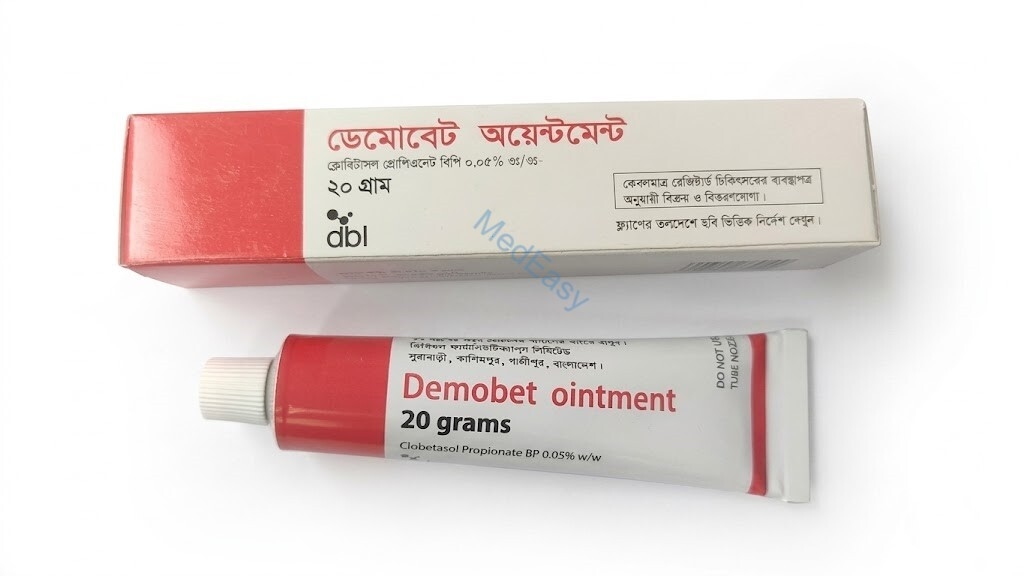
Demobet20 gm
DBL Pharmaceuticals Ltd.
৳67.50
Add to cart
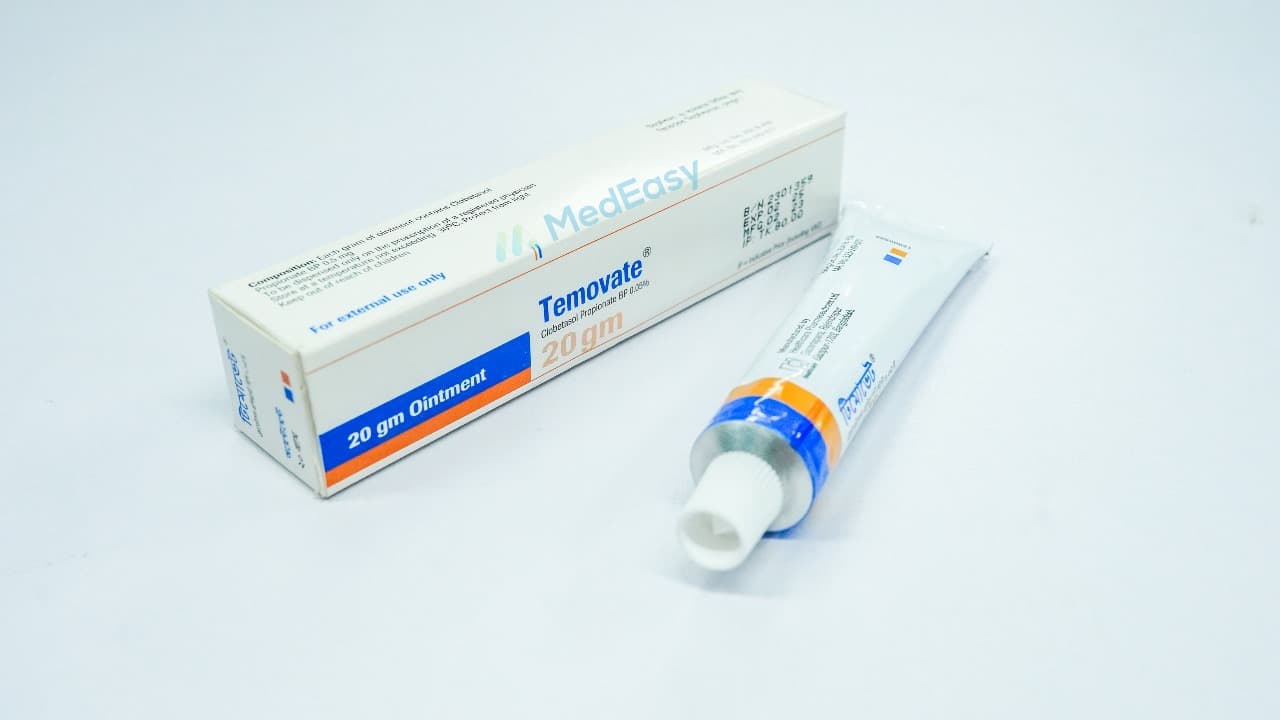

Temovate is an ultra-high-potency (Class I) topical corticosteroid indicated for the short-term treatment of corticosteroid-responsive dermatoses. Indications vary by evidence strength:
Temovate is reserved for cases that have not responded to less potent topical corticosteroids and is not intended for long-term or first-line use.
Each formulation of Clobetasol Propionate typically contains Clobetasol Propionate 0.05% w/w as the active ingredient, in a cream, ointment, gel, foam, lotion, solution, shampoo, or spray base, depending on the marketed product.
Temovate is a synthetic, halogenated corticosteroid classified as an ultra-high-potency (Class I / Group I) topical corticosteroid. It is applied to the skin to reduce inflammation, redness, itching, and scaling associated with corticosteroid-responsive dermatological conditions. Due to its high potency, Temovate is generally reserved for short courses in patients whose condition has not improved with less potent topical steroids.
Temovate belongs to the therapeutic class of topical corticosteroids and is classified as an ultra-high-potency (Class I) topical corticosteroid, the most potent category on the topical steroid potency scale.
Clobetasol Propionate exerts its therapeutic effect through anti-inflammatory, antipruritic, and vasoconstrictive actions. Like other topical corticosteroids, it diffuses across cell membranes and binds to cytoplasmic glucocorticoid receptors. The steroid-receptor complex translocates to the nucleus, where it modulates gene transcription — inducing synthesis of anti-inflammatory proteins (e.g., lipocortins, which inhibit phospholipase A2) and suppressing pro-inflammatory mediators such as prostaglandins and leukotrienes. This reduces capillary permeability, inflammatory cell infiltration, and fibroblast activity in the skin, leading to decreased erythema, edema, pruritus, and scaling. Systemic absorption through intact skin is normally minimal but increases with use over large surface areas, on thin or damaged skin, in skin folds, or under occlusive dressings.
Temovate is applied topically, and dosing varies by formulation and indication. Use the lowest effective amount for the shortest duration necessary.
| Indication | Adult Dose | Notes |
|---|---|---|
| Plaque psoriasis, severe eczema, lichen planus (body) | Apply a thin layer to the affected area twice daily (morning and night) | Rub in gently and completely; limit to 2 consecutive weeks per course |
| Scalp psoriasis | Apply a small amount of scalp solution/shampoo to affected areas twice daily | Massage into scalp; not for use under occlusion |
Total weekly use of Temovate (cream/ointment) should not exceed 50 g, and treatment should generally not exceed 2 consecutive weeks without physician reassessment, due to the risk of hypothalamic-pituitary-adrenal (HPA) axis suppression. If no improvement is seen within 2 weeks, the diagnosis should be reassessed. Temovate should not be used with occlusive dressings unless specifically directed by a physician.
Temovate is for external (topical) use only. Wash and dry hands before and after application, unless the hands are the area being treated. Apply a thin layer to the affected skin only, and rub in gently until absorbed. Avoid contact with the eyes, mouth, and mucous membranes. Do not apply to the face, groin, or axillae unless specifically directed by a physician, and do not cover the treated area with occlusive dressings or tight clothing unless instructed.
Clinically significant drug interactions with topical Temovate are uncommon because systemic absorption through intact skin is typically low. However:
Inform the physician or pharmacist of all other topical or systemic medications being used before starting Temovate.
Clobetasol Propionate is contraindicated in:
Side effects of Temovate are usually local and related to the application site, though systemic effects can occur with extensive or prolonged use.
Patients should contact a physician if irritation, worsening of the condition, or signs of infection develop during treatment with Temovate.
Temovate should be used during pregnancy only if clearly needed and if the potential benefit justifies the potential risk to the fetus. Topical corticosteroids can be absorbed systemically, and adequate, well-controlled studies of Temovate in pregnant women are lacking. A physician should be consulted before use during pregnancy.
It is not known whether topical Temovate is excreted in human breast milk in clinically significant amounts. Caution is advised during breastfeeding; avoid applying Temovate to the breast/chest area to prevent accidental ingestion by the infant, and consult a physician before use while breastfeeding.
Use Temovate only as directed by a physician. Key precautions include:
Acute overdose from a single topical application of Temovate is unlikely. However, excessive or prolonged use, use over large body surface areas, or use under occlusion can lead to sufficient systemic absorption to cause hypothalamic-pituitary-adrenal (HPA) axis suppression, Cushingoid features, hyperglycemia, or glucosuria. If accidental ingestion or signs of systemic corticosteroid excess occur, seek immediate medical attention or contact a poison control center. Chronic overuse should be managed under medical supervision, typically with gradual discontinuation of the corticosteroid rather than abrupt withdrawal.
Store at room temperature (below 30°C), away from light, heat, and moisture. Keep the container tightly closed and out of reach of children. Some foam or spray formulations of Temovate are flammable — keep away from open flame and do not smoke during or immediately after application.
Renal and hepatic impairment: No specific dose adjustment of topical Temovate is established for renal or hepatic impairment, as systemic exposure from topical use is normally minimal; caution is still advised with extensive application.
Elderly: No specific dose adjustment is required, but elderly patients may have thinner skin and could be more susceptible to local skin atrophy; use the lowest effective amount.
Pediatric patients: See Pediatric Uses.
Treatment with Temovate should generally be limited to 2 consecutive weeks per course. If there is no improvement within this period, the diagnosis should be reassessed. Total dosage should not exceed 50 g per week. Continuous long-term use beyond this without physician reassessment is not recommended due to the risk of skin atrophy and HPA-axis suppression.
Corticosteroids > Topical Corticosteroids > Ultra-High-Potency (Class I) Topical Corticosteroid
Clobetasol Propionate acts by binding to intracellular glucocorticoid receptors, modulating gene transcription to increase production of anti-inflammatory mediators (e.g., lipocortin-1) and decrease production of pro-inflammatory mediators (e.g., prostaglandins, leukotrienes, cytokines). This produces anti-inflammatory, antipruritic, vasoconstrictive, and antiproliferative effects in the skin, reducing redness, swelling, itching, and scaling associated with corticosteroid-responsive dermatoses.
C
Safety and efficacy of Temovate in pediatric patients below 12 years of age have not been established for most formulations; some formulations restrict use to patients 16 years of age or older. Because of a higher ratio of skin surface area to body mass, children are at greater risk of hypothalamic-pituitary-adrenal (HPA) axis suppression and Cushing syndrome when treated with topical corticosteroids, including Temovate. If used in children at all, it should only be under the direct supervision of a specialist, at the lowest effective dose, for the shortest possible duration, generally avoiding this ultra-high-potency class in young children unless specifically directed. Adrenal suppression, growth retardation, delayed weight gain, and intracranial hypertension have been reported in children receiving topical corticosteroids.
Q: What is Temovate 20 gm Ointment used for?
A: Temovate 20 gm Ointment is an ultra-high-potency topical corticosteroid used for short-term treatment of moderate to severe psoriasis, severe eczema, lichen planus, and other corticosteroid-responsive skin conditions that have not responded to weaker steroids.
Q: How long can I use Temovate 20 gm Ointment?
A: Treatment with Temovate 20 gm Ointment should generally be limited to 2 consecutive weeks, with total use not exceeding 50 g per week, to reduce the risk of skin thinning and hormonal side effects. If your condition does not improve, consult your physician rather than continuing use.
Q: Can I use Temovate 20 gm Ointment on my face?
A: Temovate 20 gm Ointment should not be applied to the face, groin, or armpits for prolonged periods, as these areas absorb more of the medicine and are more prone to skin thinning. Use in these areas only if your physician specifically directs it.
Q: Is Temovate 20 gm Ointment safe during pregnancy or breastfeeding?
A: Temovate 20 gm Ointment should be used during pregnancy only if clearly needed, as potential risks to the fetus cannot be ruled out with topical corticosteroids. While breastfeeding, avoid applying Temovate 20 gm Ointment to the chest area to prevent the infant from ingesting it, and consult your physician before use.
Q: Can children use Temovate 20 gm Ointment?
A: Safety and efficacy of Temovate 20 gm Ointment in children have not been well established, and children are more susceptible to hormonal (HPA-axis) side effects. It should only be used in children under a specialist's direct supervision, for the shortest possible time.
Q: What should I do if I miss a dose or apply too much Temovate 20 gm Ointment?
A: If you miss a dose, apply it as soon as you remember and continue as directed; do not apply extra to make up for a missed dose. If you or a child has accidentally ingested Temovate 20 gm Ointment or shows signs of excessive absorption, seek immediate medical attention or contact a poison control center.
Disclaimer
The information provided is accurate to the best of our knowledge, but it does not replace professional medical advice. We cannot guarantee its completeness or accuracy, and the absence of specific information about a drug should not be taken as an endorsement. We are not responsible for any consequences arising from this information, so please consult a healthcare professional for any concerns or questions.
