
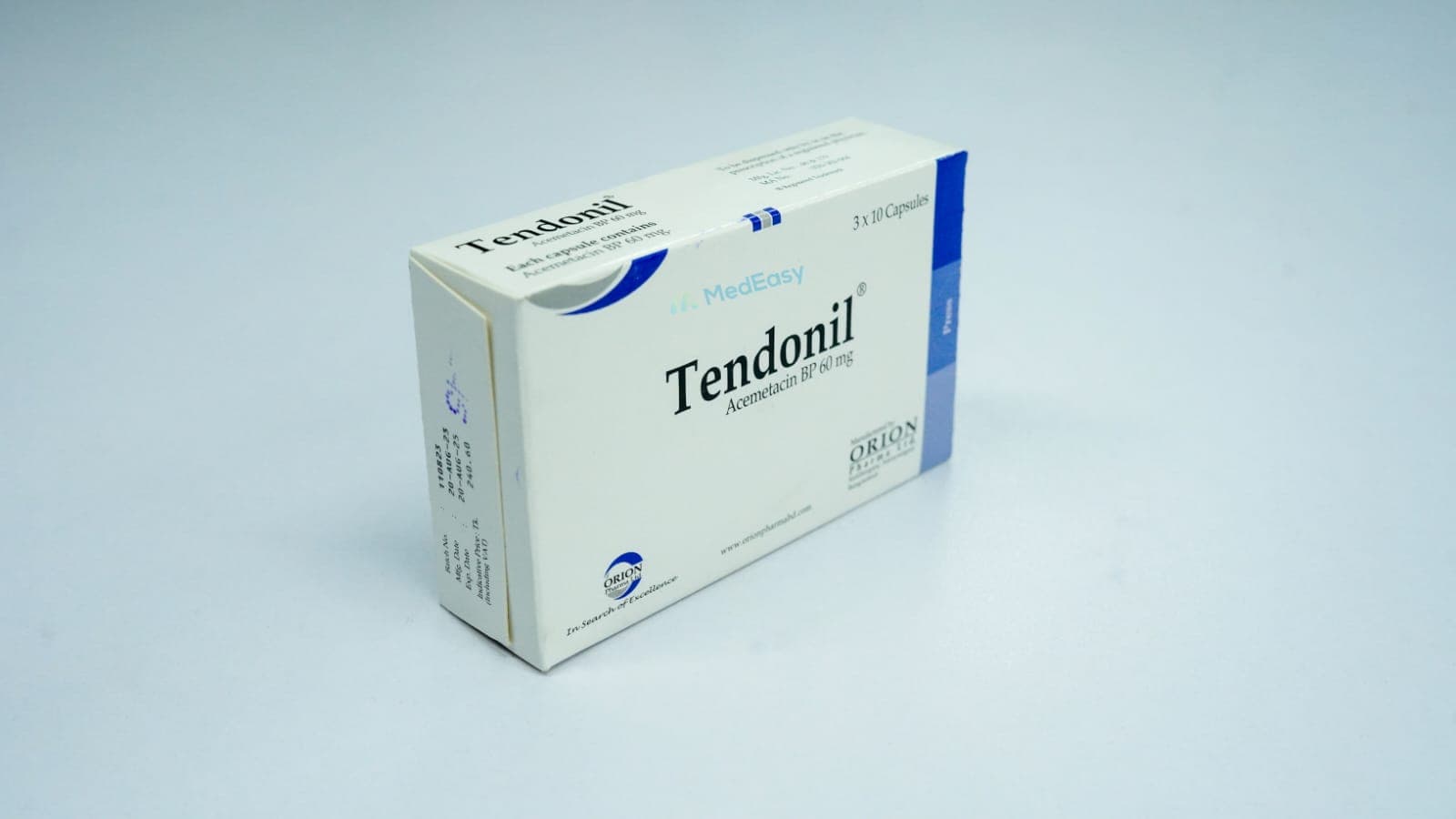

Medicine overview
Indications of Tendonil
Established Uses
Tendonil is a non-steroidal anti-inflammatory drug (NSAID) indicated for the relief of pain and inflammation in the following conditions:
- Rheumatoid arthritis
- Osteoarthritis
- Ankylosing spondylitis
- Acute low back pain and acute musculoskeletal disorders (e.g. sprains, strains, soft-tissue injury)
- Post-operative pain and inflammation
Not Recommended / Off-Label
Tendonil is not established for chronic use beyond the shortest effective duration, and it is not recommended as a first-line agent for minor, self-limiting pain where paracetamol or topical agents would suffice. Any use outside the indications above should be at the physician's discretion.
Composition
Each dosage unit of Acemetacin contains Acemetacin as the active pharmaceutical ingredient, formulated as immunodifiable capsules (commonly 60 mg or 90 mg strengths in regional markets). Acemetacin is chemically the glycolic acid ester of indomethacin.
Excipients vary by manufacturer and formulation (capsule shell components, fillers, and coloring agents) and are listed on the individual product label.
Description
Tendonil is a non-steroidal anti-inflammatory drug (NSAID) belonging to the indole acetic acid group. Structurally, Tendonil is an ester prodrug of indomethacin (the glycolic acid ester of indomethacin), and it is substantially converted to indomethacin in the body, which is largely responsible for its anti-inflammatory, analgesic, and antipyretic effects.
Tendonil is used to relieve pain, swelling, and stiffness associated with inflammatory and degenerative joint conditions as well as acute musculoskeletal and post-operative pain.
Therapeutic Class
Non-steroidal anti-inflammatory drug (NSAID) — indole/indomethacin-derivative (acetic acid derivative class); Tendonil is an ester prodrug of indomethacin.
Pharmacology
Mechanism
Acemetacin and its principal active metabolite, indomethacin, exert anti-inflammatory, analgesic, and antipyretic effects primarily through non-selective inhibition of cyclo-oxygenase (COX-1 and COX-2) enzymes, reducing the synthesis of prostaglandins that mediate pain, fever, and inflammation.
Pharmacokinetics
Acemetacin is well absorbed after oral administration and is extensively hydrolyzed to indomethacin, which undergoes further hepatic metabolism (glucuronidation, demethylation) with renal and biliary excretion of metabolites. Peak plasma concentrations of indomethacin are typically reached within a few hours of dosing, and the drug is highly protein bound.
Dosage & Administration of Tendonil
Per-Indication Dosing (Adults)
| Indication | Usual Adult Dose |
|---|---|
| Rheumatoid arthritis, osteoarthritis, ankylosing spondylitis | 60 mg two or three times daily (120–180 mg/day in divided doses), adjusted to the lowest effective dose based on response |
| Acute low back pain / acute musculoskeletal pain | 60 mg two to three times daily for the shortest period needed to control symptoms, usually not exceeding 1–2 weeks |
| Post-operative pain and inflammation | 60 mg two to three times daily, short course as directed by the physician |
Maximum recommended dose: 180 mg/day. Tendonil should always be taken exactly as prescribed by a physician; the lowest effective dose should be used for the shortest duration consistent with treatment goals.
Administration
Tendonil capsules should be taken with or immediately after food or milk, swallowed whole with a full glass of water, to reduce the risk of gastrointestinal irritation. Doses should be evenly spaced through the day.
Special Populations
See Use in Special Populations for elderly, renal, hepatic, and pediatric dosing considerations.
Administration of Tendonil
Tendonil should be swallowed whole with a full glass of water, taken with or immediately after food or milk to minimize gastrointestinal irritation. Do not crush or chew the capsules. Doses should be spaced evenly across the day (e.g. every 8–12 hours) as directed by the prescribing physician.
Interaction of Tendonil
Tendonil has clinically significant interactions with the following:
| Interacting Drug/Class | Effect |
|---|---|
| Other NSAIDs (including COX-2 inhibitors) or high-dose aspirin | Increased risk of gastrointestinal ulceration and bleeding with no added benefit; concurrent use should be avoided |
| Anticoagulants (e.g. warfarin) | Enhanced anticoagulant effect and increased bleeding risk; monitor coagulation status closely |
| ACE inhibitors / angiotensin receptor blockers / diuretics | Reduced antihypertensive/diuretic effect and increased risk of acute renal impairment ("triple whammy" effect), especially in dehydrated or volume-depleted patients |
| Lithium | Reduced renal clearance of lithium leading to elevated, potentially toxic lithium levels; monitor lithium levels |
| Methotrexate | Reduced renal clearance of methotrexate, increasing risk of methotrexate toxicity, particularly at higher methotrexate doses |
| Corticosteroids | Additive risk of gastrointestinal ulceration and bleeding |
| SSRIs and antiplatelet agents | Increased risk of gastrointestinal bleeding |
| Quinolone antibiotics | Increased risk of central nervous system stimulation and seizures |
| Alcohol | Increased risk of gastrointestinal irritation and occult bleeding |
Contraindications
Acemetacin is contraindicated in patients with:
- Known hypersensitivity to Acemetacin, indomethacin, or any excipient
- History of asthma, bronchospasm, angioedema, or urticaria precipitated by aspirin or other NSAIDs
- Active or history of recurrent peptic ulceration or gastrointestinal bleeding/perforation
- Severe heart failure, severe hepatic impairment, or severe renal impairment
- Third trimester of pregnancy
- Blood dyscrasias or coagulation disorders of unclear etiology
Side Effects of Tendonil
Adverse effects of Tendonil are generally dose- and duration-related and are consistent with the NSAID class.
| Frequency | Effects |
|---|---|
| Very common | Nausea, vomiting, abdominal pain, diarrhea, minor gastrointestinal bleeding |
| Common | Dyspepsia, flatulence, appetite loss, peptic ulcer (occasionally with bleeding or perforation), headache, dizziness, drowsiness, fatigue, elevated liver enzymes |
| Uncommon | Urticaria, fluid retention/edema, alopecia |
| Rare | Hyperkalaemia, confusion, tinnitus, transient hearing impairment |
| Very rare / serious | Gastrointestinal ulceration/perforation, severe hypersensitivity (anaphylaxis, Stevens-Johnson syndrome, toxic epidermal necrolysis), blood dyscrasias (agranulocytosis, aplastic anemia), acute renal failure, hepatic failure, aseptic meningitis, cardiovascular thrombotic events (myocardial infarction, stroke) |
Patients should seek prompt medical attention for signs of gastrointestinal bleeding (black stools, vomiting blood), unexplained bruising, chest pain, sudden weakness, or severe skin reactions.
Pregnancy & Lactation
Pregnancy
Tendonil is contraindicated in the third trimester of pregnancy because NSAIDs can cause premature closure of the fetal ductus arteriosus, fetal renal impairment, and may prolong labor. In the first and second trimesters, Tendonil should be used only if clearly needed, at the lowest effective dose for the shortest duration, and only after the potential benefit has been weighed against the potential risk to the fetus by a physician.
Lactation
NSAIDs, including Tendonil and its active metabolite, are excreted into breast milk in small amounts. Tendonil should generally be avoided during breastfeeding unless a physician determines the benefit outweighs the potential risk to the infant.
Fertility
NSAID use, including Tendonil, has been associated with reversible impairment of female fertility and should be discontinued in women having difficulty conceiving or undergoing investigation of infertility.
Precautions & Warnings
Cardiovascular risk: As with all NSAIDs, Tendonil may be associated with an increased risk of serious cardiovascular thrombotic events, including myocardial infarction and stroke, which can be fatal. This risk may increase with duration of use and in patients with existing cardiovascular risk factors or disease; cardiovascular risk should be assessed before starting Tendonil, particularly for long-term use.
Gastrointestinal risk: NSAIDs including Tendonil can cause serious gastrointestinal adverse events including bleeding, ulceration, and perforation of the stomach or intestines, which can occur at any time during treatment, with or without warning symptoms. The lowest effective dose should be used for the shortest duration necessary; caution and consideration of gastroprotection is advised in elderly patients or those with a history of peptic ulcer disease, concurrent anticoagulant/corticosteroid/antiplatelet use, or other gastrointestinal risk factors.
Renal function: Tendonil can reduce renal blood flow and precipitate renal impairment, particularly in the elderly, in dehydrated patients, or in those taking diuretics, ACE inhibitors, or other nephrotoxic drugs; renal function should be monitored, especially in at-risk patients.
Fluid retention: Tendonil may cause fluid retention and edema; use with caution in patients with hypertension or heart failure.
Hepatic function: Elevated liver enzymes may occur; liver function should be monitored during prolonged treatment, and Tendonil should be discontinued if signs of liver disease develop.
Concurrent NSAID use: Avoid taking Tendonil together with other NSAIDs or high-dose aspirin, as this increases the risk of adverse effects without added benefit.
Skin reactions: Serious skin reactions, some fatal, have been reported rarely with NSAIDs; discontinue Tendonil at the first sign of rash, mucosal lesions, or other hypersensitivity.
See Contraindications for situations in which Tendonil must not be used, and Pregnancy and Lactation for use during pregnancy/breastfeeding.
Overdose Effects of Tendonil
Symptoms of Tendonil overdose may include headache, nausea, vomiting, epigastric pain, gastrointestinal bleeding, drowsiness, disorientation, tinnitus, and, in severe cases, convulsions, acute renal failure, or liver damage.
There is no specific antidote for Tendonil overdose. If overdose is suspected, seek immediate medical attention or contact emergency services/a poison control center right away. Management is supportive and symptomatic; a physician may consider measures such as activated charcoal if given soon after ingestion, and will monitor renal and hepatic function, fluid/electrolyte status, and vital signs. Do not attempt to manage a suspected overdose at home without medical guidance.
Storage Conditions
Store below 25°C, away from light and moisture, in the original packaging. Keep out of reach and sight of children.
Use In Special Populations
Elderly
Elderly patients are at higher risk of serious gastrointestinal, renal, and cardiovascular adverse effects with Tendonil. Use the lowest effective dose for the shortest duration, and monitor closely for gastrointestinal bleeding and renal function.
Renal Impairment
Tendonil is contraindicated in severe renal impairment. Use with caution and at reduced doses in mild-to-moderate renal impairment, with regular monitoring of renal function.
Hepatic Impairment
Tendonil is contraindicated in severe hepatic impairment. Use with caution in mild-to-moderate hepatic impairment, with periodic liver function monitoring.
Pediatric Use
See Pediatric Uses field.
Pregnancy and Breastfeeding
See Pregnancy and Lactation field.
Duration Of Treatment
Tendonil should be used for the shortest duration consistent with the treatment goal, at the lowest effective dose. For acute musculoskeletal pain and post-operative pain, short courses of a few days up to about 1–2 weeks are typical. For chronic inflammatory joint conditions such as rheumatoid arthritis, osteoarthritis, or ankylosing spondylitis, longer-term use may be necessary but requires periodic clinical review and monitoring of gastrointestinal, renal, hepatic, and cardiovascular status. Treatment duration should always be determined by the prescribing physician.
Drug Classes
Non-steroidal anti-inflammatory drug (NSAID); acetic acid/indole derivative class; Acemetacin is an ester prodrug of indomethacin.
Mode Of Action
Acemetacin acts mainly through its principal metabolite, indomethacin, which non-selectively inhibits cyclo-oxygenase (COX-1 and COX-2) enzymes. This reduces the synthesis of prostaglandins and thromboxanes involved in pain signaling, inflammation, and fever, producing the analgesic, anti-inflammatory, and antipyretic effects of Acemetacin.
Pediatric Uses
The safety and efficacy of Tendonil in children and adolescents have not been established. Tendonil is therefore not recommended for use in the pediatric population. Alternative agents with an established pediatric safety profile should be used, and any pediatric use of Tendonil should only occur under specialist medical supervision if no suitable alternative exists.
Frequently Asked Questions
Q: What is Tendonil 60 mg Capsule used for?
A: Tendonil 60 mg Capsule is a non-steroidal anti-inflammatory drug (NSAID) used to relieve pain, swelling, and stiffness in conditions such as rheumatoid arthritis, osteoarthritis, ankylosing spondylitis, acute low back pain, and post-operative pain and inflammation.
Q: How should I take Tendonil 60 mg Capsule?
A: Tendonil 60 mg Capsule should be taken exactly as prescribed, with or immediately after food or milk, swallowed whole with a full glass of water, at the lowest effective dose for the shortest duration needed. Do not exceed the prescribed dose or frequency.
Q: Can I take Tendonil 60 mg Capsule during pregnancy?
A: Tendonil 60 mg Capsule is contraindicated in the third trimester of pregnancy due to risks to the fetus. In earlier pregnancy it should only be used if clearly necessary and under medical supervision, as the potential benefit must be weighed against potential risk to the fetus. Always consult your physician before taking Tendonil 60 mg Capsule if you are pregnant or planning pregnancy.
Q: Is Tendonil 60 mg Capsule safe while breastfeeding?
A: Tendonil 60 mg Capsule passes into breast milk in small amounts and is generally best avoided while breastfeeding unless your physician decides the benefit outweighs the risk to your baby.
Q: What are the main risks of taking Tendonil 60 mg Capsule?
A: Like other NSAIDs, Tendonil 60 mg Capsule carries a risk of gastrointestinal problems such as stomach pain, ulcers, and bleeding, as well as an increased risk of cardiovascular events like heart attack or stroke, particularly with long-term use or in people with heart risk factors. It can also affect kidney and liver function. Report any signs of stomach bleeding, chest pain, or unusual bruising to your physician immediately.
Q: Can children take Tendonil 60 mg Capsule?
A: No. The safety and efficacy of Tendonil 60 mg Capsule have not been established in children and adolescents, so it is not recommended for pediatric use.
Disclaimer
The information provided is accurate to the best of our knowledge, but it does not replace professional medical advice. We cannot guarantee its completeness or accuracy, and the absence of specific information about a drug should not be taken as an endorsement. We are not responsible for any consequences arising from this information, so please consult a healthcare professional for any concerns or questions.
